




Floor 1, No. 3, Shugang Avenue, Hongmei Town, Dongguan City, Guangdong Province, China

20 years environmental test chamber manufacturer3000+ customer deliverables worldwide           Email: shirley@deruitest.com
WhatsApp Consultation:+86 135 2795 8363

Battery Burning Test Chamber

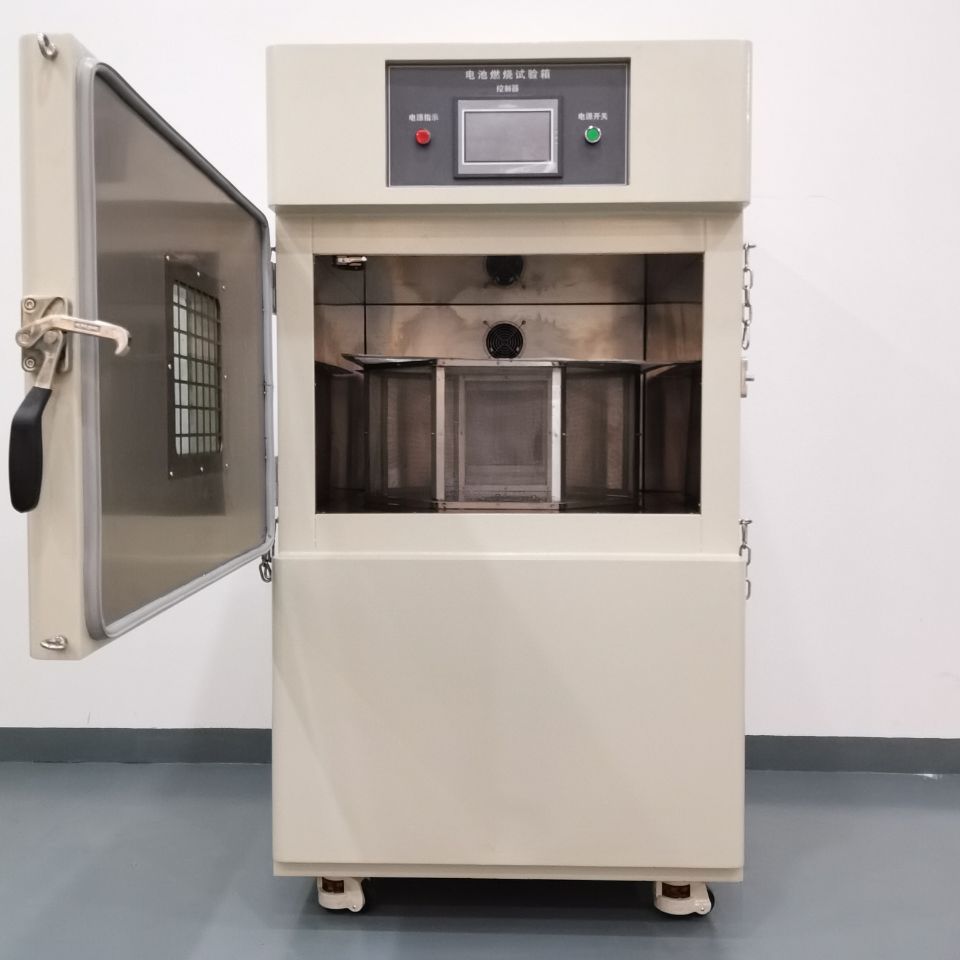
The DERUI DR-D207 battery burning test chamber uses a Bunsen burner, stainless specimen screen and removable octagonal mesh cover for specified cell or small-battery flame-exposure procedures. Confirm the exact test clause and fixture drawing before ordering.

Model DR-D207
Test Focus Controlled flame exposure with mesh surround; method-specific observation
Burner / Screen 10 mm burner mouth; 0.43 mm stainless wire, 20 openings per inch
Octagonal Cover 610 mm across opposite faces × 305 mm high; removable panels
Inner Size 750 × 750 × 500 mm (W × D × H)
Before Quotation Confirm clause/edition, cell energy and format, gas/exhaust, safety scope and FAT
Safe and reliable
well-made
Quality assurance
customization
MessageWhatsApp
Hotline number 15580327593
  • Product Details
  • Technical parameters
  • FAQ
  • Contact us
CELL FLAME EXPOSURE & PROJECTILE-CONTAINMENT SETUP

DR-D207 Battery Burning Test Chamber

A purpose-built burner, specimen screen and removable octagonal mesh cover for controlled flame-exposure testing of approved lithium cells or small batteries. Specify the adopted method, specimen and laboratory safety plan before treating any fixture geometry as a compliance claim.

What this equipment is: a flame-exposure fixture. It is not a programmable temperature chamber, a full-size pack fire tester or a UN 38.3 transport-test system.
ModelDR-D207
Burner10 mm internal tube opening; approximately 100 mm long
Specimen support0.43 mm stainless wire; 20 openings per inch
Internal enclosure750 × 750 × 500 mm (W × D × H)

What the Test Helps You Observe

During a specified flame-exposure procedure, a cell or approved small battery sits above the burner while the screen and octagonal surround define the setup and help retain ejected material. The laboratory observes the behavior required by its adopted method; pass/fail criteria must come from that method and the test plan, not from the chamber specification alone.

Controlled setup

Published burner, screen, opening and octagonal-cover dimensions provide a starting point for method review.

Visible evidence

Agree in advance how the operator will record exposure time, specimen behavior and any ejected material.

Safer procurement

Confirm fuel supply, exhaust, operator protection and post-test handling before ordering.

Published DR-D207 Configuration

Item Published value Procurement check
Control and timer Button control; flame-time setting shown as 0–99H99M Confirm actual timer input format, resolution and shutoff behavior.
Burner and opening Bunsen burner, 10 mm internal mouth, approximately 100 mm length; test opening 100 ± 2 mm Confirm burner type, flame setting and fixture drawing against the adopted standard edition.
Specimen screen 0.43 mm stainless woven wire; 20 openings per inch Confirm mounting height and replacement screen supplied.
Octagonal cover 610 mm across opposite faces; 305 mm high; eight removable panels; 0.25 mm aluminum wire, 16–18 openings per inch Request dimensional drawing and panel-retention details.
Enclosure 750 × 750 × 500 mm internal; 1000 × 950 × 1310 mm external, including door lock Confirm usable clearance around the fixture and doorway.
Utilities Methane or LPG supplied by customer; 220 V, 50/60 Hz, 200 W; approximately 160 kg Confirm gas regulation, ventilation, site power and nameplate.
Relief and exhaust 200 × 200 mm pressure-relief door; rear Ø100 mm exhaust connection; door-retention chain Confirm discharge direction, duct requirements and risk-assessed containment limits.
Dimension requiring a drawing: the old specification states “height of the flame from the screen: 38 mm.” That wording does not unambiguously define the burner-to-screen geometry; verify it on the approved setup drawing.

Method Fit: Review the Clause, Not a Logo List

The DR-D207 screen and octagonal-surround geometry warrants review against the UL 1642 Projectile Test, but published fixture similarity is not proof of conformance. In particular, the DR-D207 page specifies a Bunsen burner, while a published technical comparison describes a Meker-type burner for the UL 1642 fire-exposure setup. Verify the adopted edition, burner, all dimensions, specimen preparation, observation and acceptance rules clause by clause before any UL 1642 claim.

Do not treat this chamber as a UN 38.3 test method. The UN transport manual has defined T.1–T.8 tests; a generic “UN 38.3 T.10 burning test” claim should not appear on this page. Other standards such as UL 2054 or IEC 62133-2 may form part of a laboratory program but do not automatically validate this fixture.

Send the exact method

Standard edition, clause, cell format, sample state, exposure period and pass/fail rule.

Confirm the physical setup

Burner specification, mesh, opening, screen-to-burner position and octagonal-cover drawing.

Confirm evidence

Video/observation plan, timed exposure, calibration records and final report format.

DR-D207 Is Different from DERUI's Other Battery Fire Equipment

Equipment Primary function Do not assume
DR-D207 burning test chamber Burner, screen and octagonal mesh fixture for specified cell/small-battery flame exposure Large pack fire testing, programmable heating or certified blast containment
DR-D211 EV battery cell fire tester A different external-flame test setup; compare its published specimen and burner limits separately Interchangeability with the DR-D207 projectile-test geometry
Battery thermal abuse chamber Controlled high-temperature exposure in a heated enclosure An open-flame burner or octagonal-mesh projectile-test fixture

Site Safety and Acceptance Plan

Review the specimen

Provide chemistry, dimensions, maximum energy, charge state and credible venting behavior. Agree allowable specimen size and quantity.

Review the facility

Confirm methane/LPG supply, regulator, exhaust route, clearance, fire response and operator exclusion area with site EHS.

Witness the setup

Check burner, screen and cover dimensions, timer, gas shutoff behavior, exhaust, door and documentation during FAT.

Safety boundary: the published relief door and retention chain are construction features, not evidence of a rated explosion-proof or thermal-runaway containment system. Gas detection, suppression, data export and interlocks are not established as standard features by the current public specification.

Questions Buyers Ask

Is this a UL-certified chamber?

No certification evidence is established by the public product page. Review fixture suitability against the exact UL 1642 edition and obtain any required third-party evaluation separately.

Can it test EV modules or packs?

Do not infer that from the enclosure size. Obtain a specimen-size, energy and hazard assessment, then compare the appropriate larger-scale equipment.

Is the gas included?

The published specification says methane or LPG is customer-provided. Confirm regulator, hose, shutoff and local installation scope in the quotation.

Does it perform UN 38.3 transport testing?

No. This burner arrangement should not be presented as a UN 38.3 test. Choose the dedicated equipment for the required T.1–T.8 method.

What needs confirmation before publication or purchase?

The adopted standard edition, fixture drawing, timer format, safety controls, real-device photos, accessories and measurable FAT criteria.

Request a Method-Matched DR-D207 Proposal

Send your cell drawing and test clause. DERUI can respond with the fixture drawing, included scope, utility list and an acceptance checklist that engineering and purchasing can review together.

Discuss the DR-D207 setup

Include in the inquiry

  • Standard edition and exact clause
  • Cell/battery format and energy
  • Gas and exhaust conditions
  • Required observation and FAT records
FacebookLinkedInXRedditWhatsApp

DR-D207 values below come from the current DERUI product record. Confirm the approved drawing and safety configuration before ordering.

Item Published configuration / verification point
Model / control DR-D207; button control
Burner Bunsen burner; 10 mm internal tube-mouth diameter; approximately 100 mm tube length
Flame-time setting Published as 0–99H99M; confirm valid timer input format, resolution and shutoff logic
Test opening 100 ± 2 mm diameter
Specimen screen Stainless woven wire, 0.43 mm diameter; 20 openings per inch
Burner/screen geometry Published “38 mm” wording is ambiguous; require approved dimensioned drawing
Octagonal mesh cover 610 mm across opposite faces; 305 mm high; eight removable faces; 0.25 mm aluminum wire, 16–18 openings per inch
Fuel Methane or LPG; customer-provided. Confirm regulator, supply and shutoff requirements
Inner / outer dimensions 750 × 750 × 500 mm / 1000 × 950 × 1310 mm (W × D × H; outer includes door lock)
Relief / exhaust / door 200 × 200 mm relief door; rear Ø100 mm exhaust connection; left-opening door with retention chain. No rated containment claim established
Supply / weight 220 V single phase, 50/60 Hz, 200 W; approximately 160 kg

1. What is a Battery Burning Test Chamber?
A Battery Burning Test Chamber is a specialized, heavily reinforced enclosure designed to safely contain and study battery fires. It allows researchers to intentionally induce thermal runaway in lithium-ion cells, observing flame propagation, temperature profiles, and containment effectiveness under controlled, repeatable conditions.

2. What safety standards can be met with a Battery Burning Test Chamber?
These chambers are built to help manufacturers comply with critical international safety standards. Key ones include UL 9540A for energy storage systems, UN 38.3 for lithium battery transportation, ECE R100 for electric vehicles, and GB/T 31485 for Chinese EV battery safety requirements.

3. What are the essential safety features to look for?
Prioritize chambers with automatic fire suppression systems (like sprinklers or inert gas), explosion-proof construction, real-time gas and temperature monitoring, and emergency shut-off switches. These features are crucial for protecting your lab and personnel during a controlled burn.

4. What is the maximum temperature these chambers can withstand?
High-quality Battery Burning Test Chambers are engineered to withstand the extreme heat of a battery fire. Look for models with a maximum operating temperature of at least 1100°C (2000°F) to ensure they can contain the most severe thermal runaway events without damage.

5. Can the same chamber test different battery sizes and types?
Yes, many modern chambers feature a modular design. This allows for internal reconfiguration or the use of different fixtures to safely test everything from small consumer electronics cells to large-format EV or ESS (Energy Storage System) battery modules.

6. What kind of data does the chamber collect during a test?
Advanced chambers are equipped with integrated data acquisition systems that capture high-speed temperature data from multiple thermocouples, pressure changes, and with optional modules, gas composition analysis of the off-gas produced during combustion.

7. How is the chamber cleaned and maintained after a fire test?
Post-test cleanup involves removing fire residues and inspecting components. Chambers with smooth, stainless steel interiors, removable debris trays, and accessible viewport assemblies significantly simplify this process and ensure readiness for the next test.

8. Can the chamber be integrated with other testing equipment?
Absolutely. Look for models with standard communication ports (Ethernet, CAN) that allow them to sync with external environmental chambers for temperature preconditioning or with your lab's central data management system for consolidated reporting.

9. What is the typical lead time for delivery and installation?
Due to their custom, heavy-duty nature, lead times for a Battery Burning Test Chamber can range from 12 to 20 weeks. This includes manufacturing, safety validation, and coordination for professional on-site installation and operator training.

10. Is the chamber used for quality control or just for R&D?
It serves both functions. In R&D, engineers use it to validate new cell designs and materials. In Quality Control, it's used for batch sampling and certification testing to ensure production cells meet mandatory safety regulations before shipping.

11. What kind of ventilation or facility preparation is required?
These chambers require a dedicated, powerful exhaust ventilation system to safely remove toxic fumes and smoke after a test. It's critical to consult with the manufacturer early to understand your facility's specific power, space, and ventilation requirements.

12. What support and warranty come with the chamber?
Reputable manufacturers provide a robust warranty (e.g., 24 months on parts and workmanship) and comprehensive support. This should include on-site installation, operator training, remote diagnostics, and access to a global spare parts network for critical components.

WhatsAppWhatsApp
WhatsAppWhatsApp
WhatsApp
MessageMessage

Request a Quote