Floor 1, No. 3, Shugang Avenue, Hongmei Town, Dongguan City, Guangdong Province, China

20 years environmental test chamber manufacturer3000+ customer deliverables worldwide           Email: shirley@deruitest.com
Global Consultation Hotline:+86 15580327593

Derui environmental test chamber FAQ

Find clear answers about chamber selection, customization, testing standards, installation, operation and after-sales support.

How Much Does an Environmental Test Chamber Cost?

Batch 1 — Selection & Buying
How Much Does an Environmental Test Chamber Cost?

Practical engineering guidance for specifying, operating and accepting environmental test equipment.
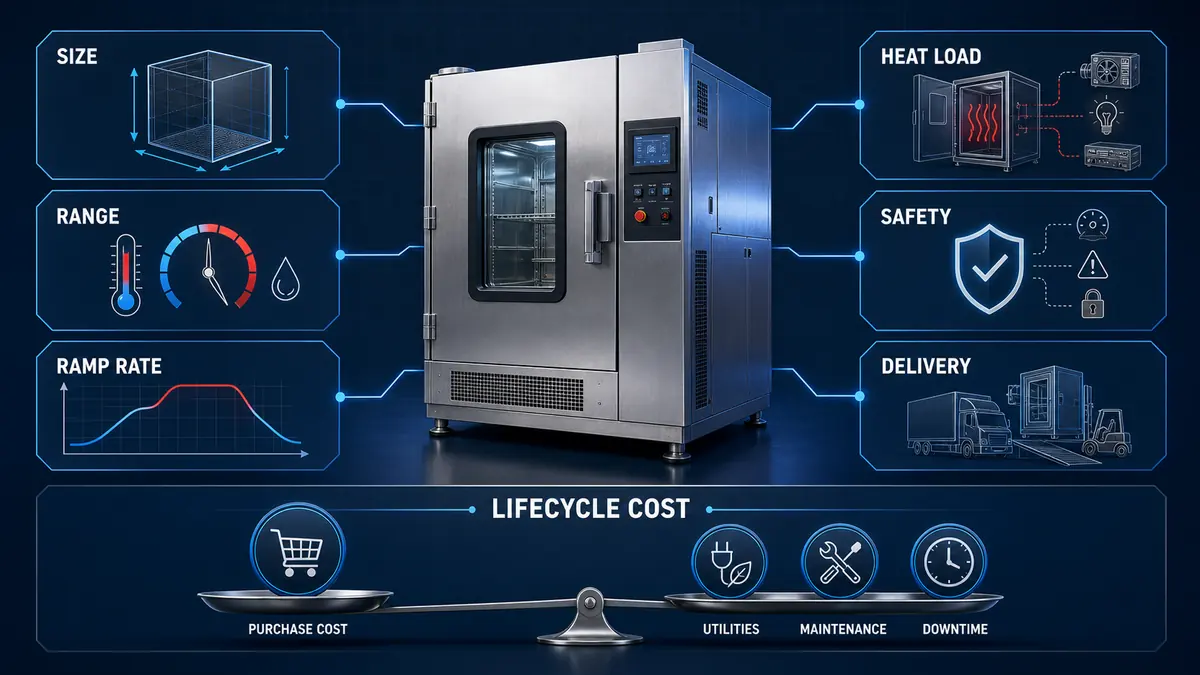
 

Short answer: There is no responsible single price without a test requirement. Cost depends on workspace, temperature and humidity envelope, ramp rate, heat load, construction, safety systems, controller/data functions, calibration, installation and delivery scope.
Environmental test chamber cost factors including size, range, ramp rate, heat load, safety and delivery
A comparable chamber quotation must include performance, safety, delivery and lifecycle scope.

Why This Question Matters

Environmental chamber results are only useful when the equipment, specimen, measurement method and acceptance criteria describe the same condition. A catalogue number alone cannot resolve load, airflow, transition, measurement or safety questions. Define the requirement in observable terms so the buyer, operator and manufacturer can verify it in the same way.

Recommended Decision Process

1. Chamber type and internal dimensions
2. Temperature/RH range and difficult combined points
3. Average or linear change rate under the declared load
4. Powered-sample heat removal and auxiliary cooling
5. Walk-in structure, floor loading and site assembly
6. Battery, explosion, corrosion or other risk controls
7. Calibration, FAT, third-party reports and documentation
8. Voltage, utilities, freight, insurance, commissioning and training

Information to Record

Test requirement

Record the standard and revision, exact profile, tolerances, dwell definition and pass/fail criteria. Mark assumptions that still require approval.

Specimen and loading

Document dimensions, mass, quantity, fixture, arrangement, materials, heat output and whether the specimen is energized.

Measurement

Identify sensor type, position, calibration status, sampling interval, stabilization rule and how calculations will be made.

Site and lifecycle

Confirm power, water, drainage, heat rejection, access, maintenance, documentation, training and future test demand.

Common Mistakes to Avoid

  • Comparing only purchase price
  • Accepting undefined performance exclusions
  • Omitting freight, utilities and site preparation
  • Buying unused extreme range or speed
  • Ignoring maintenance access, energy and spare-parts support

How to Confirm the Requirement with DERUI

For a comparable quotation, send the same RFQ and acceptance conditions to every supplier. DERUI’s usual production periods are 7–15 days for standard equipment, 30–40 days for custom equipment and 35–50 days for walk-in equipment after requirements are confirmed; contractual scope controls the final schedule and price.

Send a requirement table instead of relying only on email descriptions. Ask DERUI to return a compliance-and-deviation response, with performance conditions, options and exclusions shown separately. Keep the approved response with the quotation, drawings and acceptance protocol.

Related DERUI Resources

Compare available environmental test chambers, review the temperature test chamber range, see thermal shock chambers, or download product information from the DERUI download center.

Frequently Asked Follow-Up Questions

Should I specify only the worst point?

No. Supply the complete profile. A chamber can meet an extreme setpoint yet fail a combined condition, transition, recovery or loaded dwell.

Can catalogue values be used for acceptance?

Only when the same test condition, load, sensor method and calculation are explicitly incorporated into the purchase agreement.

When should DERUI review the requirement?

Before quotation if possible, and always before drawing approval or production. Late changes can affect capacity, cost and delivery.

What evidence should be retained?

Keep the approved specification, deviation list, drawings, calibration and FAT records, manuals, trend exports and change history.

Technical context: Test methods and quality-system requirements remain controlling. Relevant reference frameworks may include IEC 60068 environmental testing methods and traceable temperature/humidity calibration practices. This page provides selection guidance, not a substitute for the applicable standard.

Need an Engineering Review?

Send DERUI your test profile, sample data, utilities and acceptance requirements.
Discuss Your Test Chamber


Temperature Cycling Chamber vs Thermal Shock Chamber: Which Do I Need?

Batch 1 — Selection & Buying
Temperature Cycling Chamber vs Thermal Shock Chamber: Which Do I Need?

Practical engineering guidance for specifying, operating and accepting environmental test equipment.


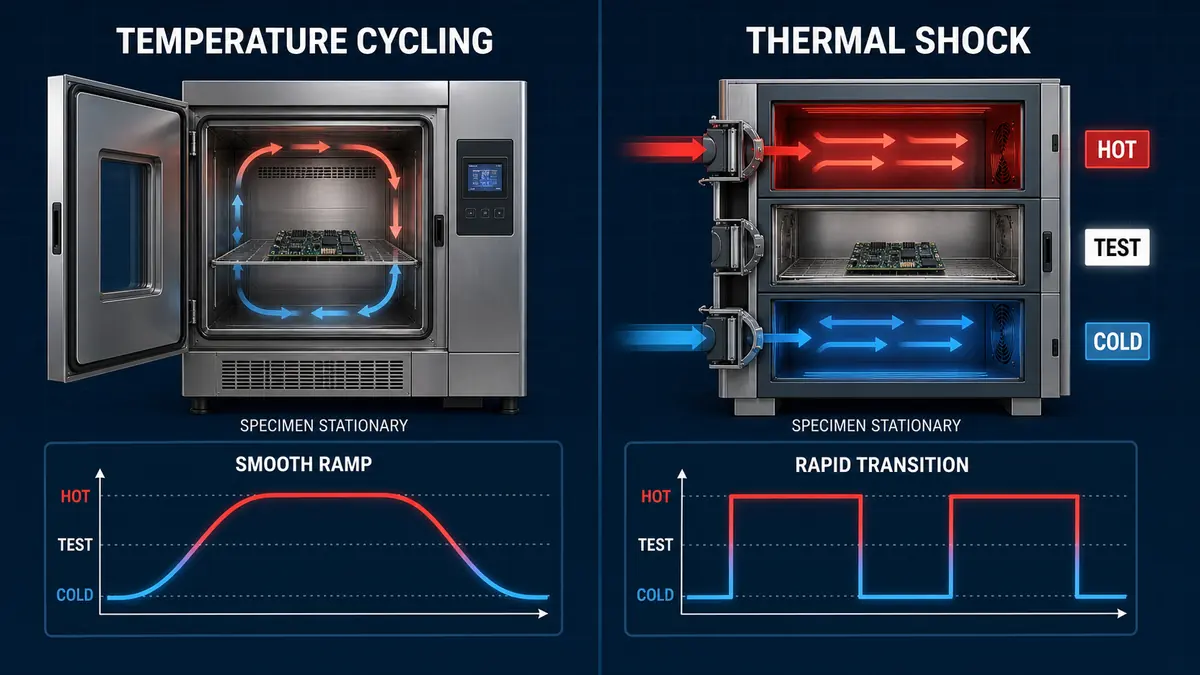
Short answer: Choose a temperature cycling chamber when the specimen remains in one workspace while conditioned air changes over time. Choose a thermal shock chamber when the method requires a rapid transition between stabilized hot and cold environments. The governing standard and intended failure mechanism decide—not the product name.
Temperature cycling chamber versus three-zone thermal shock chamber comparison
Temperature cycling changes one workspace gradually; thermal shock produces a rapid hot-to-cold transition.

Why This Question Matters

Environmental chamber results are only useful when the equipment, specimen, measurement method and acceptance criteria describe the same condition. A catalogue number alone cannot resolve load, airflow, transition, measurement or safety questions. Define the requirement in observable terms so the buyer, operator and manufacturer can verify it in the same way.

Recommended Decision Process

1. Check whether the standard specifies one chamber, two-zone transfer or three-zone air switching.
2. Confirm whether the specimen moves or remains stationary.
3. Compare required transfer or transition time and recovery time.
4. Define dwell from chamber-air recovery or specimen stabilization.
5. Assess specimen size, mass, cables and powered operation.
6. Review vibration, handling and connector risks if a basket transfers the specimen.

Information to Record

Test requirement

Record the standard and revision, exact profile, tolerances, dwell definition and pass/fail criteria. Mark assumptions that still require approval.

Specimen and loading

Document dimensions, mass, quantity, fixture, arrangement, materials, heat output and whether the specimen is energized.

Measurement

Identify sensor type, position, calibration status, sampling interval, stabilization rule and how calculations will be made.

Site and lifecycle

Confirm power, water, drainage, heat rejection, access, maintenance, documentation, training and future test demand.

Common Mistakes to Avoid

  • Calling any rapid temperature cycle a thermal shock
  • Substituting ramp rate for transfer time
  • Ignoring specimen thermal response
  • Choosing a moving-basket design for permanently connected samples
  • Assuming two test methods produce equivalent stress

How to Confirm the Requirement with DERUI

IEC 60068-2-14 addresses change-of-temperature testing, but the exact method and product standard remain controlling. DERUI can compare a cycling chamber with two-zone or three-zone thermal shock configurations after reviewing the test method.

Send a requirement table instead of relying only on email descriptions. Ask DERUI to return a compliance-and-deviation response, with performance conditions, options and exclusions shown separately. Keep the approved response with the quotation, drawings and acceptance protocol.

Related DERUI Resources

Compare available environmental test chambers, review the temperature test chamber range, see thermal shock chambers, or download product information from the DERUI download center.

Frequently Asked Follow-Up Questions

Should I specify only the worst point?

No. Supply the complete profile. A chamber can meet an extreme setpoint yet fail a combined condition, transition, recovery or loaded dwell.

Can catalogue values be used for acceptance?

Only when the same test condition, load, sensor method and calculation are explicitly incorporated into the purchase agreement.

When should DERUI review the requirement?

Before quotation if possible, and always before drawing approval or production. Late changes can affect capacity, cost and delivery.

What evidence should be retained?

Keep the approved specification, deviation list, drawings, calibration and FAT records, manuals, trend exports and change history.

Technical context: Test methods and quality-system requirements remain controlling. Relevant reference frameworks may include IEC 60068 environmental testing methods and traceable temperature/humidity calibration practices. This page provides selection guidance, not a substitute for the applicable standard.

Need an Engineering Review?

Send DERUI your test profile, sample data, utilities and acceptance requirements.
Discuss Your Test Chamber


What Cooling and Heating Rate Should I Specify?

Batch 1 — Selection & Buying
What Cooling and Heating Rate Should I Specify?

Practical engineering guidance for specifying, operating and accepting environmental test equipment.


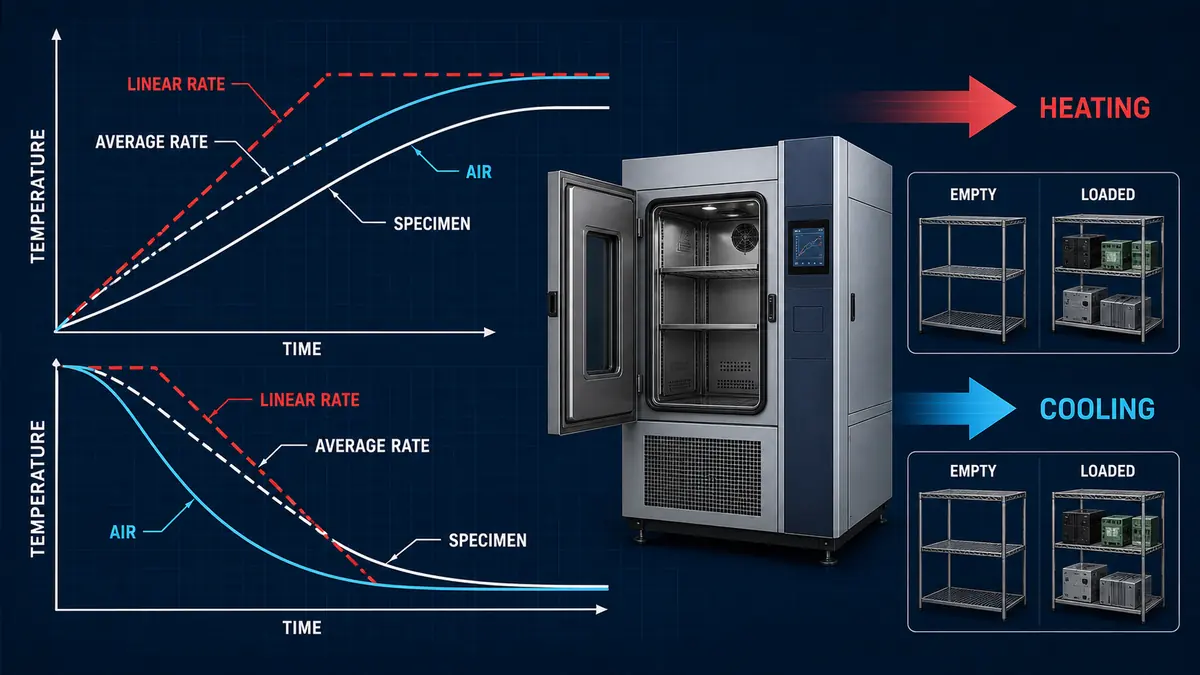
Short answer: A rate such as “5°C/min” is incomplete. State whether it is an average across a temperature interval or a continuously maintained linear rate, whether it is measured in chamber air or the specimen, and whether the chamber is empty or loaded.
Test chamber heating and cooling rate comparison for average, linear, air, specimen, empty and loaded conditions
Average versus linear, air versus specimen and empty versus loaded rates are not interchangeable.

Why This Question Matters

Environmental chamber results are only useful when the equipment, specimen, measurement method and acceptance criteria describe the same condition. A catalogue number alone cannot resolve load, airflow, transition, measurement or safety questions. Define the requirement in observable terms so the buyer, operator and manufacturer can verify it in the same way.

Recommended Decision Process

1. Define start and end temperatures for both heating and cooling.
2. State average or linear rate and the permitted deviation.
3. Identify the measurement sensor and its position.
4. Describe specimen mass, heat capacity, fixture and powered heat load.
5. Separate air-change performance from specimen response.
6. Confirm dwell timing: after air reaches setpoint or after the specimen stabilizes.

Information to Record

Test requirement

Record the standard and revision, exact profile, tolerances, dwell definition and pass/fail criteria. Mark assumptions that still require approval.

Specimen and loading

Document dimensions, mass, quantity, fixture, arrangement, materials, heat output and whether the specimen is energized.

Measurement

Identify sensor type, position, calibration status, sampling interval, stabilization rule and how calculations will be made.

Site and lifecycle

Confirm power, water, drainage, heat rejection, access, maintenance, documentation, training and future test demand.

Common Mistakes to Avoid

  • Comparing an empty-chamber average with a loaded linear requirement
  • Assuming heating and cooling rates are equal
  • Using the controller trend as the only acceptance evidence
  • Ignoring compressor capacity at high ambient temperature
  • Oversizing rate and paying for capacity the test does not require

How to Confirm the Requirement with DERUI

Provide DERUI with a plotted test profile and loading drawing. The agreed rate definition should appear in the technical agreement and FAT procedure so supplier and buyer calculate it in the same way.

Send a requirement table instead of relying only on email descriptions. Ask DERUI to return a compliance-and-deviation response, with performance conditions, options and exclusions shown separately. Keep the approved response with the quotation, drawings and acceptance protocol.

Related DERUI Resources

Compare available environmental test chambers, review the temperature test chamber range, see thermal shock chambers, or download product information from the DERUI download center.

Frequently Asked Follow-Up Questions

Should I specify only the worst point?

No. Supply the complete profile. A chamber can meet an extreme setpoint yet fail a combined condition, transition, recovery or loaded dwell.

Can catalogue values be used for acceptance?

Only when the same test condition, load, sensor method and calculation are explicitly incorporated into the purchase agreement.

When should DERUI review the requirement?

Before quotation if possible, and always before drawing approval or production. Late changes can affect capacity, cost and delivery.

What evidence should be retained?

Keep the approved specification, deviation list, drawings, calibration and FAT records, manuals, trend exports and change history.

Technical context: Test methods and quality-system requirements remain controlling. Relevant reference frameworks may include IEC 60068 environmental testing methods and traceable temperature/humidity calibration practices. This page provides selection guidance, not a substitute for the applicable standard.

Need an Engineering Review?

Send DERUI your test profile, sample data, utilities and acceptance requirements.
Discuss Your Test Chamber


What Humidity Range Do I Need for a Humidity Chamber?

Batch 1 — Selection & Buying
What Humidity Range Do I Need for a Humidity Chamber?

Practical engineering guidance for specifying, operating and accepting environmental test equipment.


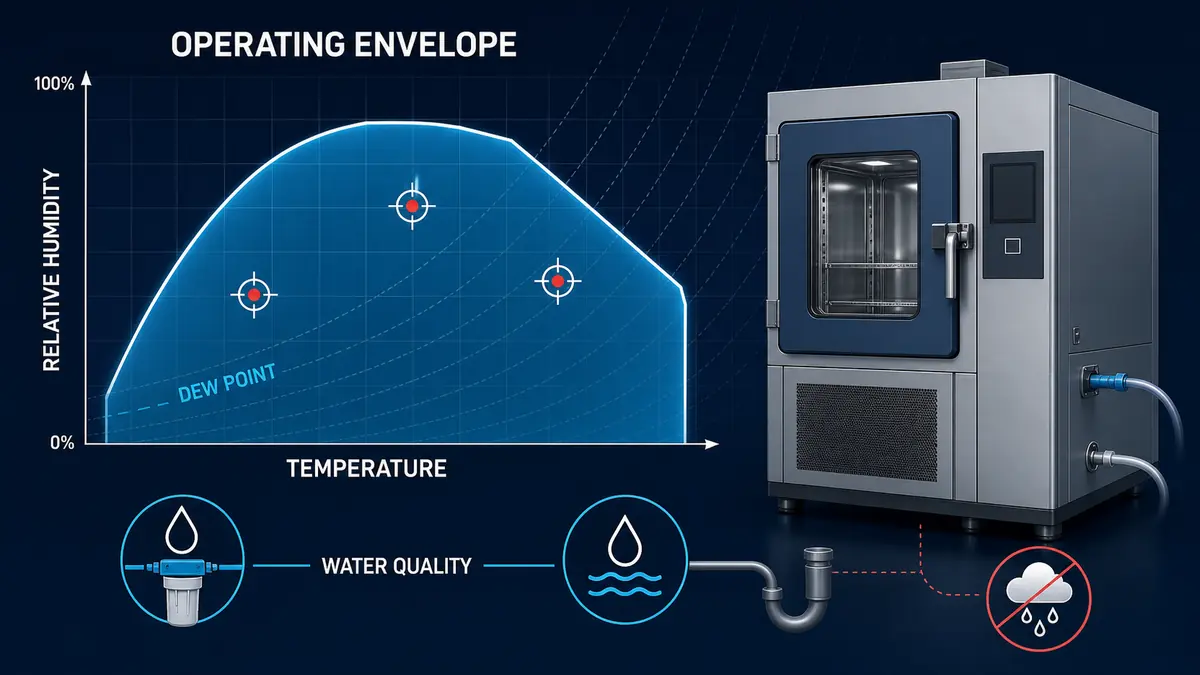
Short answer: Specify humidity as operating points such as 40°C/93% RH or 85°C/85% RH—not as an independent “20–98% RH” line. Relative humidity depends on temperature, and every chamber has a practical temperature–humidity operating envelope.
Humidity chamber operating envelope showing valid temperature and relative humidity test points
Humidity capability must be confirmed as temperature–RH operating pairs inside the usable envelope.

Why This Question Matters

Environmental chamber results are only useful when the equipment, specimen, measurement method and acceptance criteria describe the same condition. A catalogue number alone cannot resolve load, airflow, transition, measurement or safety questions. Define the requirement in observable terms so the buyer, operator and manufacturer can verify it in the same way.

Recommended Decision Process

1. Extract exact temperature/RH pairs, dwells and tolerances from the test method.
2. Mark whether condensation is prohibited, tolerated or intentionally required.
3. Declare wet or moisture-releasing samples and any ventilation or fresh-air demand.
4. Confirm water-quality requirements and drainage at the installation site.
5. Ask for the chamber’s usable humidity envelope and accuracy at critical points.
6. Define stabilization and measurement locations before acceptance.

Information to Record

Test requirement

Record the standard and revision, exact profile, tolerances, dwell definition and pass/fail criteria. Mark assumptions that still require approval.

Specimen and loading

Document dimensions, mass, quantity, fixture, arrangement, materials, heat output and whether the specimen is energized.

Measurement

Identify sensor type, position, calibration status, sampling interval, stabilization rule and how calculations will be made.

Site and lifecycle

Confirm power, water, drainage, heat rejection, access, maintenance, documentation, training and future test demand.

Common Mistakes to Avoid

  • Assuming 98% RH is available at every temperature
  • Ignoring dew point when moving between profile steps
  • Opening the door during high-humidity operation
  • Using untreated water where the manual requires purified water
  • Comparing only catalogue ranges rather than critical test points

How to Confirm the Requirement with DERUI

For demanding low-humidity, low-temperature or condensation profiles, send the complete sequence to DERUI. Engineering should confirm feasibility point by point and identify any transition restrictions.

Send a requirement table instead of relying only on email descriptions. Ask DERUI to return a compliance-and-deviation response, with performance conditions, options and exclusions shown separately. Keep the approved response with the quotation, drawings and acceptance protocol.

Related DERUI Resources

Compare available environmental test chambers, review the temperature test chamber range, see thermal shock chambers, or download product information from the DERUI download center.

Frequently Asked Follow-Up Questions

Should I specify only the worst point?

No. Supply the complete profile. A chamber can meet an extreme setpoint yet fail a combined condition, transition, recovery or loaded dwell.

Can catalogue values be used for acceptance?

Only when the same test condition, load, sensor method and calculation are explicitly incorporated into the purchase agreement.

When should DERUI review the requirement?

Before quotation if possible, and always before drawing approval or production. Late changes can affect capacity, cost and delivery.

What evidence should be retained?

Keep the approved specification, deviation list, drawings, calibration and FAT records, manuals, trend exports and change history.

Technical context: Test methods and quality-system requirements remain controlling. Relevant reference frameworks may include IEC 60068 environmental testing methods and traceable temperature/humidity calibration practices. This page provides selection guidance, not a substitute for the applicable standard.

Need an Engineering Review?

Send DERUI your test profile, sample data, utilities and acceptance requirements.
Discuss Your Test Chamber


What Temperature Range Should I Choose for a Test Chamber?

Batch 1 — Selection & Buying
What Temperature Range Should I Choose for a Test Chamber?

Practical engineering guidance for specifying, operating and accepting environmental test equipment.


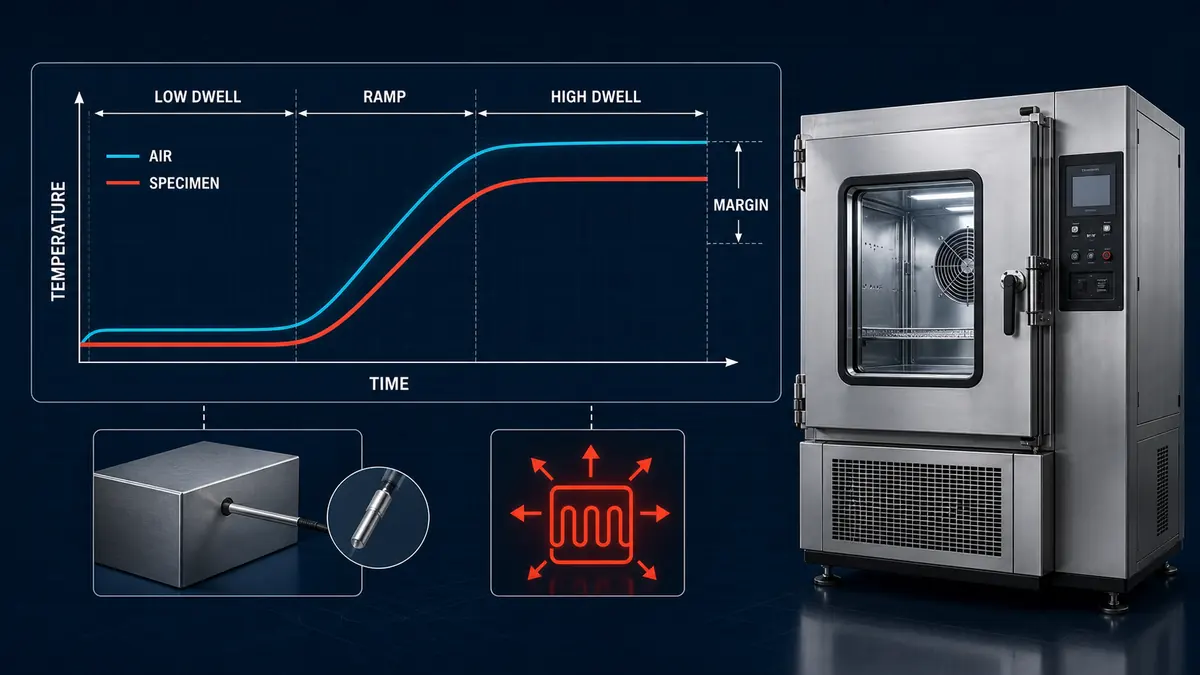
Short answer: Start with the lowest and highest air-temperature setpoints required by the applicable standard or internal profile. Then add only the engineering margin needed for control, load and future programs. A wider advertised range does not prove performance at the required loaded condition.
Test chamber temperature range selection comparing chamber air and specimen temperature across dwell and ramp stages
Specify the required profile, load and specimen response before choosing the chamber temperature range.

Why This Question Matters

Environmental chamber results are only useful when the equipment, specimen, measurement method and acceptance criteria describe the same condition. A catalogue number alone cannot resolve load, airflow, transition, measurement or safety questions. Define the requirement in observable terms so the buyer, operator and manufacturer can verify it in the same way.

Recommended Decision Process

1. List every required dwell temperature and tolerance.
2. Identify whether the requirement applies to chamber air, specimen surface or internal product temperature.
3. State heating and cooling rates and how they must be calculated.
4. Declare specimen mass, material, packaging and powered heat output.
5. Confirm whether humidity is required at any temperature point; RH capability has a narrower temperature envelope.
6. Request performance at the most difficult loaded point, not merely the empty-chamber limit.

Information to Record

Test requirement

Record the standard and revision, exact profile, tolerances, dwell definition and pass/fail criteria. Mark assumptions that still require approval.

Specimen and loading

Document dimensions, mass, quantity, fixture, arrangement, materials, heat output and whether the specimen is energized.

Measurement

Identify sensor type, position, calibration status, sampling interval, stabilization rule and how calculations will be made.

Site and lifecycle

Confirm power, water, drainage, heat rejection, access, maintenance, documentation, training and future test demand.

Common Mistakes to Avoid

  • Buying −70°C capability when the validated profile never goes below −40°C
  • Assuming maximum temperature and maximum humidity are simultaneous
  • Using controller setpoint as proof of specimen temperature
  • Ignoring recovery after door opening or sample insertion
  • Failing to define tolerances and stabilization criteria

How to Confirm the Requirement with DERUI

DERUI should receive the actual time–temperature profile and load data. The proposal can then distinguish chamber range, controllable range and guaranteed performance conditions.

Send a requirement table instead of relying only on email descriptions. Ask DERUI to return a compliance-and-deviation response, with performance conditions, options and exclusions shown separately. Keep the approved response with the quotation, drawings and acceptance protocol.

Related DERUI Resources

Compare available environmental test chambers, review the temperature test chamber range, see thermal shock chambers, or download product information from the DERUI download center.

Frequently Asked Follow-Up Questions

Should I specify only the worst point?

No. Supply the complete profile. A chamber can meet an extreme setpoint yet fail a combined condition, transition, recovery or loaded dwell.

Can catalogue values be used for acceptance?

Only when the same test condition, load, sensor method and calculation are explicitly incorporated into the purchase agreement.

When should DERUI review the requirement?

Before quotation if possible, and always before drawing approval or production. Late changes can affect capacity, cost and delivery.

What evidence should be retained?

Keep the approved specification, deviation list, drawings, calibration and FAT records, manuals, trend exports and change history.

Technical context: Test methods and quality-system requirements remain controlling. Relevant reference frameworks may include IEC 60068 environmental testing methods and traceable temperature/humidity calibration practices. This page provides selection guidance, not a substitute for the applicable standard.

Need an Engineering Review?

Send DERUI your test profile, sample data, utilities and acceptance requirements.
Discuss Your Test Chamber


How Do I Choose the Right Environmental Test Chamber Size?

Batch 1 — Selection & Buying
How Do I Choose the Right Environmental Test Chamber Size?

Practical engineering guidance for specifying, operating and accepting environmental test equipment.


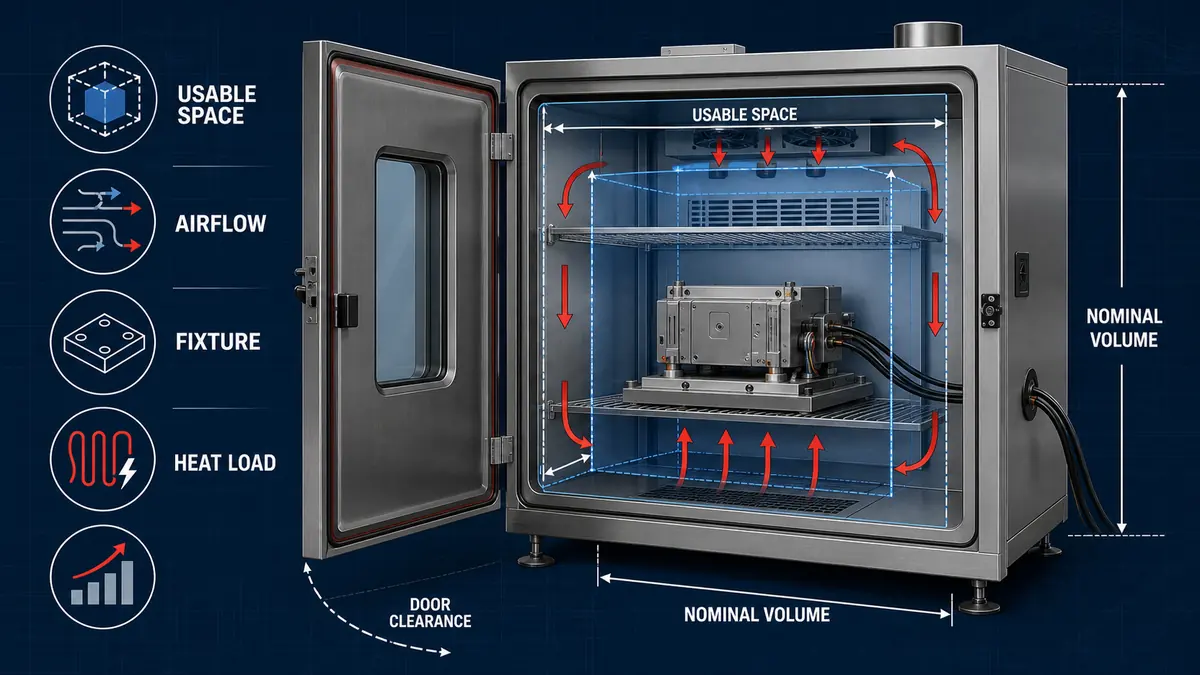
Short answer: Choose the smallest chamber that accommodates the complete test setup without obstructing conditioned-air circulation. Do not size from product volume alone: include fixtures, cables, ports, carts, door access, sample spacing, thermal mass and any powered heat load.
Environmental test chamber size selection showing usable space, airflow clearance, fixture and powered heat load
Select usable chamber space from the complete loaded setup—not nominal volume alone.

Why This Question Matters

Environmental chamber results are only useful when the equipment, specimen, measurement method and acceptance criteria describe the same condition. A catalogue number alone cannot resolve load, airflow, transition, measurement or safety questions. Define the requirement in observable terms so the buyer, operator and manufacturer can verify it in the same way.

Recommended Decision Process

1. Record the maximum specimen dimensions, mass and quantity—not only the current prototype.
2. Add shelves, racks, mounting frames, cable bend radius and operator access to obtain the usable envelope.
3. Confirm clearances around every air supply and return path with the chamber manufacturer.
4. Declare continuous and peak heat dissipation for powered specimens.
5. Check whether the assembled specimen can pass through the door and reach the installation room.
6. Reserve capacity only for a credible future load; excessive empty volume raises cost and utility demand.

Information to Record

Test requirement

Record the standard and revision, exact profile, tolerances, dwell definition and pass/fail criteria. Mark assumptions that still require approval.

Specimen and loading

Document dimensions, mass, quantity, fixture, arrangement, materials, heat output and whether the specimen is energized.

Measurement

Identify sensor type, position, calibration status, sampling interval, stabilization rule and how calculations will be made.

Site and lifecycle

Confirm power, water, drainage, heat rejection, access, maintenance, documentation, training and future test demand.

Common Mistakes to Avoid

  • Treating a “20–30% chamber fill” rule as a guarantee
  • Comparing nominal litres while ignoring internal dimensions
  • Forgetting fixture mass and heat storage
  • Blocking airflow with flat panels or tightly packed samples
  • Selecting a door or site access route that is too small

How to Confirm the Requirement with DERUI

Ask DERUI to review a dimensioned loading drawing. The final quotation should state usable workspace, permitted shelf or floor load, port locations and the declared powered heat load used for performance assessment.

Send a requirement table instead of relying only on email descriptions. Ask DERUI to return a compliance-and-deviation response, with performance conditions, options and exclusions shown separately. Keep the approved response with the quotation, drawings and acceptance protocol.

Related DERUI Resources

Compare available environmental test chambers, review the temperature test chamber range, see thermal shock chambers, or download product information from the DERUI download center.

Frequently Asked Follow-Up Questions

Should I specify only the worst point?

No. Supply the complete profile. A chamber can meet an extreme setpoint yet fail a combined condition, transition, recovery or loaded dwell.

Can catalogue values be used for acceptance?

Only when the same test condition, load, sensor method and calculation are explicitly incorporated into the purchase agreement.

When should DERUI review the requirement?

Before quotation if possible, and always before drawing approval or production. Late changes can affect capacity, cost and delivery.

What evidence should be retained?

Keep the approved specification, deviation list, drawings, calibration and FAT records, manuals, trend exports and change history.

Technical context: Test methods and quality-system requirements remain controlling. Relevant reference frameworks may include IEC 60068 environmental testing methods and traceable temperature/humidity calibration practices. This page provides selection guidance, not a substitute for the applicable standard.

Need an Engineering Review?

Send DERUI your test profile, sample data, utilities and acceptance requirements.
Discuss Your Test Chamber


What Information Is Needed to Select an Environmental Test Chamber?

Chamber Selection FAQ

What Information Is Needed to Select an Environmental Test Chamber?

A practical RFQ checklist for defining the specimen, test profile, performance, utilities, safety and acceptance requirements before requesting a quotation.

Start withThe specimen and applicable test method
Do not omitHeat load, ramp rate and combined conditions
Best resultComparable quotations and fewer redesigns


Short answer: To select an environmental test chamber, provide nine groups of information: the test purpose and standard; specimen dimensions, mass and quantity; required temperature and humidity points; change rate and dwell time; electrical or thermal load; chamber access and monitoring; safety risks; installation utilities; and documentation or acceptance requirements. You do not need a finished engineering specification, but actual values are far more useful than phrases such as “high humidity,” “fast cooling” or “a medium-size chamber.”

The Nine Inputs a Chamber Supplier Needs

A chamber is a system, not simply an insulated box with a temperature range. The same nominal chamber may perform very differently after a heavy fixture, powered electronics, fresh-air flow or frequent door opening is introduced. A useful selection brief therefore connects the chamber specification to the real test.

1Purpose and standard

State what is being qualified, the failure mechanism of interest, the test method and the exact standard or customer specification revision.

2Specimen

Provide maximum dimensions, mass, quantity, material, mounting orientation and any fixture or trolley that must enter the workspace.

3Conditions

List actual temperature and humidity setpoints, including required combinations—not only the chamber’s broad maximum ranges.

4Time profile

Define ramp rate, dwell time, number of cycles, test duration and whether rate is measured from chamber air or the specimen.

5Active load

State whether samples operate during testing and give steady and peak heat dissipation, power cycling and duty cycle.

6Interfaces

List cable ports, feedthroughs, sensor channels, data acquisition, gas lines, coolant lines, networking and remote monitoring.

7Safety

Identify stored energy and credible failure effects such as smoke, gas, liquid leakage, pressure, fire or electrical hazard.

8Installation

Confirm room access, floor loading, power, water, drainage, ventilation, cooling-water availability and ambient conditions.

9Acceptance

Specify required calibration, performance mapping, FAT/SAT tests, manuals, drawings, data records and training.

Environmental test chamber RFQ inputs including specimen dimensions, test profile, electrical interfaces and installation plan
A useful RFQ connects the specimen, test profile, interfaces and installation conditions.

1. Describe What Will Go Inside the Chamber

Begin with the largest and most demanding configuration you expect to test—not only the first sample. Include fixtures, trays, cables and packaging because they occupy space, restrict airflow and add thermal mass.

Information What to provide Why it changes the chamber
Dimensions Maximum width × depth × height, including connectors and fixture Determines usable workspace, door opening and access-port location
Mass and material Total mass plus major materials such as aluminum, steel, batteries or plastic Affects thermal response and required heating/cooling capacity
Quantity and layout Number tested at once, shelf arrangement and spacing Affects airflow, uniformity and workspace selection
Operating state Powered/unpowered, power cycle, peak load and duty cycle Determines heat-removal capacity and electrical interfaces
Connections Cables, coolant, compressed air, gas, drainage and sensors Determines ports, sealing, routing and safety provisions

Do not select capacity from the specimen envelope alone. The supplier should review clearance around the load and the chamber’s airflow path. If future products may be larger, state the anticipated envelope now so useful capacity can be reserved without buying an unnecessarily oversized system.

2. Define the Actual Test Profile

A broad catalog range such as −70°C to +150°C does not describe the test. Provide the sequence the chamber must execute. At minimum, identify the starting condition, minimum and maximum setpoints, dwell times, transition rate, cycles and total duration.

For temperature-and-humidity tests

Give combined setpoints such as “85°C/85% RH,” not independent maxima such as “up to 150°C and 98% RH.” Relative-humidity capability depends on temperature, so ask the supplier to confirm every critical temperature/RH point on its control-range diagram.

For ramp-rate requirements

Clarify whether the requirement is an average air-temperature change rate, a linear rate within a defined interval, or a specimen-temperature rate. Also state whether quoted performance must be demonstrated empty or with your representative load. These definitions can lead to very different refrigeration capacity and cost.

For steady-state tests

State the uninterrupted dwell period, door-opening frequency, fresh-air demand and any continuous moisture or heat released by the samples. Long-duration operation at a difficult condition should be explicitly confirmed rather than inferred from a published operating envelope.

3. Report Heat Load and Powered-Sample Details

Heat-generating specimens are one of the most frequently omitted RFQ inputs. A chamber must remove both the heat entering through its insulation and the heat produced inside. Available heat compensation also changes with the chamber setpoint, so a single maximum wattage without operating conditions is incomplete.

Provide: steady heat dissipation in watts, short-duration peak watts, duty cycle, lowest chamber temperature during operation, specimen power voltage/current, number of powered units and whether external power supplies also release heat into the workspace.

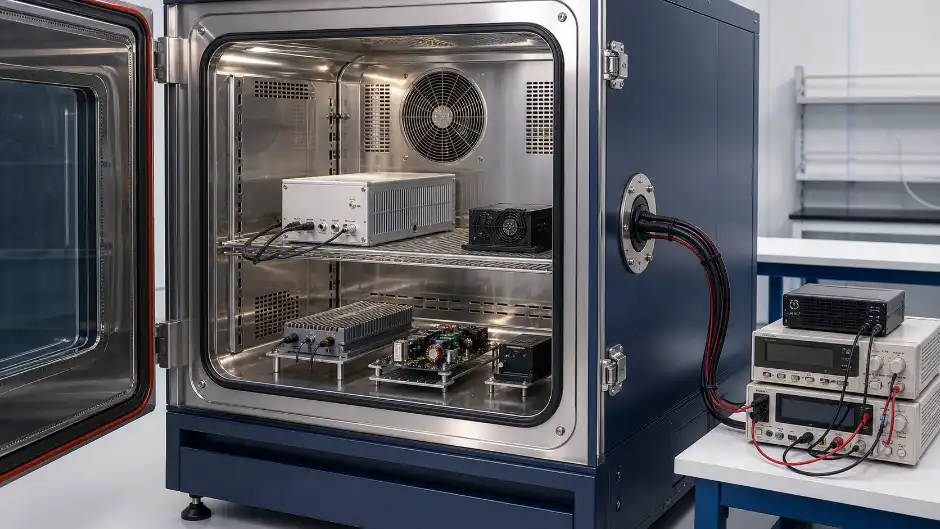
Powered electronic specimens inside an environmental test chamber with safe cable routing and external monitoring equipment
Powered specimens require heat-load data, safe feedthroughs and a clearly defined monitoring arrangement.

If heat dissipation is unknown, measure real electrical input and estimate how much becomes heat inside the workspace, or provide the supplier with the operating modes and power data for engineering review. Do not assume that chamber volume alone guarantees cooling performance.

4. Confirm Installation Space and Utilities

A correct chamber can still become an installation problem if it cannot pass through the building, reject heat into the room or connect to the available utilities. Include photographs or a simple layout for large systems.

  • Available power: voltage, frequency, phase, breaker capacity and local plug or wiring requirements.
  • Room access: doorway, corridor, lift and loading-bay dimensions.
  • Operating environment: room temperature, humidity, altitude, dust and ventilation.
  • Clearance: service access, condenser airflow and door-opening space.
  • Water and drainage: supply quality, pressure, drain location and whether deionized water is available.
  • Heat rejection: whether the facility can accept an air-cooled unit or has suitable cooling water.
  • Floor: allowable loading, levelness and access for moving equipment.

5. State the Specimen Hazards Before Configuration

Safety requirements must be based on a risk assessment of the specimen and test. Tell the supplier if a foreseeable failure can release heat, smoke, flammable or toxic gas, electrolyte, coolant, pressure or fragments. Also identify whether the sample stores electrical, chemical or mechanical energy.

Depending on the risk, engineering review may consider independent over-temperature protection, specimen power interruption, gas monitoring, ventilation or exhaust, pressure relief, leak containment, fire detection or suppression interfaces and remote observation. These are project-specific measures—not universal options that should be copied into every quotation.

6. Define How the Chamber Will Be Accepted

Agreeing on evidence before the purchase order prevents disagreement after delivery. State the conditions at which performance matters and what the supplier must demonstrate.

  • Factory acceptance test (FAT) and, if required, site acceptance test (SAT)
  • Temperature or humidity calibration points and traceability requirements
  • Empty-chamber mapping or loaded performance verification
  • Uniformity, fluctuation, deviation and ramp-rate acceptance criteria
  • Alarm, interlock, data logging and power-recovery checks
  • Operation manual, electrical drawings, parts list and maintenance documentation
  • Operator training, warranty terms and technical-support process

IEC 60068-3-6 describes a uniform method for confirming the performance of temperature/humidity chambers without specimens. If your qualification must represent a particular load, define that additional loaded test separately in the purchase specification.

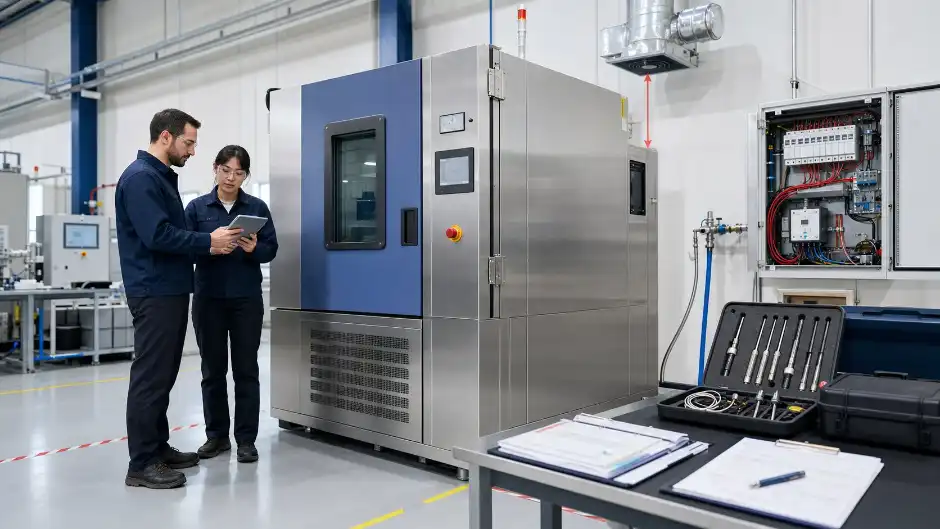
Engineers planning environmental test chamber site utilities, calibration and factory acceptance checks
Installation utilities and acceptance evidence should be agreed before the chamber is ordered.

Copyable Environmental Chamber RFQ Checklist

Copy the checklist below into your inquiry. If a value is not yet known, write “to be confirmed” instead of guessing. DERUI engineers can then identify the remaining decisions.

Project information to submit

  • Product and test objective
  • Standard and revision
  • Specimen dimensions and mass
  • Quantity and fixture details
  • Minimum/maximum temperature
  • Required temperature/RH points
  • Ramp-rate definition
  • Dwell time and cycles
  • Steady and peak heat load
  • Powered-sample duty cycle
  • Ports, cables and sensors
  • Data and communication needs
  • Sample hazards
  • Available power and utilities
  • Room and access dimensions
  • FAT/SAT acceptance criteria
  • Calibration and documents
  • Target delivery location/date

Example of a useful first inquiry

“We need to test four powered automotive electronic modules to our customer’s temperature-cycle profile. The combined fixture is 650 × 500 × 400 mm and 85 kg. The air-temperature profile runs from −40°C to +125°C at an average 5°C/min, with 60-minute dwells, for 200 cycles. The modules dissipate 1.8 kW continuously and 2.5 kW for up to 10 minutes. We need two 100 mm cable ports, specimen power interruption on over-temperature, Ethernet data export and performance verification with a representative load. Site power is 380 V, 50 Hz, three-phase.”

This is not a finished specification, but it gives a supplier enough information to propose a chamber family, identify technical risks and ask targeted follow-up questions.

Common Questions

Do I need to know every specification before contacting a supplier?

No. Start with the specimen, required test profile, operating state and installation location. Mark unknown items clearly. A competent supplier should explain which missing values materially affect selection and quotation.

Can I select a chamber using only temperature range and volume?

Not reliably. Ramp rate, specimen thermal mass, internal heat dissipation, airflow restrictions, humidity points, access ports and room conditions may change the required system even when range and volume appear suitable.

Should I quote the widest possible temperature range for future use?

Specify confirmed requirements and clearly label possible future conditions. Unnecessary range or speed can increase equipment and operating cost, while undocumented future needs may make the selected chamber unsuitable later.

What if I do not know the specimen heat load?

Provide input power, operating modes, duty cycle and the lowest chamber temperature at which the sample operates. The engineering team can help determine what must be measured or conservatively estimated.

Why should acceptance requirements be defined in the RFQ?

They make quotations comparable and establish how performance will be demonstrated. Without agreed conditions, an empty-chamber catalog value may be mistaken for performance with your actual load.

Next Step: Turn Your Test Into a Chamber Specification

Use the checklist above before comparing chamber models. For an overview of available equipment, browse DERUI’s environmental test chamber categories. If your project is primarily temperature-based, review the temperature test chamber range.

Send Us Your Test Requirements

Share your specimen, profile, heat load and installation information. DERUI can review the application and identify the chamber type and configuration that should be quoted.

Request a Chamber Recommendation
Download Product Information

Technical References


Walk-In Environmental Test Chamber FAQs

Walk-In Environmental Test Chamber FAQs

A consolidated guide to applications, stability testing, size, selection, cost, maintenance and comparison with smaller chambers.


Short answer: A walk-in environmental chamber is a large controlled room used when a specimen, fixture or batch cannot fit into a conventional reach-in chamber. It can provide heat, cold and—in a suitably configured model—humidity. Selection depends on usable space, sample heat load, performance profile, installation conditions and safety requirements. Walk-in systems are normally engineered around the application rather than selected from one universal standard size.
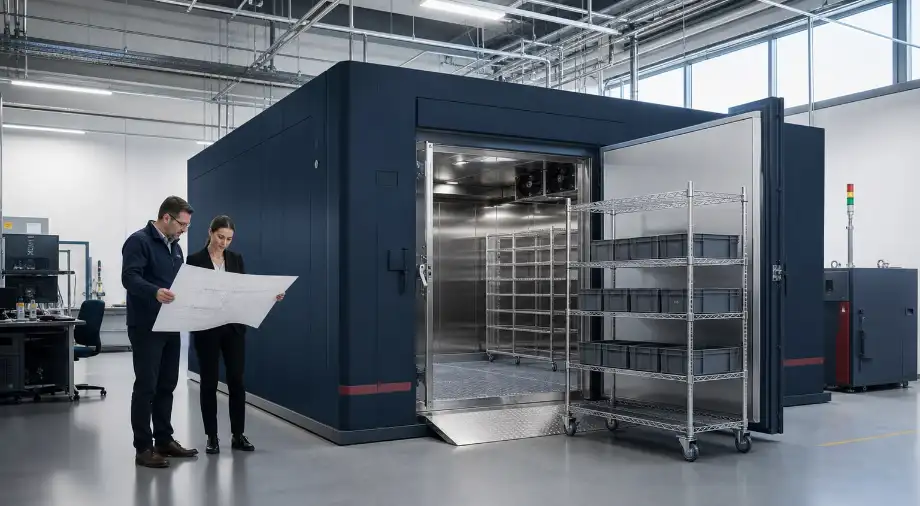
Engineers planning walk-in environmental chamber size, access, floor loading and specimen racks
Walk-in chamber planning must include usable space, door access, floor loading, utilities, specimen heat and installation conditions.

What Is a Walk-In Stability Chamber?

A walk-in stability chamber is a large temperature-and-humidity-controlled room intended for long-duration storage and stability studies. It is commonly associated with pharmaceutical ingredients, finished products, packaging and other materials that must remain at defined climatic conditions for extended periods. It differs from a general reliability chamber because stability work prioritizes long-term uniformity, monitoring, alarms, data integrity, recovery and qualification rather than aggressive temperature cycling.

If an ICH condition is required, provide the exact study condition, tolerance, storage duration, loading pattern, door-opening routine, monitoring and qualification requirements. Saying “ICH compliant” alone is not a complete specification.

What Is a Walk-In Environmental Chamber Used For?

  • Full-size automotive parts, battery modules and large electronic assemblies
  • Batch aging, burn-in and production reliability screening
  • Aerospace, defense and telecommunications equipment
  • Packaging, construction materials and industrial components
  • Pharmaceutical or material stability storage when configured for that purpose
  • Large fixtures, racks or products that require powered operation during exposure

One walk-in room should not be assumed to perform every stress. Temperature/humidity, altitude, salt spray, dust, rain and battery-abuse testing impose different construction and safety requirements.

Can a Walk-In Chamber Simulate Both Heat and Cold?

Yes, a temperature walk-in chamber can be designed for heating and refrigeration, while a climatic version can also control humidity within a defined temperature/RH operating envelope. Performance must be confirmed at the actual setpoints, load and rate. A chamber that reaches a low temperature empty may not achieve the same condition with several kilowatts of powered samples.

How Is Walk-In Chamber Size Determined?

There is no single international list of “standard sizes.” Manufacturers may offer common modular dimensions, but useful size is determined from the complete specimen envelope, quantity, fixtures, airflow clearance, access aisle, door size, shelving, floor load and possible future products.

Input Why it matters
Specimen and fixture dimensions Establishes minimum clear workspace and door opening.
Total mass and material Changes thermal response and floor requirements.
Powered heat load Determines refrigeration capacity at critical low setpoints.
People entering the room Requires operational procedures and appropriate safety review.
Racks and carts Affects internal layout, circulation and loading access.
Building route Determines whether an integral unit fits or modular site assembly is needed.

How Do I Choose a Walk-In Chamber?

  1. Define the standard and complete temperature/humidity profile.
  2. Provide sample size, mass, quantity, fixture and airflow restrictions.
  3. State continuous and peak heat dissipation.
  4. Specify ramp rate, dwell, cycles and door-opening frequency.
  5. List cable, power, coolant, sensor and data connections.
  6. Complete a sample risk assessment.
  7. Confirm power, ventilation, drainage, cooling method and floor loading.
  8. Agree on FAT, site acceptance, calibration and training.

Walk-In vs Reach-In vs Benchtop

Type Best suited to Main trade-off
Benchtop Small components and limited laboratory space Limited load size and heat-removal capacity
Reach-in Components and assemblies loaded through a front door Less flexible for very large or wheeled specimens
Walk-in Large products, racks and batch testing Higher site, energy, installation and maintenance demands

How Much Does a Walk-In Test Chamber Cost?

A responsible quotation requires a specification. Major cost drivers include room size, minimum temperature, humidity capability, change rate, heat load, refrigeration redundancy, safety configuration, material selection, data system, site assembly, utilities, calibration and international shipping. Avoid comparing quotations only by cubic volume: two rooms of the same size can require very different mechanical systems.

What Maintenance Does It Require?

Routine tasks normally include cleaning the workspace, checking door seals and drains, inspecting filters and condensers, confirming water quality, reviewing alarms and data, and scheduling calibration and qualified refrigeration/electrical service. Frequency depends on usage, environment and the manufacturer’s manual. Operators should not open live electrical panels or service refrigerant systems unless trained and authorized.

Existing DERUI Delivery Arrangement

DERUI’s typical walk-in production period is 35–50 days after technical and commercial confirmation. Units that remain within container transport dimensions may be produced as integral systems; oversized rooms are supplied in sections for site assembly. Final schedule and installation scope must be confirmed in the contract.

Common Walk-In Questions

Is a walk-in chamber always a stability chamber?

No. Stability rooms are optimized for long-term controlled storage, while industrial walk-in chambers may be designed for cycling, powered loads or large reliability tests.

Can customers choose air-cooled or water-cooled refrigeration?

The cooling approach depends on capacity, room heat rejection, ambient conditions and available cooling water. It should be decided during site review.

Can the room be customized?

DERUI can review custom dimensions, doors, load capacity, layout, ranges, rates, materials, ports, observation windows, control/data functions and project-specific safety options.

Related DERUI Resources

Review DERUI’s walk-in chamber solutions, compare the wider environmental test chamber range, or prepare the project using the environmental chamber RFQ checklist.

Plan a Walk-In Chamber

Provide a room layout, specimen data, heat load and test profile for engineering review.

Request a Walk-In Chamber Quote


Can an Environmental Test Chamber Be Customized?

Can an Environmental Test Chamber Be Customized?

Understand what can be changed, what information engineering needs and how a custom chamber moves from requirement to acceptance.


Yes. DERUI can review custom chamber dimensions, structure, door arrangement, sample load, internal layout, temperature/humidity range, change rate, materials, safety features, access ports, observation windows, power interfaces, control/data functions, remote monitoring and application-specific cooling. Customization must begin with the test and specimen—not with a cosmetic option list.
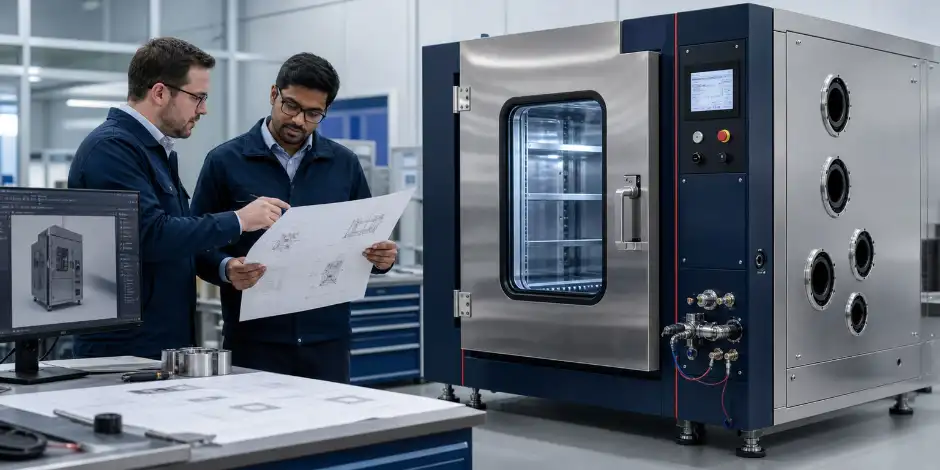
Engineers reviewing a custom environmental test chamber design with cable ports and coolant connections
A custom chamber should be engineered from the test profile, specimen, interfaces, heat load, monitoring and safety requirements.

What Can Be Customized?

Workspace and structure

Internal dimensions, total volume, modular or integral construction, door size and direction, floor or shelf load, racks, carts and internal arrangement.

Environmental performance

Temperature and humidity range, critical combined points, heating/cooling rate, recovery, powered heat-load capacity and auxiliary cooling.

Materials and environment

Internal/external material, corrosion-resistant design, appearance, low-noise design and provisions for the installation environment.

Access and interfaces

Observation windows, cable ports, internal power, sensors, coolant or gas lines, data acquisition and communications.

Control and data

Program profiles, logging, export, remote monitoring, alarms and integration requirements. English is standard; special language requirements can be reviewed.

Safety configuration

Battery-oriented or other risk-based protection, including project-specific explosion mitigation, corrosion protection, monitoring, ventilation and interlocks.

Can My Logo, Voltage and Plug Be Customized?

DERUI can provide customer-logo customization. Electrical configuration can be adapted to the destination country’s voltage, frequency and plug or hard-wiring requirements. These details must be confirmed before electrical design and production. Logo placement and appearance should also be approved in the final drawing.

What Information Is Needed?

  • Test standard and revision
  • Specimen dimensions, mass, quantity and fixture
  • Actual temperature/RH profile and change-rate definition
  • Continuous and peak sample heat load
  • Interfaces, ports, monitoring and data requirements
  • Credible sample failure hazards
  • Installation power, water, ventilation, floor and access conditions
  • Required calibration, FAT/SAT documents and delivery location

How Does the Customization Process Work?

  1. Requirement review: DERUI checks whether a catalog configuration can meet the test.
  2. Technical clarification: Unknown or conflicting parameters are resolved.
  3. Proposal and quotation: Performance, options, exclusions and commercial terms are stated.
  4. Drawing approval: Layout, interfaces and utilities are confirmed before production.
  5. Manufacture and verification: The chamber is built and tested to agreed acceptance items.
  6. Delivery and commissioning: Documentation, installation scope and training follow the contract.

How Long Does a Custom Chamber Take?

DERUI’s typical custom-equipment production period is 30–40 days after requirements, drawings and commercial terms are confirmed. Complex safety systems, oversized construction, third-party inspection or special components can change the schedule, so the contractual delivery plan remains controlling.

What Should Not Be Assumed?

“Custom” does not mean every requested combination is physically achievable or safe. For example, maximum temperature and maximum humidity may not be available simultaneously, and ramp rate may fall with a heavy powered load. Engineering must confirm the requested operating envelope and acceptance condition.

Related DERUI Resources

Start with the environmental chamber RFQ checklist, browse available test chamber types, and use the DERUI download center when comparing base configurations.

Request a Custom Configuration

Send your test profile, specimen drawing, heat load, utilities and safety requirements.

Discuss Your Custom Chamber


How Do I Choose the Right Type of Environmental Test Chamber?

How Do I Choose the Right Type of Environmental Test Chamber?

Match the chamber to the environmental stress, specimen, transition requirement and safety risk—not simply to the largest advertised temperature range.


Short answer: Choose a temperature chamber for dry heat, cold and thermal cycling; a temperature-humidity chamber when controlled moisture is required; a rapid temperature change chamber when the specified ramp rate is demanding; a thermal shock chamber when the specimen must experience abrupt hot-to-cold transfer; and a walk-in chamber when the sample or production batch is too large for a reach-in unit. Dust, rain, salt spray, altitude, UV, xenon and battery-abuse tests require purpose-built systems.

Engineer comparing temperature, humidity, thermal shock, walk-in and battery environmental test chambers

Start With the Test—Not the Chamber Name

Two chambers may look similar while being designed for different failure mechanisms. Before selecting equipment, identify the applicable test method, specimen dimensions and mass, whether the sample operates during the test, the actual environmental profile and the evidence required at acceptance.

Test need Recommended chamber family Selection warning
Dry heat, cold, storage or temperature cycling Temperature test chamber Confirm performance with the specimen load and required ramp rate.
Temperature plus controlled relative humidity Temperature and humidity chamber Confirm every required temperature/RH combination on the control-range diagram.
Fast programmable thermal cycling Rapid temperature change chamber Define average versus linear rate and air versus specimen temperature.
Very rapid hot/cold exposure Thermal shock chamber Confirm transfer time, recovery time, zone design and whether the specimen moves.
Large assemblies, vehicles or bulk batches Walk-in environmental chamber Include floor load, heat dissipation, access, utilities and installation method.
Reduced pressure with temperature Altitude chamber Pressure-vessel design and safety requirements are project-specific.
Battery cells, modules or packs Battery environmental chamber Risk assessment may require gas monitoring, ventilation, containment and fire interfaces.
Dust, rain, corrosion or weathering Dedicated dust, rain, salt spray, UV or xenon chamber A standard climatic chamber cannot reproduce every environmental stress.

Five Decisions That Separate Similar Chamber Types

1. Is humidity required?

If the method specifies relative humidity, condensation or damp heat, select a system designed to humidify and dehumidify at the required temperature points. A temperature-only chamber cannot be converted by software.

2. How quickly must conditions change?

A standard temperature chamber may cycle slowly, while ESS or rapid-change testing can require substantially more refrigeration capacity. Thermal shock is different again because it exposes the specimen to an abrupt change between conditioned zones.

3. How large and heavy is the load?

Include fixtures, shelves, cables and future variants. Large volume alone is not enough; thermal mass, airflow obstruction and floor loading also affect the design.

4. Does the specimen generate heat?

Powered electronics, batteries, motors and power supplies can prevent a chamber from reaching low setpoints. Provide continuous and peak watts, duty cycle and lowest operating temperature.

5. What can happen if the sample fails?

Identify smoke, gas, leakage, fire, pressure and stored-energy risks. The safety architecture must follow the application rather than a generic accessory list.

A Practical Selection Sequence

  1. Record the test standard and revision.
  2. Describe the specimen, fixture and operating state.
  3. Write the actual test profile, including dwell and cycles.
  4. Define temperature/RH points and transition rate.
  5. Report heat load and all interfaces.
  6. Choose the chamber family using the table above.
  7. Confirm site utilities and safety provisions.
  8. Agree on calibration, FAT/SAT and documentation.

Avoid duplication: This page answers which chamber family fits a test. For the information needed in an RFQ, use the separate checklist: What Information Is Needed to Select an Environmental Test Chamber?

Need Help Identifying the Chamber Type?

Send DERUI the specimen, test profile, heat load and applicable standard for an application review.

Request a Recommendation


DERUI Ordering, Factory Visit, Payment and Shipping FAQs

DERUI Ordering, Factory Visit, Payment and Shipping FAQs

Practical answers for international buyers—from production schedule and payment to factory inspection, export packing and delivery.


Overview: DERUI exports test equipment to more than 80 countries, accepts D/P, T/T and L/C, and commonly uses a 50% initial payment and 50% balance arrangement. EXW, FOB, CIF, DDP and other trade terms can be discussed. Customers are welcome to arrange a factory visit. Sea freight is the usual transportation method, with export plywood cases and protective internal cushioning.
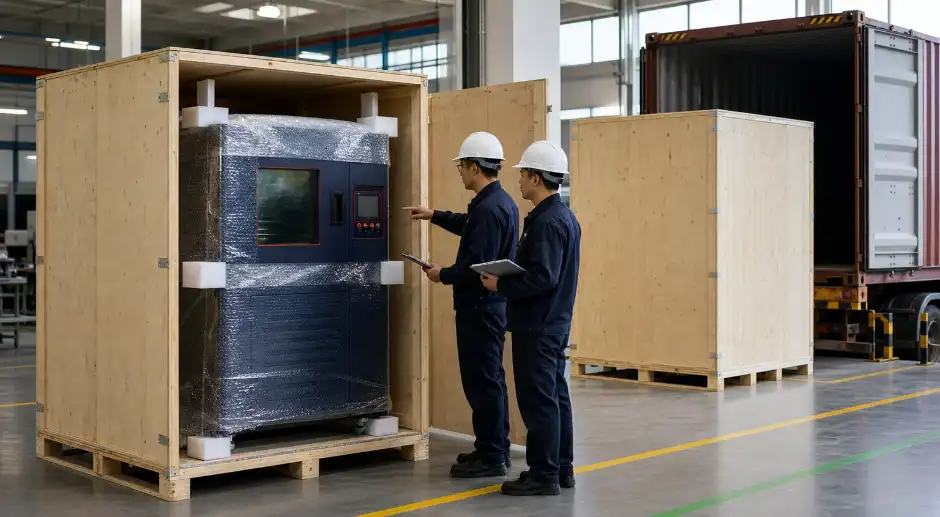
Environmental test chamber protected with cushioning inside a plywood export crate for international shipping
Export packing uses internal cushioning and a robust plywood case to limit movement and protect the chamber during international transport.

Ordering and Delivery

How long does production take?

Typical production periods are 7–15 days for standard equipment, 30–40 days for custom equipment and 35–50 days for walk-in chambers. Timing begins after technical details, drawings where applicable, payment and contractual requirements are confirmed. Special components, third-party inspection or project changes can affect the schedule.

What information is needed for an accurate quotation?

Provide the specimen, applicable standard, test profile, temperature/RH points, change rate, heat load, workspace, interfaces, safety risks, destination, electrical supply, required documents and trade term. This produces a comparable quotation and prevents late changes.

Payment and Trade Terms

What payment methods does DERUI accept?

DERUI accepts D/P, T/T and L/C. Availability and banking requirements are confirmed for each transaction.

What is the usual payment schedule?

The common arrangement is 50% as the initial payment and 50% as the balance. The final schedule, balance trigger and required pre-shipment evidence must be written in the contract or proforma invoice.

Which Incoterms are available?

DERUI can discuss EXW, FOB, CIF, DDP and other trade arrangements. The quotation should state the named place or port and the applicable Incoterms edition so responsibilities for freight, customs, tax, risk and insurance are clear.

Factory Visit and Customer References

Can I visit the DERUI factory before ordering?

Yes. DERUI welcomes customers to arrange a factory visit and can show applicable production and factory-testing activities, subject to production schedules, safety requirements and confidentiality restrictions.

Factory address: Floor 1, No. 3, Shugang Avenue, Hongmei Town, Dongguan City, Guangdong Province, China.

Has DERUI supplied chambers to customers in my country?

DERUI has exported equipment to more than 80 countries and can publicly discuss representative destination countries. Individual customer names and confidential project details are not disclosed because of confidentiality agreements. Ask the sales team about relevant voltage, climate, logistics and service experience for your destination.

Packaging and International Transport

How are test chambers packaged?

Equipment is protected with bubble film and EPE pearl-cotton cushioning to reduce movement and impact. Export cases use fumigation-free plywood material. The packing plan may be adapted to machine size, protruding components, accessories and the selected shipping route.

How are chambers transported?

Sea freight is the normal method for international delivery. Smaller equipment is shipped as packed machinery. Lifting points, center of gravity, unpacking space and delivery access should be reviewed before arrival.

Is a walk-in chamber shipped complete or assembled on site?

If the assembled chamber remains within container and transport limits, it may be manufactured as an integral unit. Oversized walk-in systems are supplied in sections and assembled at the customer site. The quotation must state which method applies and who provides local labor, lifting equipment, utilities and commissioning support.

Is cargo insurance available?

Yes, transportation insurance can be provided. Coverage, insured value, exclusions, claim documents and responsibility should be confirmed together with the selected trade term.

Arrival Checklist

  • Inspect the external case before unloading and photograph any damage.
  • Check packing list, model, accessories and documentation.
  • Use approved lifting points and suitable equipment.
  • Allow the chamber to stabilize as instructed before start-up.
  • Confirm electrical, water, drainage and ventilation conditions.
  • Complete installation and acceptance records before routine testing.

Prepare Before Ordering

Learn more about DERUI manufacturing, download available product information, and prepare the technical portion of your request with the environmental chamber RFQ checklist.

Request Commercial and Shipping Terms

Send the chamber specification, delivery address, preferred Incoterm and required delivery date.

Request a Formal Quotation


What Technical Support Is Available After Purchasing a Test Chamber?

What Technical Support Is Available After Purchasing a Test Chamber?

DERUI warranty, training, remote guidance, overseas installation and long-term spare-parts support explained clearly.


DERUI support policy: Test chambers include a one-year whole-machine warranty, lifetime technical consultation, remote video guidance and operator training. Overseas on-site installation can be arranged as a separately charged service. Spare parts can be supplied for ten years. Exact scope, response arrangement, exclusions and costs should be stated in the sales contract for the specific project.
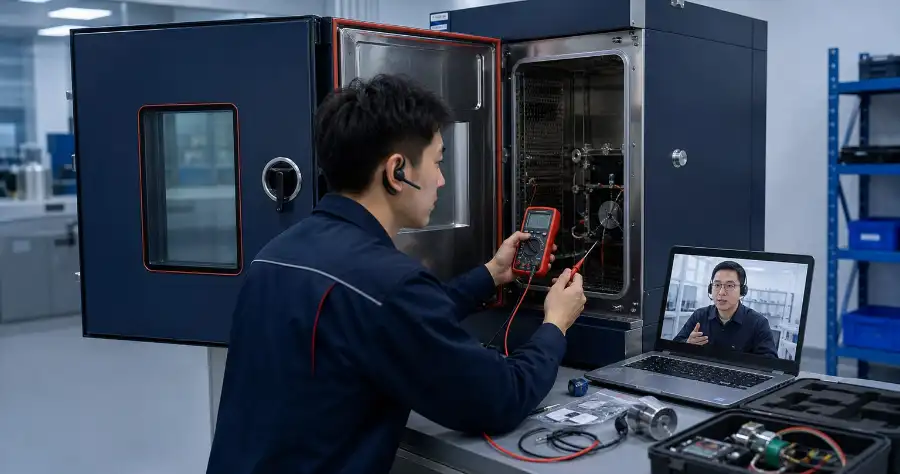
Service engineer receiving remote technical support while diagnosing an environmental test chamber
Effective support combines fault evidence, remote diagnosis, operator guidance, spare parts and on-site service when required.

Support Across the Equipment Lifecycle

Before delivery

Site-condition confirmation, utility information, installation planning, manuals and acceptance preparation.

Installation and commissioning

Guidance for setup and functional checks. Overseas on-site installation is available when included as a separately quoted service.

Operator training

Training covers safe start-up, controller use, program creation, routine checks, alarms and shutdown practices applicable to the delivered model.

Remote technical guidance

Video and communication support can help identify settings, operating errors, alarm conditions and information needed for parts or field service.

Warranty support

The standard warranty period is one year for the whole machine. Contract terms define coverage, exclusions, transport, labor and the process for confirming a warranty case.

Long-term parts and consultation

DERUI provides lifetime technical consultation and supports spare-parts supply for ten years.

What Should I Send When I Need Help?

  • Machine model, serial number and delivery date
  • Controller screen and exact alarm code
  • Setpoint, actual value and program step
  • When the problem began and whether it is repeatable
  • Photos or video of the chamber and affected area
  • Recent maintenance, utility or sample changes
  • Ambient temperature, power and water conditions
  • Whether the chamber contains a powered or hazardous specimen

Complete information makes remote diagnosis faster and reduces unnecessary parts replacement.

What Can Be Handled Remotely?

Remote guidance is often suitable for controller programming, checking operating conditions, reviewing alarm information, confirming utility requirements and identifying a likely component or maintenance action. It cannot replace qualified on-site work when electrical, refrigeration, pressure or safety systems must be opened or repaired.

Safety: Stop the equipment and follow the manual if there is smoke, abnormal odor, liquid leakage, repeated protective shutdown, exposed wiring or an unsafe sample condition. Do not bypass interlocks or protection devices to continue a test.

Does DERUI Provide Overseas Installation?

Yes. Overseas on-site installation can be arranged and is charged separately. Scope should state travel, accommodation, local transportation, visas, lifting support, utilities, installation labor, commissioning, training and acceptance responsibilities.

What Is Not Automatically Included?

Lifetime technical consultation does not mean unlimited free parts, travel or field labor. Likewise, a one-year whole-machine warranty does not automatically cover misuse, unauthorized modification, unsuitable utilities, consumables or damage caused by the specimen. The signed contract and warranty document govern each order.

Self-Service Resources

Before requesting support, check the model information in the DERUI download center and review relevant equipment demonstrations, such as the temperature and humidity chamber video. For problems that remain unresolved, send the evidence listed above through the contact page.

Prepare a Support Request

Send the model, serial number, alarm code, operating condition, photos and video.

Contact DERUI Support


Are DERUI Test Chambers Compliant With International Standards?

Are DERUI Test Chambers Compliant With International Standards?

How to distinguish company certification, equipment conformity, test-method capability, calibration and product certification.


Short answer: DERUI has obtained ISO 9001 quality-management certification, and its test chambers have CE certification. DERUI can configure chamber performance and programs for applicable IEC, ISO, ASTM, MIL-STD and industry test methods, subject to the selected model and agreed specification. A chamber’s ability to run a test method is not the same as certification of the customer’s product, and it should not be described as universal certification to every listed standard.
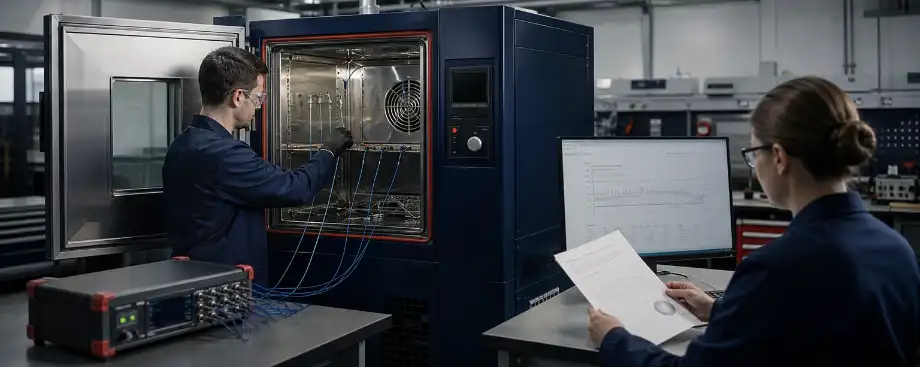
Technicians performing multi-point calibration and performance verification on an environmental test chamberCalibration and multi-point performance verification provide evidence of measurement traceability, stability and workspace uniformity.



Four Different Meanings of “Compliant”

Claim What it means Evidence to request
ISO 9001 The manufacturer operates a certified quality-management system within the certificate scope. Valid certificate, issuing body, scope and expiry.
CE conformity The equipment is assessed for applicable European requirements. Declaration, model scope and supporting documentation.
Supports a test method The chamber can reproduce the required conditions and tolerances when correctly specified. Standard revision, chamber capability, profile and acceptance data.
Customer product certification The tested product has been assessed through an applicable certification process. Report or certificate from the responsible laboratory/body.

Why the Exact Standard Revision Matters

“IEC testing” or “MIL testing” is too broad. Standards contain many methods, severities and procedures, and revisions can change definitions or tolerances. Provide the complete number, method, condition and revision. The supplier can then check temperature, humidity, transition, workspace, load, sensors and documentation against the actual requirement.

Chamber Performance Confirmation

IEC 60068-3-5 addresses confirmation of temperature chamber performance, while IEC 60068-3-6 provides a reproducible method for confirming temperature/humidity chamber performance without specimens. A customer who needs loaded performance should separately define the representative load, sensor arrangement and acceptance conditions.

Calibration Is Not the Same as Qualification

Calibration establishes the relationship between instrument indications and traceable reference measurements at stated points. Chamber mapping or performance verification evaluates spatial and temporal behavior such as uniformity, fluctuation and deviation. Qualification may also document installation, operation and performance against an approved protocol.

DERUI can provide third-party calibration reports and factory temperature-uniformity test reports. The required laboratory accreditation, points, sensor layout, language and report format should be stated before ordering.

What Should Be Written in an RFQ?

  • Complete standard, method, condition and revision
  • Required setpoints, tolerance, dwell, cycles and rate
  • Whether requirements apply empty or loaded
  • Specimen and fixture details
  • Calibration points and traceability requirements
  • FAT/SAT and witness requirements
  • Required declarations, certificates and reports
  • Destination-country electrical and regulatory requirements
Recommended wording: “The chamber shall be capable of performing the specified test profile and shall demonstrate the agreed performance at FAT.” Avoid the unsupported statement “the chamber is certified to all IEC, ISO, ASTM and MIL standards.”

Other Certificates

DERUI has additional certificates beyond ISO 9001 and CE. Because certificate type and applicability may vary by product, request the documents relevant to the specific chamber model rather than displaying unrelated certificates as universal evidence.

Continue Your Standards Review

Use DERUI’s technical articles for detailed test-method guidance, compare the available environmental chamber categories, and send the exact standard revision through the contact page for capability confirmation.

Verify a Standard Before Ordering

Send the exact standard number, revision and test condition for a chamber capability review.

Submit Your Standard


How to adjust the temperature of the constant temperature test chamber

The procedures for adjusting the temperature of the constant-temperature test chamber are outlined below:

1. Select the temperature setting mode:
- Manual adjustment: Use the knob on the control panel to manually select the desired temperature.
- Digital settings: Input the target temperature value directly into the control panel.
- Automatic control: Define a temperature range, and the system will automatically adjust accordingly.

2. Set the temperature range: Determine the appropriate temperature range based on experimental requirements to ensure operational stability.

3. Estimate preheating and cooling time: Calculate the estimated heating or cooling time required based on the equipment's capacity.

4. Position the temperature sensor: Place the sensor in an optimal location that accurately reflects the sample's temperature.

5. Define temperature control accuracy: Establish reasonable control accuracy parameters to maintain stability throughout the process.

6. Minimize abrupt temperature fluctuations: Avoid significant fluctuations during the adjustment process to prevent instability.

7. Allow for temperature equilibrium: After setting the temperature, allow sufficient time for the chamber to reach thermal equilibrium.

telephonetelephone

hotline:
155 8032 7593

WhapsAppWhapsApp
WhapsApp
LinkedinLinkedin

Derui LinkedIn Profile

messagemessage

Contact us to provide you with exclusive service!