




Calle Shugang 1, No. 3, Town de Hongmei, Ciudad de Dongguan, Provincia de Guangdong, China

Fabricante de cámaras de prueba ambiental con 20 años de experienciaMás de 3000 entregas a clientes en todo el mundo           Correo electrónico: shirley@deruitest.com
WhatsApp Consultation:+86 135 2795 8363

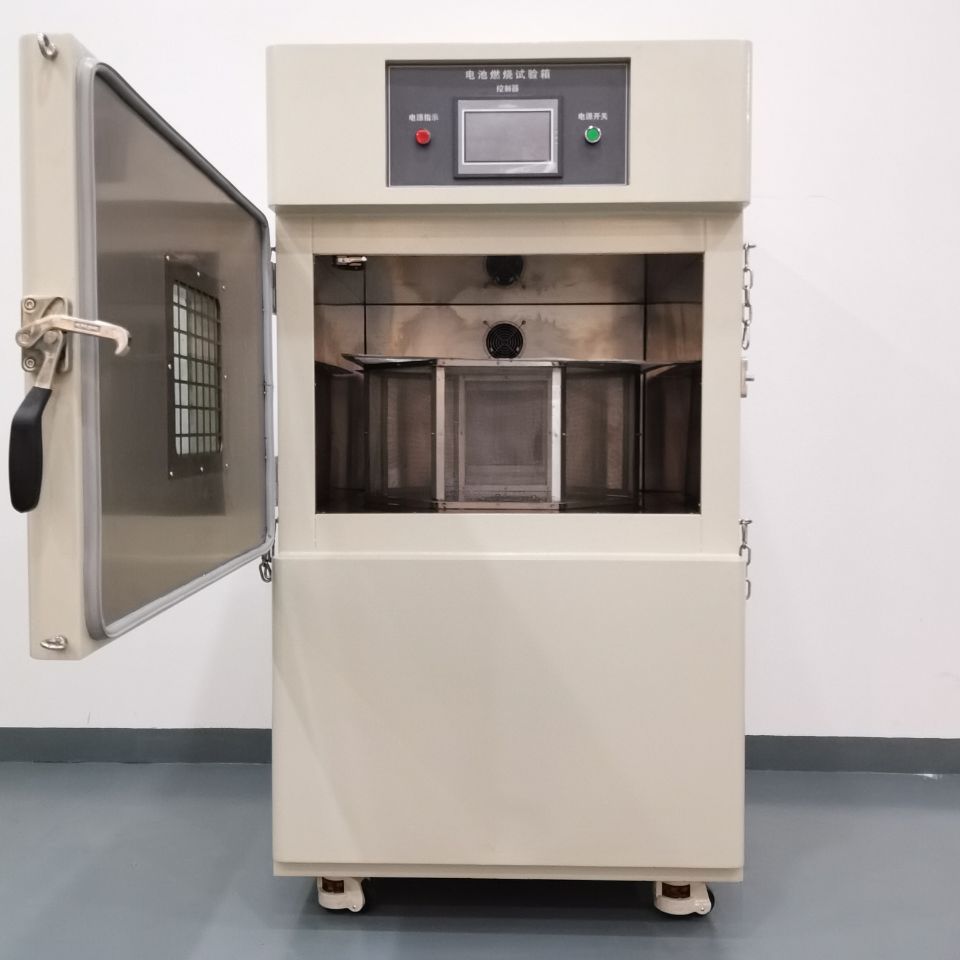
Cámara de prueba de combustión de batería

La DERUI DR-D207 battery burning test chamber uses a Bunsen burner, stainless specimen screen and removable octagonal mesh cover for specified cell or small-battery flame-exposure procedures. Confirm the exact test clause and fixture drawing before ordering.

Modelo DR-D207
Enfoque de la prueba Controlled flame exposure with mesh surround; method-specific observation
Burner / Screen 10 mm burner mouth; 0.43 mm stainless wire, 20 openings per inch
Octagonal Cover 610 mm across opposite faces × 305 mm high; removable panels
Inner Size 750 × 750 × 500 mm (W × D × H)
Before Quotation Confirm clause/edition, cell energy and format, gas/exhaust, safety scope and FAT
Segura y confiable
bien hecha
Garantía de calidad
personalización
MensajeWhatsApp
Número de línea directa 15580327593
  • Detalles del producto
  • Parámetros técnicos
  • Preguntas frecuentes
  • Contáctanos
CELL FLAME EXPOSURE & PROJECTILE-CONTAINMENT SETUP

DR-D207 Battery Burning Test Chamber

A purpose-built burner, specimen screen and removable octagonal mesh cover for controlled flame-exposure testing of approved lithium cells or small batteries. Specify the adopted method, specimen and laboratory safety plan before treating any fixture geometry as a compliance claim.

What this equipment is: a flame-exposure fixture. It is not a programmable temperature chamber, a full-size pack fire tester or a UN 38.3 transport-test system.
ModeloDR-D207
Burner10 mm internal tube opening; approximately 100 mm long
cURL Too many subrequests by single Worker invocation. To configure this limit, refer to https://developers.cloudflare.com/workers/wrangler/configuration/#limits0.43 mm stainless wire; 20 openings per inch
Internal enclosure750 × 750 × 500 mm (W × D × H)

What the Test Helps You Observe

During a specified flame-exposure procedure, a cell or approved small battery sits above the burner while the screen and octagonal surround define the setup and help retain ejected material. The laboratory observes the behavior required by its adopted method; pass/fail criteria must come from that method and the test plan, not from the chamber specification alone.

Controlled setup

Published burner, screen, opening and octagonal-cover dimensions provide a starting point for method review.

Visible evidence

Agree in advance how the operator will record exposure time, specimen behavior and any ejected material.

Safer procurement

Confirm fuel supply, exhaust, operator protection and post-test handling before ordering.

Published DR-D207 Configuration

Artículo Published value cURL Too many subrequests by single Worker invocation. To configure this limit, refer to https://developers.cloudflare.com/workers/wrangler/configuration/#limits
Control and timer Button control; flame-time setting shown as 0–99H99M Confirm actual timer input format, resolution and shutoff behavior.
Burner and opening Bunsen burner, 10 mm internal mouth, approximately 100 mm length; test opening 100 ± 2 mm Confirm burner type, flame setting and fixture drawing against the adopted standard edition.
Specimen screen 0.43 mm stainless woven wire; 20 openings per inch Confirm mounting height and replacement screen supplied.
Octagonal cover 610 mm across opposite faces; 305 mm high; eight removable panels; 0.25 mm aluminum wire, 16–18 openings per inch Request dimensional drawing and panel-retention details.
cURL Too many subrequests by single Worker invocation. To configure this limit, refer to https://developers.cloudflare.com/workers/wrangler/configuration/#limits 750 × 750 × 500 mm internal; 1000 × 950 × 1310 mm external, including door lock Confirm usable clearance around the fixture and doorway.
Servicios públicos Methane or LPG supplied by customer; 220 V, 50/60 Hz, 200 W; approximately 160 kg Confirm gas regulation, ventilation, site power and nameplate.
Relief and exhaust 200 × 200 mm pressure-relief door; rear Ø100 mm exhaust connection; door-retention chain Confirm discharge direction, duct requirements and risk-assessed containment limits.
Dimension requiring a drawing: the old specification states “height of the flame from the screen: 38 mm.” That wording does not unambiguously define the burner-to-screen geometry; verify it on the approved setup drawing.

Method Fit: Review the Clause, Not a Logo List

The DR-D207 screen and octagonal-surround geometry warrants review against the UL 1642 Projectile Test, but published fixture similarity is not proof of conformance. In particular, the DR-D207 page specifies a Bunsen burner, while a published technical comparison describes a Meker-type burner for the UL 1642 fire-exposure setup. Verify the adopted edition, burner, all dimensions, specimen preparation, observation and acceptance rules clause by clause before any UL 1642 claim.

Do not treat this chamber as a UN 38.3 test method. The UN transport manual has defined T.1–T.8 tests; a generic “UN 38.3 T.10 burning test” claim should not appear on this page. Other standards such as UL 2054 or IEC 62133-2 may form part of a laboratory program but do not automatically validate this fixture.

Send the exact method

Standard edition, clause, cell format, sample state, exposure period and pass/fail rule.

Confirm the physical setup

Burner specification, mesh, opening, screen-to-burner position and octagonal-cover drawing.

Confirm evidence

Video/observation plan, timed exposure, calibration records and final report format.

DR-D207 Is Different from DERUI's Other Battery Fire Equipment

Equipment Primary function Do not assume
DR-D207 burning test chamber Burner, screen and octagonal mesh fixture for specified cell/small-battery flame exposure Large pack fire testing, programmable heating or certified blast containment
DR-D211 EV battery cell fire tester A different external-flame test setup; compare its published specimen and burner limits separately Interchangeability with the DR-D207 projectile-test geometry
Battery thermal abuse chamber Controlled high-temperature exposure in a heated enclosure An open-flame burner or octagonal-mesh projectile-test fixture

Site Safety and Acceptance Plan

Review the specimen

Provide chemistry, dimensions, maximum energy, charge state and credible venting behavior. Agree allowable specimen size and quantity.

Review the facility

Confirm methane/LPG supply, regulator, exhaust route, clearance, fire response and operator exclusion area with site EHS.

Witness the setup

Check burner, screen and cover dimensions, timer, gas shutoff behavior, exhaust, door and documentation during FAT.

Safety boundary: the published relief door and retention chain are construction features, not evidence of a rated explosion-proof or thermal-runaway containment system. Gas detection, suppression, data export and interlocks are not established as standard features by the current public specification.

Questions Buyers Ask

Is this a UL-certified chamber?

No certification evidence is established by the public product page. Review fixture suitability against the exact UL 1642 edition and obtain any required third-party evaluation separately.

Can it test EV modules or packs?

Do not infer that from the enclosure size. Obtain a specimen-size, energy and hazard assessment, then compare the appropriate larger-scale equipment.

Is the gas included?

The published specification says methane or LPG is customer-provided. Confirm regulator, hose, shutoff and local installation scope in the quotation.

Does it perform UN 38.3 transport testing?

No. This burner arrangement should not be presented as a UN 38.3 test. Choose the dedicated equipment for the required T.1–T.8 method.

What needs confirmation before publication or purchase?

The adopted standard edition, fixture drawing, timer format, safety controls, real-device photos, accessories and measurable FAT criteria.

Request a Method-Matched DR-D207 Proposal

Send your cell drawing and test clause. DERUI can respond with the fixture drawing, included scope, utility list and an acceptance checklist that engineering and purchasing can review together.

Discuss the DR-D207 setup

Include in the inquiry

  • Standard edition and exact clause
  • Cell/battery format and energy
  • Gas and exhaust conditions
  • Required observation and FAT records
FacebookLinkedInXRedditWhatsApp

DR-D207 values below come from the current DERUI product record. Confirm the approved drawing and safety configuration before ordering.

Artículo Published configuration / verification point
Model / control DR-D207; button control
Burner Bunsen burner; 10 mm internal tube-mouth diameter; approximately 100 mm tube length
Flame-time setting Published as 0–99H99M; confirm valid timer input format, resolution and shutoff logic
Test opening 100 ± 2 mm diameter
Specimen screen Stainless woven wire, 0.43 mm diameter; 20 openings per inch
Burner/screen geometry Published “38 mm” wording is ambiguous; require approved dimensioned drawing
Octagonal mesh cover 610 mm across opposite faces; 305 mm high; eight removable faces; 0.25 mm aluminum wire, 16–18 openings per inch
Fuel Methane or LPG; customer-provided. Confirm regulator, supply and shutoff requirements
Inner / outer dimensions 750 × 750 × 500 mm / 1000 × 950 × 1310 mm (W × D × H; outer includes door lock)
Relief / exhaust / door 200 × 200 mm relief door; rear Ø100 mm exhaust connection; left-opening door with retention chain. No rated containment claim established
Supply / weight 220 V single phase, 50/60 Hz, 200 W; approximately 160 kg

1. ¿Qué es una Cámara de Prueba de Incendio de Baterías?
Una Cámara de Prueba de Incendio de Baterías es un recinto especializado y fuertemente reforzado diseñado para contener y estudiar incendios de baterías de manera segura. Permite a los investigadores inducir intencionadamente un runaway térmico en celdas de iones de litio, observando la propagación de llamas, perfiles de temperatura y la eficacia de contención bajo condiciones controladas y repetibles.

2. ¿Qué estándares de seguridad se pueden cumplir con una Cámara de Prueba de Incendio de Baterías?
Estas cámaras están construidas para ayudar a los fabricantes a cumplir con estándares internacionales críticos de seguridad. Los principales incluyen UL 9540A para sistemas de almacenamiento de energía, UN 38.3 para transporte de baterías de litio, ECE R100 para vehículos eléctricos, y GB/T 31485 para requisitos de seguridad de baterías de vehículos eléctricos en China.

3. ¿Cuáles son las características de seguridad esenciales a buscar?
Priorizar cámaras con sistemas automáticos de supresión de incendios (como aspersores o gas inerte), construcción a prueba de explosiones, monitoreo en tiempo real de gases y temperatura, y interruptores de parada de emergencia. Estas características son cruciales para proteger su laboratorio y personal durante una combustión controlada.

4. ¿Cuál es la temperatura máxima que pueden soportar estas cámaras?
Las Cámaras de Prueba de Combustión de Baterías de alta calidad están diseñadas para soportar el calor extremo de un incendio de batería. Busque modelos con una temperatura máxima de funcionamiento de al menos 1100°C (2000°F) para garantizar que puedan contener los eventos de fuga térmica más severos sin daños.

5. ¿La misma cámara puede probar diferentes tamaños y tipos de baterías?
Sí, muchas cámaras modernas cuentan con un diseño modular. Esto permite la reconfiguración interna o el uso de diferentes accesorios para probar de manera segura desde pequeñas celdas de electrónica de consumo hasta módulos de baterías de gran formato para vehículos eléctricos o sistemas de almacenamiento de energía (ESS).

6. ¿Qué tipo de datos recopila la cámara durante una prueba?
Las cámaras avanzadas están equipadas con sistemas integrados de adquisición de datos que capturan datos de temperatura de alta velocidad de múltiples termopares, cambios de presión, y con módulos opcionales, análisis de la composición de gases de los gases de escape producidos durante la combustión.

7. ¿Cómo se limpia y mantiene la cámara después de una prueba de fuego?
La limpieza posterior a la prueba implica la eliminación de residuos de fuego y la inspección de los componentes. Las cámaras con interiores lisos de acero inoxidable, bandejas de residuos extraíbles, y conjuntos de mirillas accesibles simplifican significativamente este proceso y garantizan la preparación para la próxima prueba.

8. ¿Se puede integrar la cámara con otros equipos de prueba?
Absolutamente. Busque modelos con puertos de comunicación estándar (Ethernet, CAN) que les permitan sincronizarse con cámaras ambientales externas para el preacondicionamiento de la temperatura o con el sistema central de gestión de datos de su laboratorio para la elaboración de informes consolidados.

11. ¿Cuál es el tiempo de entrega e instalación típico?
Debido a su naturaleza personalizada y de alta resistencia, los plazos de entrega de una cámara de prueba de combustión de baterías pueden oscilar entre 12 y 20 semanas. Esto incluye la fabricación, la validación de la seguridad y la coordinación para la instalación profesional in situ y la formación de los operarios.

10. ¿Se utiliza la cámara para el control de calidad o sólo para I+D?
Sirve para ambas funciones. En I+D, los ingenieros la utilizan para validar nuevos diseños de celdas y materiales. En Control de Calidad, se utiliza para el muestreo de lotes y las pruebas de certificación para garantizar que las celdas de producción cumplen las normas de seguridad obligatorias antes de su envío.

11. ¿Qué tipo de ventilación o preparación de instalaciones se requiere?
Estas cámaras requieren un sistema de ventilación de extracción potente y dedicada para eliminar de manera segura los humos tóxicos y el humo después de una prueba. Es fundamental consultar con el fabricante desde el principio para entender los requisitos específicos de energía, espacio y ventilación de su instalación.

12. ¿Qué soporte y garantía ofrece la cámara?
Los fabricantes de renombre proporcionan una garantía sólida (por ejemplo, 24 meses en piezas y mano de obra) y soporte integral. Esto debe incluir instalación en el sitio, capacitación para operadores, diagnósticos remotos, y acceso a una red global de repuestos para componentes críticos.

WhatsAppWhatsApp
WhatsAppWhatsApp
WhatsApp
MensajeMensaje

Solicitar una Cotización