




Tầng 1, số 3, đại lộ Shugang, thị trấn Hongmei, thành phố Đông Quan, tỉnh Quảng Đông, Trung Quốc

Nhà sản xuất buồng kiểm tra môi trường 20 nămHơn 3000 khách hàng trên toàn thế giới giao hàng           Email: shirley@deruitest.com
WhatsApp Consultation:+86 135 2795 8363

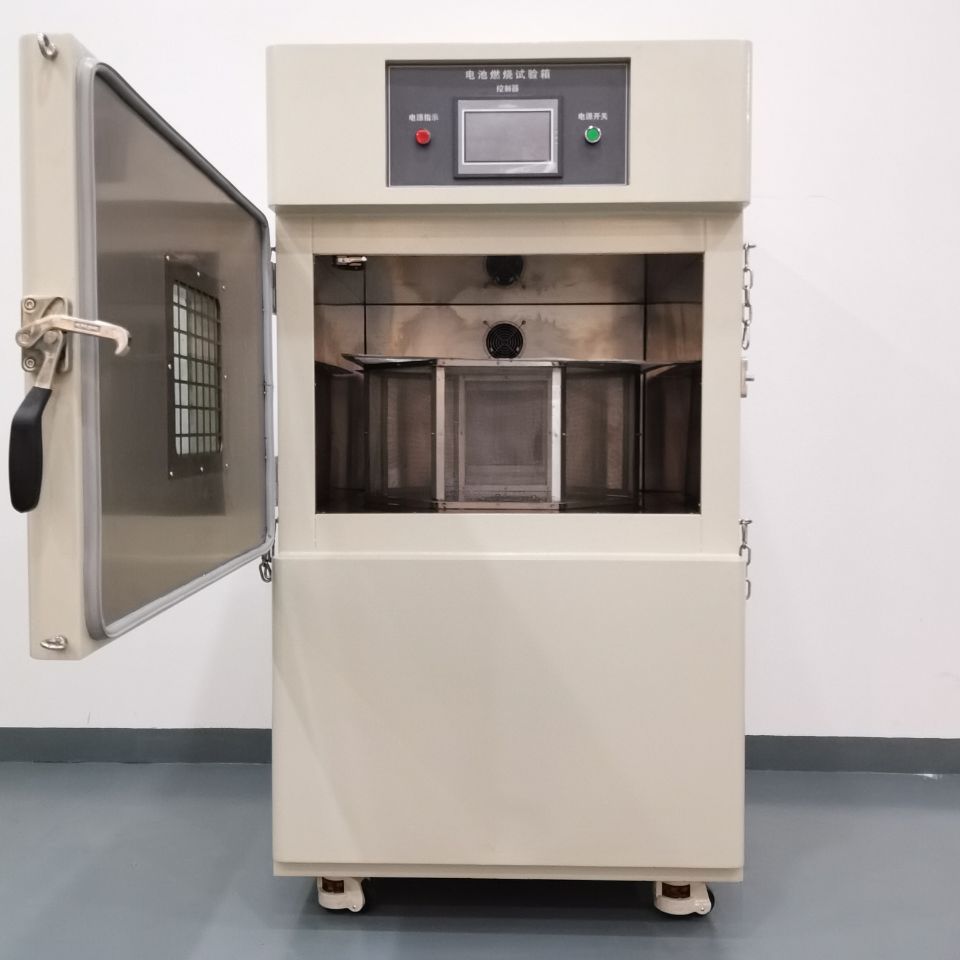
Buồng thử nghiệm đốt cháy pin

The DERUI DR-D207 battery burning test chamber uses a Bunsen burner, stainless specimen screen and removable octagonal mesh cover for specified cell or small-battery flame-exposure procedures. Confirm the exact test clause and fixture drawing before ordering.

Mẫu DR-D207
Trọng tâm kiểm tra Controlled flame exposure with mesh surround; method-specific observation
Burner / Screen 10 mm burner mouth; 0.43 mm stainless wire, 20 openings per inch
Octagonal Cover 610 mm across opposite faces × 305 mm high; removable panels
Inner Size 750 × 750 × 500 mm (W × D × H)
Before Quotation Confirm clause/edition, cell energy and format, gas/exhaust, safety scope and FAT
An toàn và đáng tin cậy
Chế tạo tốt
Đảm bảo chất lượng
Tùy chỉnh
Tin nhắnWhatsApp
Số điện thoại đường dây nóng 15580327593
  • Chi tiết sản phẩm
  • Thông số kỹ thuật
  • Câu hỏi thường gặp
  • Liên hệ với chúng tôi
CELL FLAME EXPOSURE & PROJECTILE-CONTAINMENT SETUP

DR-D207 Battery Burning Test Chamber

A purpose-built burner, specimen screen and removable octagonal mesh cover for controlled flame-exposure testing of approved lithium cells or small batteries. Specify the adopted method, specimen and laboratory safety plan before treating any fixture geometry as a compliance claim.

What this equipment is: a flame-exposure fixture. It is not a programmable temperature chamber, a full-size pack fire tester or a UN 38.3 transport-test system.
MẫuDR-D207
Burner10 mm internal tube opening; approximately 100 mm long
cURL Too many subrequests by single Worker invocation. To configure this limit, refer to https://developers.cloudflare.com/workers/wrangler/configuration/#limits0.43 mm stainless wire; 20 openings per inch
Internal enclosure750 × 750 × 500 mm (W × D × H)

What the Test Helps You Observe

During a specified flame-exposure procedure, a cell or approved small battery sits above the burner while the screen and octagonal surround define the setup and help retain ejected material. The laboratory observes the behavior required by its adopted method; pass/fail criteria must come from that method and the test plan, not from the chamber specification alone.

Controlled setup

Published burner, screen, opening and octagonal-cover dimensions provide a starting point for method review.

Visible evidence

Agree in advance how the operator will record exposure time, specimen behavior and any ejected material.

Safer procurement

Confirm fuel supply, exhaust, operator protection and post-test handling before ordering.

Published DR-D207 Configuration

Mục Published value cURL Too many subrequests by single Worker invocation. To configure this limit, refer to https://developers.cloudflare.com/workers/wrangler/configuration/#limits
Control and timer Button control; flame-time setting shown as 0–99H99M Confirm actual timer input format, resolution and shutoff behavior.
Burner and opening Bunsen burner, 10 mm internal mouth, approximately 100 mm length; test opening 100 ± 2 mm Confirm burner type, flame setting and fixture drawing against the adopted standard edition.
Specimen screen 0.43 mm stainless woven wire; 20 openings per inch Confirm mounting height and replacement screen supplied.
Octagonal cover 610 mm across opposite faces; 305 mm high; eight removable panels; 0.25 mm aluminum wire, 16–18 openings per inch Request dimensional drawing and panel-retention details.
cURL Too many subrequests by single Worker invocation. To configure this limit, refer to https://developers.cloudflare.com/workers/wrangler/configuration/#limits 750 × 750 × 500 mm internal; 1000 × 950 × 1310 mm external, including door lock Confirm usable clearance around the fixture and doorway.
Tiện ích Methane or LPG supplied by customer; 220 V, 50/60 Hz, 200 W; approximately 160 kg Confirm gas regulation, ventilation, site power and nameplate.
Relief and exhaust 200 × 200 mm pressure-relief door; rear Ø100 mm exhaust connection; door-retention chain Confirm discharge direction, duct requirements and risk-assessed containment limits.
Dimension requiring a drawing: the old specification states “height of the flame from the screen: 38 mm.” That wording does not unambiguously define the burner-to-screen geometry; verify it on the approved setup drawing.

Method Fit: Review the Clause, Not a Logo List

The DR-D207 screen and octagonal-surround geometry warrants review against the UL 1642 Projectile Test, but published fixture similarity is not proof of conformance. In particular, the DR-D207 page specifies a Bunsen burner, while a published technical comparison describes a Meker-type burner for the UL 1642 fire-exposure setup. Verify the adopted edition, burner, all dimensions, specimen preparation, observation and acceptance rules clause by clause before any UL 1642 claim.

Do not treat this chamber as a UN 38.3 test method. The UN transport manual has defined T.1–T.8 tests; a generic “UN 38.3 T.10 burning test” claim should not appear on this page. Other standards such as UL 2054 or IEC 62133-2 may form part of a laboratory program but do not automatically validate this fixture.

Send the exact method

Standard edition, clause, cell format, sample state, exposure period and pass/fail rule.

Confirm the physical setup

Burner specification, mesh, opening, screen-to-burner position and octagonal-cover drawing.

Confirm evidence

Video/observation plan, timed exposure, calibration records and final report format.

DR-D207 Is Different from DERUI's Other Battery Fire Equipment

Equipment Primary function Do not assume
DR-D207 burning test chamber Burner, screen and octagonal mesh fixture for specified cell/small-battery flame exposure Large pack fire testing, programmable heating or certified blast containment
DR-D211 EV battery cell fire tester A different external-flame test setup; compare its published specimen and burner limits separately Interchangeability with the DR-D207 projectile-test geometry
Battery thermal abuse chamber Controlled high-temperature exposure in a heated enclosure An open-flame burner or octagonal-mesh projectile-test fixture

Site Safety and Acceptance Plan

Review the specimen

Provide chemistry, dimensions, maximum energy, charge state and credible venting behavior. Agree allowable specimen size and quantity.

Review the facility

Confirm methane/LPG supply, regulator, exhaust route, clearance, fire response and operator exclusion area with site EHS.

Witness the setup

Check burner, screen and cover dimensions, timer, gas shutoff behavior, exhaust, door and documentation during FAT.

Safety boundary: the published relief door and retention chain are construction features, not evidence of a rated explosion-proof or thermal-runaway containment system. Gas detection, suppression, data export and interlocks are not established as standard features by the current public specification.

Questions Buyers Ask

Is this a UL-certified chamber?

No certification evidence is established by the public product page. Review fixture suitability against the exact UL 1642 edition and obtain any required third-party evaluation separately.

Can it test EV modules or packs?

Do not infer that from the enclosure size. Obtain a specimen-size, energy and hazard assessment, then compare the appropriate larger-scale equipment.

Is the gas included?

The published specification says methane or LPG is customer-provided. Confirm regulator, hose, shutoff and local installation scope in the quotation.

Does it perform UN 38.3 transport testing?

No. This burner arrangement should not be presented as a UN 38.3 test. Choose the dedicated equipment for the required T.1–T.8 method.

What needs confirmation before publication or purchase?

The adopted standard edition, fixture drawing, timer format, safety controls, real-device photos, accessories and measurable FAT criteria.

Request a Method-Matched DR-D207 Proposal

Send your cell drawing and test clause. DERUI can respond with the fixture drawing, included scope, utility list and an acceptance checklist that engineering and purchasing can review together.

Discuss the DR-D207 setup

Include in the inquiry

  • Standard edition and exact clause
  • Cell/battery format and energy
  • Gas and exhaust conditions
  • Required observation and FAT records
FacebookLinkedInXRedditWhatsApp

DR-D207 values below come from the current DERUI product record. Confirm the approved drawing and safety configuration before ordering.

Mục Published configuration / verification point
Model / control DR-D207; button control
Burner Bunsen burner; 10 mm internal tube-mouth diameter; approximately 100 mm tube length
Flame-time setting Published as 0–99H99M; confirm valid timer input format, resolution and shutoff logic
Test opening 100 ± 2 mm diameter
Specimen screen Stainless woven wire, 0.43 mm diameter; 20 openings per inch
Burner/screen geometry Published “38 mm” wording is ambiguous; require approved dimensioned drawing
Octagonal mesh cover 610 mm across opposite faces; 305 mm high; eight removable faces; 0.25 mm aluminum wire, 16–18 openings per inch
Fuel Methane or LPG; customer-provided. Confirm regulator, supply and shutoff requirements
Inner / outer dimensions 750 × 750 × 500 mm / 1000 × 950 × 1310 mm (W × D × H; outer includes door lock)
Relief / exhaust / door 200 × 200 mm relief door; rear Ø100 mm exhaust connection; left-opening door with retention chain. No rated containment claim established
Supply / weight 220 V single phase, 50/60 Hz, 200 W; approximately 160 kg

1. Phòng thử nghiệm cháy pin là gì?
Phòng thử nghiệm cháy pin là một buồng đặc biệt, được gia cố chắc chắn để chứa và nghiên cứu các vụ cháy pin một cách an toàn. Nó cho phép các nhà nghiên cứu gây ra sự cố quá nhiệt trong các tế bào lithium-ion, quan sát sự lan truyền của lửa, hồ sơ nhiệt độ và hiệu quả kiểm soát trong điều kiện kiểm soát và lặp lại.

2. Các tiêu chuẩn an toàn nào có thể đáp ứng với Phòng thử nghiệm cháy pin?
Các buồng này được xây dựng để giúp các nhà sản xuất tuân thủ các tiêu chuẩn an toàn quốc tế quan trọng. Các tiêu chuẩn chính bao gồm UL 9540A cho hệ thống lưu trữ năng lượng, UN 38.3 cho vận chuyển pin lithium, ECE R100 cho xe điện, và GB/T 31485 cho yêu cầu an toàn pin xe điện Trung Quốc.

3. Những tính năng an toàn thiết yếu cần tìm kiếm là gì?
Ưu tiên các buồng có hệ thống chữa cháy tự động (như sprinkler hoặc khí trơ), kết cấu chống nổ, giám sát khí và nhiệt độ theo thời gian thực, và các công tắc tắt khẩn cấp. Những tính năng này rất quan trọng để bảo vệ phòng thí nghiệm và nhân viên của bạn trong quá trình đốt cháy có kiểm soát.

4. Nhiệt độ tối đa mà các buồng này có thể chịu được là bao nhiêu?
Các buồng thử nghiệm đốt pin chất lượng cao được thiết kế để chịu đựng nhiệt độ cao của cháy pin. Tìm các mẫu có nhiệt độ hoạt động tối đa ít nhất 1100°C (2000°F) để đảm bảo chúng có thể chứa đựng các sự kiện vượt quá nhiệt độ cực đoan mà không bị hư hỏng.

5. Liệu cùng một buồng có thể thử nghiệm các loại và kích cỡ pin khác nhau không?
Có, nhiều buồng hiện đại có đặc điểm thiết kế mô-đun. Điều này cho phép cấu hình lại bên trong hoặc sử dụng các phụ kiện khác nhau để thử nghiệm an toàn mọi thứ từ các cell điện tử tiêu dùng nhỏ đến các mô-đun pin EV hoặc ESS (Hệ thống Lưu trữ Năng lượng) cỡ lớn.

6. Loại dữ liệu nào mà buồng thu thập trong quá trình thử nghiệm?
Các buồng tiên tiến được trang bị hệ thống thu thập dữ liệu tích hợp ghi lại dữ liệu nhiệt độ tốc độ cao từ nhiều thermocouple, thay đổi áp suất, và với các mô-đun tùy chọn, phân tích thành phần khí của khí thải sinh ra trong quá trình đốt cháy.

7. Buồng đốt được làm sạch và bảo trì như thế nào sau thử nghiệm cháy?
Việc dọn dẹp sau thử nghiệm bao gồm loại bỏ cặn cháy và kiểm tra các bộ phận. Các buồng có nội thất bằng thép không gỉ nhẵn, khay chứa mảnh vụn có thể tháo rời, và cụm kính quan sát có thể tiếp cận giúp đơn giản hóa đáng kể quy trình này và đảm bảo sẵn sàng cho thử nghiệm tiếp theo.

8. Buồng đốt có thể được tích hợp với các thiết bị thử nghiệm khác không?
Chắc chắn rồi. Hãy tìm các kiểu máy có cổng giao tiếp tiêu chuẩn (Ethernet, CAN) cho phép chúng đồng bộ hóa với buồng môi trường để điều chỉnh nhiệt độ trước hoặc với hệ thống quản lý dữ liệu trung tâm của phòng thí nghiệm của bạn để báo cáo tổng hợp.

11. Thời gian giao hàng và lắp đặt điển hình là bao lâu?
Do tính chất tùy chỉnh, chịu tải nặng, thời gian sản xuất cho Buồng Thử Nghiệm Đốt Pin có thể dao động từ 12 đến 20 tuần. Điều này bao gồm sản xuất, xác nhận an toàn và điều phối để lắp đặt chuyên nghiệp tại chỗ và đào tạo người vận hành.

10. Buồng đốt được sử dụng để kiểm soát chất lượng hay chỉ dành cho R&D?
Nó phục vụ cả hai chức năng. Trong R&D, các kỹ sư sử dụng nó để xác thực các thiết kế và vật liệu pin mới. Trong Kiểm Soát Chất Lượng, kiểm soát chất lượng.

11. Loại thông gió hoặc chuẩn bị cơ sở vật chất nào là cần thiết?
Các buồng này yêu cầu một hệ thống thông gió hút mạnh mẽ, hệ thống thông gió thoát khí để loại bỏ an toàn khí độc và khói sau khi thử nghiệm. Việc tham khảo ý kiến với nhà sản xuất sớm là rất quan trọng để hiểu rõ các yêu cầu về công suất, không gian và thông gió của cơ sở của bạn.

12. Hỗ trợ và bảo hành đi kèm với buồng là gì?
Các nhà sản xuất uy tín cung cấp chế độ bảo hành vững chắc (ví dụ, 24 tháng cho linh kiện và tay nghề) và hỗ trợ toàn diện. Điều này bao gồm lắp đặt tại chỗ, đào tạo vận hành, chẩn đoán từ xa, và truy cập vào mạng lưới phụ tùng thay thế toàn cầu cho các linh kiện quan trọng.

WhatsAppWhatsApp
WhatsAppWhatsApp
WhatsApp
Tin nhắnTin nhắn

Yêu cầu báo giá