




Piso 1, No. 3, Avenida Shugang, Vila Hongmei, Cidade de Dongguan, Província de Guangdong, China

Fabricante de câmaras de teste ambiental há 20 anosMais de 3000 entregas a clientes em todo o mundo           Email: shirley@deruitest.com
WhatsApp Consultation:+86 135 2795 8363

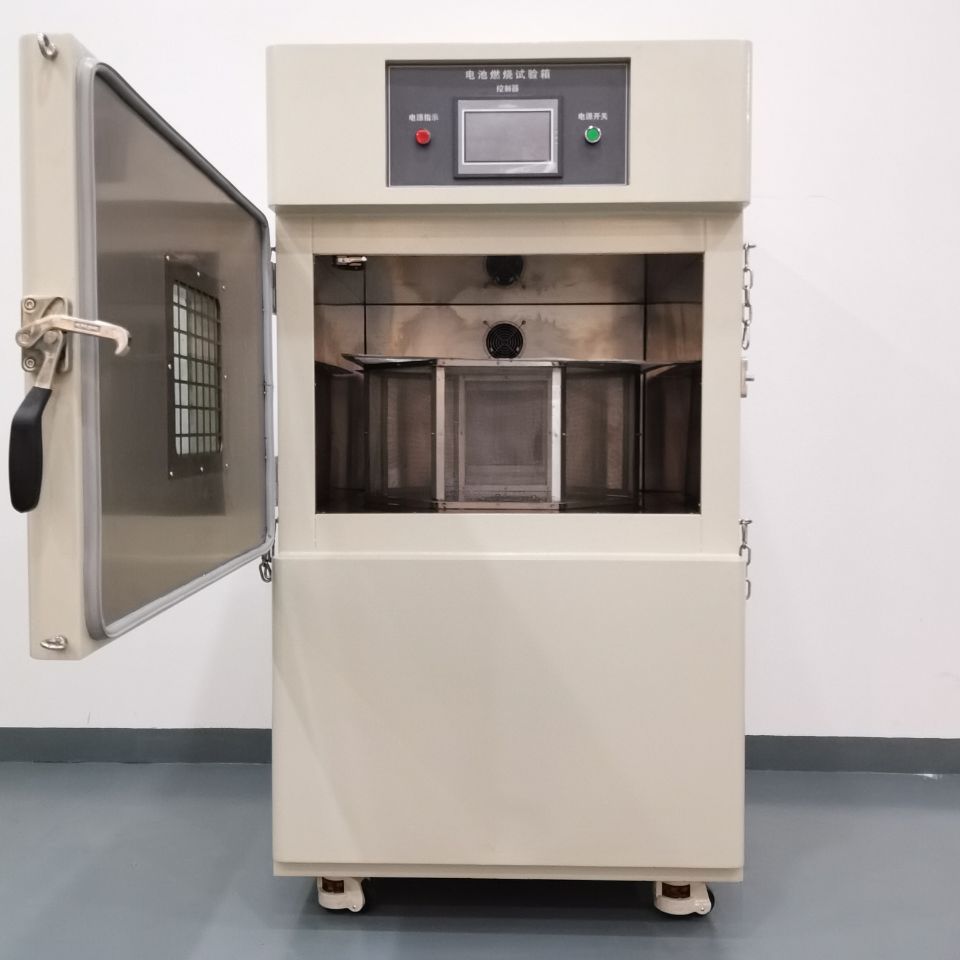
Câmara de Teste de Queima de Bateria

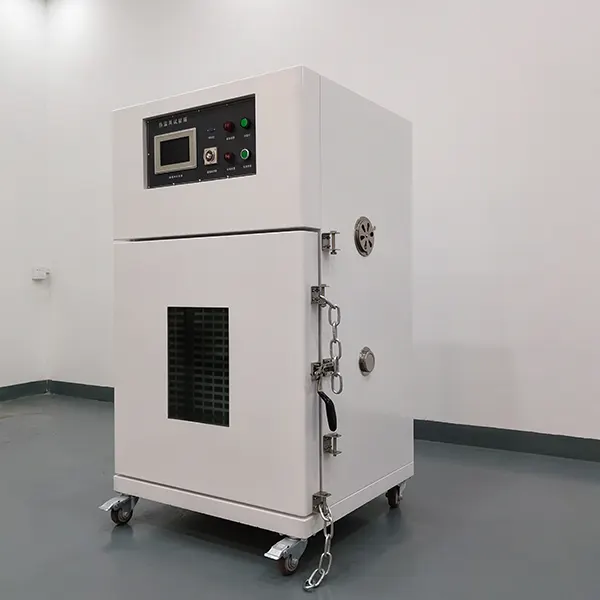
A DERUI DR-D207 battery burning test chamber uses a Bunsen burner, stainless specimen screen and removable octagonal mesh cover for specified cell or small-battery flame-exposure procedures. Confirm the exact test clause and fixture drawing before ordering.

Modelo DR-D207
Foco do Teste Controlled flame exposure with mesh surround; method-specific observation
Burner / Screen 10 mm burner mouth; 0.43 mm stainless wire, 20 openings per inch
Octagonal Cover 610 mm across opposite faces × 305 mm high; removable panels
Inner Size 750 × 750 × 500 mm (W × D × H)
Before Quotation Confirm clause/edition, cell energy and format, gas/exhaust, safety scope and FAT
Seguro e fiável
bem construído
Garantia de qualidade
personalização
MensagemWhatsApp
Número de Linha Direta 15580327593
  • Detalhes do Produto
  • Parâmetros técnicos
  • Perguntas Frequentes
  • Contacte-nos
CELL FLAME EXPOSURE & PROJECTILE-CONTAINMENT SETUP

DR-D207 Battery Burning Test Chamber

A purpose-built burner, specimen screen and removable octagonal mesh cover for controlled flame-exposure testing of approved lithium cells or small batteries. Specify the adopted method, specimen and laboratory safety plan before treating any fixture geometry as a compliance claim.

What this equipment is: a flame-exposure fixture. It is not a programmable temperature chamber, a full-size pack fire tester or a UN 38.3 transport-test system.
ModeloDR-D207
Burner10 mm internal tube opening; approximately 100 mm long
cURL Too many subrequests by single Worker invocation. To configure this limit, refer to https://developers.cloudflare.com/workers/wrangler/configuration/#limits0.43 mm stainless wire; 20 openings per inch
Internal enclosure750 × 750 × 500 mm (W × D × H)

What the Test Helps You Observe

During a specified flame-exposure procedure, a cell or approved small battery sits above the burner while the screen and octagonal surround define the setup and help retain ejected material. The laboratory observes the behavior required by its adopted method; pass/fail criteria must come from that method and the test plan, not from the chamber specification alone.

Controlled setup

Published burner, screen, opening and octagonal-cover dimensions provide a starting point for method review.

Visible evidence

Agree in advance how the operator will record exposure time, specimen behavior and any ejected material.

Safer procurement

Confirm fuel supply, exhaust, operator protection and post-test handling before ordering.

Published DR-D207 Configuration

Item Published value cURL Too many subrequests by single Worker invocation. To configure this limit, refer to https://developers.cloudflare.com/workers/wrangler/configuration/#limits
Control and timer Button control; flame-time setting shown as 0–99H99M Confirm actual timer input format, resolution and shutoff behavior.
Burner and opening Bunsen burner, 10 mm internal mouth, approximately 100 mm length; test opening 100 ± 2 mm Confirm burner type, flame setting and fixture drawing against the adopted standard edition.
Specimen screen 0.43 mm stainless woven wire; 20 openings per inch Confirm mounting height and replacement screen supplied.
Octagonal cover 610 mm across opposite faces; 305 mm high; eight removable panels; 0.25 mm aluminum wire, 16–18 openings per inch Request dimensional drawing and panel-retention details.
cURL Too many subrequests by single Worker invocation. To configure this limit, refer to https://developers.cloudflare.com/workers/wrangler/configuration/#limits 750 × 750 × 500 mm internal; 1000 × 950 × 1310 mm external, including door lock Confirm usable clearance around the fixture and doorway.
Utilidades Methane or LPG supplied by customer; 220 V, 50/60 Hz, 200 W; approximately 160 kg Confirm gas regulation, ventilation, site power and nameplate.
Relief and exhaust 200 × 200 mm pressure-relief door; rear Ø100 mm exhaust connection; door-retention chain Confirm discharge direction, duct requirements and risk-assessed containment limits.
Dimension requiring a drawing: the old specification states “height of the flame from the screen: 38 mm.” That wording does not unambiguously define the burner-to-screen geometry; verify it on the approved setup drawing.

Method Fit: Review the Clause, Not a Logo List

The DR-D207 screen and octagonal-surround geometry warrants review against the UL 1642 Projectile Test, but published fixture similarity is not proof of conformance. In particular, the DR-D207 page specifies a Bunsen burner, while a published technical comparison describes a Meker-type burner for the UL 1642 fire-exposure setup. Verify the adopted edition, burner, all dimensions, specimen preparation, observation and acceptance rules clause by clause before any UL 1642 claim.

Do not treat this chamber as a UN 38.3 test method. The UN transport manual has defined T.1–T.8 tests; a generic “UN 38.3 T.10 burning test” claim should not appear on this page. Other standards such as UL 2054 or IEC 62133-2 may form part of a laboratory program but do not automatically validate this fixture.

Send the exact method

Standard edition, clause, cell format, sample state, exposure period and pass/fail rule.

Confirm the physical setup

Burner specification, mesh, opening, screen-to-burner position and octagonal-cover drawing.

Confirm evidence

Video/observation plan, timed exposure, calibration records and final report format.

DR-D207 Is Different from DERUI's Other Battery Fire Equipment

Equipment Primary function Do not assume
DR-D207 burning test chamber Burner, screen and octagonal mesh fixture for specified cell/small-battery flame exposure Large pack fire testing, programmable heating or certified blast containment
DR-D211 EV battery cell fire tester A different external-flame test setup; compare its published specimen and burner limits separately Interchangeability with the DR-D207 projectile-test geometry
Battery thermal abuse chamber Controlled high-temperature exposure in a heated enclosure An open-flame burner or octagonal-mesh projectile-test fixture

Site Safety and Acceptance Plan

Review the specimen

Provide chemistry, dimensions, maximum energy, charge state and credible venting behavior. Agree allowable specimen size and quantity.

Review the facility

Confirm methane/LPG supply, regulator, exhaust route, clearance, fire response and operator exclusion area with site EHS.

Witness the setup

Check burner, screen and cover dimensions, timer, gas shutoff behavior, exhaust, door and documentation during FAT.

Safety boundary: the published relief door and retention chain are construction features, not evidence of a rated explosion-proof or thermal-runaway containment system. Gas detection, suppression, data export and interlocks are not established as standard features by the current public specification.

Questions Buyers Ask

Is this a UL-certified chamber?

No certification evidence is established by the public product page. Review fixture suitability against the exact UL 1642 edition and obtain any required third-party evaluation separately.

Can it test EV modules or packs?

Do not infer that from the enclosure size. Obtain a specimen-size, energy and hazard assessment, then compare the appropriate larger-scale equipment.

Is the gas included?

The published specification says methane or LPG is customer-provided. Confirm regulator, hose, shutoff and local installation scope in the quotation.

Does it perform UN 38.3 transport testing?

No. This burner arrangement should not be presented as a UN 38.3 test. Choose the dedicated equipment for the required T.1–T.8 method.

What needs confirmation before publication or purchase?

The adopted standard edition, fixture drawing, timer format, safety controls, real-device photos, accessories and measurable FAT criteria.

Request a Method-Matched DR-D207 Proposal

Send your cell drawing and test clause. DERUI can respond with the fixture drawing, included scope, utility list and an acceptance checklist that engineering and purchasing can review together.

Discuss the DR-D207 setup

Include in the inquiry

  • Standard edition and exact clause
  • Cell/battery format and energy
  • Gas and exhaust conditions
  • Required observation and FAT records
FacebookLinkedInXRedditWhatsApp

DR-D207 values below come from the current DERUI product record. Confirm the approved drawing and safety configuration before ordering.

Item Published configuration / verification point
Model / control DR-D207; button control
Burner Bunsen burner; 10 mm internal tube-mouth diameter; approximately 100 mm tube length
Flame-time setting Published as 0–99H99M; confirm valid timer input format, resolution and shutoff logic
Test opening 100 ± 2 mm diameter
Specimen screen Stainless woven wire, 0.43 mm diameter; 20 openings per inch
Burner/screen geometry Published “38 mm” wording is ambiguous; require approved dimensioned drawing
Octagonal mesh cover 610 mm across opposite faces; 305 mm high; eight removable faces; 0.25 mm aluminum wire, 16–18 openings per inch
Fuel Methane or LPG; customer-provided. Confirm regulator, supply and shutoff requirements
Inner / outer dimensions 750 × 750 × 500 mm / 1000 × 950 × 1310 mm (W × D × H; outer includes door lock)
Relief / exhaust / door 200 × 200 mm relief door; rear Ø100 mm exhaust connection; left-opening door with retention chain. No rated containment claim established
Supply / weight 220 V single phase, 50/60 Hz, 200 W; approximately 160 kg

1. O que é uma Câmara de Teste de Combustão de Baterias?
Uma Câmara de Teste de Combustão de Baterias é um recinto especializado, fortemente reforçado, projetado para conter e estudar incêndios de baterias de forma segura. Permite aos investigadores induzir intencionalmente o colapso térmico em células de íons de lítio, observando a propagação das chamas, perfis de temperatura e eficácia de contenção sob condições controladas e repetíveis.

2. Quais padrões de segurança podem ser atendidos com uma Câmara de Teste de Combustão de Baterias?
Estas câmaras são construídas para ajudar os fabricantes a cumprir padrões internacionais de segurança críticos. Os principais incluem UL 9540A para sistemas de armazenamento de energia, UN 38.3 para transporte de baterias de lítio, ECE R100 para veículos elétricos, e GB/T 31485 para requisitos de segurança de baterias de veículos elétricos chineses.

3. Quais são as características essenciais de segurança a procurar?
Priorize câmaras com sistemas automáticos de supressão de incêndios (como sprinklers ou gás inerte), construção à prova de explosões, monitorização de gás e temperatura em tempo real, e interruptores de desligamento de emergência. Estas características são cruciais para proteger o seu laboratório e pessoal durante uma queima controlada.

4. Qual é a temperatura máxima que estas câmaras podem suportar?
Câmaras de teste de queima de bateria de alta qualidade são projetadas para suportar o calor extremo de um incêndio de bateria. Procure modelos com uma temperatura máxima de funcionamento de pelo menos 1100°C (2000°F) para garantir que possam conter os eventos de fuga térmica mais severos sem danos.

5. A mesma câmara pode testar diferentes tamanhos e tipos de bateria?
Sim, muitas câmaras modernas apresentam uma design modular. Isto permite a reconfiguração interna ou o uso de diferentes suportes para testar com segurança tudo, desde pequenas células de eletrónica de consumo até módulos de bateria de grande formato para veículos elétricos ou sistemas de armazenamento de energia (ESS).

6. Que tipo de dados a câmara recolhe durante um teste?
Câmaras avançadas estão equipadas com sistemas integrados de aquisição de dados que capturam dados de temperatura de alta velocidade de múltiplos termopares, alterações de pressão, e com módulos opcionais, análise da composição dos gases dos gases de escape produzidos durante a combustão.

7. Como é que a câmara é limpa e mantida após um teste de incêndio?
A limpeza pós-teste envolve a remoção de resíduos de incêndio e a inspeção dos componentes. Câmaras com interiores lisos em aço inoxidável, bandejas de recolha de detritos removíveis, e conjuntos de visor acessíveis simplificam significativamente este processo e garantem a preparação para o próximo teste.

8. A câmara pode ser integrada com outros equipamentos de teste?
Absolutamente. Procure modelos com portas de comunicação padrão (Ethernet, CAN) que lhes permitam sincronizar com câmaras ambientais para pré-condicionamento da temperatura ou com o sistema de gestão de dados central do seu laboratório para relatórios consolidados.

11. Qual é o tempo de entrega e instalação típico?
Devido à sua natureza personalizada e robusta, os prazos de entrega de uma Câmara de Teste de Queima de Baterias podem variar entre 12 a 20 semanas. Isto inclui fabrico, validação de segurança e coordenação para instalação profissional no local e formação de operadores.

10. A câmara é utilizada para controlo de qualidade ou apenas para I&D?
Serve ambas as funções. Em I&D, os engenheiros utilizam-no para validar novos desenhos de células e materiais. Em Controlo de Qualidade, é utilizado para amostragem de lotes e testes de certificação para garantir que as células de produção atendam às regulamentações de segurança obrigatórias antes do envio.

11. Que tipo de ventilação ou preparação da instalação é necessária?
Estas câmaras requerem um sistema de ventilação de exaustão dedicado e potente sistema de ventilação de exaustão para remover com segurança vapores tóxicos e fumaça após um teste. É fundamental consultar o fabricante cedo para compreender os requisitos específicos de energia, espaço e ventilação da sua instalação.

12. Que suporte e garantia acompanham a câmara?
Fabricantes reputados oferecem uma garantia robusta (por exemplo, 24 meses em peças e mão-de-obra) e suporte abrangente. Isto deve incluir instalação no local, treinamento do operador, diagnósticos remotos, e acesso a uma rede global de peças sobressalentes para componentes críticos.

WhatsAppWhatsApp
WhatsAppWhatsApp
WhatsApp
MensagemMensagem

Solicitar Orçamento