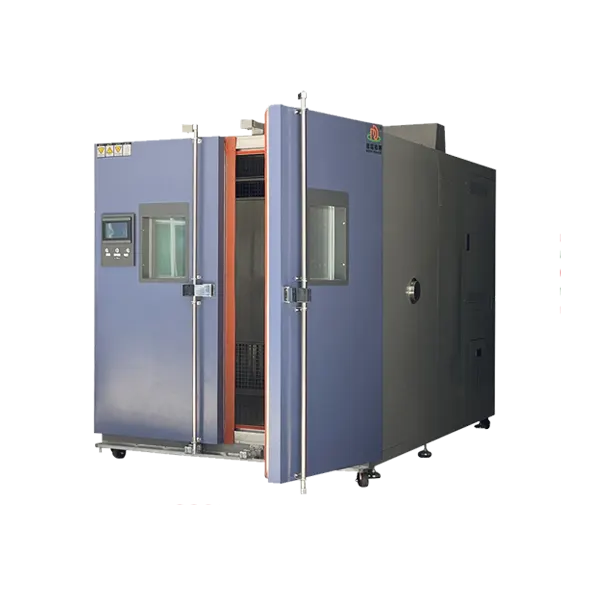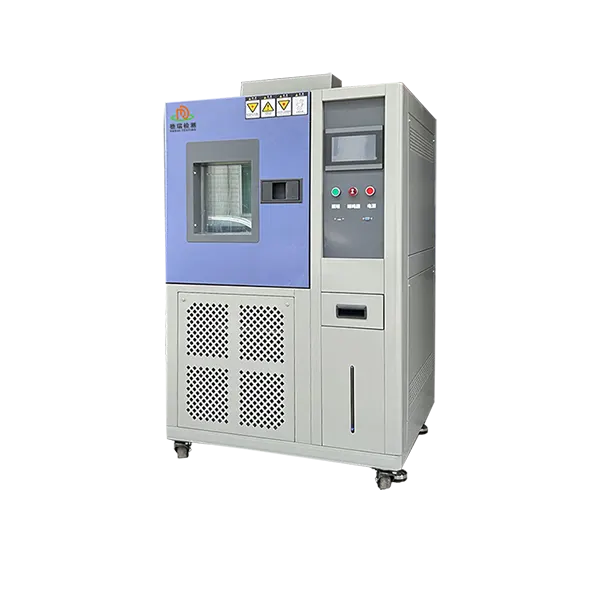







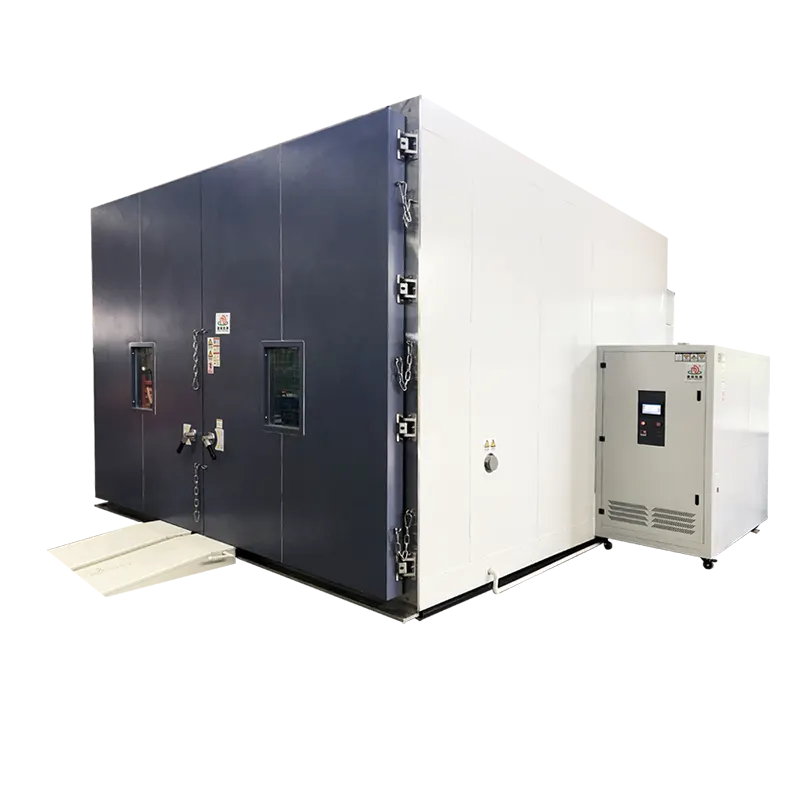
DR-H201 80L Temperature and Humidity Test Chamber
Run programmed temperature, damp-heat and cyclic climatic profiles in a compact 80 L chamber. The configuration should be selected from the complete specimen load, powered heat, required temperature-humidity points, transition rate and acceptance criteria.
What the 80L Chamber Is Designed to Do
The chamber provides controlled air temperature and relative humidity around stationary specimens. It can support component reliability, material conditioning, damp-heat exposure and powered functional checks when the required interfaces and heat load are included in the configuration.
Compact specimen testing
Suitable for smaller components, circuit assemblies, sensors, connectors, materials and other loads that fit the usable workspace with airflow clearance.
Coupled climatic exposure
Program temperature and humidity together at valid operating points rather than treating the separate headline ranges as one rectangular envelope.
Repeatable records
Define stabilization, dwell, sensor locations and data requirements so repeated tests can be compared against the same method.
Published Configuration and Required Confirmation
| Item | Current published information | How to use it |
|---|---|---|
| Series / nominal capacity | DR-H201 / 80 L | Confirm usable internal W × D × H and shelf arrangement |
| 80 L page headline temperature | -20°C to +100°C | Baseline shown on the product header |
| Series temperature options | -20°C, -40°C or -70°C low end; up to +150°C | Select one engineered refrigeration configuration |
| 80 L page headline humidity | 20% to 90% RH | Confirm the valid temperature-RH operating envelope |
| Series humidity statement | 20% to 98% RH | Do not assume the full range at every temperature |
| Temperature fluctuation | ≤ ±0.5°C | Confirm stabilized, empty/loaded condition and sensor point |
| Temperature deviation / uniformity | ≤ ±2°C / ≤ ±2°C | Confirm mapping method and working-space definition |
| Published heating rate | -40°C to +150°C at 3°C/min under standard load | Confirm average/linear method and applicability to the selected 80 L configuration |
| Power supply | AC220V, 50/60Hz | Confirm current, phase, rated power and plug/terminal arrangement |
How Temperature and Humidity Control Interact
Refrigeration and heating
Cooling and heating establish the chamber-air temperature and transition profile selected for the test.
Humidification and dehumidification
Moisture addition and removal regulate relative humidity, subject to the valid combined temperature-RH envelope.
Air circulation and sensing
Forced airflow and calibrated sensing determine how the controlled condition is distributed and recorded in the working space.
80L DERUI Chamber Reference Image
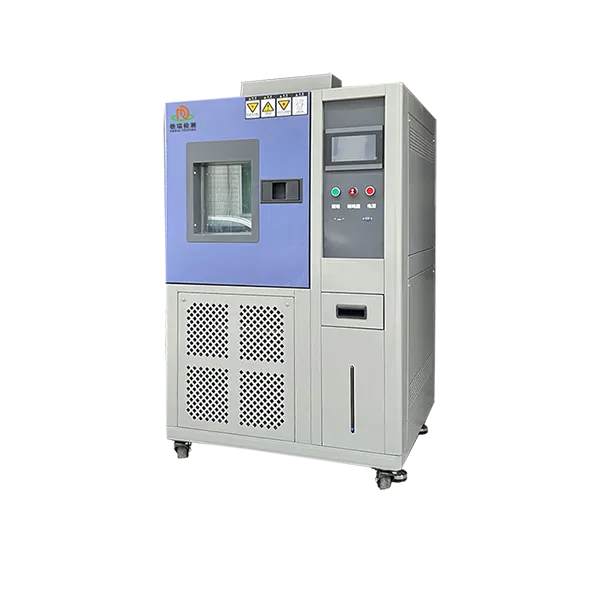
Current DERUI image for the 80 L temperature and humidity chamber. Confirm the final controller, port, shelf and exterior arrangement in the approved drawing.
Prepare the Specimen and Chamber Correctly
Protect airflow paths
Keep clearance around specimens and do not block supply or return air. Confirm usable space after fixtures and cables are installed.
Seal cable ports
Close unused space around cables to limit ambient air and moisture infiltration, which can disturb control and encourage frosting.
Use specified water quality
Confirm the required humidification-water conductivity and maintenance procedure in the operating manual before commissioning.
Define dwell correctly
State whether dwell begins when the controller reaches setpoint or after designated specimen sensors stabilize.
Record the loaded condition
Document specimen mass, location, powered operation and fixture layout so results can be reproduced.
Control condensation
Use a procedure-appropriate ramp sequence and post-test handling plan when condensation could influence the specimen or measurements.
Map the Standard to the Required Profile
The chamber may support temperature and damp-heat procedures when its configured operating envelope covers the required points. The selected method—not the chamber name—defines setpoints, transitions, dwell, cycles and evaluation.
| Reference | Typical purpose | What to confirm |
|---|---|---|
| IEC 60068-2-30 | Cyclic damp heat | Adopted edition, cycle, transition, condensation and recovery requirements |
| IEC 60068-2-78 | Steady-state damp heat | Temperature, RH, duration, stabilization and specimen condition |
| MIL-STD-810H Method 507.6 | Tailored humidity exposure | Procedure, climatic cycle, specimen operation and acceptance criteria |
| JESD22-A101 / A100 | Temperature-humidity bias or accelerated moisture testing | Device-specific method, bias interfaces, safety and monitoring |
Temperature-Humidity Chamber vs Adjacent Equipment
Temperature-humidity chamber
Controls coupled climatic profiles around stationary specimens over time.
Thermal shock chamber
Uses rapid transfer or airflow switching between stored hot and cold zones; it creates a different stress mechanism.
Dry temperature chamber
Controls temperature without a verified humidity system and may be preferable when moisture is not part of the method.
RFQ and FAT Information
| Topic | Information to provide or verify |
|---|---|
| Specimen | Dimensions, mass, quantity, fixture, material and powered heat output |
| Profile | Temperature-RH points, transitions, dwell, cycles and tolerances |
| Interfaces | Ports, power, signals, thermocouples, network and data logging |
| Utilities | Electrical supply, ambient limits, water quality, drainage, ventilation and installation access |
| FAT | Sensor map, empty/loaded condition, stabilization, deviation, uniformity, alarms and report format |
Frequently Asked Questions
Is the 80L chamber limited to -20°C to +100°C?
That is the current product-header range. The technical record also lists wider DR-H201 series options. Confirm the exact selected 80 L refrigeration and control configuration in the quotation.
Can it maintain 98% RH at every temperature?
No such rectangular operating envelope should be assumed. Request the valid combined temperature-RH chart for the configured chamber.
What does 80 L tell me about usable specimen space?
It is nominal volume only. Obtain the internal dimensions and allow for fixtures, shelves, cables and airflow clearance.
How does specimen heat affect performance?
Powered heat opposes refrigeration and changes relative humidity. Include maximum watts and duty cycle in the sizing request.
Can it replace a thermal shock chamber?
Not automatically. A temperature-humidity chamber changes one workspace according to a programmed profile; a shock chamber uses rapid transfer between stored conditions.
What should be sent for a quotation?
Send the method and edition, specimen drawing and mass, powered heat, complete temperature-RH profile, interfaces, site utilities and FAT requirements.
Configure the 80L Chamber from the Actual Test
Send the complete profile and specimen information. DERUI can confirm the required low-temperature option, humidity envelope, refrigeration capacity, interfaces, utilities and acceptance plan before quotation.