








90-TYPE CABINET · 270 L CAPACITY · LABORATORY CORROSION CHECKS
Size Your Salt Spray Setup Around the Samples You Actually Test
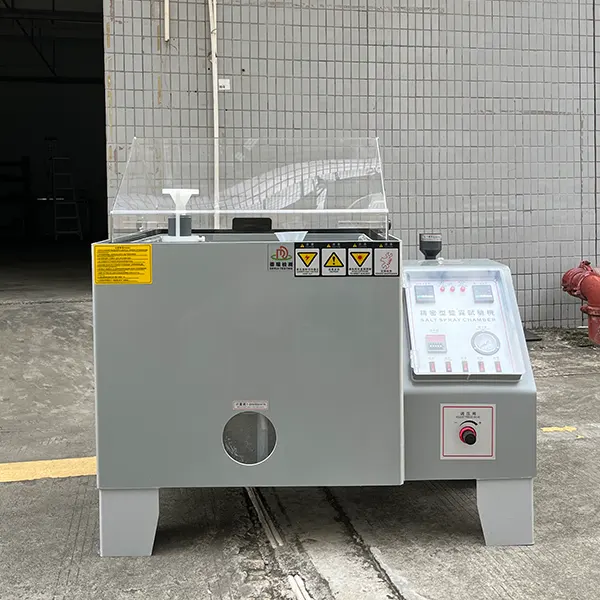
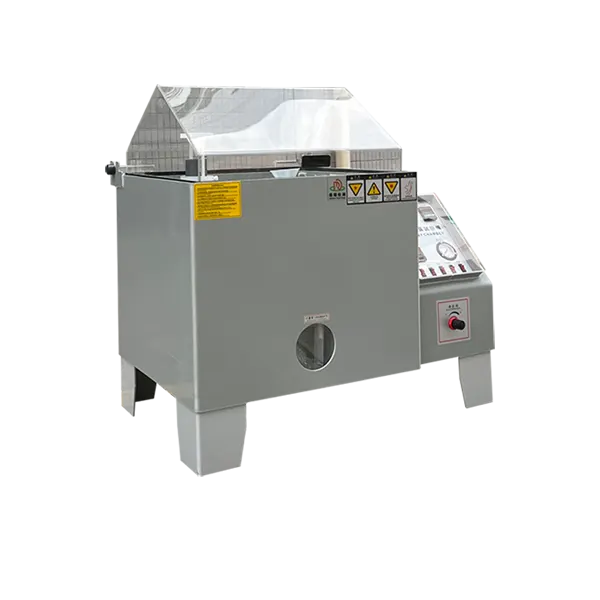
The DERUI DR-H304-270 salt spray corrosion chamber provides a 900 × 600 × 500 mm enclosure for laboratory specimens, small component sets and coated coupons. This 90-type model has 270 L nominal volume, with continuous or periodic spray operation for a defined corrosion-test programme.
900 mm internal width
Check the complete specimen and fixture envelope.
270 L nominal capacity
Choose the layout before assigning a sample count.
1460 × 960 mm footprint
Allow additional cover movement and service access.
For a laboratory handling smaller runs, start with the required exposure and specimen layout. Request a DR-H304-270 proposal that includes mounting, utilities and the records your quality system needs.
When a 270L Cabinet Is the Right Starting Point
A laboratory does not always need a large batch cabinet. If prepared specimens, their holders and the required collectors fit inside the 900 mm-wide enclosure, this model provides a smaller installation envelope than the 600 L and 800 L cabinets.
Suitable inquiries include coated test panels, plated hardware and small component assemblies whose required exposure is salt fog. The selected method and evaluation criteria determine the test—not an industry label or a generic number of hours.
| Laboratory task | What makes the layout suitable |
|---|---|
| Routine checks of a defined finish | Specimen preparation, mounting and evaluation can be repeated between runs. |
| Small component qualification | The component and fixture fit without shielding required surfaces or interfering with collection. |
| Coated coupons from a process investigation | Coupons use a common prescribed exposure, with documented preparation and specimen-level results. |
Check the 900 × 600 × 500 mm Loading Envelope
Use the internal dimensions to build a top and side view of the proposed arrangement. The 270 L figure is geometric volume, not unrestricted usable space. Include holders, inclination, collector positions and clearance for fog exposure.
Coated coupons
Specify panel size, exposed face, quantity and required angle. Avoid overlapping faces or runoff onto neighboring panels.
Fasteners and small parts
Include the full tray or hanging-fixture drawing. Identify contact points and surfaces that must remain exposed.
Small assemblies
Include recesses, orientation and drainage. Check height with the support installed, not just the bare component.
The listed supports provide 15° or 30° positions. Use the angle prescribed for the specimen and procedure. Do not add stacked layers or pack the cabinet tightly simply because the overall dimensions appear to fit.
A useful inquiry includes specimen quantity, individual dimensions, total mass and the complete fixture envelope. If the same laboratory tests different sizes, show the most demanding arrangement as well as the routine one.
270L Salt Spray Chamber Configuration
The following parameters apply to the DR-H304-270. Dimensions are presented as width × depth × height. Select the required exposure and specimen layout together when specifying the equipment.
| Specification | DR-H304-270 |
|---|---|
| Model | DR-H304-270; 90-type salt spray chamber |
| Nominal volume | 270 L geometric enclosure volume |
| Internal dimensions (W × D × H) | 900 × 600 × 500 mm |
| External dimensions (W × D × H) | 1460 × 960 × 1150 mm; additional operating and service clearances required |
| Cabinet temperature range | Room temperature +5°C to 55°C |
| Air-saturator temperature range | Room temperature +10°C to 70°C |
| Temperature uniformity | ≤2°C |
| Temperature fluctuation | ±0.5°C |
| Fog collection rate | 1–2 mL per 80 cm² per hour; listed as a 16-hour average. Apply the measurement interval required by the adopted procedure |
| Spray operation | Continuous or periodic spray |
| Test timer | 1–9999, with hours/minutes/seconds settings |
| Cycle timer | 1–99, with hours/minutes/seconds settings |
| Specimen rack inclination | 15° or 30°; use the orientation required by the procedure |
| Air pressure specification | Listed as 2.00 ±0.01 kg/cm². Define the connection and regulator measurement point in the installation specification |
| Method selection | Specify NSS, AASS or CASS and the required compatible configuration before ordering |
Nominal volume includes space later occupied by supports and clearances. Agree the specimen arrangement and acceptance checks for the selected exposure. Temperature settings and spray timing are not proof of controlled humidity or drying-stage capability.
Specify Salt Fog Operation Without Adding Unneeded Climate Functions
Continuous spray and periodic spray are distinct operating choices. Define spray duration, inspection access and the treatment of interruptions in the test programme. A spray-off interval does not demonstrate a controlled drying or humidity stage.
| Requirement | Decision before purchase |
|---|---|
| NSS exposure | Define the adopted method, solution preparation, operating checks and product-specific endpoint. |
| AASS or CASS exposure | Specify chemistry compatibility, solution handling, operating conditions and cleaning requirements. |
| Cyclic corrosion with climate stages | Assess the complete environmental sequence and transitions; these functions are not established by this cabinet’s spray timer. |
The ISO 9227 scope distinguishes NSS, AASS and CASS. Exposure duration, specimen details and result interpretation must come from the applicable product requirement. NSS is a neutral exposure; salt fog testing does not reproduce every condition of a marine service environment.
For a primary CASS requirement, see the CASS corrosion test chamber. For method selection and result interpretation, use the salt spray testing guide. This page focuses on selecting and installing the 270 L cabinet.
A Repeatable Routine for Small Laboratory Runs
- Identify the specimens. Record finish, batch, preparation, exposed face and any edge protection or scribe.
- Document the layout. Photograph positions, supports and collectors before exposure.
- Verify the setup. Apply the required temperature, solution and fog checks rather than rely on the timer alone.
- Record the exposure. Keep inspection access, replenishment, faults and interruptions associated with the run.
- Evaluate the stated endpoint. Use the specified handling and assessment method, with individual results for each specimen.
Fog collection, temperature verification and instrument calibration are different checks. Keep collector readings separately with their positions and measurement interval. Do not use one acceptable average to conceal an unsuitable location.
A result such as “no red rust” needs the duration, surfaces assessed, preparation and evaluation basis. Salt spray hours do not provide a universal conversion to years in service. When comparing repeat checks of the same finish, retain the same preparation and assessment conditions.
If exported records, automatic logging or chemistry monitoring are needed, include the channels and format in the quotation. These functions are not implied by the published timer settings.
Fit the Equipment and Connections Into Your Laboratory
The cabinet dimensions are 1460 mm wide × 960 mm deep × 1150 mm high. Check the delivery route, cover opening and service access with the installation drawing. A floor-plan rectangle alone is not the complete space requirement.
| Site item | Planning check |
|---|---|
| Compressed air | Required pressure, delivery, air treatment, regulator location and connections. |
| Electrical supply | Voltage, frequency, phase, circuit protection and cable requirements for the ordered configuration. |
| Water and solution preparation | Method-appropriate water quality, filling access and space for preparing the required chemistry. |
| Exhaust and drainage | Corrosion-resistant connection routes, ventilation and facility-approved effluent handling. |
| Access and ambient conditions | Clearance for cover movement, inspection and maintenance; laboratory ambient suitable for the required operating temperature. |
The chamber’s room-temperature +5°C lower limit depends on the laboratory ambient and does not indicate refrigeration. Check that the required setpoint is achievable at your installation conditions.
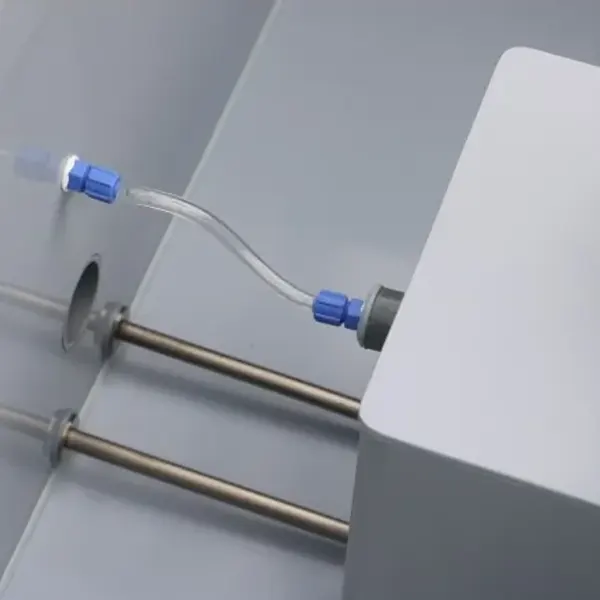
Specify reservoir capacity, filling arrangements and any requested automatic replenishment in the proposal. Do not estimate unattended duration from cabinet volume. Establish solution inspection and maintenance using the operating instructions.
Agree What the Delivered Chamber Must Demonstrate
Exposure checks
Required spray mode, temperature checks and fog collection with the agreed specimen layout.
Equipment scope
Mounting arrangement, utility connections, accessories, alarms and requested record functions.
Handover evidence
Operating and maintenance instructions, calibration scope and the agreed acceptance report.
Equipment acceptance and product approval are separate decisions. A chamber demonstration does not certify the corrosion resistance of your parts. Define the specimen test and acceptance criterion in the laboratory programme.
For routine maintenance, inspect solution delivery, atomization, collectors and drains. Clean using the equipment instructions for the selected chemistry. Include nozzle inspection in the maintenance schedule and request a demonstration of any specified automatic solution-control functions.
Need More Space? Compare the Complete Layout
| Option | Internal W × D × H | Selection reason |
|---|---|---|
| DR-H304-270 / 270 L | 900 × 600 × 500 mm | Laboratory specimens and smaller fixture arrangements that fit the required exposure layout. |
| DR-H304-120 / 600 L | 1200 × 1000 × 500 mm | Additional width and depth for larger fixtures or specimen groups. |
| DR-H304-160 / 800 L | 1600 × 1000 × 500 mm | More horizontal space for batch loading. |
All three listed cabinets have 500 mm internal height. Moving to the 600 L or 800 L model does not solve every height constraint; include supports and the required orientation in your comparison.
Review the DR-H304 corrosion chamber series for additional size choices, or return to the salt spray equipment category for the full range. Larger dimensions do not automatically add a different exposure method.
270L Laboratory Salt Spray Chamber FAQs
Does the 90-type name mean 90 litres?
No. This page covers DR-H304-270. Its 900 × 600 × 500 mm internal dimensions correspond to 270 L nominal geometric volume.
Is it a benchtop chamber?
Do not assume so. The listed external dimensions are 1460 × 960 × 1150 mm in width × depth × height. Plan the installed location and connections using the equipment drawing.
How many coupons or parts fit inside?
Use the complete specimen and fixture layout, including inclination, clearances and collectors. A sample count cannot be established from 270 L alone.
Can small painted or plated specimens be tested?
Yes, with a procedure appropriate to the finish and ordered configuration. Define preparation, exposure and acceptance before starting the test.
Does periodic spray include humidity and drying control?
No. The timer establishes spray sequencing, not verified multi-stage climate capability.
Are automatic solution mixing and data export included?
These are not established by the published timer and spray specifications. Include the functions and required record format explicitly in the quotation.
Can it operate below room temperature?
The published cabinet range starts at room temperature +5°C. It does not establish active cooling or low-temperature cycling.
What should I send for a quotation?
Provide the required method and edition, specimen dimensions and quantity, fixture layout, exposure duration, evaluation needs and laboratory utilities.
BUILD YOUR LABORATORY CORROSION SETUP
Start With Your Samples.
Request the Right 270L Configuration.
Send specimen dimensions, quantity and the required exposure. Include your fixture layout and laboratory utilities to review the DR-H304-270 installation and quotation.