METAL FINISHES · COATING QUALITY · 600 L CAPACITY
A Defined Salt Fog Setup for Metal and Coating Quality Control
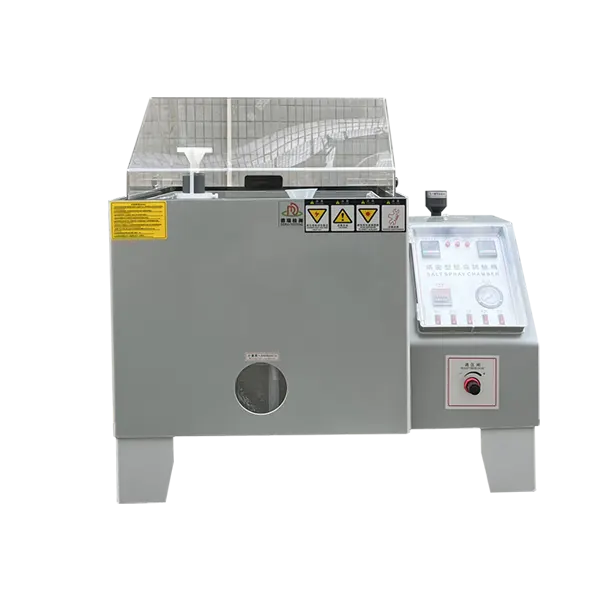
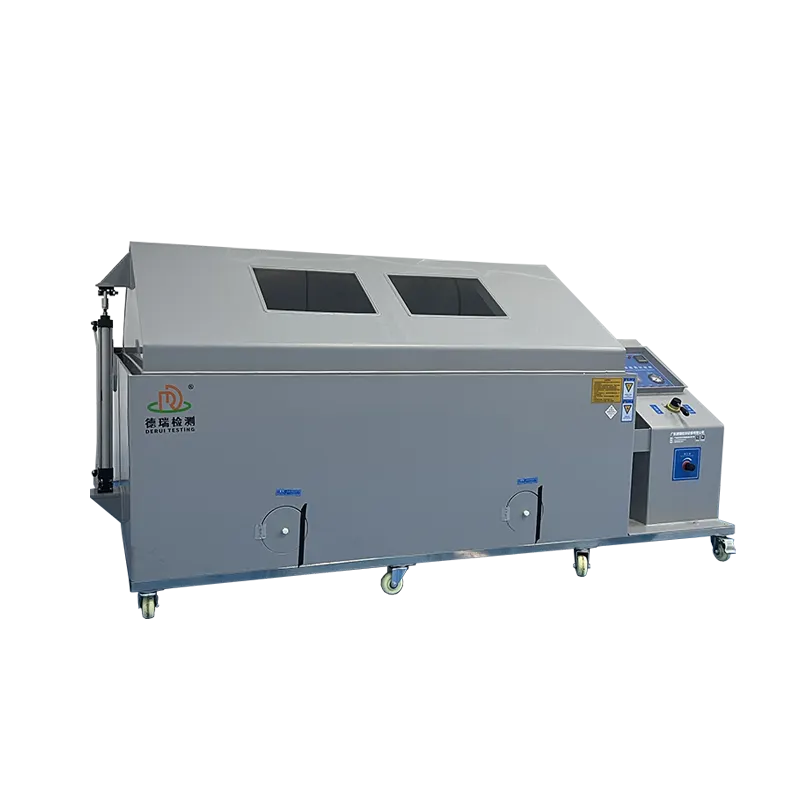
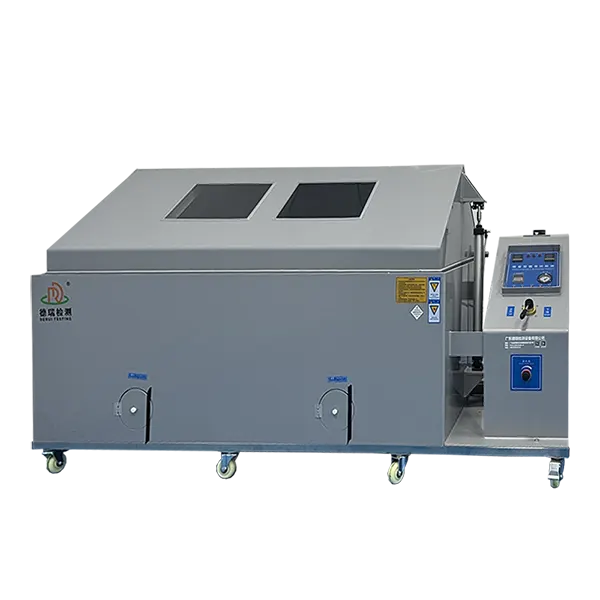
The DERUI DR-H304-120 metal salt spray test chamber provides a 1200 × 1000 × 500 mm enclosure for metal parts, plated finishes and coated panels. Its 600 L nominal capacity and continuous or periodic spray operation support method-defined laboratory exposure. Select the specimen layout and required procedure together—not by volume alone.
600 L enclosure
1200 mm width × 1000 mm depth × 500 mm height.
PVC construction
8 mm rigid PVC cabinet material.
40 L solution tank
Plan refilling and inspection around the required exposure.
Use this model for a defined quality-control or qualification programme. Start with your coating system, specimen quantity and exposure requirement to request a configuration matched to the work your laboratory needs to perform.
Match the Test to the Finish You Need to Evaluate
A plated fastener, painted bracket and coated flat panel may all fit in the same cabinet, but their preparation and acceptance rules can differ. Identify the substrate and finish before selecting the exposure and rack arrangement.
This chamber is an equipment choice for controlled salt fog testing. It does not decide whether a particular coating should be tested by NSS, an acidic method or a customer-specific procedure.
| Specimen or finish | Useful quality-control question | Details to define |
|---|---|---|
| Plated fasteners and hardware | Does the specified finish meet the required corrosion endpoint? | Thread exposure, contact points, white corrosion/substrate corrosion limits and inspection timing. |
| Painted brackets and coated panels | How does the coating behave under the specified salt fog exposure? | Cure history, thickness, scribe requirement, edge sealing and the relevant damage-rating method. |
| Metal assemblies and formed parts | Can all required surfaces be exposed consistently? | Part orientation, recesses, drainage, dissimilar-metal contacts and fixture geometry. |
Use representative specimens and a reproducible layout for batch comparisons. A longer salt fog result is not, by itself, a universal ranking of unrelated coating systems or a prediction of years in outdoor service.
Will Your Parts Fit? Check the Loading Plan, Not Just 600 Litres
The internal dimensions give 600 L of geometric volume. Racks, collectors, supports and deposition clearances reduce the space available for specimens. The 500 mm internal height is particularly important for upright assemblies and suspended parts.
Flat coated panels
Provide panel dimensions, exposed face, quantity and the required inclination. Reserve positions for collectors and avoid contact with adjacent panels.
Small metal parts
Provide a tray or hanging-fixture drawing. Include part quantity, total mass and contact points rather than quote only the largest individual component.
Irregular assemblies
Check recesses and drainage. Prevent shielding and runoff from one specimen onto another; confirm the surfaces included in the evaluation.
The listed glass-fiber rods and V-shaped supports allow inclined mounting. The prescribed orientation comes from the applicable method and specimen requirements; one standard rack angle is not suitable for every part.
600L Chamber Configuration
The DR-H304-120 provides a 600 L nominal enclosure for salt fog exposure. Instrument performance, fog distribution and the selected test procedure are separate acceptance items. Agree measurement locations and representative loading when specifying verification.
| Specification | DR-H304-120 configuration |
|---|---|
| Model | DR-H304-120 |
| Nominal chamber volume | 600 L; calculated from the internal dimensions, before fixtures and loading clearances |
| Internal dimensions (W × D × H) | 1200 × 1000 × 500 mm |
| External dimensions (W × D × H) | 1900 × 1300 × 1400 mm; additional installation and service clearance required |
| Cabinet material | Rigid PVC plate, 8 mm thickness |
| Specimen supports | 10 mm diameter glass-fiber rods and V-shaped supports for inclined placement; choose the actual orientation from the test procedure |
| Temperature range | Room temperature to 55°C; operating capability depends on laboratory ambient conditions |
| Temperature fluctuation | ≤ ±0.5°C |
| Temperature uniformity | ≤ ±2°C |
| Temperature accuracy | ±1°C |
| Spray operation | Continuous and periodic spray |
| Solution tank capacity | 40 L |
| Fog collection rate | 1.0–2.0 mL per 80 cm² per hour; verify collectors and the measurement interval against the adopted method |
| Compressed-air source | Buyer-provided; the equipment listing specifies a 1 HP air pump. Specify required air delivery, pressure and treatment in the installation agreement |
| Protection functions | Electrical leakage, overpressure, overtemperature and overload fuse protection |
| Listed accessories | Test salt, collection/measuring equipment and one nozzle set; item quantities to be included in the quotation |
Select the test method, solution chemistry and operating setpoints from the adopted procedure. The temperature range and spray timer do not establish capability for controlled drying, humidity stages or every cyclic corrosion programme.
Define the Exposure Before Choosing the Recipe
For ASTM B117 or ISO 9227 programmes, specify the adopted edition, exposure method, duration and evaluation endpoint. The chamber must be operated and verified for that procedure; a standard name on an equipment quotation is not a corrosion-resistance certificate for your products.
| Requirement | What to specify for this model |
|---|---|
| Neutral salt spray (NSS) | Required solution preparation, cabinet operating conditions, fog verification and specimen evaluation. |
| Acidified or copper-accelerated exposure | Method-specific chemistry, material compatibility, solution path and cleaning requirements before ordering. |
| Continuous or periodic spray | Required spray timing and permitted interruptions. Timed spray/stop operation is not equivalent to controlled wet/dry cycling. |
| Humidity/drying or multi-stage corrosion cycle | A separately verified environmental sequence, including transitions and loaded performance—not an assumed function of this salt fog cabinet. |
For a dedicated CASS requirement, review the ASTM B368 CASS corrosion chamber. For the broader distinction between methods and result evaluation, use the salt spray testing guide. These are separate decisions from choosing a 600 L cabinet.
The ASTM B117 scope describes apparatus operation rather than one universal product pass duration. ISO 9227 addresses NSS, AASS and CASS methods; use the controlled procedure for the selected exposure.
Build Repeatable Batch Checks Around the Chamber
A reliable process comparison requires more than repeating the same timer setting. Record the specimen batch, finish, preparation and mounting alongside the actual exposure checks. Keep the following items consistent or document the change.
| Control | Practical check |
|---|---|
| Specimen preparation | Coating thickness, cure/treatment history, cleaning, edge protection and scribing where required. |
| Loading | Rack positions, inclination, exposed surfaces, collectors and drainage. |
| Exposure | Cabinet temperature, collected fog, solution checks and relevant air-supply conditions. |
| Inspection | Agreed intervals, handling and evaluation conditions; identify any pauses or deviations. |
| Result | Individual observations and the specified limit—not an unexplained “passed salt spray” statement. |
For example, a plated component programme may distinguish corrosion of the finish from corrosion of the substrate. A painted-panel programme may assess damage around a prescribed scribe. Establish these endpoints before exposure instead of applying the same visual rating to every material.
Temperature-sensor calibration and cabinet verification serve different purposes. A calibrated probe does not establish correct fog deposition or the corrosivity checks required by the selected method. Specify both where your programme requires them.
Prepare the Laboratory Before Delivery
Plan for the 1900 × 1300 × 1400 mm cabinet footprint plus door/lid movement, maintenance access and service connections. Check the delivery route and room access before fixing the installation position.
| Utility or site item | Information to include in the proposal |
|---|---|
| Compressed air | Buyer-provided source. Confirm pressure, delivery, air treatment and connection requirements; motor horsepower alone does not define usable air quality or flow. |
| Power | Destination voltage, frequency, phase, protective devices and cable requirements. |
| Water and solution preparation | Water quality, filling arrangement, salt-solution preparation and access to the 40 L tank. |
| Exhaust and drainage | Corrosive-fog exhaust route, drainage connections and site-approved effluent handling. |
| Room and service access | Ambient conditions, cabinet clearance, delivery route and access to atomization and solution systems. |
The 40 L tank is not a guaranteed number of unattended test hours. Consumption depends on the operating settings and exposure. Include inspection and replenishment arrangements in the laboratory procedure, and follow the operating instructions for any permitted access.
Make Acceptance Measurable Before Ordering
Agree which functions and checks will be demonstrated for the ordered DR-H304-120. Separate equipment acceptance from the later acceptance of your coated products.
Exposure demonstration
Required method, temperature checks, fog collection positions and the representative loading arrangement.
Controls and protection
Continuous/periodic spray operation and agreed protection checks. Include any requested alarm behavior in the acceptance checklist.
Records and documentation
Operating instructions, accessory list, calibration scope and requested test records. Specify data export or automatic logging explicitly if required.
A sample operating record is useful when your quality system needs traceability. Define required channels, timestamps and report format; do not assume automated pH measurement, remote monitoring or data export is included without a defined configuration.
Routine care includes inspection of solution supply, atomization, collectors and drains, together with cleaning appropriate to the chemistry. Ask for the maintenance procedure and consumable list when preparing the purchase specification.
Choose 600L—or Move to a Different Loading Size
Choose the DR-H304-120 when its 1200 × 1000 × 500 mm internal envelope suits the complete loading arrangement. If more space is needed, compare the actual dimensions rather than infer volume from the product’s “type” number.
| Selection need | Related equipment |
|---|---|
| More cabinet space for multiple specimens | DR-H304-160: 800 L, 1600 × 1000 × 500 mm |
| A longer/wider cabinet loading envelope | DR-H304-200: 1200 L, 2000 × 1000 × 600 mm |
| Oversized assemblies or walk-in access | DR-H304-B custom walk-in salt spray test room |
For the complete equipment range, return to the salt spray test chamber category. Moving to a larger cabinet changes the loading envelope; it does not automatically add drying, humidity control or a different test method.
600L Metal Salt Spray Chamber FAQs
Is DR-H304-120 a 120 L chamber?
No. Its internal dimensions are 1200 × 1000 × 500 mm, corresponding to 600 L geometric volume. The model suffix should not be interpreted as litres.
How many metal specimens can it hold?
Capacity depends on part dimensions, holders, inclination, collectors and the clearances needed for exposure. Send the complete loading layout rather than request a sample count from volume alone.
Can it be used for painted and plated specimens?
Yes, for a defined salt fog programme appropriate to the finish and ordered configuration. Specify preparation, exposure and acceptance requirements for each coating system.
Does periodic spray mean full cyclic corrosion testing?
No. Periodic spraying confirms timed spray/stop operation. Controlled drying, humidity and multi-stage transitions require separately specified and verified functions.
Is the compressed-air source included?
The listed configuration calls for a buyer-provided 1 HP air pump. Confirm the actual required pressure, air delivery and treatment in the installation agreement.
Does the 40 L tank allow unattended testing for a fixed duration?
Not by capacity alone. Consumption and replenishment depend on operation. Plan inspection and refilling using the equipment instructions and applicable procedure.
Are data export and automatic chemistry records standard?
Specify the records you need in the quotation. Do not assume automated chemistry measurement, remote access or export from the spray-control description.
What should I provide for a quotation?
Provide the coating/material system, standard and edition, exposure duration, part and fixture dimensions, quantity, total mass, required records and site utilities. Include a loading drawing if available.
SPECIFY YOUR METAL-FINISH TEST SETUP
Request a 600L Chamber Proposal
Built Around Your Specimens
Send your coating system, required method and loading drawing. Include part quantity, fixture dimensions, exposure duration and laboratory utilities so DERUI can review the DR-H304-120 configuration with you.