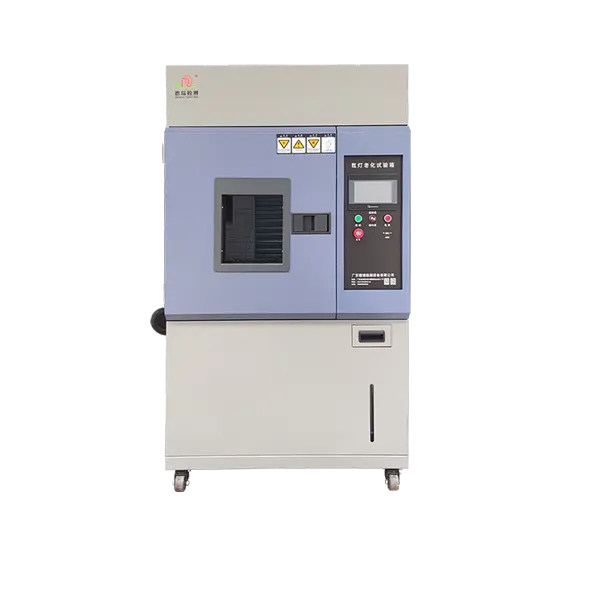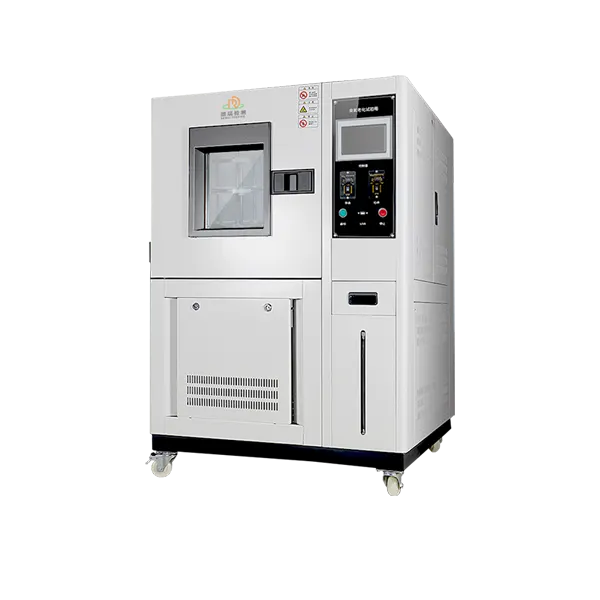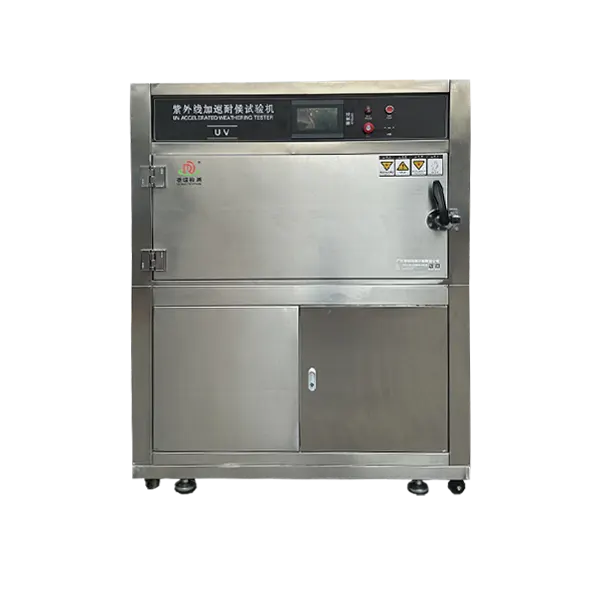



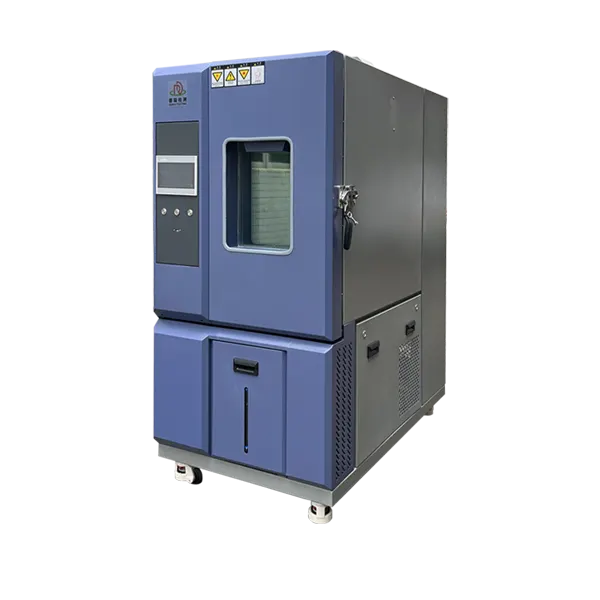
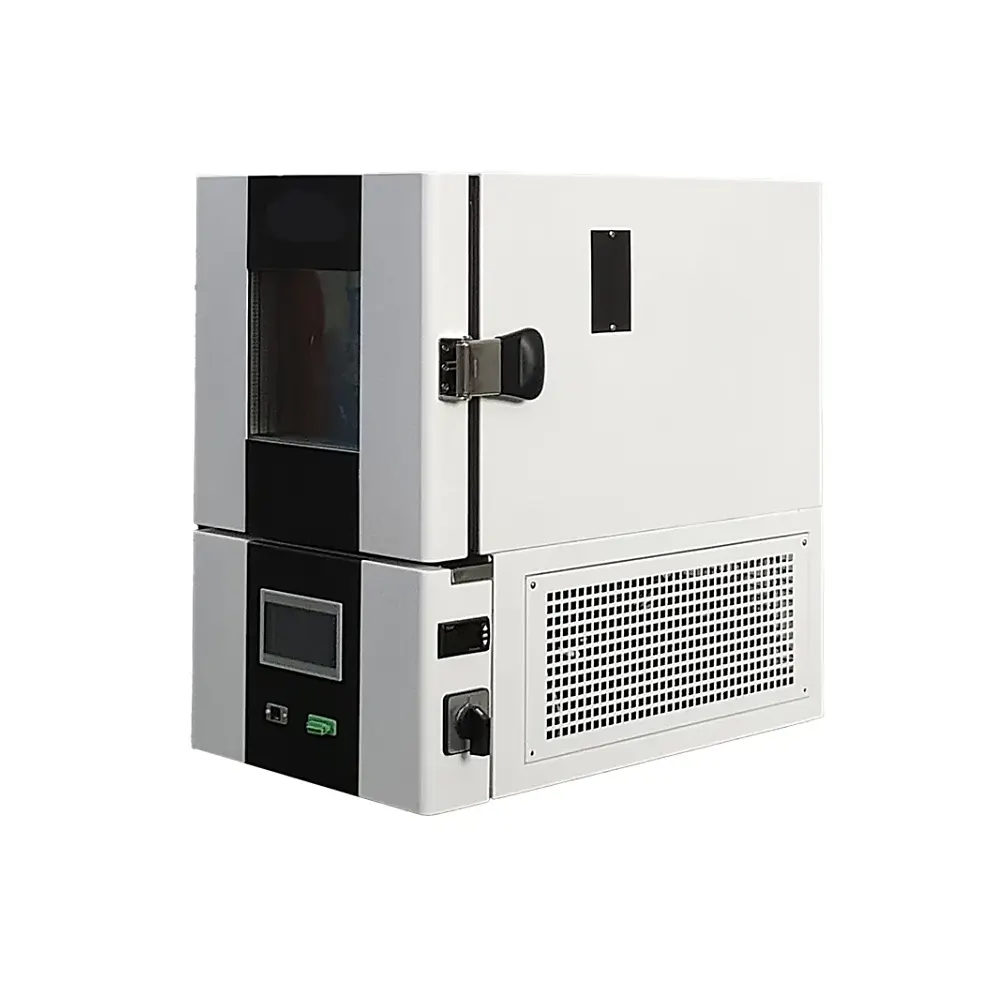
ASTM G154 UV Weathering Test Chamber
Evaluate comparative changes in plastics, coatings, sealants, adhesives and other nonmetallic materials under controlled fluorescent UV, heat and moisture exposure.
What the chamber is designed to evaluate
A UV weathering chamber repeatedly exposes specimens to fluorescent ultraviolet radiation and moisture under controlled conditions. The resulting data can compare formulations, suppliers, coatings or production batches for changes such as color shift, gloss loss, chalking, cracking, embrittlement and strength retention.
ASTM G154 is an apparatus operating practice—not a universal product qualification cycle. The lamp type, irradiance, black-panel temperature, wet phase, duration, specimen evaluation method and acceptance criteria must come from the applicable material specification or customer test plan.
Select the light source by end-use exposure
Configuration note: confirm the lamp family, spectral specification, control wavelength and irradiance setpoint before ordering. Different lamps are not interchangeable within one test.
Fluorescent UV or xenon arc?
| Decision factor | Fluorescent UV chamber | Xenon arc chamber |
|---|---|---|
| Spectrum | Concentrates on the UV region that drives many polymer and coating failures | Reproduces a broader UV, visible and infrared solar spectrum through a lamp/filter system |
| Moisture | Condensation and, on equipped systems, water spray | Commonly water spray and controlled chamber climate |
| Best fit | Comparative UV degradation, coating and polymer screening | Full-spectrum lightfastness, color response and specifications requiring xenon arc |
| Typical operating practice | ASTM G154 / ISO 4892-3 / ISO 16474-3 as applicable | ASTM G155 / ISO 4892-2 as applicable |
If your specification requires xenon arc, review the xenon arc test chamber. Do not replace one lamp technology with the other simply to shorten test time.
Moisture exposure: condensation is not ordinary RH control
During a condensation phase, heated water produces vapor that condenses on the cooler specimen surface. This simulates dew-type wetting and is different from operating a temperature-humidity chamber at a stated relative-humidity setpoint. A spray phase may be used only when the selected method requires it and the chamber includes the corresponding water-delivery system.
- Use the water quality required by the chamber manual and test method.
- Document UV, dark, condensation and spray periods exactly.
- Keep specimen mounting and exposed area consistent between batches.
- Inspect reservoirs, nozzles, drains and specimen holders on a planned schedule.
Standards and method selection
| Reference | Use | Important limitation |
|---|---|---|
| ASTM G154-23 | Operating fluorescent UV lamp and water apparatus for material exposure | Does not by itself define the best cycle or pass/fail criteria |
| ISO 4892-3:2024 | Fluorescent UV, heat and water exposure methods for plastics | Use the method and lamp classification specified for the plastic application |
| ISO 16474-3 | Fluorescent UV exposure of paints and varnishes | Do not substitute the plastics method without checking the product specification |
| Material/OEM method | Defines cycle, duration, conditioning, measurements and acceptance | This document should control the equipment configuration |
For a deeper method discussion, see our ASTM G154 and ISO 4892 UV weathering guide.
Specifications to confirm before quotation
The supplied source did not identify a DERUI model or verified configuration. To avoid publishing inaccurate values, request a model-specific datasheet for the following:
| Item | What to specify |
|---|---|
| Test method | Exact standard, edition, exposure cycle and customer/OEM document |
| Lamp system | Lamp classification, quantity, spectral requirement and replacement plan |
| Irradiance | Control wavelength, operating range, calibration and uniformity requirements |
| Temperature | Black-panel/black-standard range, specimen/chamber temperature and tolerance |
| Moisture | Condensation capability, spray requirement, water consumption and water quality |
| Specimens | Dimensions, thickness, exposed area, quantity and holder type |
| Control and records | Program steps, alarms, data export, user access and calibration records |
| Utilities | Voltage/frequency, ambient conditions, water supply and drainage |
Recommended test workflow
Frequently asked questions
What does ASTM G154 test?
ASTM G154 describes how to operate fluorescent UV lamp and water apparatus to expose materials to UV, heat and moisture. A material or product method must define the cycle and evaluation criteria.
Does an ASTM G154 chamber simulate years of outdoor exposure?
It accelerates selected degradation mechanisms for comparative testing, but there is no universal hours-to-years conversion. Correlation requires material-specific field data and controls.
Which lamp should I choose: UVA-340, UVA-351 or UVB-313?
Use the lamp classification required by the applicable method. UVA-340 represents short-wave outdoor sunlight, UVA-351 represents behind-glass UV, and UVB-313 is a more severe screening source that may cause unrealistic degradation.
Can this equipment control relative humidity?
A typical fluorescent UV weathering chamber creates condensation rather than controlling a normal RH setpoint. If an RH-controlled stage is required, confirm whether separate climatic equipment is needed.
Are ASTM G154 and ISO 4892-3 identical?
No. They address closely related fluorescent UV exposure, but their detailed requirements and application scopes differ. Use the exact referenced document and edition.
Can I test bare metal corrosion in this chamber?
ASTM G154 states that it is not intended for corrosion testing of bare metals. Select a salt-spray or cyclic-corrosion method when corrosion is the primary mechanism.
What information is required for chamber selection?
Provide the standard and cycle, material, specimen dimensions and quantity, lamp classification, irradiance setpoint, moisture phase, evaluation plan, utilities and required records.
How should results be reported?
Report the apparatus, lamps, exposure cycle, irradiance, temperatures, moisture conditions, duration, interruptions, specimen mounting, controls and the property-measurement methods used.
Confirm the chamber configuration before ordering
Send DERUI your standard, exposure cycle, specimen dimensions and capacity. We will match the lamp, irradiance control, moisture system and fixture configuration to the test method.