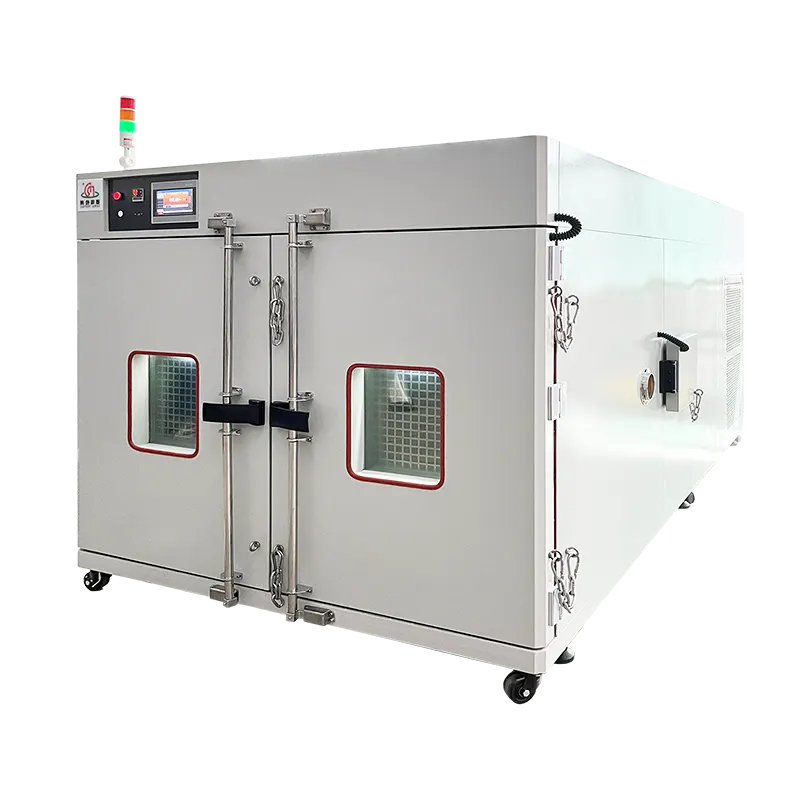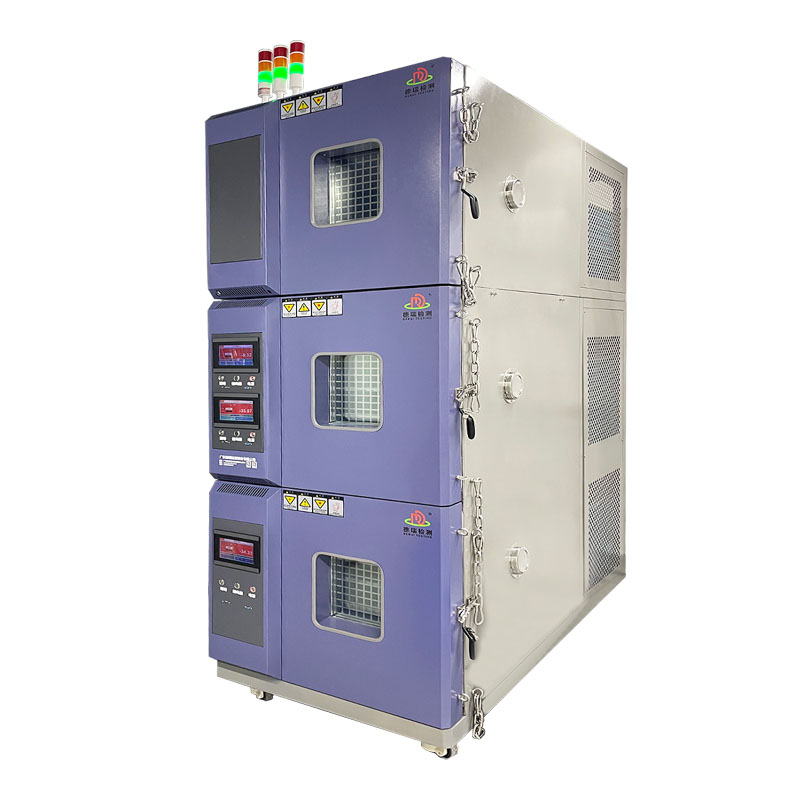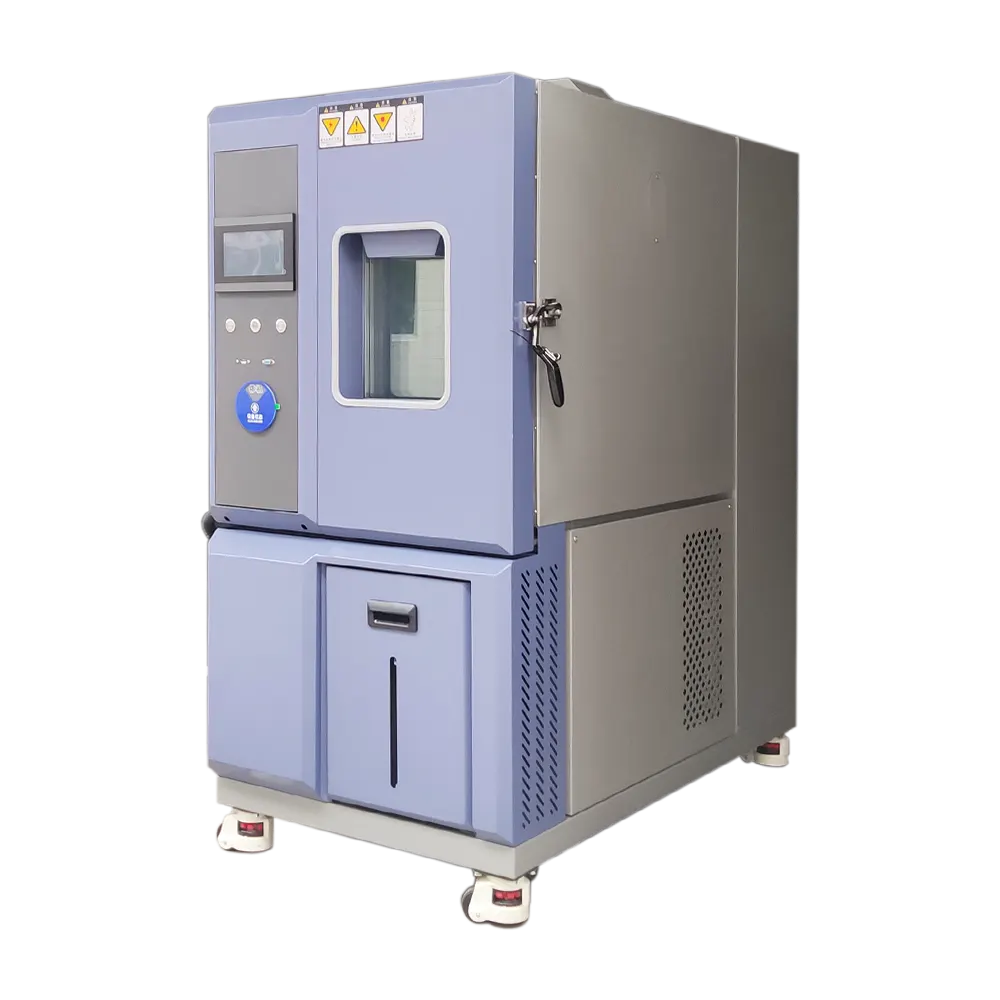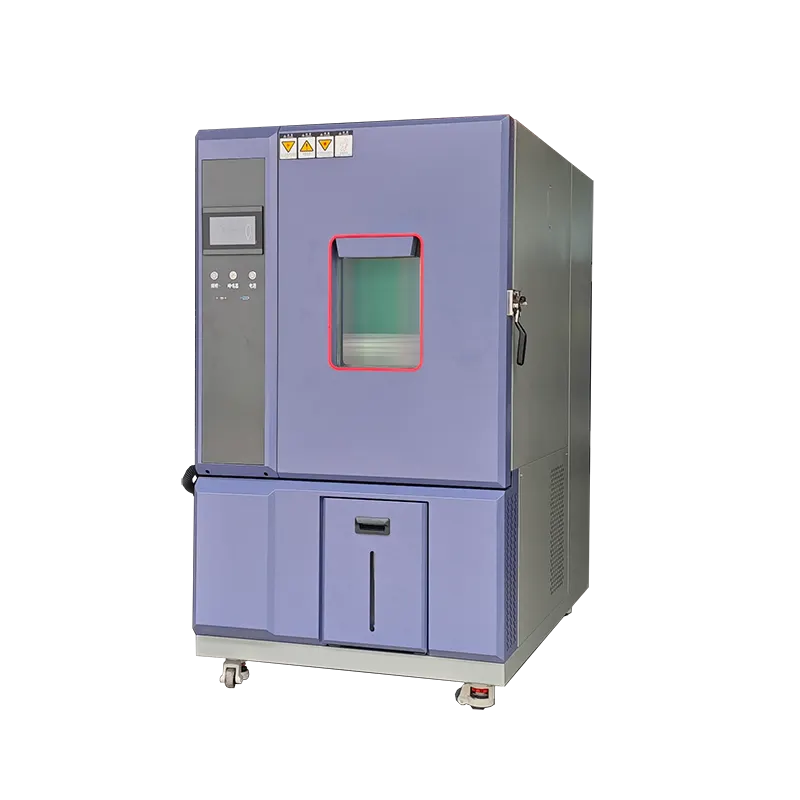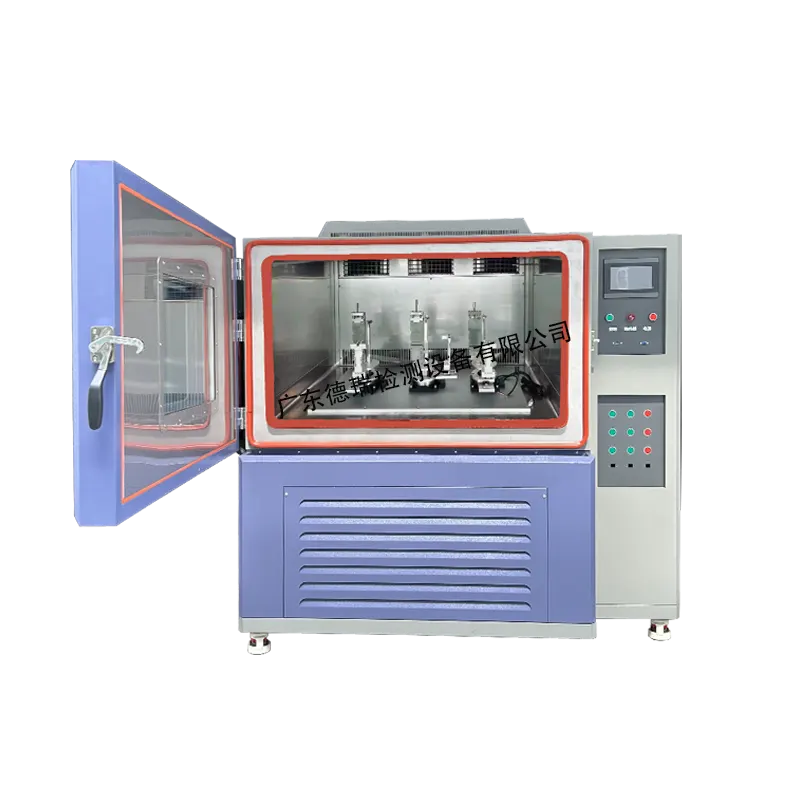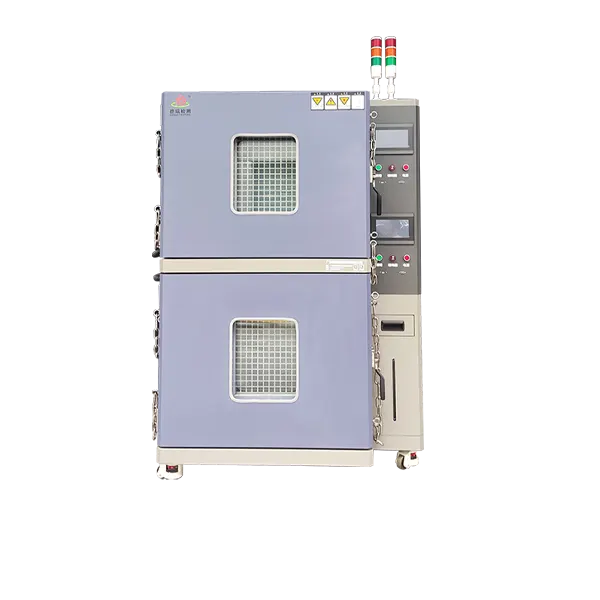








Double-Layer Temperature and Humidity Test Chamber
Run two different environmental profiles at the same time without installing two separate cabinets. Each upper and lower chamber has its own controller and independent start/stop operation for parallel R&D, verification and quality-control testing.
Why Use a Double-Layer Chamber?
Two simultaneous profiles
Run different setpoints, programmes or specimen groups in the upper and lower zones during the same shift.
Higher laboratory throughput
Increase available test capacity without allocating the floor area required for two standalone chambers.
Separation of test work
Keep development and routine QC, different batches or different temperature-humidity conditions operationally separate.
Published DR-H201 Double-Layer Model Matrix
| Model | Volume per layer | Internal size per layer |
|---|---|---|
| DR-H201-80-2 | 80 L | 500 × 400 × 400 mm |
| DR-H201-100-2 | 100 L | 400 × 500 × 500 mm |
| DR-H201-150-2 | 150 L | 500 × 600 × 500 mm |
| DR-H201-225-2 | 225 L | 500 × 750 × 600 mm |
| DR-H201-408-2 | 408 L | 600 × 850 × 800 mm |
Published Environmental Performance
| Item | Published value | Procurement check |
|---|---|---|
| Temperature range options | 0 / -20 / -40 / -70°C to +150°C | Select the required low-temperature configuration for both layers. |
| Temperature uniformity | ≤2°C, no-load | Confirm sensor map, setpoint and working-space definition. |
| Temperature fluctuation | ±0.5°C, no-load | Confirm stabilized condition and measurement interval. |
| Humidity range | 20% to 98% RH | Request the valid combined temperature-RH operating envelope. |
| Humidity uniformity / fluctuation | +2/-3% RH / ±2% RH | Confirm setpoint, load and measurement method. |
| Heating / cooling | 1–3°C/min / 0.7–1°C/min | Confirm average definition, temperature span and loaded performance. |
| Time setting | 1–60,000 min | Confirm programme steps, cycles and independent records. |
Confirm True Independence Between the Two Layers
Control independence
Verify separate programmes, sensors, alarms, start/stop control and data files for upper and lower chambers.
Thermal independence
Define simultaneous worst-case profiles and confirm one layer’s load does not invalidate the other layer’s performance.
Utility independence
Confirm shared versus separate refrigeration, humidification, water, drainage and electrical protection architecture.
Construction and Daily-Use Features
SUS304 workspaces
Brushed stainless-steel chambers, silicone seals and locking doors support repeated climatic exposure.
Adjustable sample racks
Rack height can be adapted to the specimen, but loading must preserve supply and return airflow.
Observation and access
Heated observation windows and selectable 50 or 100 mm cable ports support monitoring and powered tests.
Forced-air circulation
Centrifugal blowers, adjustable deflectors and supply/return ducts distribute conditioned air in each zone.
Humidity system
Independent humidification and evaporator-based dehumidification are stated; confirm water and control architecture per layer.
Compact vertical layout
Stacked zones increase throughput per floor area, but room height, service clearance and transport access must be checked.
Match Each Layer to Its Test Method
| Reference | Typical use | What to confirm |
|---|---|---|
| IEC 60068-2-1 | Cold testing | Test type, setpoint, stabilization, duration and specimen operation. |
| IEC 60068-2-2 | Dry heat | Heat-dissipating state, airflow and measurement points. |
| IEC 60068-2-78 | Steady damp heat | Temperature, RH, duration, load and evaluation. |
| IEC 60068-2-30 | Cyclic damp heat | Cycle, transitions, condensation and recovery. |
RFQ and Dual-Zone FAT Checklist
| Topic | Information to provide or verify |
|---|---|
| Layer A profile | Setpoints, ramps, dwells, cycles, load and powered heat. |
| Layer B profile | Setpoints, ramps, dwells, cycles, load and powered heat. |
| Simultaneous operation | Worst-case combined condition and required performance in both layers. |
| Interfaces | Ports, power, signals, thermocouples, communications and data files. |
| Utilities | Voltage, current, water, drain, heat rejection and service access. |
| FAT | Separate sensor maps, simultaneous profiles, alarms, records and acceptance limits. |
Frequently Asked Questions
Can the two layers run different test conditions?
Yes. The page states that each cabinet has its own controller and can start or stop independently. Confirm the full thermal and utility architecture in the quotation.
Is the listed capacity total volume?
The table describes the volume of the upper or lower layer. For example, the 150 L model provides two nominal 150 L workspaces.
Can one layer run temperature-only while the other runs humidity?
This should be possible only when the selected configuration provides independent humidity and refrigeration control. State the simultaneous profiles for confirmation.
Does 20–98% RH apply at every temperature?
No rectangular envelope should be assumed. Request the combined temperature-RH chart for the selected configuration.
Can powered specimens be tested?
Yes when port, cable, specimen heat and safety requirements are included in the engineering calculation.
What should I send for a quotation?
Send both layer profiles, specimen drawings, quantities, mass, powered heat, interfaces, utilities and simultaneous FAT requirements.
Configure Both Test Zones Before Quotation
Send the upper- and lower-layer profiles separately. DERUI can confirm capacity, temperature options, humidity envelope, interfaces, utilities and simultaneous acceptance testing.