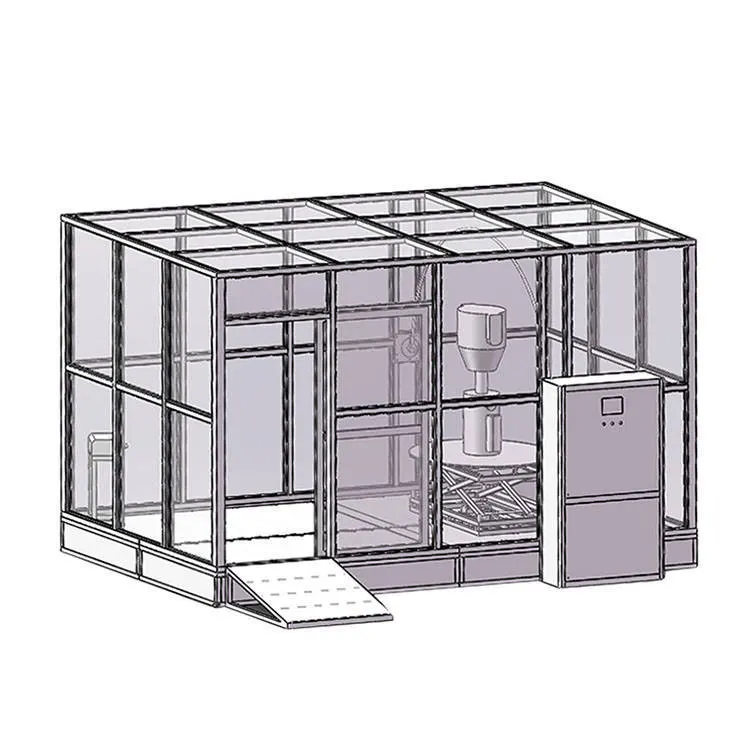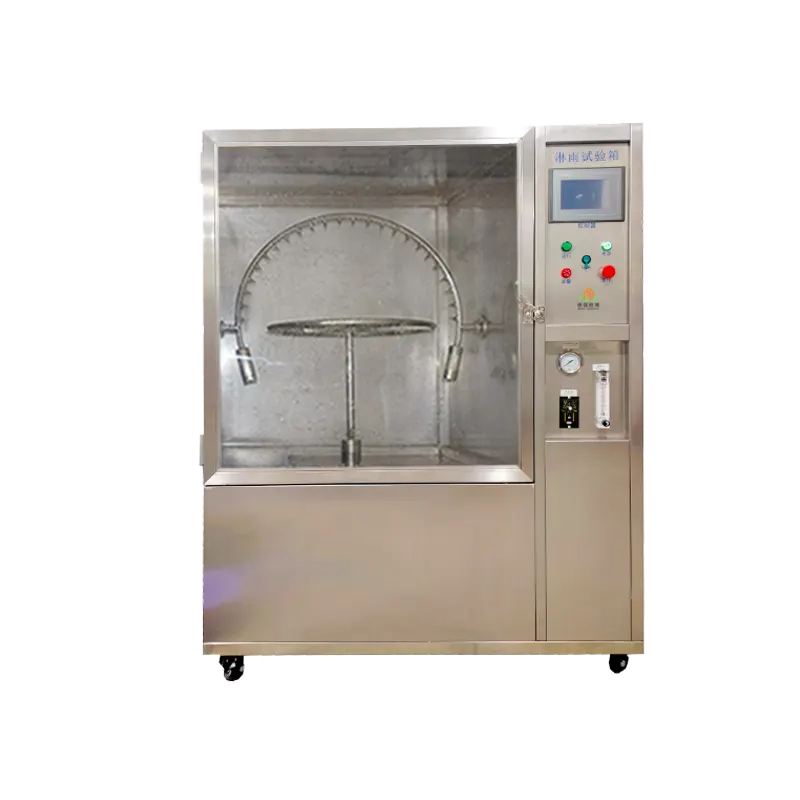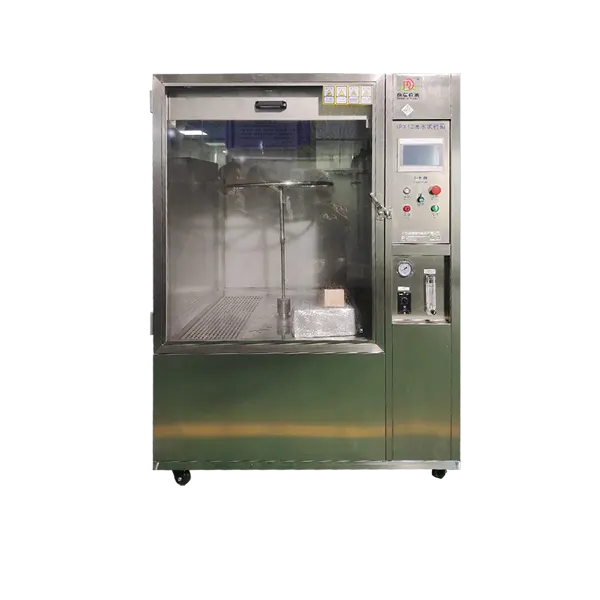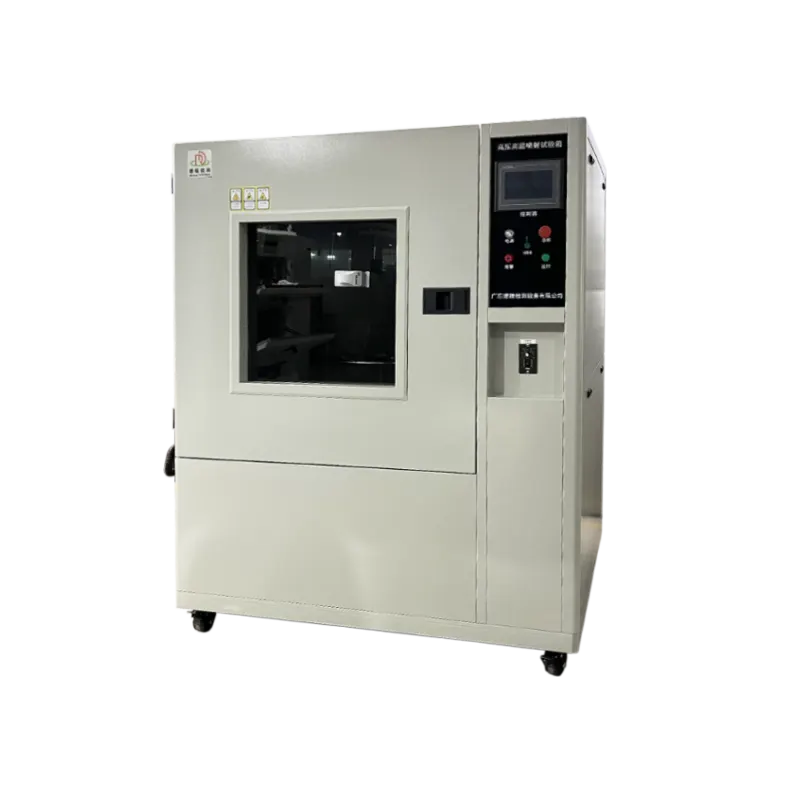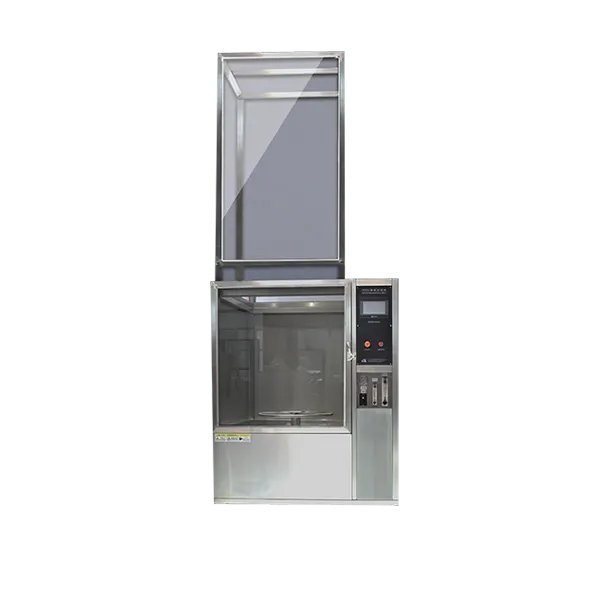








One Enclosed System for IPX5 and IPX6 Water-Jet Exposure
The H503-2 combines two water-jet configurations in a stainless-steel test enclosure: a 6.3 mm nozzle with 12.5 L/min delivery for the published IPX5 setup, and a 12.5 mm nozzle with 100 L/min delivery for the published IPX6 setup. A 500 mm rotating table helps expose different specimen surfaces at the defined nozzle distance.
The chamber supplies the water exposure. The governing standard, product specification or customer procedure defines specimen orientation, accessible surfaces, duration, operating state and acceptance criteria. Passing the chamber program does not by itself prove product compliance.
Direct answer: select H503-2 when both jet levels are required and the complete specimen and fixture fit the 1000 mm workspace and 500 mm table. Use separate equipment for drip, oscillating-tube, immersion, automotive K-code or high-pressure/high-temperature jet procedures unless those functions are explicitly added and verified.
H503-2 Technical Specifications
Use these published values for preliminary assessment and reconfirm the ordered water circuit, drawing and utilities in the technical agreement.
| Item | IPX5 setup | IPX6 setup |
|---|---|---|
| Nozzle internal diameter | 6.3 mm | 12.5 mm |
| Water delivery rate | 12.5 L/min ±5% | 100 L/min ±5% |
| Substantial-stream core | Approx. 40 mm diameter at 2.5 m | Approx. 120 mm diameter at 2.5 m |
| Spray distance | 2.5–3 m from nozzle to enclosure surface | |
| Duration basis | 1 min per square metre of enclosure surface likely to be sprayed; minimum 3 min | |
| Internal workspace | 1000 × 1000 × 1000 mm (W × D × H), customization stated | |
| External dimensions | 1400 × 1200 × 3500 mm (W × D × H) | |
| Specimen table | 500 mm diameter; adjustable rotation speed | |
| Controller | PLC touch screen | |
| Construction | SUS304 stainless-steel interior; stainless-steel exterior | |
| Power supply | AC380 V, 50 Hz, three phase | |
Additional test requirements: include any water-temperature control, specimen electrical interface, data recording or remote-monitoring requirement in your request. The configuration proposal will identify the supplied functions and acceptance checks. This water-jet configuration does not establish chamber-air temperature or humidity control.
IPX5 and IPX6 Are Separate Water-Jet Tests
IPX5 and IPX6 use different nozzle and delivery-rate arrangements. Select the exposure and test sequence required by the adopted standard, product specification or customer program. Where both tests are explicitly requested, document each setup and result; a separate IPX5 run should not be treated as an automatic additional requirement in every IPX6 program.
IPX5 configuration
The published H503-2 setup uses the smaller nozzle and lower delivery rate. Confirm distance, duration, coverage and specimen condition from the controlled test document.
- 6.3 mm nozzle
- 12.5 L/min ±5%
- Approx. 40 mm stream core at 2.5 m
- Defined accessible surfaces and orientation
IPX6 configuration
The larger nozzle and higher delivery rate produce a more powerful jet. Fixture strength, specimen stability, splash containment and water supply capacity need separate review.
- 12.5 mm nozzle
- 100 L/min ±5%
- Approx. 120 mm stream core at 2.5 m
- Higher water demand and mechanical loading
From Nozzle Verification to Ingress Evaluation
Identify the specimen
Record model, enclosure state, seals, connectors, vents and pre-test condition.
Mount as specified
Reproduce orientation and supports without masking surfaces that must receive water.
Select the nozzle
Install the required IPX5 or IPX6 nozzle and prevent an incorrect program selection.
Verify exposure
Measure flow, establish distance, set duration and confirm table movement and coverage.
Run and monitor
Record powered state, interruptions, flow deviations and any abnormal specimen response.
Inspect and decide
Open, drain and evaluate only as the method requires; document ingress and functional results.
Recommended record: standard and edition, IP code, specimen photographs, fixture and orientation, nozzle ID, measured delivery rate, distance, program, exposure time, operating state, deviations, internal inspection and acceptance decision.
Size the Entire Water-Test System
Nozzle compliance is only one part of the purchase. Confirm specimen clearance, water capacity, fixture, drainage and laboratory utilities before approving the chamber.
Usable workspace
Check specimen, fixture, cable routing, rotation and nozzle clearance inside the 1000 mm workspace.
Water supply
Define inlet capacity, tank volume, filtration, recirculation, make-up water and the 100 L/min IPX6 demand.
Drainage and containment
Review floor drain, overflow protection, splash control, cleaning access and discharge restrictions.
Powered testing
Specify feedthroughs, voltage, current, control sequence, leakage protection and required monitoring.
Laboratory installation
Verify AC380V three-phase power, equipment height and access route, floor load, water and service clearance.
Acceptance checks: workspace and table dimensions, both nozzle diameters, measured delivery rates, distance, timer, table rotation, controller programs, water containment, safety interlocks, ordered options and documentation.
Plan the IPX6 Water Circuit and Full Jet Path
Separate delivery from consumption
At the listed 100 L/min delivery, a three-minute exposure passes approximately 300 L through the nozzle. That is cumulative delivered water, not automatically the fresh-water consumption or minimum tank volume.
Size the selected circuit
For a recirculating arrangement, evaluate return flow, splash loss, filtration, make-up water and usable tank level. For once-through operation, review supply and discharge capacity. Specify the actual circuit in the proposal.
Verify the installed distance
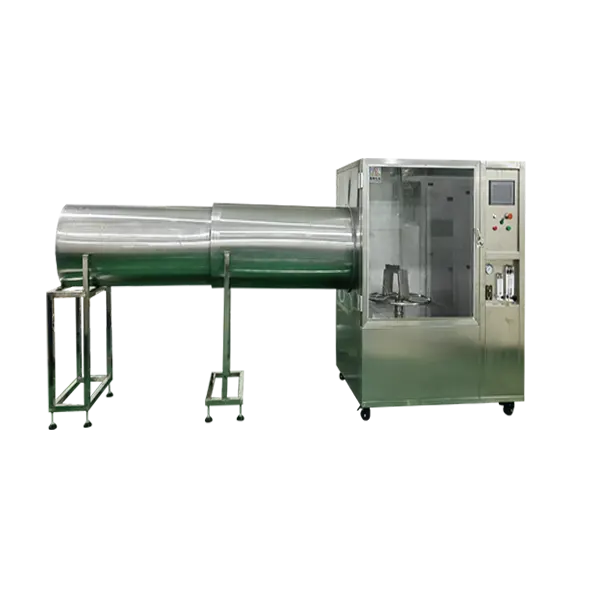
The listed cabinet workspace is 1000 mm, while the method-facing nozzle distance is 2.5–3 m. Check nozzle placement, enclosure surface reference and actual jet path on the approved drawing and during acceptance.
A rotating table does not guarantee every required face is exposed. Review fixture masking, cable routes, specimen stability and the directions required by the test plan. Agree a loaded demonstration with the intended assembly.
H503-2 IPX5/IPX6 Chamber FAQs
Does H503-2 include temperature and humidity control?
The listed configuration establishes IPX5/IPX6 water-jet testing, not chamber-air temperature or humidity control. Specify water-temperature conditioning separately if your procedure requires it.
Must every IPX6 program also include a separate IPX5 run?
No. Determine the required test sequence and rating assignment from the adopted standard and product requirement. If the customer explicitly requests both exposures, use each specified nozzle, delivery rate, distance and evaluation sequence.
Can H503-2 perform IPX6K or IPX9K?
These are distinct automotive water-test designations. The listed 6.3 mm and 12.5 mm nozzle setups do not by themselves establish those capabilities. Provide the exact code and method for a separate configuration review.
Does passing mean absolutely no water can enter?
Not universally. The applicable product or customer requirement defines harmful ingress and the necessary inspection, functional or electrical checks. Document the result against that criterion.
Can products operate during water-jet testing?
Specify specimen voltage, current, cables, switching sequence and monitoring. Powered operation requires appropriate electrical interfaces and wet-test protection in the ordered configuration; it is not established by the chamber supply voltage alone.
What is needed for an accurate quotation?
Provide the required standard edition and IP code, specimen dimensions and mass, fixture and orientation, surfaces to expose, powered state, water conditions, acceptance checks and site utilities. Include any recording/export or monitoring requirement.
Confirm the Required IPX5 and IPX6 Configuration
Send the test document, specimen drawing, powered state, exposure surfaces, utilities and acceptance checks.