Environmental Chamber FAT Checklist and Acceptance Record Template
Date: 10/22/2026 Categories: Test Chambers Views: 3079
Factory acceptance · Practical records
Agree on the Acceptance Evidence Before the Chamber Is Built
Connect each purchase requirement to a test condition, measurement, evidence file and review outcome. Use the blank record structure below to plan and document an environmental chamber factory acceptance test.
1. Define what this FAT will establish
A factory acceptance test should demonstrate the equipment requirements agreed between buyer and supplier. Write down the configuration, functions and performance points that will be checked, together with the conditions and records needed to judge them.
This checklist is a planning and recording aid for an environmental chamber project. It does not prescribe a universal temperature tolerance, sensor count, test duration or safety test. Select those details from the approved purchase specification, applicable method and project responsibilities before execution.
Use the chamber buying guide for the wider purchase process and the specification FAQs for requirement inputs. This page focuses on the acceptance record itself.
2. Separate FAT, calibration, loaded verification and SAT
| Evidence or activity | What it addresses | What to record separately |
|---|---|---|
| Factory acceptance test | The agreed demonstration before factory release or shipment. | Equipment identity, configuration, conditions, results and deviations. |
| Calibration | The measurement-related information covered by the calibration scope. | Instrument ID, certificate, relevant points and applicability to the measurement. |
| Loaded performance verification | Performance under the defined actual or representative load. | Load identity, mass/heat dissipation, fixture and measurement basis. |
| Site acceptance test | Agreed checks after installation at the destination, if required. | Site conditions, services, configuration changes and the SAT scope. |
Do not use an empty-chamber report as evidence of a different loaded condition without agreement. A change in fixtures, powered heat output, connections or installation conditions may require additional review.
3. Complete the plan before testing
Freeze the requirement
Identify the order, specification and revisions. Record exceptions and the person authorized to approve changes.
Define the setup
Record the working zone, load state, utilities, measurement locations and instruments used for each check.
Set the decision rule
Agree on limits, the calculation/evaluation method and how measurement uncertainty will be handled where relevant.
Confirm who executes, witnesses and reviews the FAT, including remote attendance if applicable. Identify the original data and reports to be delivered and the action required if a test is interrupted or cannot be completed.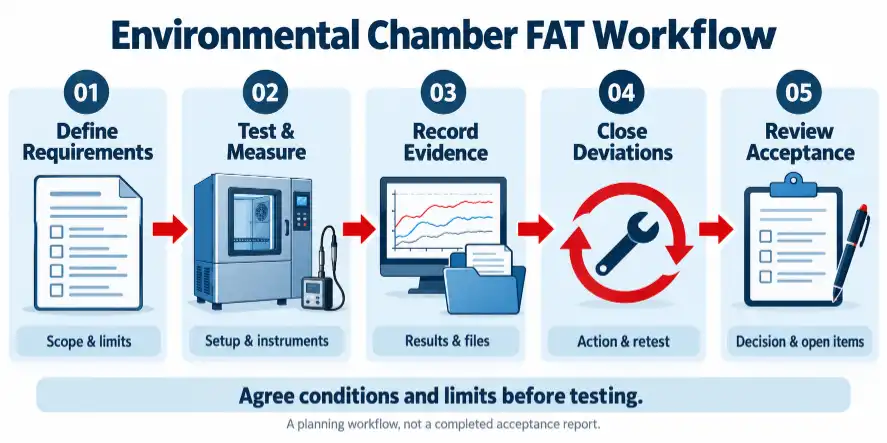
4. Environmental chamber FAT checklist
| Check area | Items to define and record |
|---|---|
| Identity and configuration | Model, serial number, order/drawing revision, working zone, installed options and software version. |
| Site and utilities | Recorded ambient condition, supply, cooling/water services and any abnormal condition affecting the test. |
| Measurement system | Instrument/sensor IDs, applicable calibration records, measurement locations and data/time settings. |
| Environmental performance | Agreed setpoints, temperature/RH pairs, stabilization, duration and applicable evaluation method. |
| Transitions and specimen load | Defined rate/interval or transition time; chamber-air versus specimen basis; empty, dummy or actual load. |
| Control and records | Program/recipe identification, recorded channels, data export, timestamps and agreed interruption handling. |
| Protection functions | Only the approved functional checks, conditions, expected response and authorized procedure. |
| Documentation and handover | Required manuals, drawings, records, parts/support information, training and outstanding items. |
Mark an item Not applicable only with a reason and the required approval. Keep Not tested separate from Pass. Do not turn a missing result into an acceptance decision.
For specialist equipment—such as pressure, thermal shock, battery-hazard, dust, rain or corrosion systems—add the checks required by that equipment and its approved procedure. This general record is not a substitute for a specialist verification plan.
5. Blank acceptance record structure
Create a separate record for each check, or repeat the rows below. Fill the agreed condition and acceptance criterion before testing, then enter the observed result and evidence reference after execution. The underscores identify blank fields, not actual test results.
| Requirement ID / source | Agreed condition and limit | Measurement / setup | Observed result / evidence file | Status / action |
|---|---|---|---|---|
| REQ-___ / document revision ___ | Setpoint/profile ___; limit ___ | Load ___; instruments ___ | Result ___; data/photo file ___ | Pass / Fail / Not tested / N/A ___ |
| REQ-___ / document revision ___ | Setpoint/profile ___; limit ___ | Load ___; instruments ___ | Result ___; data/photo file ___ | Pass / Fail / Not tested / N/A ___ |
| REQ-___ / document revision ___ | Setpoint/profile ___; limit ___ | Load ___; instruments ___ | Result ___; data/photo file ___ | Pass / Fail / Not tested / N/A ___ |
Setup attachment: Include the loading drawing or photograph, sensor-location plan, instrument list, software/recipe version and relevant utility conditions. Use the same record identifier on the attachments so the result can be reconstructed later.
6. Make a performance result traceable to its setup
For a temperature or temperature/humidity check, identify the requested condition and the approved evaluation method. Record the stabilization basis, acquisition interval and evaluation period. Distinguish the control indication from the independent measurements used to evaluate performance.
For a transition check, identify the starting and ending condition, direction, time basis and whether the requirement applies to chamber air or a point on the specimen. For loaded testing, record mass, fixture arrangement and powered dissipation where relevant.
Keep the original data, not only a screenshot of the controller. Record the location and identification of each channel so a reported maximum, minimum or deviation can be traced back to the measurement.
Relevant standard scopes to check
IEC 60068-3-6:2018 describes performance confirmation for temperature/humidity chambers without specimens. IEC 60068-3-7:2020 addresses loaded temperature-chamber measurements for cold and dry-heat tests. Neither title should be applied as a universal FAT procedure for every chamber type. Confirm the controlled edition and scope required for your project.
7. Record functional checks without inventing a test procedure
List the agreed controller, alarm, interlock, export and recovery functions, together with the authorized way to demonstrate them. Record the expected response, actual response and evidence file for each check.
Use approved equipment instructions and qualified personnel for functional or protective-system testing. Do not improvise a fault injection or bypass a protective device to complete a checklist. If a check cannot be performed, record why, who decides the next action and when it will be closed.
8. Record deviations and retest evidence
| Deviation ID / requirement | Observed issue / evidence | Action and owner | Retest / closure |
|---|---|---|---|
| DEV-___ / REQ-___ | Observation ___; file ___ | Action ___; owner ___; due ___ | Result/file ___; reviewer/date ___ |
| DEV-___ / REQ-___ | Observation ___; file ___ | Action ___; owner ___; due ___ | Result/file ___; reviewer/date ___ |
Preserve the original finding when recording a correction. Link the retest to the same requirement and identify any changed setup or software. Agree on who can accept a deviation and whether it affects shipment, installation or intended use.
9. Document the handover decision
Before release, check that every planned item has a result or a documented disposition. Record the completed evidence package, remaining actions, responsible people and conditions for the next stage.
| Handover field | Blank entry |
|---|---|
| Evidence package index | Report ___; raw data ___; photographs ___; calibration documents ___; manuals/drawings ___ |
| Open items | Item / owner / due date / required verification ___ |
| Acceptance decision | Decision and authority ___; conditions / exceptions ___ |
| Shipment / next-stage authorization | Authorized scope ___; responsible person ___; date ___ |
| Site follow-up, if required | SAT scope ___; utilities / installation checks ___; owner ___ |
Keep equipment acceptance, shipment authorization and specimen qualification distinguishable in the record. A completed FAT does not by itself establish that the customer’s product passed its qualification program.
Questions about the FAT record
Is there one mandatory FAT checklist for all environmental chambers?
No. The checks and limits depend on the equipment, applicable requirements and the buyer–supplier agreement. Use this structure to organize that agreed plan.
Does a calibration certificate replace the FAT?
No. Calibration and equipment acceptance address different questions. Review the actual scope of the certificate and the performance or functional evidence required by the order.
Can FAT be witnessed remotely?
Agree on the witness arrangement, access to the setup and the evidence to be delivered. Remote observation should still allow the parties to identify what was tested and retain the agreed records.
Can I use this template as a completed acceptance report?
It is a blank structure. A completed record must contain the actual requirement, setup, measurement, evidence and authorized review outcome for the project.
Define the acceptance scope in your chamber inquiry
Send the purchase specification and your proposed acceptance points. Ask DERUI to identify the configuration, verification conditions, deliverable records and any items requiring agreement.