2026 Environmental Test Chamber Buying Guide: How to Choose the Right Chamber
Date: 05/15/2026 Categories: Resources、Technical articles Views: 5907
Excerpt:
Last updated: May 2026 Author: Technical Content Team --- > TL;DR: This guide covers all major types of environmental test chambers — temperature & humidity, thermal shock, rapid temperature change (ESS), high-low temperature, walk-in, and specialized chambers. We've included a comparison table,...
2026 Environmental Test Chamber Buying Guide: How to Choose the Right Chamber for Your Industry
Last updated: May 2026 | Reading time: 18 min | Author: Technical Content Team
TL;DR: This guide covers all major types of environmental test chambers — temperature & humidity, thermal shock testing equipment, rapid temperature change (ESS), high-low temperature, walk-in, and specialized chambers. We've included a comparison table, pricing benchmarks, selection checklist, and industry-specific recommendations to help engineers and procurement managers make an informed purchase in 2026.
Table of Contents
- What Is an Environmental Test Chamber?
- Types of Environmental Test Chambers
- Key Specifications Explained
- Industry Standards & Compliance
- How to Choose: Decision Framework
- 2026 Pricing Benchmarks
- Top Manufacturers in 2026
- Common Mistakes to Avoid
- Maintenance & Calibration Guide
- Frequently Asked Questions
1. What Is an Environmental Test Chamber?
An environmental test chamber (also called a climate chamber or environmental chamber) is a sealed enclosure that precisely controls temperature, humidity, and often other environmental parameters — such as altitude, vibration, or corrosive atmospheres — to simulate real-world conditions for product testing.
Why does it matter in 2026?
As product cycles shorten and reliability requirements tighten across automotive, aerospace, electronics, and battery industries, environmental testing has moved from a "nice-to-have" to a regulatory and competitive necessity. A single field failure in an EV battery or aerospace component can cost millions and damage brand reputation irreparably.
Environmental test chambers help engineers:
- Accelerate failure discovery before products reach customers
- Validate compliance with international testing standards (IEC, MIL-STD, ISO)
- Reduce time-to-market by identifying design weaknesses early in R&D
- Ensure safety in high-stakes applications (batteries, medical devices, automotive electronics)
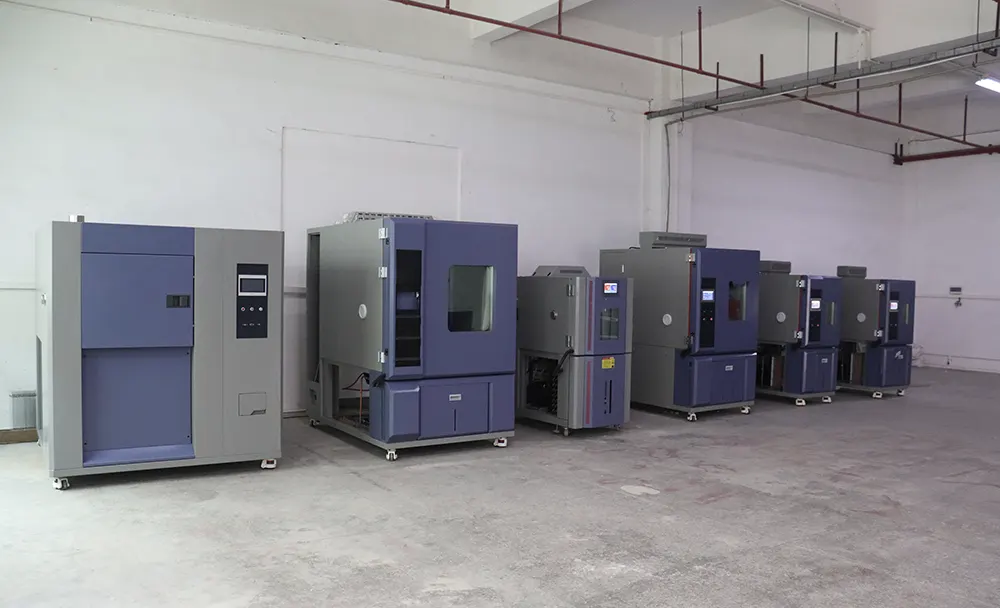
2. Types of Environmental Test Chambers
2.1 Temperature & Humidity Chamber
The most widely used type — accounts for ~29.6% of the global market (Grand View Research, 2025).
Simulates combined temperature and humidity conditions, cycling through programmable profiles from high heat/high moisture to cold/dry environments.
| Spec | Typical Range |
|---|---|
| Temperature | -40°C to +180°C |
| Humidity | 10%RH to 98%RH |
| Temperature accuracy | ±0.5°C |
| Humidity accuracy | ±2%RH |
| Ramp rate (standard) | 1–3°C/min |
| Volume range | 50L to 10,000L+ |
Best for: Electronics PCBs, automotive components, consumer goods, battery storage systems, pharmaceutical stability testing.
2.2 Thermal Shock Chamber
Uses rapid movement between hot and cold zones (or dual-chamber systems) to expose weaknesses caused by sudden temperature transitions. This tests a product's ability to withstand thermal stress without mechanical failure.
| Spec | Typical Range |
|---|---|
| Temperature range | -75°C to +200°C |
| Ramp rate | 10–25°C/min |
| Recovery time | <5 minutes between zones |
| Configurations | Single-chamber / Two-chamber / Three-zone |
Key distinction from temperature chambers: Thermal shock chambers prioritize speed of transition, not steady-state accuracy. Products are subjected to extreme rate-of-change conditions that can reveal solder joint fractures, delamination, and material incompatibility issues invisible to precision temperature test chambers tests.
Best for: Aerospace components, automotive electronics, printed circuit boards (PCBs), smartphones, semiconductors.
2.3 Rapid Temperature Change Chamber (ESS / HASS)
Environmental Stress Screening (ESS) chambers push products through high-frequency temperature cycles to accelerate the detection of latent manufacturing defects. Think of it as thermal shock at production scale — hundreds or thousands of cycles rather than a few.
| Spec | Typical Range |
|---|---|
| Temperature range | -70°C to +180°C |
| Ramp rate | 5–25°C/min (linear) |
| Cycle capacity | Continuous, programmable up to 9999 cycles |
| Focus | Defect discovery, not qualification |
Best for: High-volume electronics manufacturing, battery production lines, reliability testing labs, semiconductor packaging.
ESS vs HALT/HASS: ESS uses moderate stress levels to screen production defects. HALT (Highly Accelerated Life Testing) pushes products to destructive limits to find design margins. HASS (Highly Accelerated Stress Screening) applies HALT-derived stress levels to production units.
2.4 High-Low Temperature Chamber (Dry Heat / Cold)
Operates at extreme temperatures without humidity control. Ideal for products that need pure temperature endurance testing — no moisture variables.
| Spec | Typical Range |
|---|---|
| Temperature range | -70°C to +180°C (some reach -196°C with liquid nitrogen) |
| Humidity | None (or <5%RH as ambient) |
| Accuracy | ±0.5°C to ±1°C |
Best for: Materials science, aerospace components, LED lighting, optical components, coatings, rubber and polymer testing.
2.5 Walk-In Environmental Chamber
Large-scale chambers sized for human entry, accommodating full-scale products, vehicles, or bulk quantities for accelerated life testing.
| Spec | Typical Range |
|---|---|
| Volume | 1,000L to 100,000L+ |
| Temperature | -70°C to +180°C |
| Humidity | 10%RH to 95%RH |
| Application | Full-vehicle testing, data center validation, large component stacks |
Best for: Automotive OEM testing, aerospace subsystem testing, telecom equipment, HVAC systems, electric vehicle battery packs.
2.6 Specialized Chambers
| Type | Application |
|---|---|
| Altitude / vacuum chamber | Aerospace, high-altitude electronics testing |
| Thermal vacuum chamber | Spacecraft component qualification |
| Vibration + temperature chamber | Combined mechanical + climatic stress testing |
| salt spray corrosion test chambers / corrosion chamber | Marine coatings, metal corrosion resistance (ASTM B117) |
| Mixed gas corrosion chamber | Industrial atmosphere corrosion testing |
| UV weathering chamber | Plastic, paint, coating outdoor durability |
| Benchtop / tabletop chamber | Small lab samples, limited-space facilities |
| Battery-specific chamber | EV battery pack testing with integrated safety systems |
3. Key Specifications Explained
Before purchasing, understand these technical parameters — they directly affect test validity and cost.
3.1 Temperature Performance
Temperature range — The minimum and maximum temperatures the chamber can achieve. Match this to your worst-case field conditions. Most applications need at least -40°C to +85°C; aerospace and cold-chain testing may require -70°C or below.
Ramp rate — How fast the chamber heats or cools (°C/min). Critical for thermal shock and ESS chambers. Standard chambers: 1–3°C/min. High-performance: 5–25°C/min.
Temperature uniformity — Spread of temperature across the working space at a given setpoint. Specified as ±°C. A ±1°C uniformity is adequate for most applications; precision semiconductor testing may require ±0.5°C.
Temperature accuracy — Deviation from the setpoint at the control sensor location. Industry standard is ±0.5°C.
3.2 Humidity Performance
Humidity range — 10%RH to 98%RH covers most applications. Note: humidity below 10%RH and above 98%RH requires specialized equipment.
Humidity accuracy — Industry standard: ±2%RH to ±3%RH. Precision applications (pharmaceutical) may need ±1%RH.
Humidification method — Steam boiler (faster response) vs. ultrasonic (more energy-efficient, better at low temperatures). Steam boiler is more common in industrial chambers.
3.3 Chamber Volume
Choose based on your largest test sample plus a safety margin:
- Benchtop (50–200L): Individual components, small samples, R&D labs
- Mid-size (200–1,000L): PCBs, automotive modules, consumer electronics
- Large (1,000–10,000L): Vehicle components, telecom equipment, multiple samples
- Walk-in (10,000L+): Full vehicles, battery packs, large subsystems
Rule of thumb: The test sample should occupy no more than 20–30% of the chamber's working volume to ensure proper air circulation and temperature uniformity.
3.4 Controller & Software
Modern chambers use programmable logic controllers (PLCs) or microprocessor-based systems with PC connectivity. Key features to evaluate:
- Profile programming: Number of programmable segments (minimum 64 is standard; high-end: 1200+)
- Communication: Ethernet, USB, RS-485 for data logging and remote monitoring
- Software interface: Touchscreen HMI vs. traditional keypad; cloud connectivity in 2026 models
- Data export: CSV, PDF reports, integration with MES/ERP systems
- Security: Multi-user access, audit logs (essential for GMP/pharmaceutical compliance)
3.5 Refrigeration System
The type of refrigeration affects performance, energy consumption, and ambient temperature tolerance:
| System | Pros | Cons |
|---|---|---|
| Cascade (standard) | Reliable, wide temp range | Higher energy consumption |
| Auto-cascade | Better energy efficiency | Limited to -55°C or warmer |
| LN₂ boost (liquid nitrogen) | Ultra-fast cooling, -196°C achievable | Ongoing LN₂ consumable cost |
| CO₂ (eco-friendly) | Lower GWP refrigerant | Limited to -40°C to +180°C |
4. Industry Standards & Compliance
Purchasing a chamber without considering standards compliance is a costly mistake. Here's what you need to know in 2026:
4.1 Key Standards
| Standard | Region | Description |
|---|---|---|
| IEC 60068 | International | Comprehensive environmental testing procedures (temperature, humidity, vibration, etc.) |
| MIL-STD-810 | USA (Military) | Tailored environmental engineering considerations; widely adopted in aerospace & defense |
| ISO 16750 | International | Road vehicle electrical/electronic equipment environmental conditions |
| ASTM B117 | USA | Salt spray (fog) testing for corrosion resistance |
| JEDEC Standards | Global (Semiconductor) | JESD22 series for IC component reliability testing |
| IATA / RTCA DO-160 | Aviation | Environmental conditions and test procedures for aircraft equipment |
| UN 38.3 | Global | Lithium battery transportation testing |
| GMP / FDA 21 CFR Part 11 | USA (Pharmaceutical) | Electronic records and signatures compliance for stability chambers |
| E/ECE/324/Rev.2 | Europe | Automotive regulatory standards |
4.2 IEC 60068 vs MIL-STD-810: Which Do You Need?
| Factor | IEC 60068 | MIL-STD-810 |
|---|---|---|
| Origin | International Electrotechnical Commission | US Department of Defense |
| Approach | Pre-defined test procedures; fixed parameters | Tailored to specific product lifecycle and environment |
| Best for | Commercial electronics, global product launches | Aerospace, defense, government contracts |
| Flexibility | Less flexible | Highly customizable |
| Global recognition | ✅ Universal | ❌ Primarily US government/aerospace supply chain |
Practical tip: If you sell globally to commercial markets, IEC 60068 compliance is typically required. If you supply to the US aerospace or defense sector, MIL-STD-810 compliance may be contractually mandated.
4.3 Chamber Calibration Requirements
Your test results are only valid if your chamber is properly calibrated. In 2026, calibration traceability to national standards (NIST in the US, CNAS in China, etc.) is required for:
- ISO 9001 / IATF 16949 quality management certifications
- Pharmaceutical GMP compliance
- Aerospace AS9100 certification
- Automotive supply chain requirements
Most manufacturers recommend calibration every 12 months with intermediate checks every 6 months for high-stakes applications.
5. How to Choose: Decision Framework
Use this decision tree to narrow down your chamber type:
Start: What are you testing?

│

├─ Temperature + Humidity cycles?

│   └─ Is rapid transition (>10°C/min) required?

│       ├─ NO → Temperature & Humidity Chamber

│       └─ YES → Thermal Shock Chamber

│

├─ Extreme temperatures only (no humidity)?

│   └─ Is temperature uniformity critical?

│       ├─ Standard → High-Low Temperature Chamber

│       └─ Precision → High-Precision Temperature Chamber

│

├─ High-volume production screening?

│   └─ Rapid Temperature Change / ESS Chamber

│

├─ Full-scale product / vehicle?

│   └─ Walk-In Environmental Chamber

│

└─ Specialized (altitude / corrosion / vibration)?

└─ Specialized Chamber type
5.1 Industry-Specific Recommendations
| Industry | Primary Chamber Type | Key Standards | Special Considerations |
|---|---|---|---|
| Automotive | Temp/Humidity + Thermal Shock | ISO 16750, IEC 60068 | Vibration integration, large test samples |
| EV Battery | Temp/Humidity + ESS + Walk-in | UN 38.3, IEC 62660 | Safety systems (explosion-proof), large packs |
| Aerospace | Thermal Vacuum + Altitude + Temp/Humidity | MIL-STD-810, DO-160 | Extreme temp ranges, vacuum integrity |
| Electronics / PCB | Temp/Humidity + ESS + Thermal Shock | IEC 60068, JEDEC | High-volume screening capability |
| Semiconductor | High-Precision Temp/Humidity + ESS | JEDEC standards | ±0.3°C uniformity, ultra-clean environment |
| Pharmaceutical | Temp/Humidity (stability-grade) | GMP, FDA 21 CFR Part 11 | ±0.5°C / ±2%RH accuracy, data integrity |
| Consumer Electronics | Temp/Humidity + Thermal Shock | IEC 60068 | Rapid ramp rate for short product cycles |
| Research / Academia | Benchtop Temp/Humidity | No mandatory standard | Budget sensitivity, flexibility |
| Defense | Thermal Vacuum + Altitude + Temp/Humidity | MIL-STD-810 | Custom configurations, ruggedized |
6. 2026 Pricing Benchmarks
Note: Prices are indicative for standard configurations in USD, FOB origin. Ex-works China prices are typically 40–60% lower than equivalent US/EU-manufactured equipment.
6.1 By Chamber Type
| Chamber Type | Budget Tier | Mid-Range | High-End / Premium |
|---|---|---|---|
| Temp & Humidity (Benchtop, 50–200L) | $3,000–$8,000 | $8,000–$20,000 | $20,000–$45,000 |
| Temp & Humidity (Mid-size, 200–1000L) | $8,000–$25,000 | $25,000–$60,000 | $60,000–$120,000 |
| Temp & Humidity (Large, 1000L+) | $25,000–$80,000 | $80,000–$200,000 | $200,000–$500,000+ |
| Thermal Shock (Standard) | $15,000–$40,000 | $40,000–$100,000 | $100,000–$300,000 |
| Thermal Shock (High-speed, 25°C/min) | $40,000–$80,000 | $80,000–$200,000 | $200,000–$500,000+ |
| Rapid Temp Change / ESS | $20,000–$50,000 | $50,000–$120,000 | $120,000–$350,000 |
| High-Low Temperature (Dry) | $5,000–$15,000 | $15,000–$50,000 | $50,000–$150,000 |
| Walk-In Chamber | $50,000–$150,000 | $150,000–$400,000 | $400,000–$1,000,000+ |
| Altitude / Vacuum Chamber | $30,000–$100,000 | $100,000–$300,000 | $300,000–$800,000+ |
| Benchtop / Tabletop | $1,500–$5,000 | $5,000–$15,000 | $15,000–$35,000 |
6.2 By Manufacturer Region
| Tier | Regions | Price Range Multiplier | Typical Brands |
|---|---|---|---|
| Premium | USA / Germany / Japan | 1.0x (baseline) | ESPEC, Weiss Technik, Thermotron |
| Mid-High | Italy / Korea / Taiwan | 0.6–0.8x | Angelantoni, Lab Companion |
| Mid-Range | China (export grade) | 0.4–0.6x | Sanwood, ASLI, Dongguan Haida |
| Budget / Economy | China (domestic grade) | 0.2–0.4x | Various small manufacturers |
6.3 Total Cost of Ownership (TCO)
Don't just evaluate purchase price. A 10-year TCO analysis should include:
| Cost Category | Estimate |
|---|---|
| Purchase price | 40–60% of TCO |
| Installation & commissioning | 5–10% |
| Annual energy consumption | 10–15% |
| Annual maintenance / service | 5–8% |
| Calibration (every 12 months) | $500–$3,000/year |
| Spare parts (refrigerant, filters, sensors) | 3–5% |
| Downtime opportunity cost | Variable |
Key insight: A chamber with a higher purchase price but superior energy efficiency and reliability can have a lower 10-year TCO than a cheaper alternative that consumes more power and requires frequent service.
7. Top Manufacturers in 2026
7.1 Premium Tier (USA / Europe / Japan)
| Manufacturer | Country | Specialty | Warranty | Best For |
|---|---|---|---|---|
| ESPEC | Japan | Full range, benchtop to walk-in | 2 years | High-precision reliability testing |
| Weiss Technik | Germany | Climate simulation, automotive | 2 years | European automotive OEMs |
| Thermotron | USA | HALT/HASS, custom integration | 2 years | US aerospace & electronics |
| Angelantoni | Italy | Thermal vacuum, aerospace | 2 years | Space & defense programs |
7.2 Mid-High Tier
| Manufacturer | Country | Specialty | Warranty | Best For |
|---|---|---|---|---|
| Lab Companion (JEIO) | Korea | Research labs, life sciences | 1–2 years | Academic & pharmaceutical |
| Sanwood | China | Export-grade quality, ESS | 1–2 years | International buyers |
| ASLI | China | Full range, good value | 1–2 years | Budget-conscious buyers |
7.3 China Export Tier (Best Value)
| Manufacturer | Specialty | MOQ | Export Support |
|---|---|---|---|
| Dongguan Haida | Mid-range temp/humidity | 1 unit | Global shipping |
| Linpin Instrument | High-low temp, aging | 1 unit | Technical documentation |
| CME Environmental | Custom configurations | 1 unit | ODM/OEM available |
| Bell Test Equipment | Temp/humidity, walk-in | 1 unit | Factory-direct pricing |
Buying from China in 2026: Major Chinese exporters now offer CE/UL certification, English-language software, remote technical support, and global spare parts networks. The quality gap with European brands has narrowed significantly at the entry and mid-level segments.
8. Common Mistakes to Avoid
❌ Mistake 1: Buying Based on Price Alone
A chamber that's $5,000 cheaper but requires twice the energy consumption, calibrates every 6 months instead of 12, and has a 1-year warranty instead of 2 will cost you more in the long run.
Fix: Calculate TCO over 5–10 years before comparing purchase prices.
❌ Mistake 2: Underestimating Chamber Volume
Purchasing a chamber that fits today's samples but leaves no room for growth forces expensive replacement when product lines expand.
Fix: Size for your largest anticipated test sample + 30% buffer. Consider modular/walk-in options for scalable needs.
❌ Mistake 3: Ignoring Ambient Temperature Conditions
A chamber rated for +40°C operation will struggle to reach -70°C in a +35°C ambient factory floor. Most chambers are rated for operation in a 20–25°C controlled environment.
Fix: Know your facility's ambient temperature range and choose a chamber with adequate temperature margin.
❌ Mistake 4: Skipping Compliance Verification
Buying a chamber that "claims" to meet IEC 60068 but hasn't been independently verified wastes money when customers or auditors request proof of calibration traceability.
Fix: Request calibration certificates traceable to national standards before purchase. Verify with the manufacturer that the chamber's temperature mapping (mapping validation) has been performed.
❌ Mistake 5: Not Planning for Serviceability
Cheap Chinese chambers with no global service network become expensive paperweights when they break down.
Fix: Evaluate the manufacturer's service response time, availability of spare parts in your region, and whether they offer remote diagnostics support.
9. Maintenance & Calibration Guide
9.1 Routine Maintenance Schedule
| Interval | Task |
|---|---|
| Weekly | Check water level (if steam humidification), inspect door seals |
| Monthly | Clean air filters, check drain lines, verify sensor readings |
| Quarterly | Inspect refrigeration coils, check door gasket integrity |
| Every 6 months | Intermediate calibration check for critical applications |
| Annually | Full calibration, refrigerant level check, controller verification |
| Every 2–3 years | Major service (compressor inspection, heating element check, controller replacement) |
9.2 Temperature Mapping (Qualification)
Before using a new chamber for regulated testing, perform a temperature mapping study to verify uniformity across the working volume:
- Place calibrated temperature loggers at a minimum of 9 locations (corners + center + midpoints)
- Run the chamber at extreme temperature setpoints (cold and hot extremes)
- Record data for at least 24 hours at each setpoint
- Calculate temperature distribution and deviation from setpoint
- Document results in a formal report for audit purposes
ICH Q1A / GMP requirement: Temperature mapping is mandatory for pharmaceutical stability chambers. It is strongly recommended for all regulated industry applications.
10. Frequently Asked Questions
Q1: What's the difference between a climate chamber and an environmental test chamber?
A: The terms are used interchangeably. "Climate chamber" emphasizes temperature and humidity control. "Environmental test chamber" is a broader term covering any environmental parameter — temperature, humidity, altitude, vibration, corrosion, UV, etc.
Q2: What temperature range do I need for automotive testing?
A: Most automotive standards (ISO 16750) require testing from -40°C to +85°C as a baseline. EV battery testing may require -40°C to +60°C with humidity. Extreme climate testing for Arctic or desert deployment may need -70°C to +120°C.
Q3: Can a temperature chamber also do thermal shock testing?
A: No. Standard temperature chambers use gradual ramp rates (1–3°C/min). Thermal shock chambers achieve 10–25°C/min transitions through hot/cold zone switching or liquid nitrogen boost. You need a dedicated thermal shock chamber for this type of testing.
Q4: How long does a temperature humidity test cycle take?
A: A typical IEC 60068 damp heat cycle lasts 24 to 48 hours per test condition. Full product qualification can involve 10–56+ cycles, meaning weeks to months of continuous chamber operation. Factor this into your chamber utilization planning.
Q5: Is it worth buying a used environmental test chamber?
A: Proceed with caution. Hidden issues include:
- Degraded refrigeration compressor performance
- Sensor drift (uncalibrated sensors)
- Outdated controller firmware / incompatible software
- Unknown service history
- Shortened remaining lifespan
Recommendation: Only buy used from a reputable refurbisher that provides a warranty, recalibration, and temperature mapping validation. Budget typically 40–60% of new price.
Q6: How much does it cost to run a chamber per year?
A: Energy consumption varies widely:
- Benchtop chamber: $500–$1,500/year
- Mid-size chamber: $2,000–$8,000/year
- Walk-in chamber: $10,000–$50,000+/year
Energy costs depend on usage hours, ambient temperature, and chamber efficiency. Chambers with inverter compressors and variable-speed fans (becoming standard in 2026) can reduce energy consumption by 30–40%.
Q7: Do I need a walk-in chamber or a standard benchtop?
A: Choose benchtop/standard if:
- Testing individual components or small samples
- Limited floor space and budget
- Running one sample at a time is acceptable
Choose walk-in if:
- Testing full assemblies, vehicles, or large components
- Multiple large samples tested simultaneously
- Required by industry standards (automotive OEM protocols)
- Budget and facility space allow it
Q8: What's new in environmental test chambers for 2026?
A: Key trends shaping 2026:
- IoT / Industry 4.0 integration — Remote monitoring, predictive maintenance alerts, cloud-based data logging
- Eco-friendly refrigerants — CO₂ (R744) and ultra-low GWP refrigerants replacing HFC-based systems due to regulatory pressure
- AI-assisted test profile optimization — Machine learning algorithms recommending test parameters based on failure mode databases
- Hybrid chambers — Chambers combining temperature + humidity + vibration + altitude in a single unit
- Battery-specific solutions — Explosion-proof designs with integrated gas monitoring for EV battery testing
- Modular architecture — Scalable chamber systems that grow with testing demand
Quick-Reference Selection Checklist
Before contacting a manufacturer, confirm you have answers to:
- [ ] Temperature range needed (min °C / max °C)
- [ ] Humidity range needed (min %RH / max %RH)
- [ ] Ramp rate requirement (°C/min)
- [ ] Test sample dimensions and volume (L × W × H, total volume)
- [ ] Number of samples per test run
- [ ] Standards compliance required (IEC 60068, MIL-STD-810, etc.)
- [ ] Facility ambient temperature (will the chamber operate in an uncontrolled warehouse?)
- [ ] Power supply available (220V single-phase vs. 380V three-phase)
- [ ] Floor load capacity (especially for large walk-in chambers)
- [ ] Budget range (purchase price and annual operating budget)
- [ ] Service location / support requirement (local technician availability)
- [ ] Data connectivity needs (Ethernet, USB, integration with existing systems)
Conclusion
Choosing the right environmental test chamber in 2026 requires balancing technical specifications, compliance requirements, budget constraints, and long-term operational costs. The most common purchasing mistakes — buying on price alone, underestimating volume needs, and skipping compliance verification — are entirely avoidable with proper upfront planning.
Use this guide as your evaluation framework. When in doubt, consult with a chamber manufacturer that offers application engineering support — a reputable supplier should help you size and configure the right chamber before you commit to purchase.
For a personalized chamber recommendation based on your specific testing requirements and industry, [contact our technical team].
Next read: [Battery Testing with Environmental Chambers: Complete Guide →]
📘 Extended Reading
If your QC program also includes UV resistance and accelerated weathering (ASTM G154 / ISO 4892-3), read the related guide:
UV Weathering Testing: ASTM G154 & ISO 4892 Guide — covers QUV vs xenon arc chamber selection, lamp types (UVA-340 / UVB-313 / UVA-351), and test cycle parameters used in automotive, coatings, and plastics labs.
📘 Extended Reading
If your weathering program involves xenon arc testing (ASTM G155 / ISO 4892-2), read the standard comparison guide:
ASTM G155 vs ISO 4892-2: Weathering Standard Comparison for Global Markets