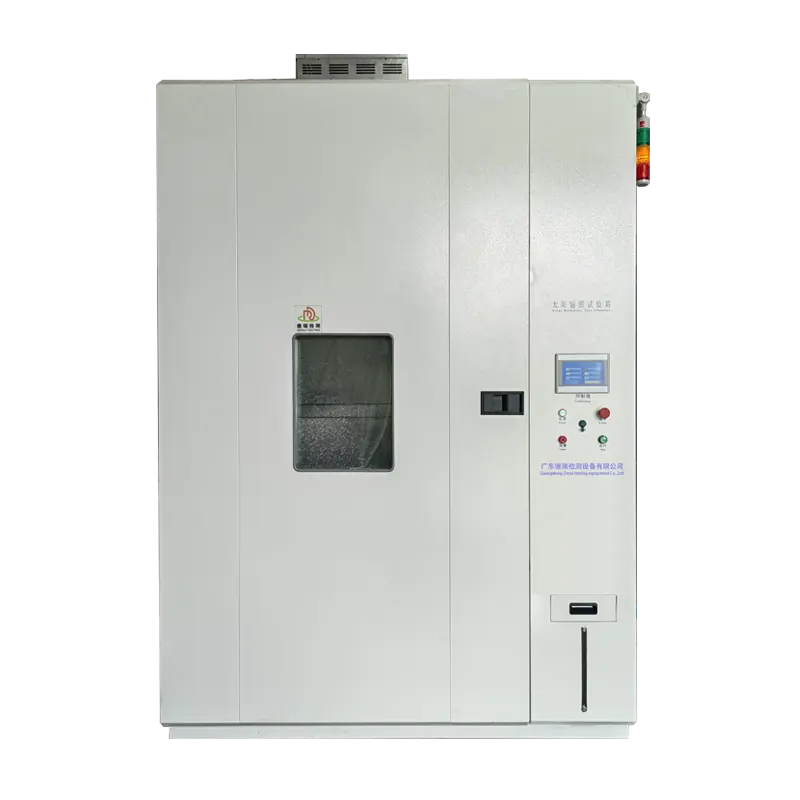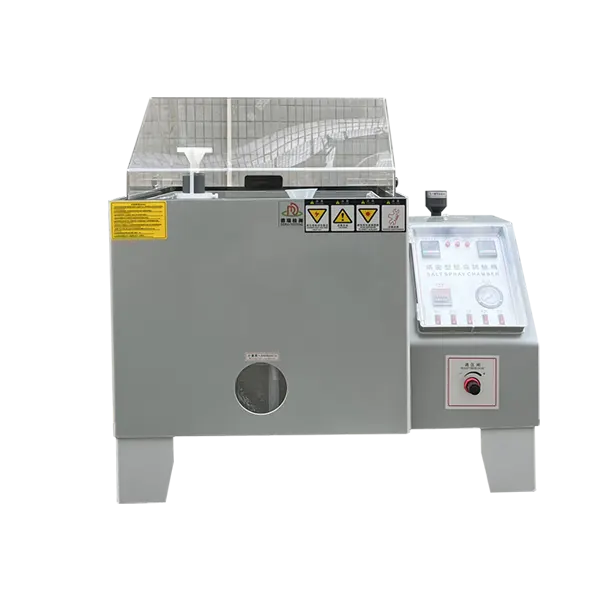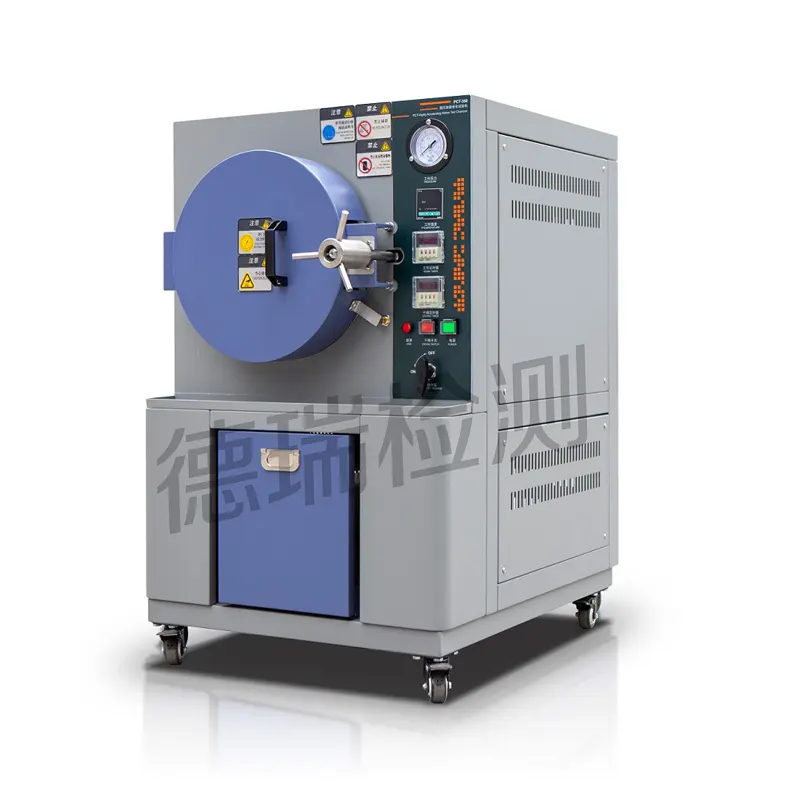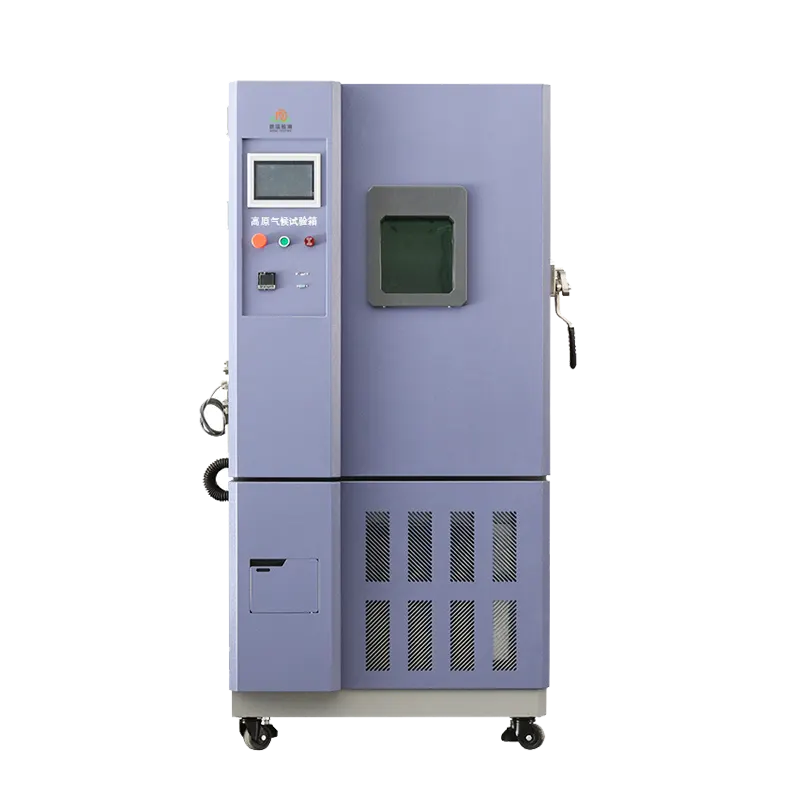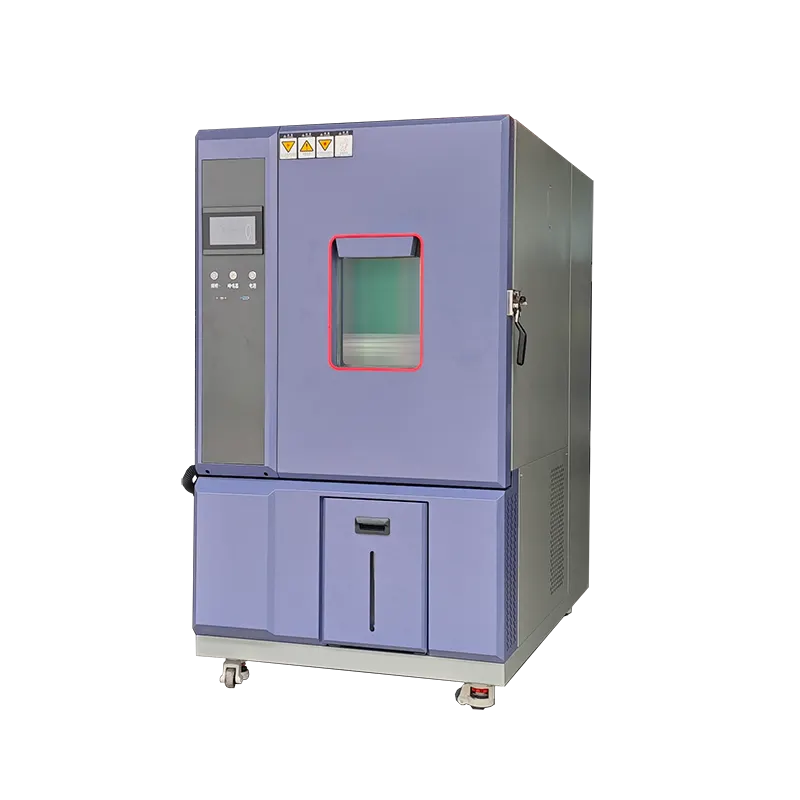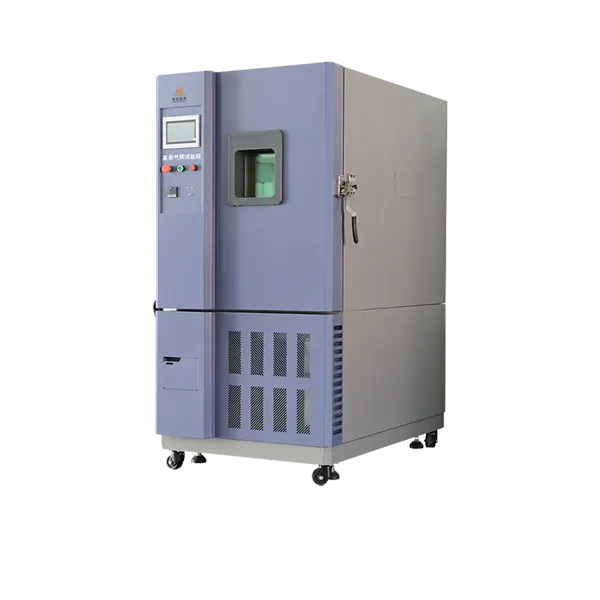








Altitude Temperature Test Chamber for Combined Environmental Testing
Configure high- and low-temperature testing with controlled low air pressure in one chamber. The DR-H208 series supports powered specimens, programmable temperature-pressure profiles and traceable records for aerospace, defense, automotive, electronics and research applications.
Product summary
An altitude temperature test chamber reproduces reduced atmospheric pressure together with high or low temperature. It is used to evaluate whether a powered or unpowered specimen can operate, dissipate heat, maintain insulation, resist leakage and retain mechanical integrity under simulated altitude conditions.
The DR-H208 platform can run temperature or low-pressure exposure independently, or control both stresses in a programmed sequence. Standard models are available from 225 L to 2,000 L. The 1,000 L configuration below is the reference baseline; final dimensions, rates, power and vacuum architecture depend on the selected volume and test profile.
Reference 1,000 L performance
| Parameter | Reference specification | Status / boundary |
|---|---|---|
| Working dimensions | 1,000 (W) × 1,000 (D) × 1,000 (H) mm | 1,000 L baseline |
| External dimensions | Approx. 1,650 (W) × 2,050 (D) × 2,100 (H) mm | Configuration dependent |
| Temperature range | -40°C to +150°C | Reference standard -20/-60/-70°C low end or +180°C high end optional |
| Temperature fluctuation | ≤ ±0.5°C | Atmospheric pressure, empty chamber, stabilized condition |
| Temperature uniformity | ≤ 2.0°C | Atmospheric pressure, empty chamber |
| Temperature deviation | ≤ ±2.0°C; at ≥100°C, ≤ ±3.0°C | Atmospheric pressure, empty chamber |
| Heating time | +20°C to +150°C within 60 min | Atmospheric pressure, empty chamber, whole-range average |
| Cooling rate | Approx. 0.7 to 1.0°C/min from +20°C to the selected low-temperature endpoint | Atmospheric pressure, empty chamber average |
| Pressure type and range | Absolute pressure; 101.3 kPa to 0.5 kPa | 1 kPa or 0.1 kPa endpoints by configuration |
| Altitude reference | Approx. 1 kPa ≈ 30,000 m; 0.5 kPa ≈ 35,000 m; 0.1 kPa ≈ 45,000 m | Indicative conversion; the test method governs the pressure setpoint |
| Pressure reduction | Atmospheric pressure to 1 kPa within 30 min at room temperature | Some configurations ≤45 min; rapid system ≤20 min |
| Pressure recovery | Adjustable, normally ≤10 kPa/min; about 10 min from 1 kPa to atmospheric pressure | Confirm the required procedure before manufacture |
| Pressure deviation | ≥40 kPa: ±2 kPa; 4–40 kPa: ±0.5 kPa or ±5%; ≤4 kPa: ±0.1 kPa | Final criterion stated in the technical agreement |
| Power supply | AC 380 V ±10%, 50 Hz, three-phase four-wire plus protective earth | 1,000 L reference: approx. 18 kW / 35 A |
| Reference weight | 225 L approx. 1,200 kg; 720 L approx. 1,800 kg; 1,000 L approx. 2,000 kg | Final weight follows chamber and vacuum/refrigeration configuration |
Chamber and pressure-system overview
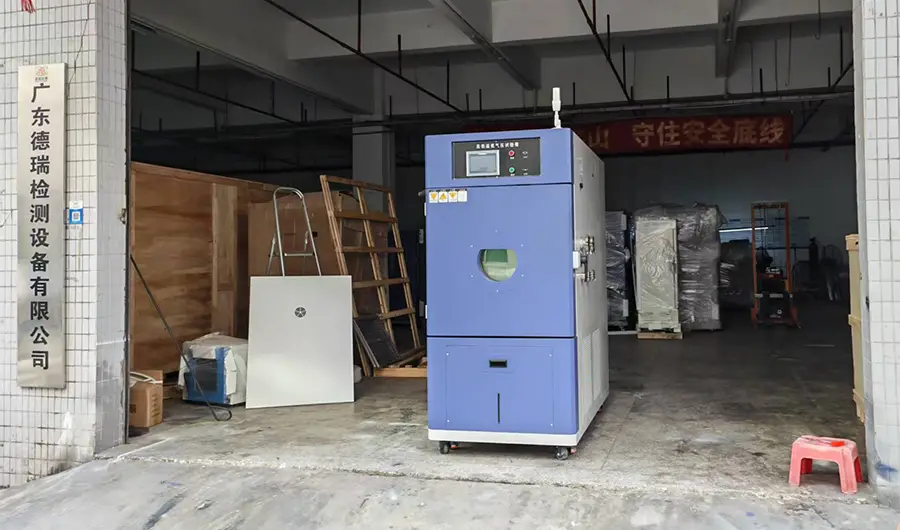
DERUI 1,000 L altitude temperature test chamber with its pressure-control and vacuum-system arrangement.
Standard equipment supplied with the 1,000 L baseline
Optional engineering modules
| Option | When it is needed | What must be confirmed |
|---|---|---|
| Humidity function | Temperature-humidity-pressure programs; nominal 20%–98% RH near atmospheric pressure | Humidity at low pressure is not standard; provide the exact coupled condition |
| Rapid decompression / recovery | MIL-STD-810H Method 500.6 rapid or explosive decompression procedures | Starting/ending pressure, transition time, load and safety response |
| Oil-free or Roots-assisted vacuum | Clean testing, higher pumping speed or large workspace | Ultimate pressure, contamination limit and pump redundancy |
| Battery safety package | Powered cells, modules or packs under low-pressure testing | Hazard analysis, gas detection, pressure relief, fire strategy, interlock matrix and local rules |
| Vibration integration | Combined climatic and mechanical-stress testing | Shaker interface, load, fixture, vibration axis and chamber sealing |
| Remote and data integration | PC supervision, MES connection, video monitoring or expanded acquisition | Protocol, cybersecurity, data fields, sampling and retention |
| Multi-channel feedthrough | Several powered or monitored specimens | AC/DC current, connector type, RS485/CAN/Ethernet and sealing |
| Third-party calibration | Customer, export or laboratory-quality requirements | Required CNAS/CMA scope, points, uncertainty and certificate language |
| Custom chamber performance | Non-standard volume, wider temperature range or faster temperature change | Engineering review is required for -80°C to +200°C or 5–25°C/min proposals |
Typical test applications
Standards and procedure coverage
| Standard / method | Capability statement | Configuration boundary |
|---|---|---|
| MIL-STD-810H Method 500.6 | Supports low-pressure storage, transport and operation profiles | Rapid and explosive decompression require the corresponding optional system |
| IEC 60068-2-13 | Supports basic low-air-pressure test conditions | Confirm pressure, duration, specimen operation and recovery sequence |
| RTCA DO-160G Section 4 | Can be configured for applicable temperature and altitude procedures | Required category and complete profile must be stated |
| GB/T 2423.21 | Supports low-air-pressure environmental testing | Use the edition required by the customer or laboratory |
| GJB 150.2A | Can support specified low-pressure procedures | Profile, transition rate and acceptance method govern configuration |
| UN 38.3 T.1 altitude simulation | Can provide ≤11.6 kPa for ≥6 h at the specified ambient condition | Cell/module/pack testing requires project-specific battery safety review |
| Automotive methods | Profiles may be configured for ISO 16750-4, GB/T 28046.4 and applicable GB 38031 work | No blanket compliance claim; identify the relevant clause and specimen type |
| Packaging altitude methods | Reduced-pressure capability may support ASTM D6653 or ISO 2873 procedures | Confirm package dimensions, load and pressure cycle |
Environmental capability does not by itself certify a specimen or guarantee compliance with every clause. DERUI reviews the cited edition, profile, specimen and reporting requirement before confirming the chamber configuration.
Powered specimen and feedthrough setup
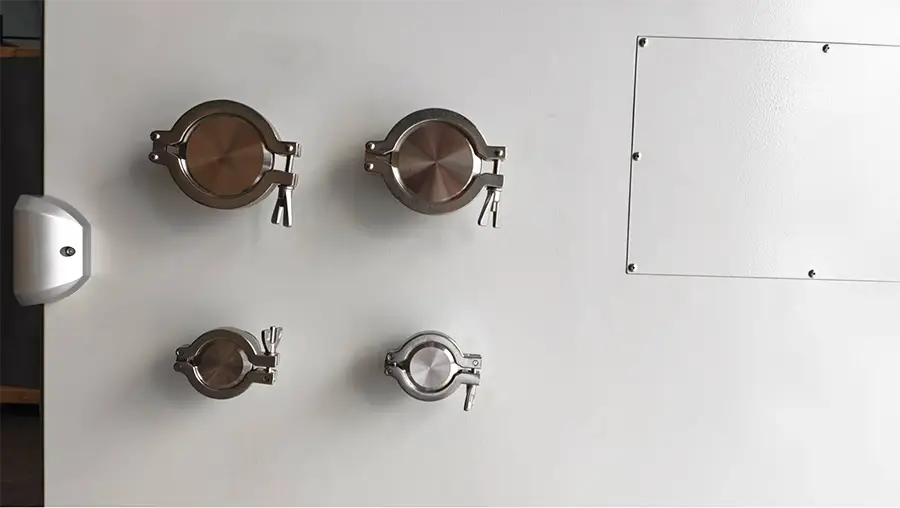
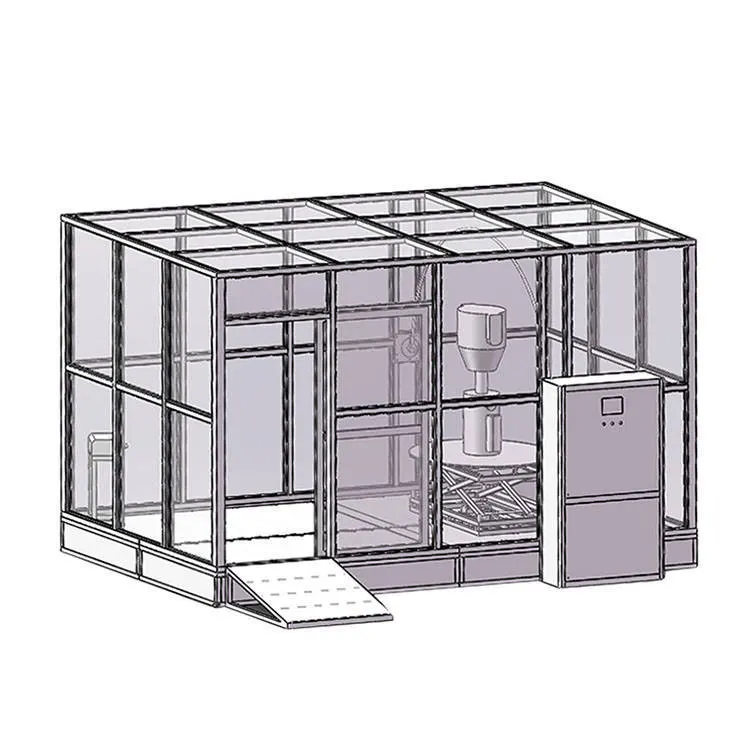
A powered-test arrangement showing the working space, sealed feedthrough and monitoring connections.
Calibration and factory acceptance
DERUI performs factory inspection and issues a unit-specific report. The agreed measurement points, loaded or unloaded condition, stabilization rule, instrumentation and acceptance limits should be written into the technical agreement before manufacture.
Recommended FAT schedule
- Approve the test matrix.
Fix temperature points, pressure points, load, dwell, rates and acceptance limits. - Witness performance.
Review temperature mapping, pressure accuracy, transitions and representative coupled operation. - Close the project record.
Confirm alarms, communication, exported curves, deviations, corrective work and signed FAT report.
Traceable temperature-pressure record
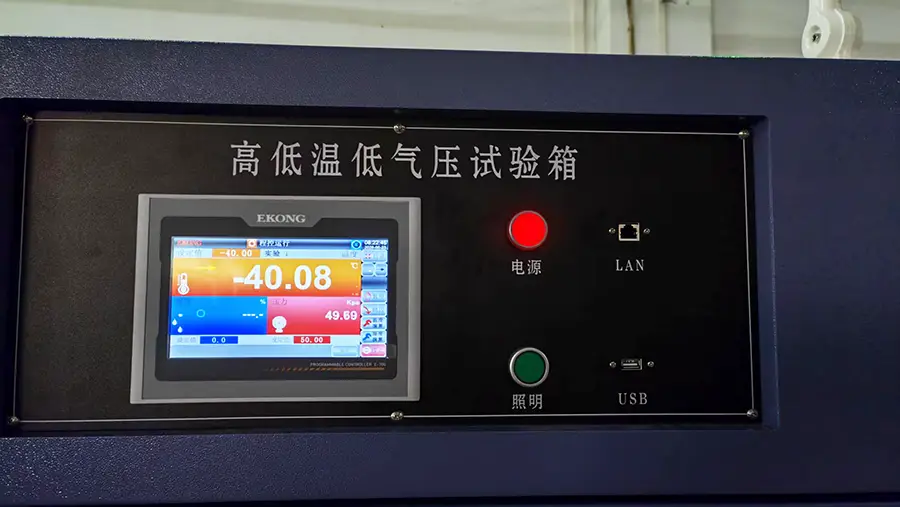
Temperature and absolute-pressure data support review of stability, transitions and the agreed acceptance profile.
Documents and accessories supplied
| Delivery item | Standard scope |
|---|---|
| Operating manual | Installation, operation, maintenance and operating procedure |
| Factory inspection report / acceptance sheet | Unit-specific performance records |
| Qualification and warranty documents | One set supplied with the equipment |
| Factory calibration report | Measurement results and applicable uncertainty information; third-party CNAS certificate optional |
| Electrical schematic / wiring diagram | Supports maintenance and approved modification |
| Spare-parts list | Identifies consumables such as pump oil, seals and fuses |
| Hardware accessories | Shelves, rails, door keys, power cable and printer consumables if a printer is installed |
| Training record | Provided where included in the project contract |
Warranty and technical support
Remote diagnosis can use the confirmed LAN/RS485 interfaces. On-site work, calibration, consumables, vacuum-pump oil, misuse and operation outside the approved range are handled according to the contract and service terms.
Information required for an accurate quotation
| Requirement | What to send |
|---|---|
| Governing procedure | Standard name, exact edition, method/section/category and customer-specific deviations |
| Specimen | Dimensions, mass, quantity, heat output, operating state and hazard information |
| Temperature-pressure profile | Start/end values, simultaneous or sequential operation, rates, dwell and cycle count |
| Working space | Loaded envelope, fixtures, clearances, shelves and access arrangement |
| Powered monitoring | AC/DC power, current, sensor count, CAN/RS485/Ethernet and connector/feedthrough type |
| Safety | Battery chemistry, stored energy, flammable materials, vent gas and required interlock response |
| Installation | Site voltage, cooling-water availability, room conditions, access path and service clearance |
| Acceptance | Calibration points, FAT witness requirement, report language, third-party certificate and delivery date |
Frequently asked questions
Can temperature and low pressure run at the same time?
Yes. The chamber can operate temperature and pressure independently or in a combined program. Send the required coupled setpoints because atmospheric temperature performance does not automatically apply at the lowest pressure.
What is the difference between absolute pressure and gauge pressure?
Altitude simulation is specified using absolute pressure referenced to vacuum. A value such as 11.6 kPa therefore means 11.6 kPa absolute, not 11.6 kPa below local atmospheric pressure.
Does 0.5 kPa equal one exact altitude?
No single conversion is universally exact because atmospheric models and conditions differ. Use the pressure value required by the governing test method; altitude figures on this page are selection references.
Can the chamber perform UN 38.3 T.1?
The pressure system can be configured for the T.1 altitude-simulation condition. Battery testing also requires the complete UN procedure, suitable specimen handling and a project-specific safety review. It should not be confused with T.4 shock testing.
Is humidity included?
Humidity is optional. The typical humidity range applies near atmospheric pressure; low-pressure/high-humidity conditions require separate engineering confirmation.
Can powered specimens be monitored?
Yes. The confirmed 1,000 L baseline includes auxiliary specimen power and communication/data interfaces. State voltage, current, channels, connectors and signals before manufacture.
Is rapid or explosive decompression standard?
No. Conventional controlled pressure reduction is the baseline. Rapid or explosive decompression requires an optional vacuum/valve/control design matched to the start pressure, end pressure and transition time.
What cooling method is required?
Air or water cooling is selected according to volume, refrigeration load and site conditions. Large cascade-refrigeration systems may require cooling water; final flow, pressure and heat rejection are stated in the installation drawing.
What is included with delivery?
The standard delivery includes the operating documentation, factory inspection and calibration records, qualification/warranty documents, electrical drawings, parts list and agreed hardware accessories. Third-party CNAS calibration is optional.
What should be confirmed before ordering?
Confirm the exact standard, loaded workspace, operating specimen, complete temperature-pressure profile, safety needs, interfaces, utilities and FAT criteria. These determine the chamber architecture more accurately than nominal volume alone.
Related resources
Compare the broader altitude test chamber range, review DERUI's qualifications and measurement evidence, or learn more about DERUI manufacturing and engineering support.
Match the chamber to your actual altitude test profile
Send the complete requirement instead of selecting from pressure and volume alone. DERUI will review the workspace, refrigeration capacity, vacuum architecture, powered interfaces, safety controls and FAT points.
- Standard, edition and procedure
- Specimen size, mass and heat load
- Temperature-pressure sequence and dwell
- Interfaces, safety, utilities and FAT