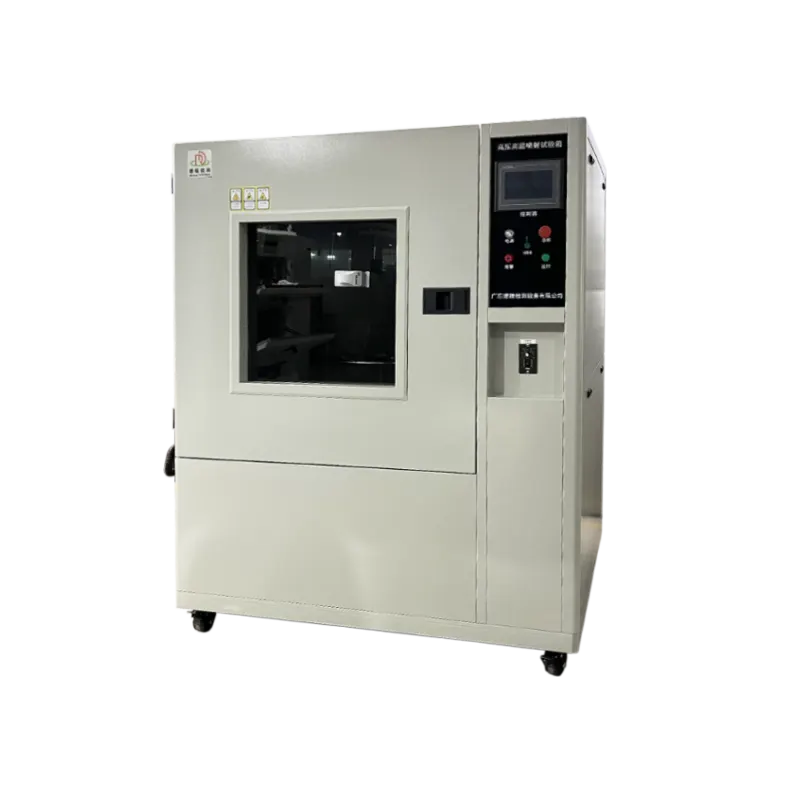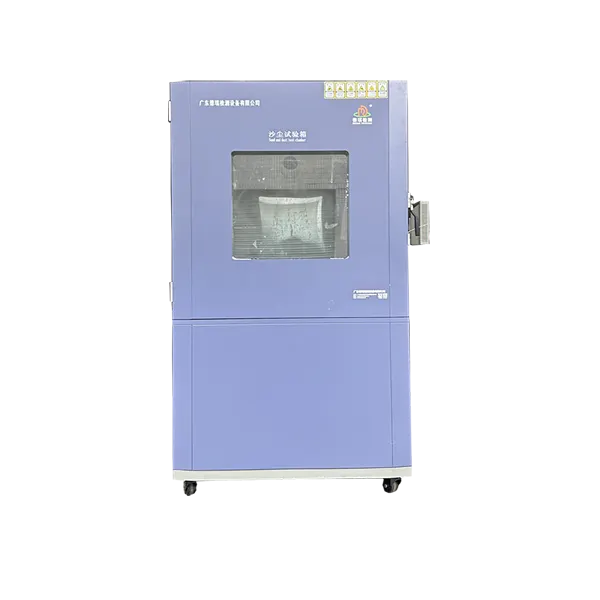
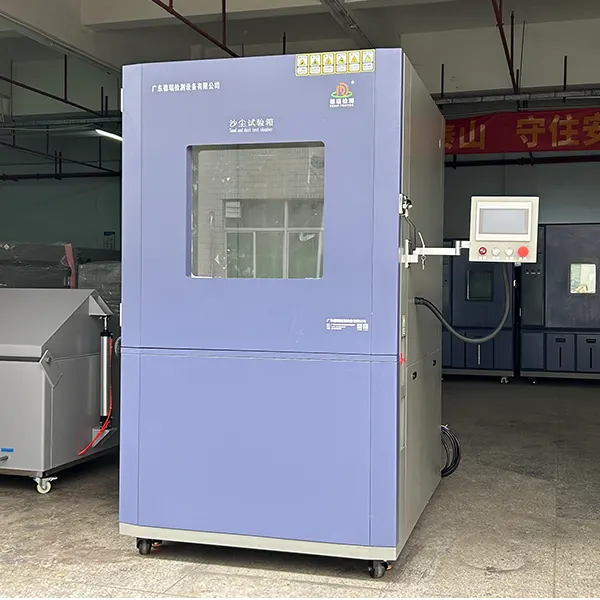
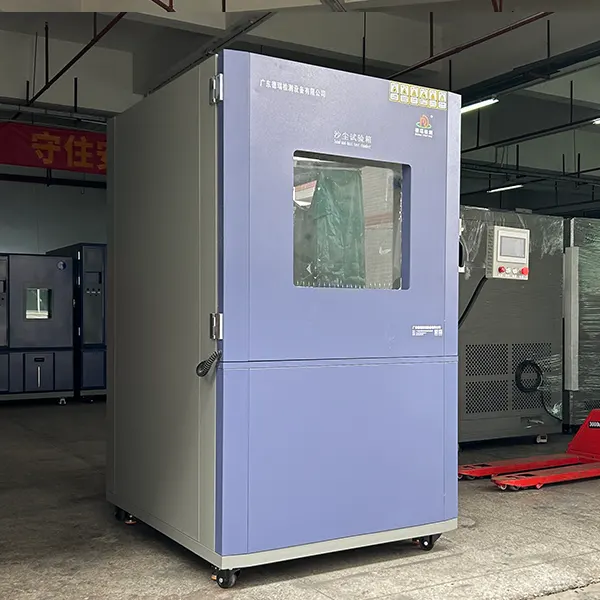








DR-H508 Custom Automotive Sand Test Chamber
Configure the workspace, fixture, specimen power, feedthroughs and operating sequence around vehicle lighting, instrument housings, electrical covers, steering components, locks, seals and other automotive assemblies.
Configure Around the Actual Automotive Assembly
Lighting and optical housings
Define lamp orientation, mounting points, powered state, heat output, ventilation paths and post-test optical or electrical checks.
Controllers and instruments
Specify connectors, communication, monitoring channels, cable glands and whether functional operation continues during dust exposure.
Mechanical parts and seals
Provide the real installation orientation, motion or load state, sealing surfaces and agreed internal inspection method.
Published DR-H508 Construction Features
| Assembly | Published feature | Custom project decision |
|---|---|---|
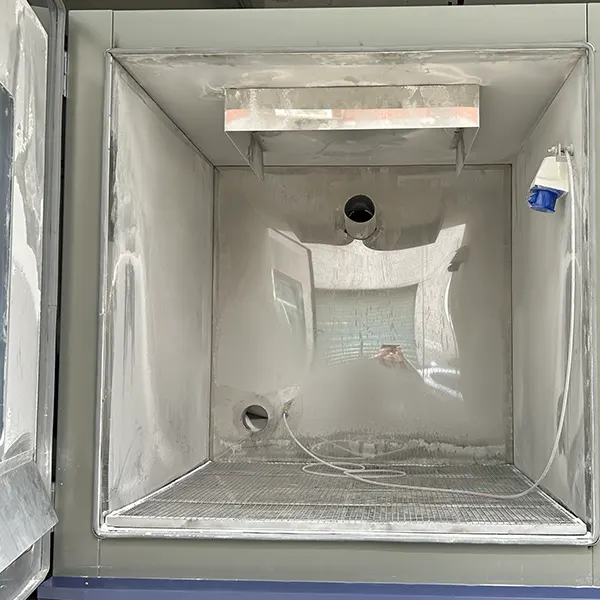
| Interior | SUS304 stainless steel | Confirm dimensions, thickness, shelves, floor loading and cleaning access. |
| Exterior | Cold-rolled steel with baked-paint finish | Confirm colour, footprint, doors and destination environment. |
| Dust-blowing motor | Stainless-steel shell, sealed construction, low-noise/high-speed description | Confirm actual airflow function against the selected method; do not infer a MIL blowing-sand profile. |
| Internal dust path | Funnel-shaped lower shell with adjustable vibration cycle | Confirm recovery path, dead zones and specimen clearance. |
| Observation | Door-mounted observation window | Confirm required size, lighting and safe viewing procedure. |
| Main accessories | Dust fan, vibration motor, heating tube and filter screen | Confirm supplied quantity, material, maintenance access and spare parts. |
| Vacuum components | Vacuum gauge, filter, gas flowmeter and quick connector | Confirm range, accuracy, pump inclusion and specimen connection. |
Published Timing Functions
| Controller item | Published range | What must be defined |
|---|---|---|
| Sandblasting/dust-blowing time | 0–99 h | Active exposure stage and circulation sequence. |
| Impact time | 0–99 h | The page does not define the physical function; clarify the exact controlled output before ordering. |
| Load time | 0–99 h | Specimen power timing, electrical load and safety isolation. |
| Accumulated working hours | 0–9999 h | Maintenance counter, reset permission and record requirement. |
Custom Fixture and Interface Design
Specimen envelope
Provide the largest dimensions, mass, quantity and loading method.
Installed orientation
Replicate vehicle position, fasteners, seals, openings and cable direction.
Powered operation
Define voltage, current, maximum heat, duty cycle and isolation response.
Monitoring
List temperature, voltage, current, communication and functional channels.
Pressure connection
Confirm enclosure category, free volume, target depression, flow limit and connection.
Post-test checks
Define cleaning restrictions, internal inspection and electrical or mechanical acceptance.
DR-H508 Custom Chamber Reference Image
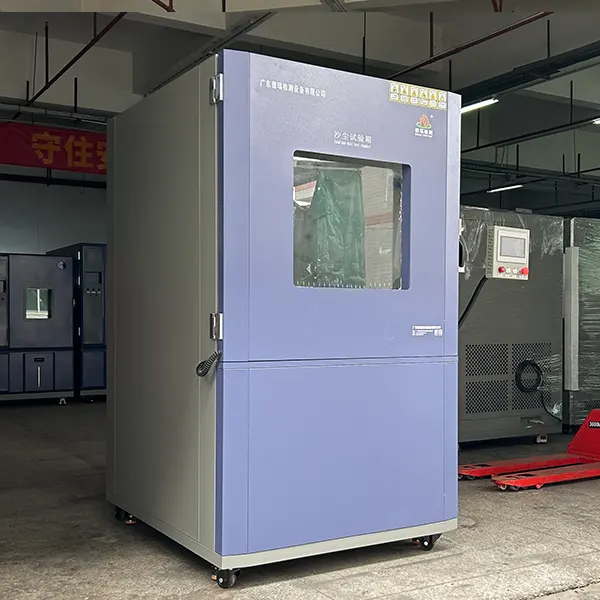
Final workspace, fixture, ports, powered interfaces, dust circuit and vacuum components must follow the approved automotive test configuration.
Three Dust Pages with Three Different Jobs
| Page | Primary role | Do not use it for |
|---|---|---|
| Dust ingress test chamber | Method-led IP5X/IP6X selection, enclosure category and custom chamber sizing | A fixed model specification when the buyer has already selected 1 m³. |
| 1000 L sand dust test chamber | Published DR-H508-2 dimensions, timers, dust loading, power and standard hardware | Non-standard large parts or dedicated automotive fixtures. |
| This custom automotive page | Fixture-led automotive components, powered operation, ports and custom workspace | A generic duplicate description of IP5X/IP6X or the fixed 1,000 L specification. |
Standards Must Be Selected Before Design
| Reference | Potential relevance | Boundary |
|---|---|---|
| ISO 20653 | Degrees of protection for electrical equipment in road vehicles | Confirm designation, edition, enclosure category, pressure condition and acceptance. |
| IEC 60529 | General enclosure IP protection | Use the exact first-digit procedure; water-protection ratings require separate equipment. |
| GB/T 2423.37 / IEC 60068-2-68 | Sand and dust environmental test references | Confirm the applicable method, particle specification, airflow and severity before claiming capability. |
| MIL-STD-810 Method 510 | Tailored blowing dust and blowing sand procedures | Requires a separately verified particle-feed and airflow configuration; DR-H508 naming alone is insufficient. |
Recommended Custom-Project FAT
Mechanical fit and handling
Load the representative fixture or dimensional dummy; verify door, clearance, shelf/floor load, ports and service access.
Sequence and interfaces
Run dust, vibration, heating, load timing, pressure connection, specimen power and monitoring through the agreed programme.
Protection and records
Verify overload, short circuit, grounding, over-temperature, alarm shutdown, accumulated time and required documentation.
Information Needed for a Custom Proposal
| Topic | Provide |
|---|---|
| Automotive part | Drawing, dimensions, mass, quantity, installed orientation and handling points. |
| Method | Standard, edition, designation/procedure, dust and duration. |
| Fixture | Mounting points, allowable materials, rotation/motion if any and access clearance. |
| Powered interfaces | Voltage, current, heat, duty cycle, connectors, communications and monitoring. |
| Pressure condition | Enclosure category, free volume, target depression, flow and pump requirement. |
| Acceptance | Inspection, functional checks, FAT points, data and report format. |
Frequently Asked Questions
Why keep this page if DERUI already has two dust-chamber pages?
This page serves custom automotive projects requiring dedicated fixtures, powered interfaces, monitoring or non-standard workspace. The other pages handle method selection and the fixed 1,000 L configuration.
Are the chamber dimensions fixed?
No fixed dimensions are published on this page. Size the chamber from the specimen envelope, fixture, circulation clearance and loading access.
What does the published “impact time” control?
The existing page does not define it clearly. The quotation must identify the physical output and sequence before the term is used as a product claim.
Are powered automotive components supported?
They can be considered only after specimen voltage, current, heat, feedthroughs, monitoring and isolation are engineered into the quoted configuration.
Does this chamber automatically support MIL-STD-810 Method 510?
No. The exact procedure, particle feed, airflow, temperature and controls require separate confirmation.
What evidence should be requested before shipment?
Request the approved drawing, configuration list, representative-load FAT, interface checks, protection tests, manuals, wiring information and agreed calibration records.
Build the Chamber Around the Vehicle Component
Send the part drawing, installed orientation, powered interfaces, pressure condition and test method. DERUI can return a custom chamber, fixture and FAT configuration for review.