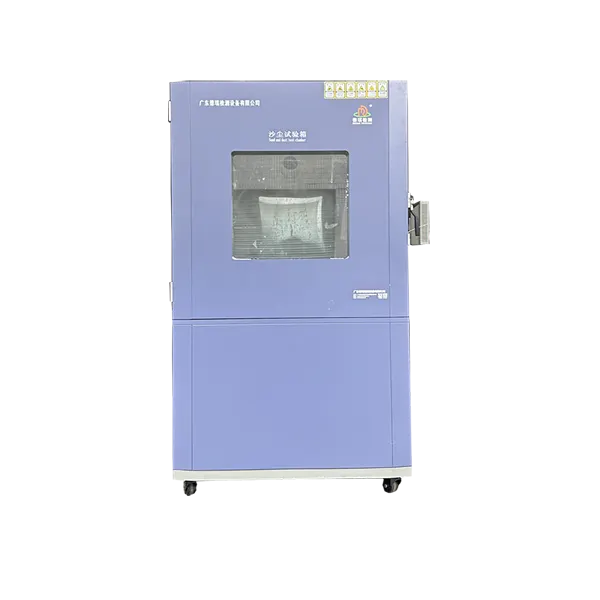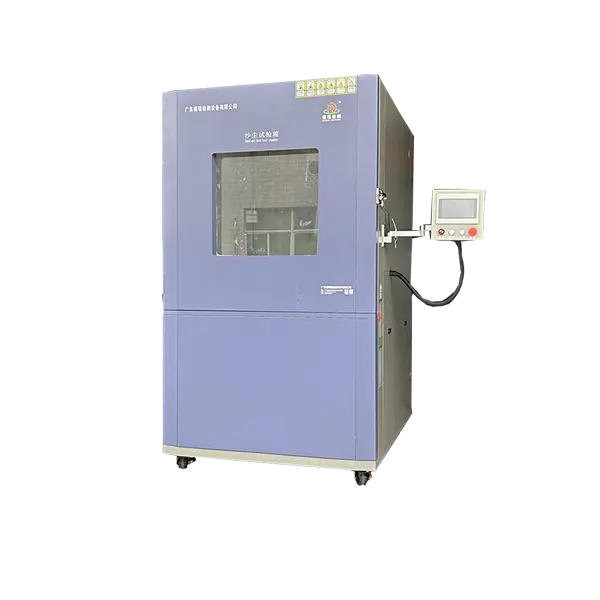








DR-H508-2 1000 L Sand Dust Test Chamber
A floor-standing 1,000 L configuration for enclosure sealing tests on automotive parts, electrical products, instruments and industrial housings. The chamber combines a stainless-steel workspace, dust recirculation, pneumatic vibration, dust heating and provision for specimen pressure connection.
Where This 1,000 L Configuration Fits
Automotive assemblies
Headlamps, instrument housings, electrical covers, steering components, locks and seals that fit the 1 m³ workspace and required clearances.
Electrical enclosures
Control boxes, appliances, instruments and outdoor electronics evaluated for dust entry under a specified enclosure-protection procedure.
Production and design verification
Use repeatable timing, dust circulation and specimen connections for engineering validation, incoming checks or periodic quality control.
Published DR-H508-2 Specifications
| Item | Published value | Technical-agreement check |
|---|---|---|
| Internal dimensions (D × W × H) | 1000 × 1000 × 1000 mm | Confirm usable clearance, shelves and specimen orientation. |
| External dimensions (D × W × H) | 1480 × 1260 × 1980 mm | Check doorway, transport route, service and cleaning clearance. |
| Metal mesh wire / nominal pitch | 50 μm / 75 μm | Confirm terminology and required sieve specification for the selected method. |
| Dust consumption | 2 kg/m³ | Treat as published loading, not continuously measured airborne concentration. |
| Vibration timer | Up to 99 min 59 s | Confirm cycle logic and interval setting. |
| Test timer | Up to 99 h 59 min | Confirm required duration, interruptions and accumulated-time handling. |
| Specimen power socket | Dustproof AC220 V, 16 A | Confirm specimen current, heat and destination socket arrangement. |
| Power supply | AC380 V ±10%, 50 Hz, three-phase five-wire | Confirm destination voltage and protective device before production. |
Construction and Control System
| Assembly | Published construction or function | Why it matters |
|---|---|---|
| Cabinet | Powder-coated steel exterior; SUS stainless-steel mirror-finish interior | Supports cleaning, durability and dust containment. |
| Door and observation | Transparent glass observation door | Allows visual checks without opening during the active test. |
| Dust circulation | Closed alloy low-noise motor and multi-blade centrifugal fan | Blows settled dust into the workspace for recirculation. |
| Pneumatic vibration | Vibration device and bottom dust-replacement arrangement | Helps return accumulated powder to the circulation path. |
| Dust heating | Stainless-steel mica-sheet heating sleeve with timed control | Helps prevent moisture-related dust clumping; it is not specimen climate control. |
| Controller | Touchscreen with PLC programme and working-time display | Controls test sequence, timing and operating status. |
| Mobility | Fixed casters at the chamber base | Supports positioning while retaining stable placement. |
Vacuum and Safety Configuration
Pressure connection components
The published package includes a pressure gauge, air filter, pressure-regulating tee and connecting pipe. Confirm range, accuracy, flow measurement and specimen connection.
Vacuum pump boundary
The current specification states that the vacuum pump is supplied separately and must be specified when ordering. Do not assume it is included.
Equipment protection
Published protections include leakage, short circuit, over-temperature, motor overheat, over-current, phase-loss and phase-sequence protection.
1000 L Sand Dust Chamber Reference Image
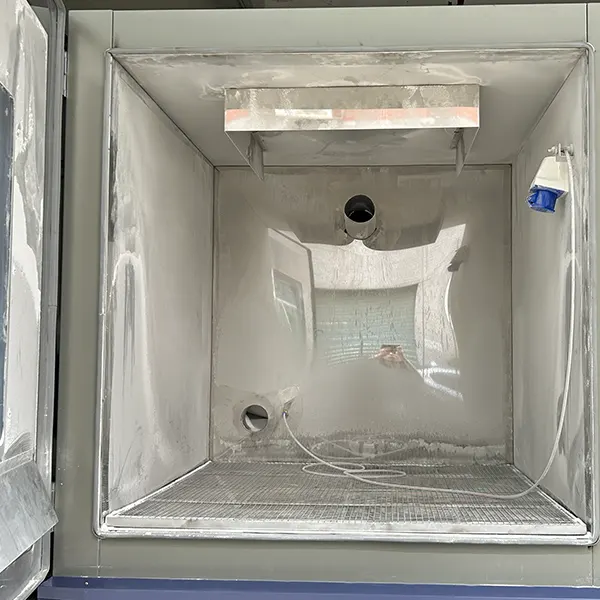
Reference image for the DR-H508 series. Verify the ordered 1000 × 1000 × 1000 mm workspace, controller, ports, vacuum components and destination power against the approved drawing.
Keep the Two Dust Pages Separate
| Page | Primary search intent | Use it when |
|---|---|---|
| This 1000 L sand dust chamber page | Specific DR-H508-2 model, 1 m³ dimensions, construction, timers and electrical configuration | The specimen fits the published chamber and the buyer needs a concrete equipment specification. |
| Dust ingress test chamber page | IP5X/IP6X method selection, enclosure category, pressure conditions and configurable chamber sizing | The buyer is still determining the correct method and configuration. |
| Dedicated blowing sand/dust system | MIL-STD-810 Method 510 profiles | The requirement specifies controlled high airflow, particle feed and tailored blowing sand or dust conditions. |
Commissioning and Routine Control
Verify installation
Check floor loading, access clearance, protective earth, three-phase supply and ventilation.
Verify the test medium
Confirm dust specification, dry condition, sieve suitability, loading and reuse/replacement rule.
Verify specimen setup
Record orientation, seals, cable glands, powered state and any pressure connection.
Run the approved cycle
Set circulation, vibration, heating and test timers according to the selected procedure.
Recover and clean
Allow dust to settle, protect operators and avoid moving external powder into the enclosure during handling.
Inspect and document
Apply the agreed internal inspection, functional checks and acceptance criteria.
Factory Acceptance Checklist
| Check | Recommended verification |
|---|---|
| Dimensions and access | Measure workspace, door opening and external envelope; verify shelves and caster arrangement. |
| Dust circuit | Demonstrate fan, vibration, heating, recovery path and timer sequence. |
| Vacuum components | Verify supplied parts, connection, pressure indication and ordered pump boundary. |
| Specimen power | Confirm socket voltage/current, isolation and powered-load restrictions. |
| Safety | Test leakage, short-circuit, over-temperature, motor, over-current and phase protections. |
| Documentation | Check manual, wiring diagram, inspection record, packing list and agreed calibration evidence. |
Frequently Asked Questions
Is this page the same product as the dust ingress test chamber page?
They are related, but the page roles are different. This page presents the published 1,000 L DR-H508-2 configuration; the other page explains method-led IP5X/IP6X selection and custom sizing.
Is the vacuum pump included?
The current specification says it is supplied separately and must be specified when ordering. Confirm the pump, control range and flow requirements in the quotation.
Does 2 kg/m³ mean measured airborne dust concentration?
No. It is published as dust consumption/loading. Do not describe it as continuous concentration measurement unless the ordered system includes verified instrumentation.
Does the dust heating system control specimen temperature?
No. Its stated function is to reduce dust adhesion and clumping. It is not a temperature-conditioning system for the specimen.
Can it perform MIL-STD-810 blowing sand?
Not from the published configuration alone. Method 510 requires separate confirmation of particle feed, airflow, temperature and procedure-specific controls.
What must be confirmed before ordering?
Confirm specimen size and mass, standard, enclosure category, dust, pressure conditions, powered state, destination power, accessories, FAT and documentation.
Confirm the 1 m³ Configuration Against the Specimen
Send the enclosure drawing, required procedure, dust, pressure condition and powered state. DERUI can confirm whether the published DR-H508-2 configuration fits or a different chamber is required.