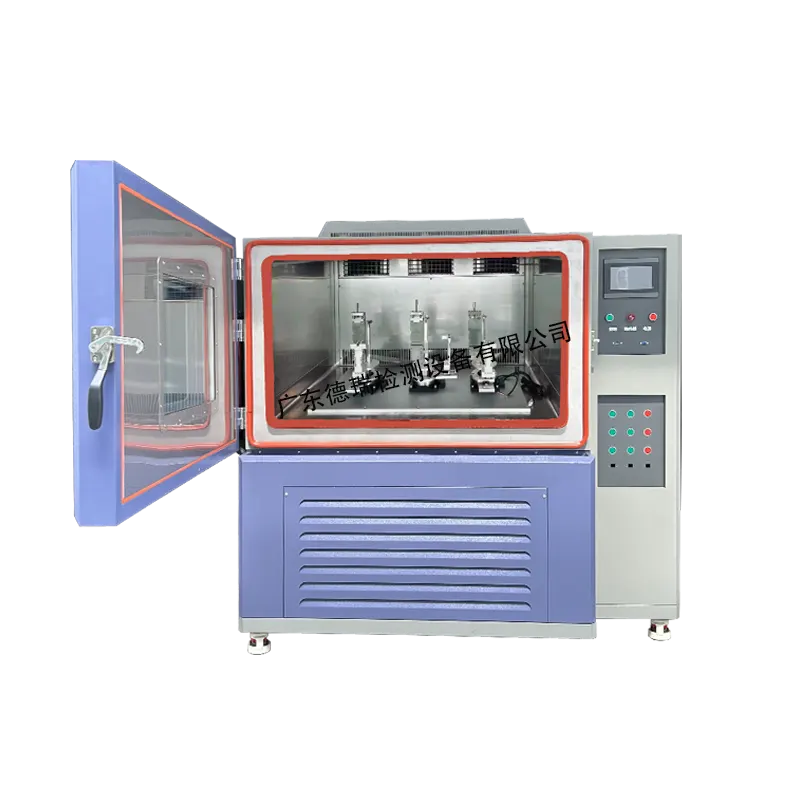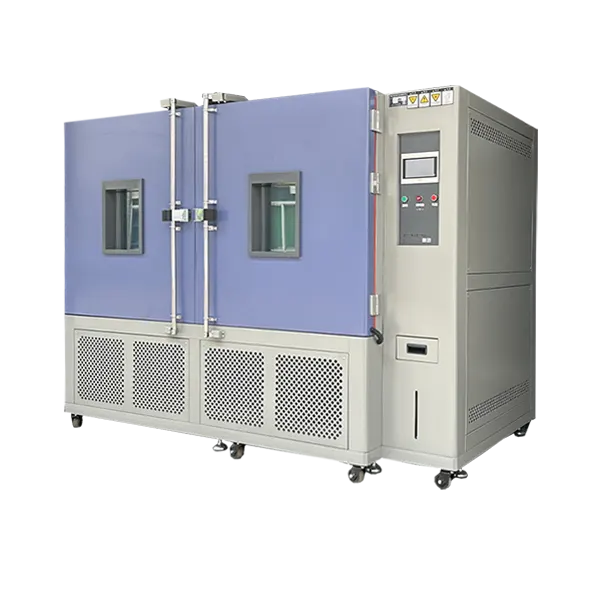








2000L Climate and Temperature Test Chamber for Large Test Loads
Model DR-H201-2000 provides a 2,000 L workspace for large assemblies, multiple specimens and fixtures that cannot be evaluated in a standard cabinet. DERUI configures the temperature range, humidity system, refrigeration capacity, interfaces and site utilities around the actual load and test profile.
What the 2000L Workspace Changes
A larger chamber is not simply a scaled-up cabinet. Product mass, fixtures, cable routing and heat generated during operation affect airflow, pull-down, recovery and uniformity. Define the complete loaded condition before selecting refrigeration and air-handling capacity.
Loaded specimen envelope
Provide the maximum W × D × H, quantity, orientation, mass and support points. Keep clearance around the load so conditioned air can circulate.
Powered heat load
State whether specimens operate inside the chamber and provide their maximum heat dissipation. Live load can materially change achievable ramp and recovery performance.
Access and interfaces
Confirm door opening, test ports, power, thermocouples, signal cables, network connections and any fluid lines before the chamber drawing is approved.
DR-H201-2000 Published Configuration
The following values are retained from the current DERUI product record. Items not yet supported by a final project specification must be confirmed in the quotation and technical agreement.
| Item | Published value | Procurement note |
|---|---|---|
| Model | DR-H201-2000 | Custom 2,000 L environmental chamber |
| Internal workspace | 2000 × 1000 × 1000 mm | Confirm dimension order as W × D × H on the approved drawing |
| Temperature range options | -20°C / -40°C / -70°C to +150°C | Select one low-temperature configuration for the project |
| Published heating rate | 3°C/min | Confirm average or linear rate, measured range, load and cooling rate |
| Control accuracy | ±0.5°C | Confirm sensor location and stabilized test condition |
| Temperature uniformity | ±2°C | Confirm empty or loaded workspace and applicable mapping method |
| Interior | SUS304 stainless steel | Designed for durability and routine cleaning |
| Humidity capability | Project-specific | Confirm required RH range, temperature-humidity envelope and accuracy |
| Exterior, power and cooling | Project-specific | Confirm finish, supply, rated power, air/water cooling and utilities |
Construction, Airflow and Control
Insulated chamber structure
The current design record identifies a SUS304 interior, high-density polyurethane foam and glass-fiber insulation, an illuminated multilayer observation window, a 50 mm cable port, casters and leveling feet.
Forced air circulation
An extended-shaft motor and stainless multi-wing fan circulate conditioned air through the workspace. Final duct design must be reviewed against the occupied volume and fixture layout.
Programmable controller
The published configuration includes a 7-inch color interface, set/actual value display, program and segment status, curve display, timing and cycle information, and RS232/RS485 communication.
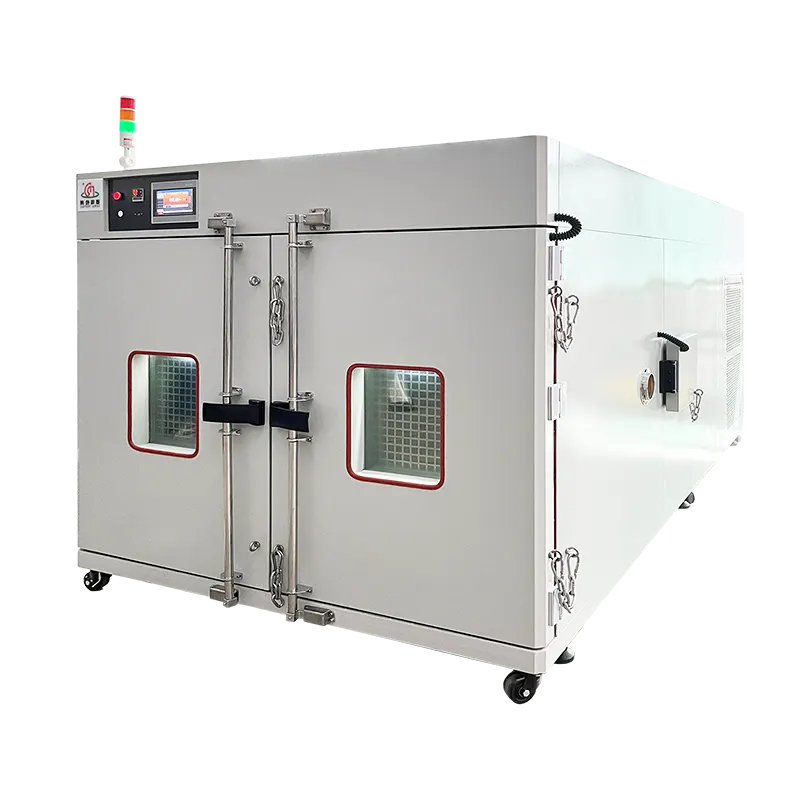
2000L DERUI Chamber Reference Image
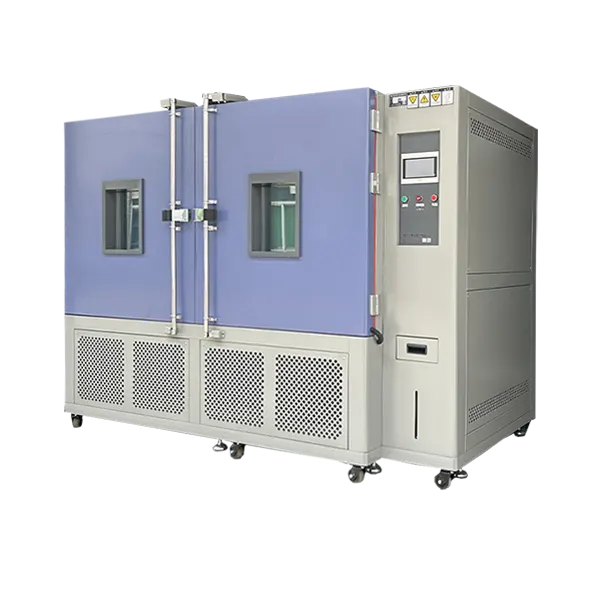
Reference image of the current 2000L DERUI chamber. Final door arrangement, exterior finish, ports and utilities follow the approved project drawing.
Define Performance Before the Design Is Frozen
| Requirement | Information DERUI needs | Why it matters |
|---|---|---|
| Test profile | Temperature and RH setpoints, transitions, dwell, cycles and tolerances | Determines refrigeration, heating, humidification and control capacity |
| Specimen load | Dimensions, mass, quantity, fixtures and material | Affects usable workspace, airflow and response |
| Operating load | Maximum watts, duty cycle and internal auxiliaries | Defines required heat-removal capacity |
| Site utilities | Power, cooling water if applicable, drain, ambient condition and access | Prevents installation and commissioning delays |
| Acceptance | Empty/loaded mapping, sensor points, alarms, data and report format | Creates measurable FAT and delivery criteria |
How to Interpret Large-Chamber Performance
Performance figures only become meaningful when the measurement condition is defined. For a 2,000 L chamber, the technical agreement should separate chamber-air capability from the response of the actual specimen.
Air temperature vs specimen temperature
The controller measures chamber air at a defined sensor location. A dense or insulated specimen may reach the target later, so product temperature should be monitored separately when it governs the test.
Empty vs loaded performance
Uniformity, ramp rate and recovery measured in an empty chamber do not automatically describe a fully occupied workspace. State the load mass, placement and powered heat output for any loaded guarantee.
Average vs linear ramp rate
An average rate is calculated across a defined temperature interval; a linear rate limits the slope throughout that interval. The quotation should name the method, start/end temperatures and allowable tolerance.
Stabilization and dwell
A programmed dwell begins at the controller setpoint unless the procedure states otherwise. For large assemblies, define whether dwell starts after chamber air or designated specimen sensors stabilize.
Door-opening recovery
Recovery depends on door-open time, ambient conditions, load and operating heat. If access during testing is required, include the opening sequence and recovery target in the project specification.
Humidity operating envelope
Relative-humidity capability changes with temperature. Specify combined temperature-RH points rather than separate headline ranges so the humidification and dehumidification system can be sized correctly.
Where This 2000L Chamber Fits—and Where It Does Not
Suitable project direction
Large assemblies, batch-loaded components, cabinets, modules and fixtures that require programmed temperature or temperature-humidity exposure within a 2 m³ workspace.
Powered functional testing
Possible when power, signal and monitoring interfaces are defined in advance and the specimen heat output is included in the refrigeration calculation.
Do not assume equivalence
This configuration should not be treated automatically as a thermal shock chamber, altitude chamber, vibration system or hazardous battery-abuse enclosure. Those exposures require dedicated engineering and safety review.
Recommended FAT for a Custom 2000L Chamber
Agree the acceptance method before manufacturing so the delivered system is judged against measurable project requirements rather than catalogue wording.
| FAT item | What to verify | Acceptance basis |
|---|---|---|
| Drawing and construction review | Internal clear space, door access, shelves/fixtures, ports, drainage, utilities and service clearance | Approved general-arrangement drawing and bill of materials |
| Temperature mapping | Specified sensor positions, setpoints, stabilization, deviation, fluctuation and uniformity | Values and method stated in the technical agreement |
| Humidity mapping, if configured | Agreed temperature-RH points, stabilization and recorded deviation | Approved combined operating points—not separate maximum ranges |
| Ramp and recovery | Defined start/end points, average or linear method, empty/loaded condition and specimen heat | Project-specific guaranteed condition |
| Controls and safety | Programs, alarms, interlocks, sensor faults, communications and data records included in the order | Approved functional checklist |
| Delivery records | FAT report, calibration or verification records, manuals, electrical drawings and packing list | Contract document schedule |
Factory Configuration and Project Options
The published delivery list includes a qualification certificate, user manual, electrical schematic, two specimen trays and eight support hooks. Final quantities, tray loading and documentation must follow the approved bill of materials.
Frequently Asked Questions
Is this a standard 2000L chamber?
No. DR-H201-2000 is presented as a custom large-capacity chamber. The final refrigeration, humidity, interfaces and utilities are selected from the approved test requirement.
Does 2000L guarantee enough usable space?
No. Confirm the loaded envelope, fixture, airflow clearance, cable bend radius and door access. Nominal volume alone does not confirm fit or uniformity.
Can the chamber control humidity?
The current product record describes temperature-humidity control, but it does not publish a complete RH range. The required humidity envelope and accuracy must therefore be confirmed in the quotation.
Is 3°C/min guaranteed with the customer load?
Not from the current published information. Define whether the rate is average or linear, the measured range, specimen mass and operating heat load before stating a guarantee.
What should be included in FAT?
Agree temperature and humidity points, sensor layout, empty or loaded condition, stabilization, uniformity, deviation, alarms, communications, data export and report format before manufacture.
Configure the 2000L Chamber from the Actual Load
Send the test standard, specimen dimensions and mass, fixture layout, powered heat load, temperature-humidity profile, required transition rates, site utilities and FAT criteria. DERUI can review the configuration before preparing the technical proposal.
Request a 2000L Chamber ReviewDownload Equipment Information