CASS Test Explained: Full Form, ASTM B368 and Differences from NSS and AASS
Date: 09/14/2026 Categories: Technical articles Views: 2745
CASS Is a Specific Acidic Salt-Fog Method—not a Generic Name for Every Corrosion Test
Direct answer: CASS stands for Copper-Accelerated Acetic Acid Salt Spray. ASTM B368 specifies CASS conditions for suitable decorative electrodeposited coatings and anodized aluminum. ISO 9227 contains NSS, AASS and CASS as three separate salt-spray methods. They differ in solution chemistry, pH, temperature and intended coating systems, so their exposure hours are not interchangeable.
Use this guide to identify the method your specification actually calls for, understand what the result can demonstrate, and prepare the information needed to select a corrosion test chamber.
What Does CASS Mean?
The full form of CASS is Copper-Accelerated Acetic Acid Salt Spray, also called the copper-accelerated acetic acid-salt spray or fog test. A sodium-chloride solution is acidified with acetic acid and contains a copper salt. The combination creates a controlled, aggressive cabinet environment used to reveal defects and changes in particular protective and decorative finishes.
ASTM states that the method was developed specifically for decorative nickel/chromium and copper/nickel/chromium electrodeposited coatings. Its stated uses include specification acceptance, manufacturing control, research and simulated-service evaluation. The ASTM scope also includes relevant coatings on steel, zinc alloys, aluminum alloys and plastics intended for severe service, plus anodized aluminum. Suitability and correlation should be established before applying CASS to other material systems.
Do not read “accelerated” as a service-life conversion. Ten or twenty-four CASS hours cannot be converted by one universal formula into NSS hours, years outdoors or warranty life. Corrosion mechanisms and correlations depend on the coating, substrate, geometry and real environment.
How NSS, AASS and CASS Change the Test Environment
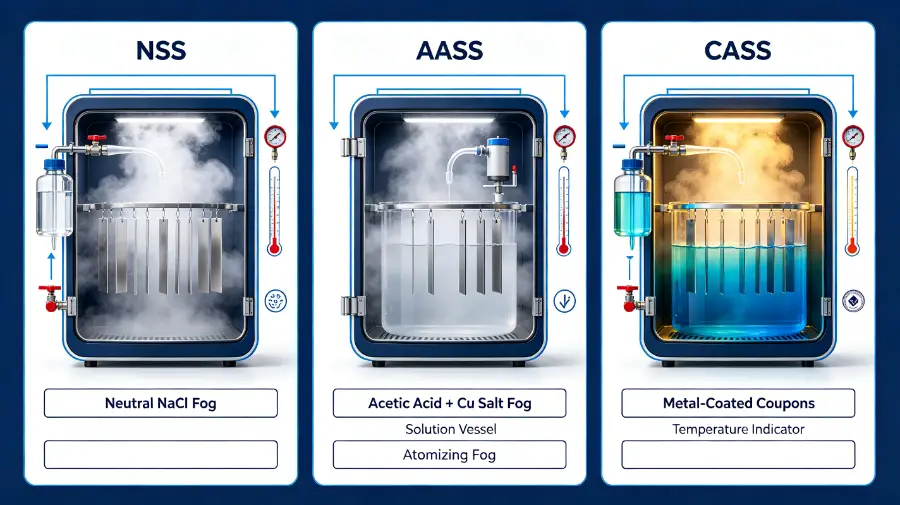
The three methods are related, but they are not simply three selectable “strength levels.” Each has a defined chemistry and intended application. A buyer should therefore begin with the product or customer requirement—not choose CASS only because it is often more aggressive.
| Decision point | NSS | AASS | CASS |
|---|---|---|---|
| Full form | Neutral Salt Spray | Acetic Acid Salt Spray | Copper-Accelerated Acetic Acid Salt Spray |
| Solution concept | Sodium-chloride solution at neutral pH | Sodium-chloride solution acidified with acetic acid | Acidified sodium-chloride solution with copper salt |
| Collected-solution pH | 6.5–7.2 | 3.1–3.3 | 3.1–3.3 |
| Cabinet temperature | 35°C ±2°C | 35°C ±2°C | 50°C ±2°C |
| Typical ISO 9227 use | Metals and alloys; metallic, conversion, anodic oxide and organic coatings | Decorative Cu/Ni/Cr or Ni/Cr coatings; certain anodic and organic coatings on aluminum | Decorative Cu/Ni/Cr or Ni/Cr coatings; certain anodic and organic coatings on aluminum |
| Can hours be directly converted? | No universal conversion should be used. Follow the exposure and acceptance criteria in the product, coating or customer specification. | ||
The table summarizes key method conditions for selection; it is not a substitute for a controlled copy of the applicable standard. Reagent quality, water quality, atomizing air, specimen placement, collection rate, cabinet corrosivity and interruption rules also affect validity.
ASTM B368 and ISO 9227: Related CASS Methods, but Check the Exact Document
ASTM B368-21
ASTM B368 is dedicated to the CASS test. It prescribes the conditions required for specification testing but does not choose the specimen type, exposure period or result interpretation for a particular product. Those decisions remain with the applicable product or coating specification.
ISO 9227:2022
ISO 9227 covers NSS, AASS and CASS apparatus, reagents and procedures and describes evaluation of cabinet corrosivity. ISO states that specimen dimensions, exposure period and interpretation are supplied by the relevant product specification. ISO 9227:2022 also has Amendment 1:2024.
Do not write “tested to ISO 9227” without naming the selected method. A useful test instruction identifies the edition, NSS/AASS/CASS method, specimen preparation and orientation, duration, permitted interruptions, post-test treatment, defect-rating method and acceptance criteria.
ASTM B117 is not ASTM B368. ASTM B117 describes operation of salt-spray apparatus and does not prescribe CASS as a universal replacement for neutral salt fog. Likewise, a CASS chamber does not automatically perform ASTM G85 or automotive cyclic corrosion programs that require separate spray, humidity, drying or temperature transitions.
What Must Be Controlled During a CASS Test?
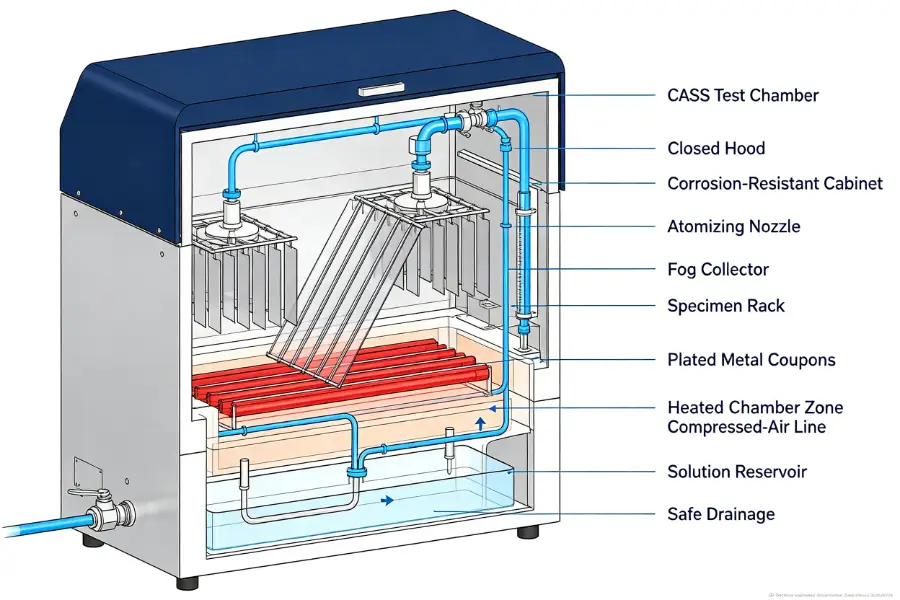
How to Choose Between NSS, AASS and CASS
-
Read the governing requirement
Start with the customer drawing, coating specification, OEM procedure or contract. Record its exact revision.
-
Identify the material system
State substrate, pretreatment, coating layers, thickness, sealing and decorative or functional purpose.
-
Select the named method
Use NSS, AASS or CASS only when the controlling document specifies or permits it.
-
Define the specimen
Confirm size, quantity, orientation, exposed area, cut edges, masking and fixture material.
-
Define duration and acceptance
Take hours, inspection intervals and pass/fail criteria from the product requirement—not from the chamber catalogue.
-
Verify equipment and records
Confirm usable space, chemical compatibility, controls, collectors, utilities, calibration and report fields.
When NSS is usually the better starting point
Choose NSS when a general neutral salt-fog method is explicitly required for the applicable metal or coating system. It is not automatically less valid because CASS is more aggressive.
When AASS may be specified
AASS is intended for suitable decorative coating systems and certain coatings on aluminum where an acidic salt-fog method is required but copper acceleration is not part of the method.
When CASS is appropriate
CASS is particularly relevant to decorative nickel/chromium and copper/nickel/chromium systems and applicable anodized aluminum. Confirm suitability before applying it to paints, zinc-rich systems, electronic assemblies or other materials outside the stated scope.
Information Needed Before Selecting a CASS Test Chamber
| Input | Why it changes the chamber or quotation |
|---|---|
| Standard, method and edition | Separates continuous CASS fog from NSS, AASS and true cyclic corrosion programs. |
| Specimen drawing and quantity | Determines usable chamber envelope, rack design, spacing and fog exposure. |
| Substrate and coating stack | Supports chemical-compatibility review and selection of the correct test method. |
| Exposure and inspection schedule | Defines timer, refill capacity, operating continuity and planned interruptions. |
| Acceptance criteria | Clarifies whether the report must record pits, corrosion area, blistering, rating number or appearance. |
| Required test modes | Confirms whether one system must perform only CASS or also NSS/AASS; cross-contamination control must be reviewed. |
| Site utilities | Defines power, clean compressed air, water, exhaust, drainage and installation conditions. |
| Documentation | Establishes calibration, fog-distribution checks, alarms, data records, FAT and report requirements. |
DERUI’s ASTM B368 CASS corrosion test chamber page explains the product-selection boundary for model DR-H304-6. For broader neutral salt-fog equipment, review the salt spray test chamber range and the ASTM B117 salt spray corrosion chamber.
Five Claims a Defensible CASS Report Should Avoid
CASS Test Frequently Asked Questions
What is the full form of CASS test?
CASS means Copper-Accelerated Acetic Acid Salt Spray. The method uses an acidified sodium-chloride solution containing copper salt in a controlled salt-fog cabinet.
What is ASTM B368 used for?
ASTM B368 specifies CASS test conditions for suitable decorative copper/nickel/chromium and nickel/chromium coatings, related substrates intended for severe service and anodized aluminum. The product specification must provide exposure time and result interpretation.
What is the difference between CASS and NSS?
NSS uses a neutral sodium-chloride solution and normally operates at 35°C. CASS uses an acidified solution containing copper salt and operates at 50°C. They target different coating systems and their hours should not be directly converted.
What is the difference between AASS and CASS?
Both use acidic salt solution, but CASS adds copper salt and uses the CASS cabinet temperature. Choose the exact method named by the governing specification.
What are the typical CASS temperature and pH?
Common ASTM B368 and ISO 9227 CASS conditions include a cabinet temperature of 50°C ±2°C and collected-solution pH of 3.1–3.3. Verify all conditions in the controlled edition used by your laboratory.
How long is a CASS test?
There is no single universal duration. ASTM B368 and ISO 9227 define the test environment; the relevant product, coating, customer or OEM specification defines exposure time and acceptance.
Can CASS test hours predict real service life?
Not by a universal formula. Use CASS for the purpose supported by the applicable specification and any validated correlation for the actual coating and service environment.
Can the same chamber run NSS, AASS and CASS?
Only if the equipment is designed for the required modes and the laboratory has an effective cleaning, contamination-control and verification procedure. Copper and acid residues can influence later work, so confirm this before purchasing.
Confirm the Method Before You Specify the Chamber
Send the standard edition, coating system, specimen drawing, required test modes, exposure schedule and site utilities. DERUI can review whether a CASS configuration or another corrosion-test system fits the requirement.