Temperature and Humidity Testing for Automotive Components: Complete 2026 Guide
Date: 05/15/2026 Categories: Resources、Technical articles Views: 10075
Excerpt:
A comprehensive guide to automotive temperature humidity testing covering ISO 16750 standards, test methodologies, failure modes, and chamber selection for reliable automotive components.
Temperature and humidity test chambers Testing for Automotive Components: Complete 2026 Guide
Temperature and humidity testing for automotive components uses specialized environmental test chambers to validate product reliability under real-world conditions. With over 30,000 parts in modern vehicles, each designed to function across extreme temperature ranges from -40C to +125C, systematic environmental testing is critical for automotive quality assurance.
This guide covers: International standards (ISO 16750, SAE), test methodologies, industry-specific requirements for ECUs and batteries, and practical chamber selection advice for automotive applications.
Why Temperature Humidity Testing Matters for Automotive Quality
Temperature-humidity testing evaluates automotive components for:
- Material stability under sustained moisture exposure in tropical climates
- Component reliability for electronics operating in engine compartments at 125C+
- Corrosion resistance for connectors and fasteners exposed to road salt
- Long-term durability for parts operating across -40C to +85C ambient ranges
Industry Impact
Environmental factors contribute to approximately 30% of all automotive component failures. Average recall costs exceed $500 per vehicle, making proactive environmental testing a critical quality investment.
Key International Standards for Automotive Testing
| Standard | Scope | Key Requirements |
|---|---|---|
| ISO 16750-1 | General requirements | Temperature grades: Grade A (-40C to +50C), Grade B (-40C to +60C), Grade C (-40C to +85C) |
| ISO 16750-2 | Electrical load testing | 24-hour damp heat cycle at 85C/85% RH; identifies insulation degradation and connector corrosion |
| ISO 16750-4 | Climatic testing | Temperature gradients, steady-state exposure, thermal cycling for accelerated aging |
| SAE J1211 | Electronic module characterization | Recommended practices for testing electronic modules in vehicles |
| SAE J1766 | Accelerated exposure testing | Requirements for accelerated exposure of automotive electronic components |
Note: ISO 16750 series serves as the global benchmark, while SAE standards address North American regional requirements. Both frameworks are often referenced together for comprehensive automotive testing programs.
Types of Temperature Humidity Tests for Automotive Components
1. Steady-State Humidity Testing
Maintains constant temperature and humidity for extended durations (typically 96 to 1000 hours). The industry-standard "85/85 test" at 85C/85% RH accelerates aging equivalent to years of field exposure.
2. precision temperature test chambers Testing
Alternates between hot and cold conditions (-40C to +125C), inducing mechanical stress from differential thermal expansion. Thermal shock chambers achieve rapid transitions for severe testing protocols.
Common Automotive Test Conditions
| Condition | Temperature | Humidity | Duration |
|---|---|---|---|
| High Temperature Operation | +125C | N/A | 1000 hours |
| Damp Heat (85/85) | +85C | 85% RH | 1000 hours |
| Temperature Cycle | -40C to +125C | Ambient | 500-1000 cycles |
| Cold Operation | -40C | N/A | 72 hours |
Critical Automotive Components Requiring Environmental Testing
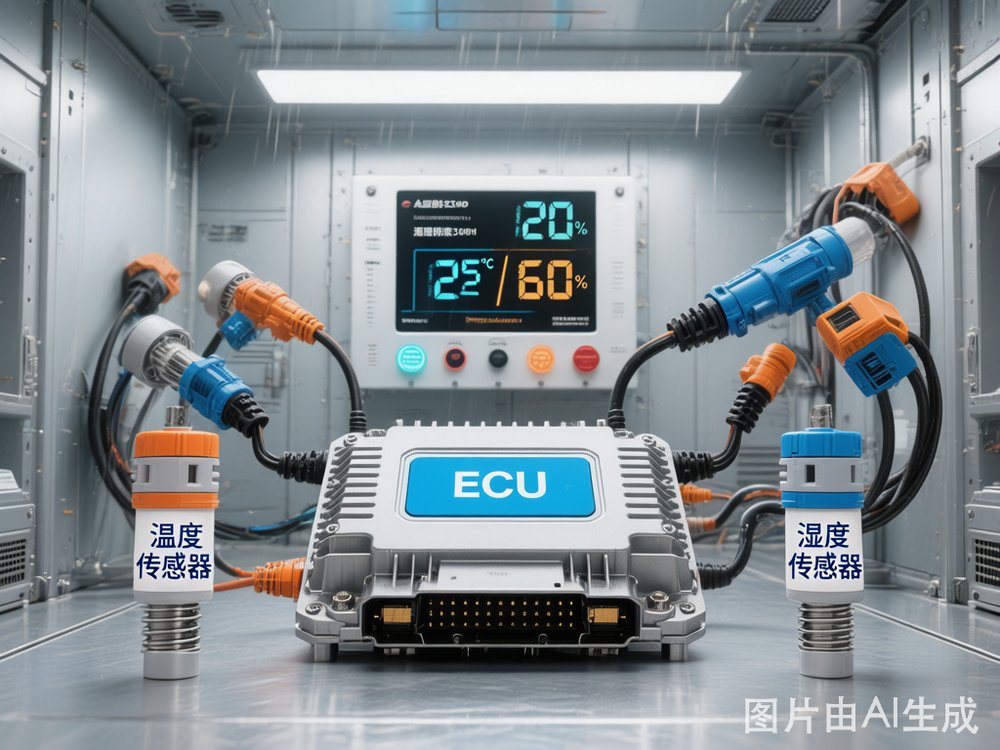
Electronic Control Units (ECUs) and Sensors
Modern vehicles contain over 100 ECUs managing everything from engine control to climate regulation. These electronic modules must survive under-hood temperatures exceeding 125C while maintaining precise signal integrity.
Comprehensive ECU testing validates:
- PCB delamination and trace cracking resistance
- Solder joint integrity under thermal stress from 500+ thermal cycles
- Connector terminal corrosion resistance for humidity exposure
- Semiconductor package moisture sensitivity levels (MSL ratings)
Battery Systems and Energy Storage
Electric vehicle battery packs represent some of the most thermally demanding automotive components. Battery testing chambers must maintain optimal operating temperatures between 15C and 35C while vehicles operate in ambient temperatures ranging from -30C to +50C.
EV Battery Testing Focus
- Capacity retention at -30C cold soak
- Thermal runaway propagation characteristics
- BMS functionality across humidity ranges
- Explosion-proof safety features
UN 38.3 Requirements
- altitude test chambers simulation
- Thermal cycling (-40C to +75C)
- Vibration testing
- Shock and short circuit tests
Interior Trim and Exterior Lighting
Interior components experience elevated humidity during occupant use, condensation from temperature swings, and UV-induced thermal aging. Testing validates adhesive bond strength, surface finish stability, and foam compression set after thermal-humidity cycling.
Exterior lighting systems face thermal cycling from ambient temperatures, solar loading through lens materials, and internal heat from illuminated sources. Testing addresses lens transparency retention and reflector corrosion under humidity exposure.
Environmental Test Chamber Selection for Automotive Testing
Key Consideration: Automotive testing requires chambers with wider temperature ranges (-70C to +180C), faster ramp rates (10C/min heating), and precise humidity control (±2% RH accuracy) for compliance with ISO 16750 standards.
Recommended Chamber Specifications
| Parameter | Minimum | Recommended |
|---|---|---|
| Temperature Range | -40C to +150C | -70C to +180C |
| Heating Rate | 5C/minute | 10C/minute or higher |
| Cooling Rate | 3C/minute | 5C/minute or higher |
| Humidity Range | 30% to 95% RH | 10% to 98% RH |
| Temperature Accuracy | ±2C | ±1C |
| Humidity Accuracy | ±5% RH | ±2% RH |
For comprehensive equipment evaluation, see our manufacturer comparison covering 20 brands across Premium, Mid-High, and China Export tiers.
Common Failure Modes Identified Through Testing
Intermittent Connections
Humidity causes connector terminal oxidation, increasing contact resistance. Temperature cycling exacerbates this through differential thermal expansion.
Delamination
Multi-layer assemblies fail at material interfaces where thermal expansion mismatches concentrate stress over repeated cycling.
Galvanic Corrosion
Corrosion between dissimilar metals accelerates under humidity, particularly when temperature cycling introduces moisture into microscopic gaps.
Seal Degradation
Seal materials degrade under temperature humidity cycling. Leak detection methods quantify sealant performance.
Best Practices for Automotive Temperature Humidity Testing
Specimen Preparation
- Use production-representative samples, not prototypes
- Mount specimens using production-typical methods and hardware
- Include typical wire harnesses and connectors
- Document mounting orientation and torque specifications
Test Parameter Selection
- Match temperature ranges to installation location within vehicle
- Consider shipping and storage conditions (container exposure)
- Reference applicable industry standards (ISO 16750, SAE)
- Document rationale for any protocol modifications
Data Collection and Documentation
- Record temperature and humidity data continuously throughout testing
- Monitor specimen parameters (voltage, current, resistance) during exposure
- Capture photographic evidence of any visible degradation
- Archive raw data for future reference and regulatory compliance
Conclusion
Temperature humidity testing represents an essential discipline in automotive component development, providing the data necessary to predict field performance and identify design weaknesses before they cause customer failures. By following established international standards—including ISO 16750, SAE protocols—manufacturers ensure that automotive components deliver reliable performance across diverse global environmental conditions.
For manufacturers seeking to establish or enhance their environmental testing capabilities, investing in high-quality temperature humidity chambers designed specifically for automotive applications provides the foundation for comprehensive reliability validation.
Related Testing Guides
- Thermal Shock Testing Guide — Learn about rapid temperature transition testing methods for automotive components
- Battery Testing Chamber Guide — Comprehensive EV and automotive battery testing solutions
- Environmental Test Chamber Buying Guide — Equipment selection criteria and procurement recommendations
- Manufacturer Comparison — Compare leading test chamber brands across multiple tiers
Extended Reading: Vietnam Client Automotive Electronics Test Case Study — a real-world case study showing how a Vietnam-based Tier 1 automotive supplier validated ECU reliability under tropical and rapid-cycling conditions using Derui chambers.