How to Choose the Right Temperature Test Chamber: A Complete Guide
Date: 05/16/2026 Categories: Technical articles Views: 10652
Excerpt:
Learn how to select the right temperature test chamber: temperature range, chamber volume, ramp rate, compliance standards (IEC 60068, MIL-STD-810, ISO 16750), and total cost of ownership.
How to Choose the Right Temperature Test Chamber: A Complete Guide
Why Your Temperature Test Chamber Choice Matters
Selecting the wrong temperature test chamber doesn't just waste budget — it can invalidate entire test campaigns. A chamber that cannot maintain uniform temperature distribution, or lacks the cooling capacity for your product's heat load, will produce non-compliant results that fail auditor scrutiny.
This guide walks through every decision factor, with data-backed recommendations drawn from 20 years of manufacturing and servicing environmental test chambers for aerospace, automotive, and electronics customers worldwide.
1. Define Your Temperature Range Requirements
The single most important specification. Common ranges and their applications:
| Temperature Range | Typical Applications | Standard |
|---|---|---|
| -20°C to +150°C | Consumer electronics, general industrial | IEC 60068-2-1/2 |
| -40°C to +150°C | Automotive components, telecom equipment | ISO 16750-4 |
| -70°C to +180°C | Aerospace, military, battery testing | MIL-STD-810H |
| -70°C to +200°C | High-temp curing, specialized materials | Custom specs |
2. Chamber Volume: Don't Undersize
Chamber volume directly affects temperature uniformity and ramp rates. The general rule:
- Product volume < 1/3 of chamber volume — ensures proper air circulation
- Add 20% headroom — for fixtures, wiring, and future product sizes
- Consider heat load — powered devices generate heat during test; oversize accordingly
For reference, Derui's temperature test chamber lineup covers 50L (benchtop) to 3000L (walk-in), with custom sizes available.
50L – 150L
Benchtop / small components
Suitable for R&D labs
200L – 1000L
Standard production test
Most popular range
2000L – 3000L
Walk-in / large assemblies
Automotive modules, battery packs
3. Ramp Rate and Uniformity
Two often-overlooked specs that determine test validity:
Temperature Uniformity
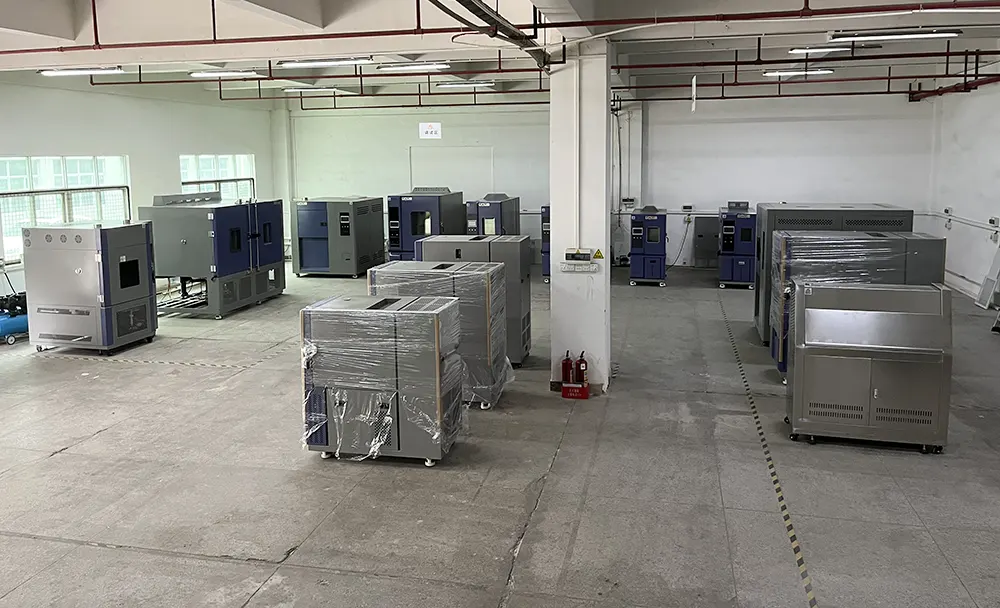
Per IEC 60068-2-1, uniformity must be within ±2°C. Quality chambers achieve ±0.5°C to ±1.0°C. Always ask for the uniformity mapping report — a chamber with poor uniformity can create 5-8°C variation between corners and center.
Ramp Rate (Heat-up / Pull-down)
| Application | Recommended Ramp Rate |
|---|---|
| ESS (Environmental Stress Screening) | 5–15°C/min (rapid change chambers) |
| Qualification testing | 1–3°C/min (standard rate) |
| Battery testing (UN 38.3) | Controlled ramp, typically 1°C/min max |
4. Compliance Standards Checklist
Different industries require different standards. Verify your chamber is certified for:
- ✅ IEC 60068-2-1 (Cold) & IEC 60068-2-2 (Dry Heat)
- ✅ MIL-STD-810H Method 501.7 / 502.8
- ✅ ISO 16750-4 (Road vehicles — Environmental conditions)
- ✅ JIS C 60068 (Japanese standard)
- ✅ UN 38.3 (Lithium battery transport)
If you're testing automotive components, also review our automotive temperature humidity testing guide for ISO 16750 compliance details.
5. Cooling System: Air vs. Water
Large chambers (>1000L) or high-ramp-rate chambers need water-cooled condensers. Air cooling is sufficient for benchtop units and small walk-ins.
| Cooling Type | Pros | Cons |
|---|---|---|
| Air-cooled | No water connection needed, lower install cost | Noisier, limited capacity (~15kW max) |
| Water-cooled | Quieter, higher capacity, better efficiency | Needs cooling tower or water line |
6. Instrumentation and Data Logging
Modern chambers should offer:
- PID temperature controller with programmable profiles (ramp/soak)
- USB/RS232/RS485 data export
- Alarm outputs for over-temperature conditions
- Remote monitoring (Ethernet/IP, Modbus TCP)
Derui chambers come standard with a 7-inch color touchscreen controller, programmable for up to 100 test profiles, with USB data download — no subscription fees.
7. Budget Planning: Total Cost of Ownership
Purchase price is only 40–50% of 5-year TCO. Factor in:
- Energy consumption: ~3-8 kW during cooling, ~2-4 kW during steady state
- Calibration: Annual calibration recommended ($500–$1500/year)
- Maintenance: Compressor service every 3–5 years
- Refrigerant: R404A/R23 — ensure future availability (some regions phasing out)
Quick Decision Flowchart
| Your Need | Recommended Chamber |
|---|---|
| Small R&D lab, occasional testing | 80L–150L, -40°C/+150°C, air-cooled |
| Production line QC | 200L–500L, -40°C/+150°C, water-cooled |
| ESS / rapid temperature cycling | Rapid temperature change chamber, 5–15°C/min |
| Aerospace / military | -70°C/+180°C, MIL-STD-810 certified |
| Large battery modules | Walk-in chamber, -40°C/+85°C, explosion-proof option |
Get a Configured Quote in 24 Hours
Derui has shipped 3,000+ chambers to 40+ countries. ISO 9001 and CE certified. Every chamber is factory-tested with a full uniformity report before shipping.
View Full Temperature Test Chamber Series →
Published: May 2026 | Technical reference for lab managers, test engineers, and procurement teams.