Common Temperature Test Standards Explained: IEC 60068, MIL-STD-810, ISO 16750
Date: 05/16/2026 Categories: Technical articles Views: 9920
Excerpt:
A practical guide to IEC 60068-2, MIL-STD-810H, and ISO 16750-4 temperature test standards. Which one does your product actually need?
Common Temperature Test Standards Explained
Why Standards Compliance Matters
Using a non-compliant chamber — or misinterpreting the standard — leads to two costly outcomes:
- Failed audits: Customer or third-party audits reject test reports if chamber specs don't meet the invoked standard.
- Warranty claims: Products that passed non-compliant tests may fail in the field, triggering warranty costs far exceeding the chamber price.
Always verify that your temperature test chamber has a valid calibration and compliance certificate for the standards you claim to test against.
IEC 60068-2: The Global Baseline
IEC 60068 (Environmental testing — Part 2) is the most widely adopted standard for electronic and electromechanical products. Key temperature-related test methods:
| Test Method | Purpose | Typical Temp Range |
|---|---|---|
| IEC 60068-2-1 (Test Ad: Cold) |
Storage and operation at low temperature | -10°C to -65°C |
| IEC 60068-2-2 (Test Bd: Dry Heat) |
Storage and operation at high temperature | +55°C to +200°C |
| IEC 60068-2-14 (Test N: Thermal Shock) |
Sudden extreme temperature changes | -65°C to +150°C |
| IEC 60068-2-30 (Test Db: Humidity) |
Damp heat, cyclic | +25°C to +55°C, 95% RH |
MIL-STD-810H: Military & Defense
Developed by the U.S. Department of Defense, MIL-STD-810H is widely used beyond military — aerospace, automotive tier-1 suppliers, and industrial equipment manufacturers adopt it for its rigorous environmental profiles.
Method 501.7 — High Temperature
- Storage: up to +71°C (depending on geographic deployment)
- Operation: +30°C to +50°C (with solar loading simulation)
- Includes solar radiation effects (optional)
Method 502.8 — Low Temperature
- Storage: down to -51°C
- Operation: -25°C to -51°C (equipment-dependent)
- Added procedure for cold soak + operational check
Method 503.7 — Thermal Shock
- Transfer time between extremes: <5 minutes
- 10 cycles minimum (unless otherwise specified)
- Focus on material cracking and seal failure
| MIL-STD-810H vs IEC 60068 | Key Difference |
|---|---|
| Temperature Extremes | MIL-STD includes more extreme profiles (-51°C, +71°C) |
| Solar Load | MIL-STD 501.7 includes solar radiation; IEC does not |
| Geographic Tailoring | MIL-STD uses actual deployment locations; IEC uses fixed classes |
ISO 16750-4: Road Vehicles
ISO 16750-4 specifies environmental conditions for electrical and electronic equipment in road vehicles. Critical for any supplier to automotive OEMs (Volkswagen, Toyota, GM, etc.).
| Temperature Grade | Operating Range | Storage Range | Typical Location in Vehicle |
|---|---|---|---|
| Grade A | -40°C to +85°C | -40°C to +90°C | Engine compartment |
| Grade B | -40°C to +65°C | -40°C to +75°C | Passenger compartment (dash/console) |
| Grade C | -40°C to +55°C | -40°C to +65°C | Protected exterior locations |
For a complete walkthrough of ISO 16750 testing, see our automotive temperature humidity testing guide.
Standard Selection Quick Guide
Consumer Electronics
→ IEC 60068-2-1/2
Grade: 0°C to +40°C operating
Automotive
→ ISO 16750-4
Grade A: -40°C to +85°C
Aerospace / Defense
→ MIL-STD-810H
+ solar load simulation
Chamber Compliance Checklist
Before purchasing, verify the chamber manufacturer provides:
- ✅ Factory calibration report traceable to NIST or equivalent
- ✅ Uniformity mapping report (9-point or 27-point, per standard)
- ✅ Compliance certificate for named standards (IEC/MIL-STD/ISO)
- ✅ Temperature ramp rate verification data
- ✅ Annual recalibration service availability
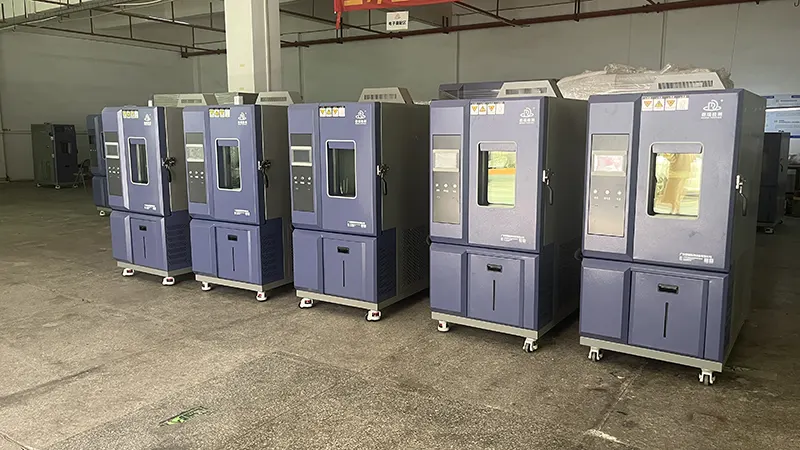
Derui temperature test chambers ship with a full factory calibration report, uniformity mapping, and compliance certificates for IEC 60068, ISO 16750, and MIL-STD-810H. ISO 9001 and CE certified.
Download: Standard Cross-Reference Table
| Test Type | IEC 60068 | MIL-STD-810H | ISO 16750 |
|---|---|---|---|
| Low Temp (Storage) | 2-1 | 502.8 | 4 (Grade A/B/C) |
| High Temp (Storage) | 2-2 | 501.7 | 4 (Grade A/B/C) |
| Thermal Shock | 2-14 | 503.7 | 4 (optional) |
Get Help Specifying Your Chamber
Not sure which standard applies to your product? Derui's engineering team can review your test plan and recommend the right temperature test chamber configuration — with the correct temperature range, ramp rate, and compliance documentation.
View Temperature Test Chambers →
Request Compliance Consultation →
Published: May 2026 | References: IEC 60068-2 (Ed.7), MIL-STD-810H (2024), ISO 16750-4 (2022). For test engineers and quality managers.