DO-160 and MIL-STD-810 Environmental Testing for Aerospace Equipment
Date: 07/29/2026 Categories: Aerospace & Defense、Applications Views: 3646
Aerospace & Defense Application Guide
DO-160 and MIL-STD-810 Environmental Testing for Aerospace Equipment
Turn installation conditions and mission profiles into defensible temperature, altitude, humidity, vibration and combined-environment tests.
What Are DO-160 and MIL-STD-810?
RTCA DO-160 defines environmental conditions and test procedures for airborne equipment. It supports qualification of avionics, sensors, displays, communication equipment, power supplies and other items installed on aircraft. The applicable test categories depend on the equipment location, aircraft type and certification basis—not every unit is subjected to every section.
MIL-STD-810 is a United States Department of Defense test-method standard for environmental engineering and laboratory testing. Its central principle is tailoring: the test program should represent the environments an item will encounter through storage, transport, deployment and operation. A contract or program specification determines which methods, procedures and severities apply.
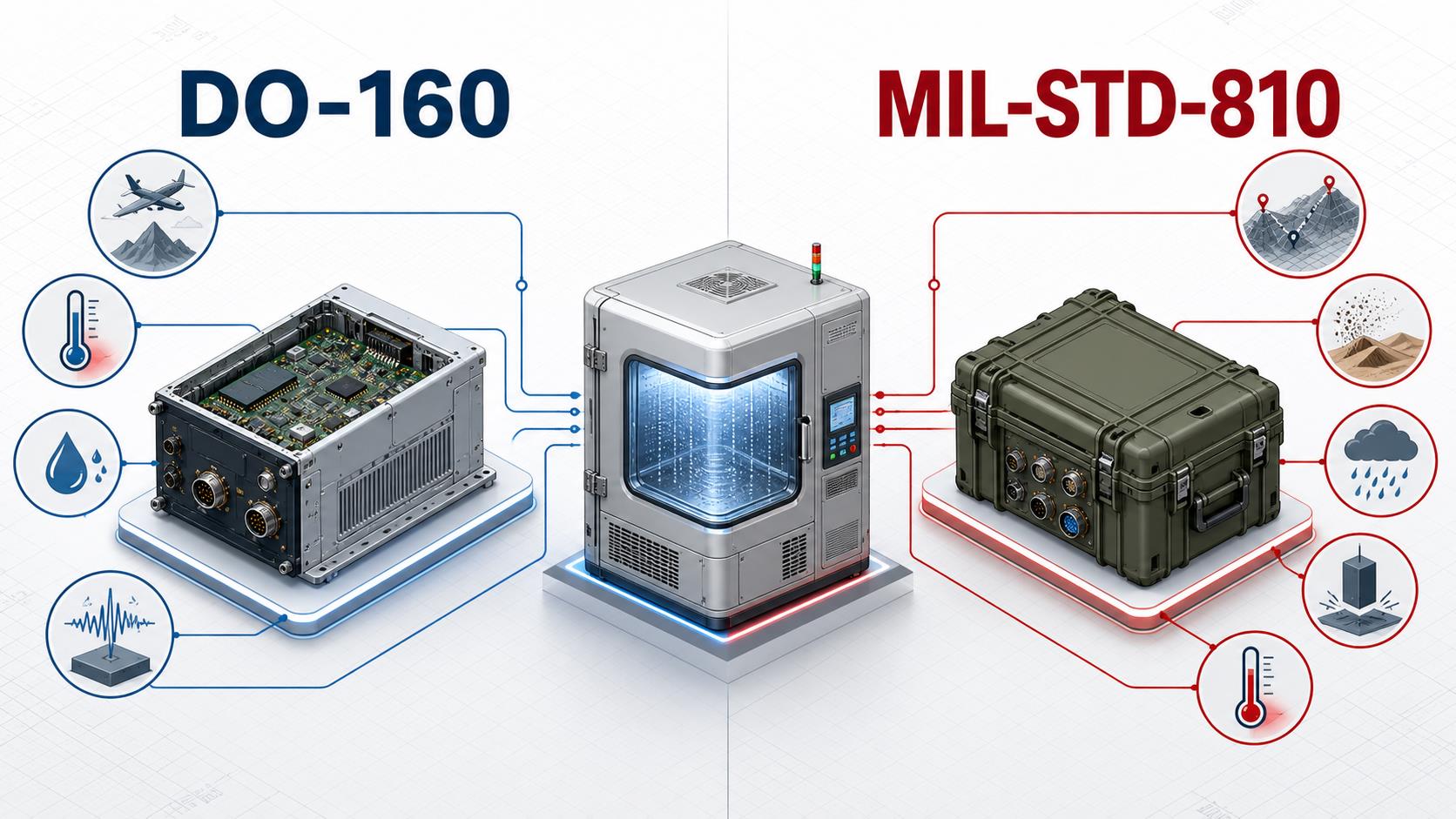 DO-160 focuses on airborne equipment categories, while MIL-STD-810 emphasizes environment and mission-profile tailoring.
DO-160 vs. MIL-STD-810: Which One Applies?
| Decision factor | RTCA DO-160 | MIL-STD-810 |
|---|---|---|
| Primary context | Airborne equipment for civil and other aviation programs | Defense materiel and contractually specified rugged equipment |
| Test selection | Equipment category, installation location and certification basis | Life-cycle environmental profile and program tailoring |
| Typical items | Avionics, flight displays, radios, sensors, power units | Airborne, ground, shipboard and transportable defense equipment |
| Climatic focus | Temperature/altitude, temperature variation, humidity, waterproofness, icing and more | Low pressure, high/low temperature, shock, rain, humidity, sand/dust, salt fog and more |
| Qualification claim | Must identify revision, sections and categories tested | Must identify revision, methods, procedures and tailored parameters |
Some programs reference both standards or add OEM, aircraft, platform and customer requirements. Resolve document precedence before ordering equipment or starting qualification.
Key Aerospace Environmental Tests
Temperature and Altitude
Reduced air pressure changes convective cooling, dielectric behavior, sealed-volume pressure differential and the operation of fans, sensors and displays. Temperature and altitude testing therefore requires more than placing an avionics unit in a cold chamber. Engineers must control pressure, temperature, equipment power and stabilization while monitoring function.
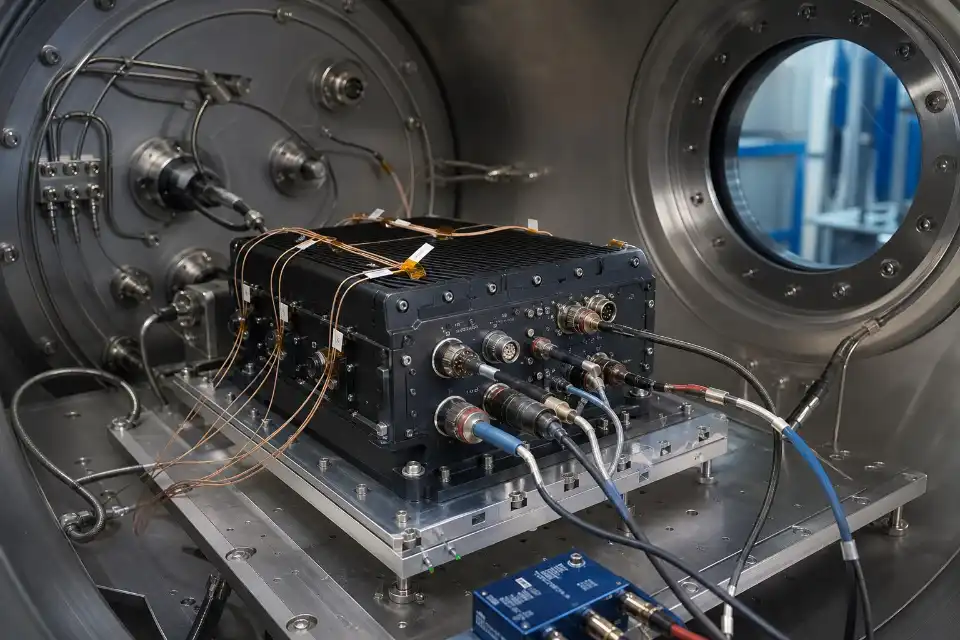 Representative powered avionics testing with pressure-rated feedthroughs, fixture control and multiple product thermocouples.
Temperature Variation and Thermal Shock
Temperature transitions stress solder joints, connectors, seals, optical assemblies and dissimilar materials. Confirm whether the procedure calls for a controlled ramp in one workspace or rapid transfer between zones. See DERUI’s guide comparing a temperature chamber and thermal shock chamber.
Humidity
Humidity testing exposes corrosion, insulation loss, conformal-coating defects and moisture-sensitive materials. Condensation requirements must be explicit: an unintended wet surface may invalidate a dry temperature-variation test, while preventing condensation during a humidity procedure may remove the intended stress.
Vibration and Combined Environments
Vibration can reveal loose hardware, connector fretting, fatigue and intermittent electrical faults. When temperature or altitude is combined with vibration, the chamber, shaker interface, fixture, thermal barrier, cable routing and control system must be engineered as one test system.
Rain, Dust, Salt Fog and Fluids
Exterior, unpressurized and exposed installations may need dedicated waterproofness, sand/dust or corrosion tests. These normally require purpose-built equipment such as a dust ingress test chamber or salt-spray system rather than a standard climatic chamber.
How to Build a Defensible Aerospace Test Plan
-
Define the installation environment
Document the aircraft or platform, pressurized or unpressurized zone, cooling method, mounting orientation, nearby heat sources and expected exposure.
-
Confirm governing documents
Identify the exact DO-160 revision and categories or MIL-STD-810 revision, methods and procedures, plus contract, certification and equipment specifications.
-
Create the life-cycle profile
Include storage, ground operation, takeoff, climb, cruise, descent, landing, transport and maintenance conditions where applicable.
-
Define operating modes
State when equipment is off, powered, transmitting, processing data or driving loads. Define supply, cooling, software, interfaces and monitoring limits.
-
Set acceptance criteria
Specify functional performance, allowable interruptions, leakage, insulation, visual condition and checks during exposure, after exposure and after recovery.
-
Plan sequence and evidence
Define specimen allocation, preconditioning, test sequence, calibration, synchronized data, photographs, deviations and the final report package.
How to Select an Aerospace Environmental Chamber
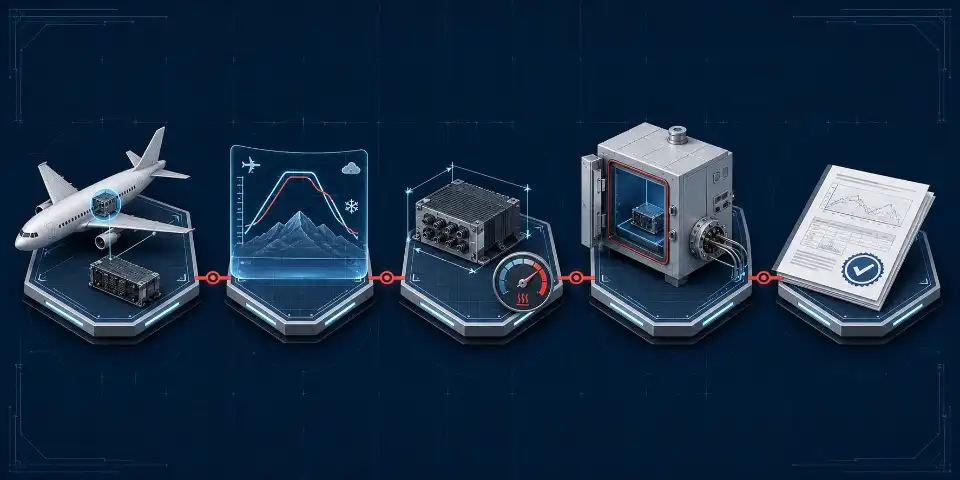 Base chamber selection on installation conditions, the environmental profile, specimen load, interfaces and required evidence.
| Test need | Recommended system | Critical questions |
|---|---|---|
| High/low temperature | Temperature chamber | Range, ramp, specimen mass, powered heat load |
| Temperature and humidity | Temperature/humidity chamber | Operating envelope, condensation and water quality |
| Temperature plus low pressure | Climatic altitude chamber | Minimum pressure, change rate, heat rejection and feedthrough leakage |
| Rapid hot/cold transfer | Thermal shock chamber | Transfer time, recovery, specimen size and cable connection |
| Large assemblies | Walk-in chamber | Floor loading, airflow, access, heat load and facility utilities |
| Combined vibration | Chamber/shaker integrated system | Interface geometry, fixture resonance, sealing and control coordination |
Pressure and Thermal Performance Must Be Evaluated Together
Cooling capacity falls as air density decreases, and a powered avionics unit may run hotter at altitude. Ask for chamber performance at the required pressure, temperature and specimen heat load—not separate best-case specifications.
Specify Feedthroughs Before Manufacture
List power, Ethernet, fiber, RF coax, pneumatic lines, thermocouples and cooling connections. Pressure-rated feedthrough design, cable length and connector access can determine whether functional testing is practical.
Demand Traceable Test Evidence
Confirm calibration, spatial mapping, pressure accuracy, data export, alarms, time synchronization and report requirements. Chamber controller data should align with functional and electrical measurements.
Failures Aerospace Testing Can Reveal
| Failure | Possible mechanism | Evidence to capture |
|---|---|---|
| Reset or communication dropout | Cold start, power margin, connector movement or timing drift | Bus log, supply trace, chamber profile and product temperatures |
| Overtemperature at altitude | Reduced convective cooling or internal hot spot | Multi-point thermocouples, power and pressure record |
| Seal or enclosure leakage | Pressure differential, thermal contraction or gasket damage | Leak test, inspection and pressure history |
| Display or sensor drift | Temperature sensitivity, pressure response or moisture | Reference measurement during and after exposure |
| Intermittent vibration fault | Connector fretting, cracked joint or fixture resonance | Vibration control data synchronized with functional events |
Aerospace Chamber RFQ Checklist
- Applicable standard revision, sections, categories, methods and procedures
- Complete pressure, temperature, humidity and transition profiles
- Specimen dimensions, mass, quantity and mounting fixture
- Maximum powered heat dissipation at each condition
- Minimum absolute pressure and required pressure-change rate
- Required temperature ramp at chamber air and/or product
- All electrical, RF, fiber, pneumatic and cooling feedthroughs
- Functional monitoring, sampling rate and synchronization
- Safety interlocks, specimen power shutdown and alarms
- Calibration, mapping, documentation and witness-test requirements
- Facility power, cooling water, drainage, ventilation and floor loading
Configure an Aerospace Environmental Test System
Send DERUI your test profile, specimen dimensions, powered heat load, altitude requirement, interfaces and governing standard. Our engineers can review the full operating envelope and recommend a temperature, humidity, altitude, thermal shock or custom walk-in solution.
Frequently Asked Questions
What is RTCA DO-160 used for?
It provides environmental conditions and test procedures for airborne equipment. The applicable sections and categories depend on the equipment, installation and certification basis.
Is DO-160 the same as MIL-STD-810?
No. DO-160 is organized for airborne equipment qualification, while MIL-STD-810 uses tailored environmental methods based on the item’s life-cycle and mission profile.
Does DO-160 require every test section?
No. The approved qualification plan identifies the applicable sections and categories. Tests that do not represent the installation may be excluded when properly justified.
What chamber is needed for DO-160 temperature and altitude testing?
A climatic altitude chamber capable of controlling temperature and absolute pressure while supporting powered functional monitoring is typically required. The exact range and pressure-change performance come from the selected category and procedure.
Can a standard temperature chamber perform altitude testing?
No. Altitude simulation requires a pressure-rated vessel, vacuum system, pressure measurement and suitable feedthroughs in addition to temperature control.
Why does avionics heat load matter at altitude?
Lower air density reduces convective heat transfer. Powered equipment may become hotter even when chamber air temperature is unchanged, so chamber and specimen thermal performance must be evaluated together.
Is a test chamber “DO-160 certified”?
It is more precise to state the sections, categories and environmental conditions the chamber is designed to support. Product qualification depends on the complete setup, procedure, instrumentation, evidence and results.