Temperature and Humidity Testing Guide 2026: Complete Technical Reference
Date: 05/15/2026 Categories: Resources、Technical articles Views: 7714
Excerpt:
A comprehensive guide to temperature and humidity testing covering international standards (IEC 60068, MIL-STD-810), testing methods, and chamber selection for electronics, automotive, and pharmaceutical industries.
Temperature and Humidity Testing Guide 2026
Temperature and humidity testing uses specialized environmental test chambers to simulate real-world environmental conditions and validate product reliability. Unlike accelerated life tests that push materials to failure, temperature-humidity tests evaluate performance under sustained environmental stress-critical for electronics, automotive components, pharmaceuticals, and aerospace systems.
This guide covers: International standards (IEC 60068, MIL-STD-810H), test methodologies, industry-specific requirements, and practical chamber selection advice.
Understanding Temperature and Humidity Testing
Temperature-humidity testing exposes products to controlled environmental conditions to evaluate:
- Material stability under sustained moisture exposure
- Component reliability in humid environments
- Moisture-sensitive device (MSD) integrity for semiconductor packaging
- Long-term durability for outdoor and tropical applications
Precision Climate Control
Modern test chambers maintain precise temperature (-40C to +180C) and humidity (5% to 98% RH) with strict uniformity specifications for accurate testing results.
Key International Standards
| Standard | Scope | Key Requirements |
|---|---|---|
| IEC 60068-2-78 | Basic environmental testing | Steady-state humidity at controlled conditions |
| IEC 60068-2-30 | Cyclic damp heat testing | 12h+12h cycles with temperature ramps |
| MIL-STD-810H | Military environmental engineering | Comprehensive climatic testing procedures |
| JEDEC JESD22-A101 | Steady-state temperature-humidity life test | 85C/85% RH accelerated aging |
| GB/T 2423 | Chinese national standards | Equivalent to IEC 60068 |
Note: IEC 60068-2-78 remains the foundational standard, while industry-specific standards (AEC-Q, JESD) reference it for particular applications.
Types of Temperature-Humidity Tests
1. Steady-State Humidity Testing
Maintains constant temperature and humidity for extended durations (typically 96 to 1000 hours).
2. Cyclic Humidity Testing
Alternates humidity levels with temperature cycles, creating condensation-evaporation cycles that simulate real-world conditions.
Common Test Conditions
| Condition | Application | Standard |
|---|---|---|
| 85C / 85% RH | Electronics accelerated aging | JESD22-A101 |
| 40C / 93% RH | Tropical storage simulation | IEC 60068-2-78 |
| 30C / 95% RH | Subtropical long-term storage | GB/T 2423 |
| 60C / 90% RH | Pharmaceutical stability | ICH Q1A |
IEC 60068-2-30 Test Cycle (Variant 1)
- Ramp to 25C / 95% RH over 3 hours
- Hold for 9 hours
- Ramp to 55C / 50% RH over 3 hours
- Hold for 3 hours
- Return to start (3 hours)
Total cycle: 24 hours
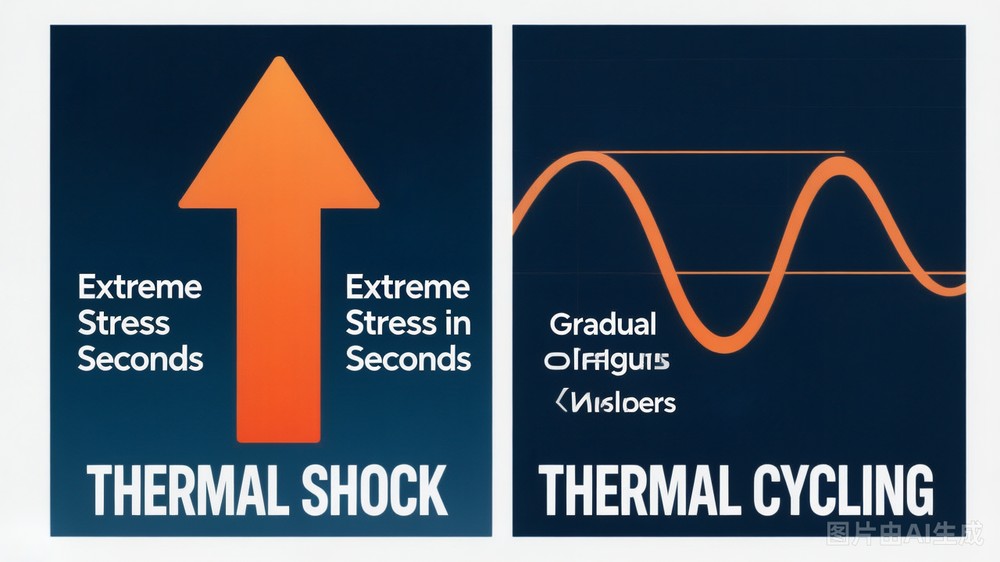
For comparison, thermal shock testing protocols achieve faster temperature transitions but test similar humidity resistance mechanisms.
Industry Applications
Electronics and PCB Assembly
Temperature-humidity testing is essential for moisture-sensitive devices classified under IPC/JEDEC J-STD-020 (Moisture Sensitivity Levels):
| MSL Level | Floor Life | Application |
|---|---|---|
| MSL 1 | Unlimited at less than 30C/60% RH | Baseline certification |
| MSL 2 | 1 year at less than 30C/60% RH | Standard components |
| MSL 3 | 168 hours at less than 30C/60% RH | Sensitive assemblies |
| MSL 5-5a | 24-48 hours | High-sensitivity devices |
Critical: Moisture trapped in packages causes delamination and popcorn cracking during reflow soldering at 260C peak temperatures.
Automotive Electronics
AEC-Q Qualification Requirements are mandatory for automotive-grade components. For EV battery testing chamber requirements including UN 38.3 and IEC 62660 protocols...
| Standard | Component Type | Test Conditions |
|---|---|---|
| AEC-Q100 | Integrated Circuits | 85C/85% RH for 1000h |
| AEC-Q101 | Discrete Semiconductors | 85C/85% RH for 1000h |
| AEC-Q200 | Passive Components | 85C/85% RH for 1000h |
Pharmaceutical and Medical Devices
Stability Testing per ICH Q1A is required for drug registration:
| Study Type | Long-Term | Accelerated |
|---|---|---|
| General climate | 25C / 60% RH | 40C / 75% RH |
| Hot climate | 30C / 65% RH | 40C / 75% RH |
| Cold chain | 5C plus/minus 3C | 25C / 60% RH |
Aerospace and Defense
- MIL-STD-810H Method 507.6: Temperature-Humidity test procedures for military equipment. For aerospace thermal testing standards including Method 503.5...
- RTCA DO-160G Section 6: Aircraft equipment environmental conditions including humidity performance
Chamber Selection Guide
Key Technical Specifications
When evaluating complete chamber selection criteria including temperature range, humidity precision, and heating rates...
Temperature Performance
| Specification | Standard | Extended |
|---|---|---|
| Temperature range | -40C to +150C | -70C to +180C |
| Heating rate | 3C/min | 5-10C/min |
| Cooling rate | 1-2C/min | 3-5C/min |
| Uniformity | plus/minus 1.0C | plus/minus 0.5C |
Humidity Performance
| Specification | Standard | Precision |
|---|---|---|
| Humidity range | 20-95% RH | 10-98% RH |
| Humidity deviation | plus/minus 5% RH | plus/minus 2% RH |
| Dew point | +3C min | -10C min |
| Stability | plus/minus 3% RH | plus/minus 1% RH |
Budget Tiers
| Price Range | Class | Volume | Best For |
|---|---|---|---|
| Under $15,000 | Entry-level | 100-250L | QA inspection, labs |
| $15,000-$40,000 | Industrial | 250-800L | Production testing |
| $40,000-$80,000 | High-performance | 500-1000L | Automotive, aerospace |
| $80,000+ |
For a 2026 manufacturer comparison with pricing across premium European, mid-tier Asian, and China export options...
Common Failure Modes
Common Failure Modes
| Failure Mode | Root Cause | Detection |
|---|---|---|
| Popcorn cracking | Rapid moisture vaporization during reflow | Cross-section microscopy |
| Delamination | Adhesive failure at package interface | Scanning acoustic microscopy |
| Corrosion | Electrochemical reaction | Visual inspection, SEM |
| Electrical drift | Parameter shift in sensitive components | Parametric testing |
Testing Best Practices
Sample Preparation
- Record initial weight and appearance
- Document serial numbers and batch codes
- Establish baseline electrical parameters
- Pre-condition samples at 25C/30% RH for 24h
Post-Test Evaluation
- Electrical testing within 96 hours of test completion
- Cross-section analysis for suspected moisture damage
- Moisture content analysis (Karl Fischer titration)
- Compare against acceptance criteria
Conclusion
Temperature-humidity testing remains a cornerstone of environmental certification for electronics, automotive, pharmaceutical, and aerospace products. Understanding the interplay between test standards, acceleration factors, and failure mechanisms enables engineering teams to design effective qualification programs.
Key Takeaways
- Match test conditions to your product end-use environment
- Reference applicable industry standards (IEC, AEC-Q, MIL-STD-810H)
- Select chamber specifications that exceed your test requirements
- Implement rigorous sample preparation and post-test evaluation
Derui offers temperature-humidity test chambers ranging from 108L benchtop units to 1,500L production-scale systems, all configured for IEC 60068, MIL-STD-810H, and automotive qualification requirements.
Related Articles
- Environmental Test Chamber Buying Guide 2026
- Thermal Shock Testing: Chamber vs. Air-Cooled Systems
- Salt Spray Testing for Corrosion Protection
📘 Extended Reading
If your QC program also includes UV resistance and accelerated weathering (ASTM G154 / ISO 4892-3), read the related guide:
UV Weathering Testing: ASTM G154 & ISO 4892 Guide — covers QUV vs xenon arc chamber selection, lamp types (UVA-340 / UVB-313 / UVA-351), and test cycle parameters used in automotive, coatings, and plastics labs.
📘 Extended Reading
If your weathering program involves xenon arc testing (ASTM G155 / ISO 4892-2), read the standard comparison guide:
ASTM G155 vs ISO 4892-2: Weathering Standard Comparison for Global Markets