Piso 1, No. 3, Avenida Shugang, Vila Hongmei, Cidade de Dongguan, Província de Guangdong, China

Fabricante de câmaras de teste ambiental há 20 anosMais de 3000 entregas a clientes em todo o mundo           Email: shirley@deruitest.com
WhatsApp Consultation:+86 135 2795 8363

Banco de Teste de Vibração Electromagnética com Faixa de Frequência de 600Hz

A DERUI DR-D701 electromagnetic vibration test bench should be selected against the specimen's actual sine, random or battery-transport vibration profile. Confirm its drive architecture and loaded force–stroke–velocity–frequency envelope before committing to a test method.

Modelo DR-D701
Engineering Focus Reproduce the specified profile with specimen and fixture installed
Architecture Shaker versus four-point platform requires approved drawing
Frequency Current page conflicts: 600 Hz heading versus 5–5,000 Hz body
Sizing Check total moving mass, force, stroke, velocity, acceleration and axes together
Before Quotation Send profile, load/fixture drawing and FAT targets; request signed DR-D701 datasheet
Seguro e fiável
bem construído
Garantia de qualidade
personalização
MensagemWhatsApp
Número de Linha Direta 15580327593
  • Detalhes do Produto
  • Perguntas Frequentes
  • Parâmetros técnicos
  • Contacte-nos
VIBRATION PROFILE → MACHINE ARCHITECTURE → WITNESSED PROOF

Can DR-D701 Reproduce Your Vibration Profile with the Real Payload?

A frequency number alone cannot answer that. The proposed machine must sustain the specified acceleration or displacement after the specimen and fixture are installed, in the required axis, for the full test duration. Use this page to define that engineering decision before ordering DR-D701.

Model evidence status: DERUI's live page identifies DR-D701 but labels it “600Hz” in the H1 while its body claims “5–5,000Hz.” Those cannot both be treated as a single confirmed rating. Ask for the serial/model-specific datasheet.
Start withMethod + waveform + axis
Then sizeSpecimen + fixture + moving element
Then verifyForce + stroke + velocity + control
01 · Identify the machine

Is DR-D701 a Shaker System or a Multi-Point Vibration Platform?

The present page uses “electromagnetic shaker,” “four-point excitation” and “uniform table vibration” as if they describe one unambiguous machine. They may imply different actuator and control architectures. This must be resolved before a technical claim—or a vibration-standard comparison—is credible.

Electrodynamic shaker route

Request the shaker model, armature diameter/mass, amplifier rating, cooling method, controller, head expander or slip table, and loaded performance envelope. A single shaker system is normally selected around force, displacement, velocity and acceleration limits.

Multi-point platform route

Request actuator count/location, table size, payload distribution, phase synchronization, control-point placement and measured spatial uniformity. A “four-point” statement cannot substitute for this evidence.

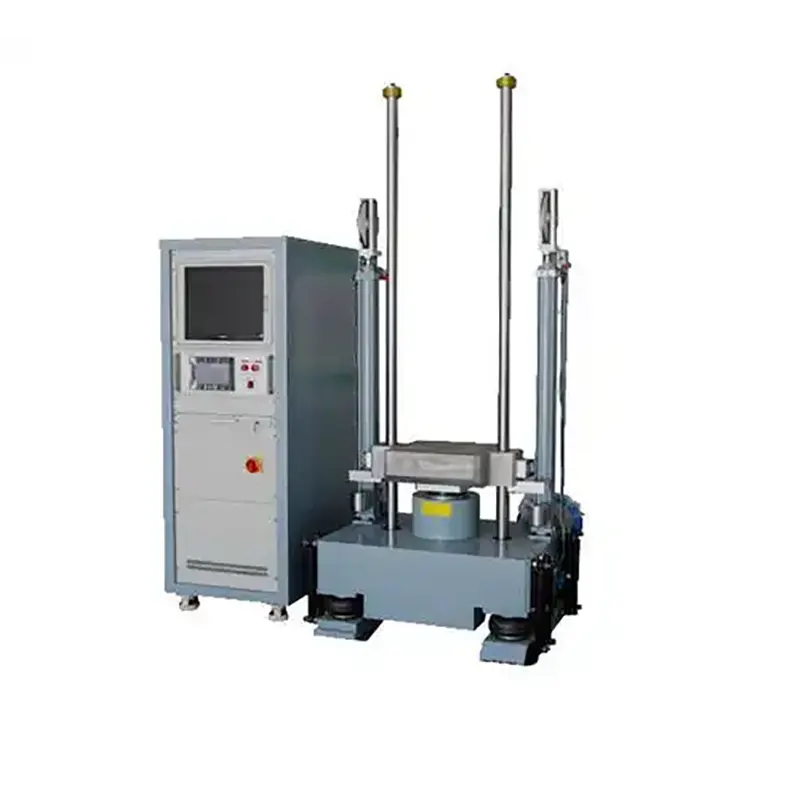
Publishing gate: obtain a real DR-D701 machine photo, nameplate and mechanical drawing before describing its drive mechanism. The present gallery and prose alone do not resolve the architecture.
02 · Size the load

Why 100 kg and 50 g Cannot Be Quoted in Isolation

The first screening calculation for a shaker is required force ≈ total moving mass × target acceleration. “Total” includes the specimen, fixture, armature or slip-table moving parts, adapters, cables and relevant attachments—not just the specimen on the bench. Resonance and control strategy can increase the practical demand, so final selection requires the vendor's rated envelope and a witnessed run.

Illustrative sizing only—not a DR-D701 capability claim

If a proposed test has a 20 kg specimen, 10 kg fixture and 8 g peak acceleration, even the specimen plus fixture alone call for approximately (20 + 10) × 8 × 9.81 = 2,354 N peak. The moving-element mass, margins and dynamic effects would increase the required system rating. This example cannot prove DR-D701 can perform the test.

Low frequencies: stroke

Large displacement may be required before a high acceleration value is reached. Confirm peak-to-peak stroke and mechanical clearance.

Middle band: velocity

The velocity limit can constrain the sweep even when force and stroke appear adequate.

High frequencies: force/control

Moving mass, fixture resonances and sensor placement govern whether target acceleration is actually maintained.

For a sinusoidal point, peak displacement is x = a/(2πf)². This relationship explains why the same acceleration target can demand very different travel at different frequencies. It is a physics check, not a substitute for the machine's measured performance curve.

03 · Choose the right test

Three Profiles That Should Not Be Merged into One Claim

Buyer request Required input What DR-D701 must demonstrate
IEC 60068-2-6 sinusoidal vibration Frequency band, sweep rate, amplitude/acceleration, axes, duration, functional checks and mounting Loaded sine sweep with control tolerance and resonance handling
IEC 60068-2-64 broadband random vibration PSD breakpoints, overall grms, duration, axes, control/abort channels Installed random controller, force rating, control spectra and data report
UN 38.3 T.3 battery transport vibration Adopted manual revision, specimen definition, mounting orientations, prescribed sweep and post-test criteria Method-specific profile, fixture/monitoring and witnessed evidence; no automatic product certification

IEC describes cURL Too many subrequests by single Worker invocation. To configure this limit, refer to https://developers.cloudflare.com/workers/wrangler/configuration/#limits as a sinusoidal method and IEC 60068-2-64 as broadband random. The UN Manual of Tests and Criteria has a separate T.3 transport-vibration procedure. The final test plan, not the standard name in a brochure, determines suitability.

04 · Control the specimen

The Fixture and Accelerometer Can Decide the Result

Mounting review

Document the bolt pattern, fixture material, stiffness, first fixture resonance, specimen center of gravity and cable routing. A heavy, flexible fixture may consume force and distort the input before the specimen sees the intended vibration.

When the test changes axis, define whether a horizontal slip table or a separate mounting orientation is used. The horizontal assembly's mass and travel must be included in sizing.

Control review

Place control and monitoring accelerometers according to the method and fixture dynamics. Agree single- or multi-point control, abort limits, notching where appropriate, sensor calibration and what waveform/PSD report will be delivered.

At resonances, the specimen can experience an amplified response while the control point remains within tolerance. Compare both control and response channels during FAT.

Battery-specific boundary: the shaker is only one part of a battery test. State the cell/battery condition, voltage and temperature monitoring, containment/exhaust review and post-test inspection separately.
05 · Evidence that closes the purchase risk

Ask DERUI to Prove One Representative Loaded Profile

1. Identify the build

DR-D701 nameplate, actual machine and fixture photos, shaker/actuator, amplifier, controller and axis hardware.

2. Show the envelope

Rated sine/random force, frequency, stroke, velocity, acceleration, payload and table size—with definitions and simultaneous-limit conditions.

3. Witness the profile

Run a representative specimen/fixture mass at agreed low-, mid- and high-band points. Supply raw control data and deviation/abort record.

Also agree factory utilities: electrical input, cooling airflow, floor loading, room noise, lifting/access clearance and any climate-chamber interface. If combined temperature/vibration is required, review the separate combined system rather than assuming it is part of DR-D701.

06 · Buyer questions

Questions to Resolve Before Quotation

Is the DR-D701 frequency ceiling 600 Hz or 5,000 Hz?

The live page states both. The correct value—and whether it changes by configuration—requires a signed DR-D701 datasheet and loaded performance curve. The H1 should not retain “600Hz” until resolved.

Does “100 kg load” mean it can deliver 50 g with 100 kg installed?

No such combined capability is proven by the page. Total moving mass and the force, velocity, stroke and frequency limits must be checked at the required test points.

Is random vibration standard?

The current copy claims sine and random, but the exact controller, amplifier and loaded random-force rating are not identified. Confirm the ordered software and witnessed PSD run.

Does the machine provide four-point excitation?

The phrase appears in the existing copy without a machine drawing. Confirm the actual actuator architecture before making it a product feature.

Will this automatically satisfy UN 38.3?

No. A qualified laboratory must follow the adopted T.3 procedure with the correct specimen and records; the equipment must first be shown capable of the required loaded profile.

Send One Profile. Get a Verifiable System Proposal.

Share the test method and your specimen/fixture data. Ask for the exact DR-D701 configuration, a sizing calculation and a witnessed sample run—not a collection of unrelated headline maximums.

Request DR-D701 engineering review

Attach these four items

  • Waveform or PSD and duration
  • Specimen and fixture mass/drawing
  • Axes and sensor locations
  • Acceptance/reporting requirements
FacebookLinkedInXRedditWhatsApp
  1. P: Para que serve uma bancada de teste de vibração eletromagnética?
    A: Uma bancada de teste de vibração eletromagnética (ou shaker) é usada para simular ambientes de vibração do mundo real em um ambiente de laboratório controlado. É essencial para testar a durabilidade, fiabilidade e integridade estrutural de produtos como componentes automotivos, peças aeroespaciais, eletrônicos (PCBs) e baterias, para garantir que possam suportar vibrações durante o transporte e uso.

  2. P: Como funciona uma bancada de teste de vibração eletromagnética?
    A: Funciona com base no princípio do eletromagnetismo. Um sinal elétrico (onda senoidal, aleatória ou perfil de choque) é enviado para um amplificador de potência, que conduz uma corrente elevada através de uma bobina (armadura) suspensa num campo magnético. Isso cria uma força (força de Lorentz) que move a bobina e a mesa/plataforma de teste ligada, produzindo vibrações mecânicas precisas e repetíveis.

  3. P: Quais são as principais vantagens de um shaker eletromagnético em relação a outros tipos?
    A: Os excitadores eletrodinâmicos oferecem controlo superior numa vasta gama de frequências (tipicamente de 5 Hz a 5.000 Hz+), alta capacidade de aceleração (até 50 g ou mais) e a capacidade de reproduzir com precisão perfis complexos de vibração, como senoidal, aleatória e de choque. São geralmente mais limpos, mais precisos e requerem menos manutenção do que excitadores hidráulicos para a maioria das aplicações de alta frequência.

  4. P: O que significa “excitação de quatro pontos” numa bancada de teste de vibração?
    A: A excitação de quatro pontos refere-se a um sistema de acionamento onde quatro atuadores eletromagnéticos (um em cada canto da mesa) trabalham em uníssono. Este design garante uma distribuição uniforme da vibração por toda a superfície de teste, eliminando “pontos quentes” e proporcionando stress consistente e fiável a todas as amostras de teste, o que é fundamental para resultados precisos e repetíveis.

  5. P: Quais indústrias utilizam comumente sistemas de teste de vibração eletromagnética?
    A: Indústrias-chave incluem Automóvel (testando componentes e conformidade de baterias UN38.3), Aeroespacial e Defesa (qualificação de peças para vibração de voo), Eletrónica de Consumo (testes de durabilidade para telemóveis, portáteis), Fabricação Industrial, e Investigação & Desenvolvimento laboratórios em vários setores.

  6. P: O que devo procurar ao escolher uma bancada de teste de vibração eletromagnética?
    A: Especificações-chave a considerar são: Faixa de Frequência, Aceleração Máxima (g), Deslocamento (mm), Capacidade de Carga (kg), se precisa de Orientação Vertical ou Horizontal e, Conformidade com Normas (por exemplo, IEC 60068, MIL-STD). Além disso, avalie recursos como circuitos anti-interferência, software de controlo e o suporte e garantia do fabricante.

  7. P: Como garante a precisão de um teste de vibração eletromagnética?
    A: A precisão é garantida através de calibração regular usando acelerómetros de referência, controladores digitais avançados que gerenciam com precisão o sinal de entrada, e circuitos integrados anti-interferência para minimizar o ruído elétrico. Funcionalidades como excitação uniforme de quatro pontos também evitam distorções nos dados causadas por movimento irregular da mesa.

  8. P: Um banco de ensaio de vibração eletromagnética pode realizar testes multi-eixo?
    A: Um excitador vertical padrão testa em um eixo. Para testes multi-eixo, sistemas são frequentemente utilizados com uma mesa de deslizamento (para movimento horizontal) ou configurados em um conjunto multi-excitador. Alguns sistemas integrados avançados são projetados especificamente para simulação de vibração multi-eixo simultânea.

  9. P: Quão importante é o design anti-interferência em um excitador de vibração?
    A: Extremamente importante. O ruído elétrico proveniente da fonte de alimentação ou de equipamentos circundantes pode contaminar os sinais de controlo e medição, levando a resultados de teste imprecisos. Excitadores de alta qualidade possuem circuitos dedicados anti-interferência para garantir vibrações “limpas” e dados confiáveis, o que é crucial para testes de conformidade e deteção precoce de falhas.

  10. P: Que manutenção um banco de ensaio de vibração eletromagnética necessita?
    A: A manutenção regular inclui verificar e apertar parafusos de montagem, inspecionar sistemas de arrefecimento (ar ou água), monitorizar rolamentos do armadura para desgaste, e realizar calibração periódica do sistema. Seguir o cronograma do fabricante e usar peças de reposição genuínas é vital para a fiabilidade e desempenho a longo prazo.

Use this sheet to close the gaps in the current DR-D701 page. It is not a signed performance guarantee or a replacement for the manufacturer's datasheet.

Selection item Current evidence / required document
Identity and architecture DR-D701 on live page; request nameplate, real photos and actuator/drive drawing
Frequency 600 Hz in H1; 5–5,000 Hz in body. Do not publish either as confirmed ceiling until reconciled
Sine/random force No model-specific rating or force-versus-frequency curve supplied
Stroke and velocity 25 mm peak-to-peak appears in general copy; velocity is not defined. Require both with conditions
Acceleration/payload 50 g and 100 kg appear separately. No simultaneous loaded point is established
Fixture and axes Table size, bolt pattern, allowed center of gravity, vertical/horizontal hardware and effective moving mass to confirm
Controller and sensors Sine/random licensing, control/limit accelerometers, calibration and raw export to confirm
Facility Amplifier nameplate, power, cooling, floor loading, noise and installation clearance to confirm
FAT Witness selected loaded sine and/or random profile with tolerance, abort and report data
WhatsAppWhatsApp
WhatsAppWhatsApp
WhatsApp
MensagemMensagem

Solicitar Orçamento