EV Battery Test Chamber Safety Requirements and Selection Guide
Date: 07/30/2026 Categories: Applications、New Energy & Lithium Battery Views: 11361
New Energy & Lithium Battery Guide
EV Battery Test Chamber Safety Requirements and Selection Guide
Specify the chamber from the battery energy, test method, credible failure consequence, powered heat load and laboratory response plan—not from temperature range alone.
What Is an EV Battery Test Chamber?
An EV battery test chamber controls temperature and, when required, humidity or pressure around a lithium-ion cell, module or pack while external cyclers and measurement systems charge, discharge and monitor it. It supports performance, durability, storage, thermal cycling and selected safety-related programs.
The chamber is part of a system. Battery cyclers, coolant conditioning, BMS communication, gas handling, electrical isolation, fixtures, laboratory ventilation and emergency procedures determine whether the test can be performed safely and repeatably.
Standards Do Not All Require the Same Chamber
| Reference | Typical scope | Chamber implication |
|---|---|---|
| UN 38.3 | Transport tests for lithium cells and batteries | Altitude and thermal tests are only part of the complete sequence |
| IEC 62660 series | Secondary lithium-ion cells for electric road vehicles | Performance, reliability and safety procedures vary by part |
| ISO 12405 series | Electrically propelled road-vehicle battery packs and systems | Pack fixtures, cycling interfaces and thermal management matter |
| UL 2580 | EV battery safety evaluation | Use qualified labs and the applicable complete program |
| Customer/OEM specification | Product-specific validation | May add profiles, monitoring and safety requirements |
Always obtain the current document and approved test plan. Environmental conditioning equipment does not perform vibration, crush, impact or electrical abuse tests unless designed as a dedicated integrated system.
Start with Battery Energy and Failure Consequence
A single small cell, a high-capacity prismatic cell and a fully charged EV pack cannot share one safety assumption. Record chemistry, format, capacity, voltage, state of charge, number of devices, electrical energy, test fault conditions, vent-gas potential and expected hazard level.
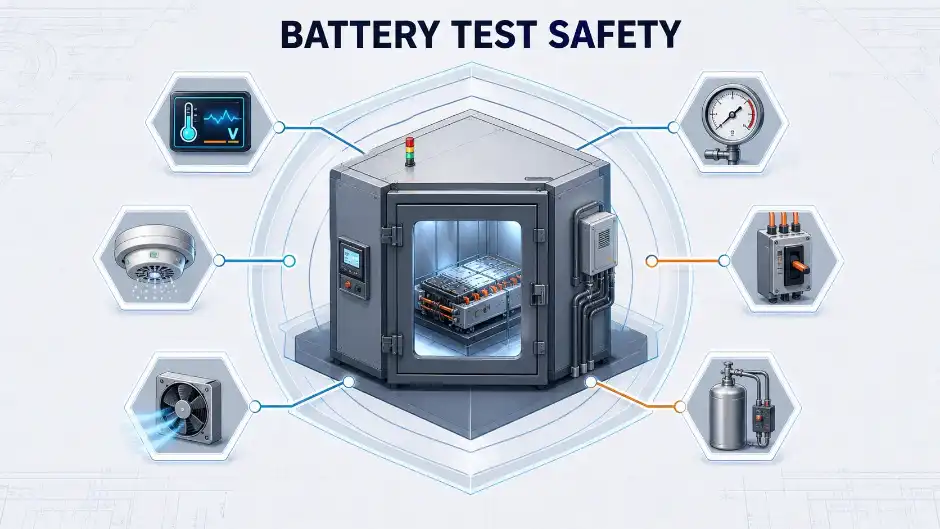
Battery Chamber Safety Functions
| Safety layer | Purpose | Questions to specify |
|---|---|---|
| Temperature, voltage and current monitoring | Detect abnormal behavior early | Channels, sampling, thresholds and independent shutdown |
| Smoke and gas detection | Identify venting or decomposition products | Target gases, sensor location, calibration and response logic |
| Emergency ventilation/purge | Remove hazardous gases | Flow, discharge location, interlocks and facility capacity |
| Pressure relief | Provide a controlled pressure-release path | Direction, area, ducting and exclusion zone |
| Door restraint and interlock | Reduce unintended opening and operator exposure | Lock logic, emergency access and status indication |
| Power isolation | Stop cycler and specimen energy input | Hardwired contacts, fail-safe state and response time |
| Fire mitigation | Support the approved emergency strategy | Agent compatibility, re-ignition risk and local authority requirements |
How to Select the Chamber
-
Define the exact test
Separate routine performance cycling from deliberate abuse testing; the hazard assumptions can be completely different.
-
Size workspace and floor loading
Include pack, trolley, fixtures, coolant connections, bend radius and airflow clearance.
-
Calculate live heat load
Provide cell losses, cable losses, coolant heat exchange and auxiliary equipment operating inside the workspace.
-
Specify electrical and fluid interfaces
Define insulated HV feedthroughs, voltage taps, thermocouples, CAN, coolant supply/return and leak detection.
-
Integrate facility safety
Coordinate exhaust, drainage, gas discharge, fire response, remote operation and exclusion zones with site EHS staff.
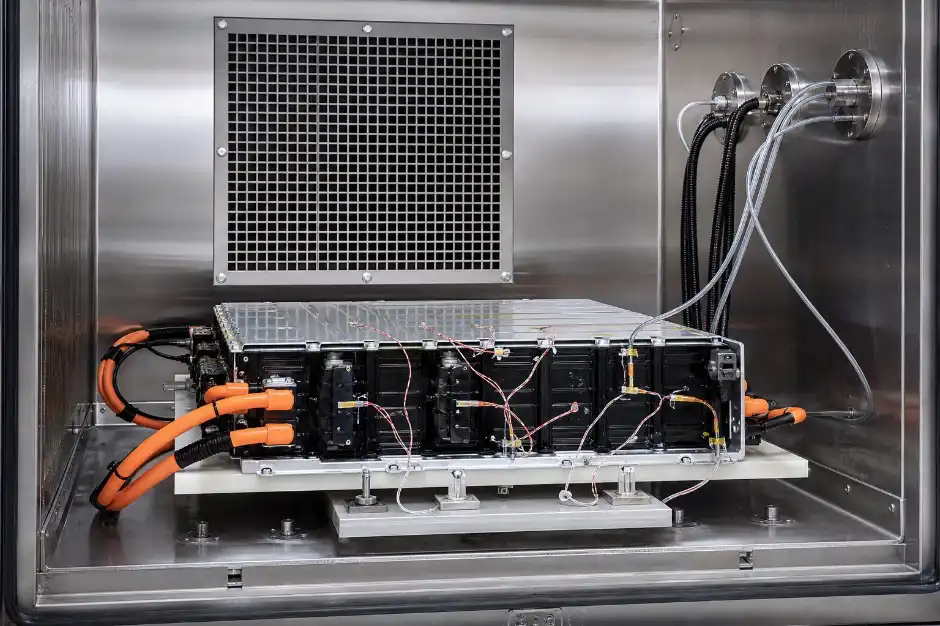
Build a Repeatable Battery Test Setup
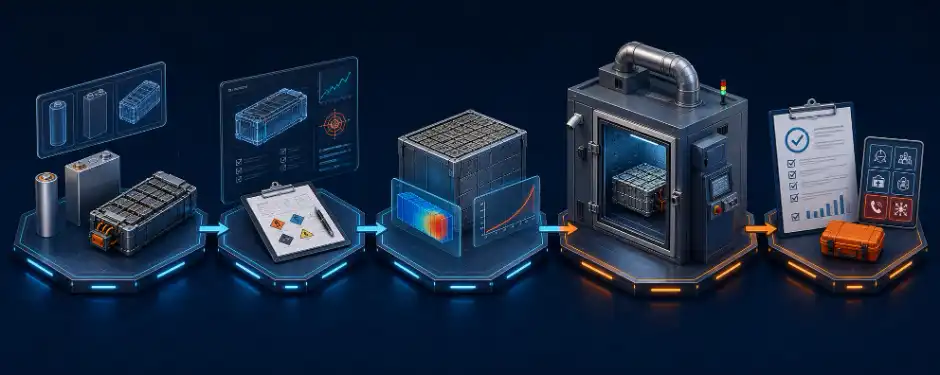
Use nonconductive or appropriately grounded fixtures, maintain airflow, protect cables against sharp edges, verify polarity and isolation, pressure-test coolant connections and conduct an interlock dry run before energizing the battery. Synchronize chamber, cycler, BMS, temperature and gas data so early warning signals can be reconstructed.
Large packs may require a custom walk-in environmental chamber; rapid profiles may use a rapid temperature change chamber.
Battery Chamber RFQ Checklist
- Cell chemistry, format, capacity, voltage and state of charge
- Cell/module/pack quantity and maximum stored energy
- Routine test or abuse test and credible failure consequence
- Temperature, humidity, altitude, ramp and dwell profiles
- Pack dimensions, mass, trolley and floor load
- Charge/discharge heat and coolant conditions
- HV, measurement, CAN and fluid feedthroughs
- Gas/smoke detection and alarm logic
- Pressure relief, exhaust and discharge routing
- Emergency shutdown, fire strategy and facility integration
- Calibration, mapping, data synchronization and documentation
Configure an EV Battery Test Chamber
Send DERUI your battery data, test profile, maximum energy, heat load, interfaces and risk assessment. Our engineers can help define the environmental performance and safety options for cells, modules or packs.
Frequently Asked Questions
What is an EV battery test chamber used for?
It controls environmental conditions around cells, modules or packs during performance, durability and selected safety testing.
Does “explosion-proof” mean every battery failure is contained?
No. Capability depends on energy, chemistry, device count, test method and chamber design. Use a project-specific risk assessment.
Which gases should be detected?
The selection must follow the battery chemistry, expected vent products, sensor limitations and site safety strategy.
Can battery cyclers be placed inside the chamber?
Normally the power electronics remain outside; only approved fixtures and necessary interfaces enter the workspace.
Why is live heat load important?
Charging and discharging create heat. Without sufficient capacity, the chamber may not hold or ramp the required condition.
Can one chamber handle cells and full packs?
Not automatically. Workspace, energy, gas release, floor load and emergency provisions change significantly with scale.
What should be tested before the first live run?
Verify sensors, alarms, ventilation, interlocks, shutdown, coolant integrity, data capture and the emergency response plan.