Battery Testing Environmental Chambers: Complete Guide for EV and Energy Storage 2026
Date: 05/15/2026 Categories: Resources、Technical articles Views: 11470
Excerpt:
Last updated: May 2026 Author: Technical Content Team --- > TL;DR: Battery testing chambers are specialized environmental test chambers designed for lithium-ion battery safety validation, cycle life testing, and energy storage system qualification. This guide covers testing standards (UN 38.3, IEC...
Battery Testing Environmental Chambers: Complete Guide for EV and Energy Storage Testing in 2026
Last updated: May 2026 | Reading time: 20 min | Author: Technical Content Team
TL;DR: Battery testing chambers are specialized environmental test chambers designed for lithium-ion battery safety validation, cycle life testing, and energy storage system qualification. This guide covers testing standards (UN 38.3, IEC 62660, SAE J2464), chamber types, safety requirements, and a complete procurement checklist for 2026 EV and ESS projects.
Table of Contents
- Why Battery Testing Chambers Are Different
- Key Testing Standards
- Types of Battery Testing Chambers
- Temperature & Humidity Requirements by Battery Type
- Safety Requirements: Why Explosion-Proof Matters
- 2026 Pricing Benchmarks
- Top Manufacturers for Battery Testing
- Test Protocols & Procedures
- Common Pitfalls in Battery Chamber Procurement
- Procurement Checklist
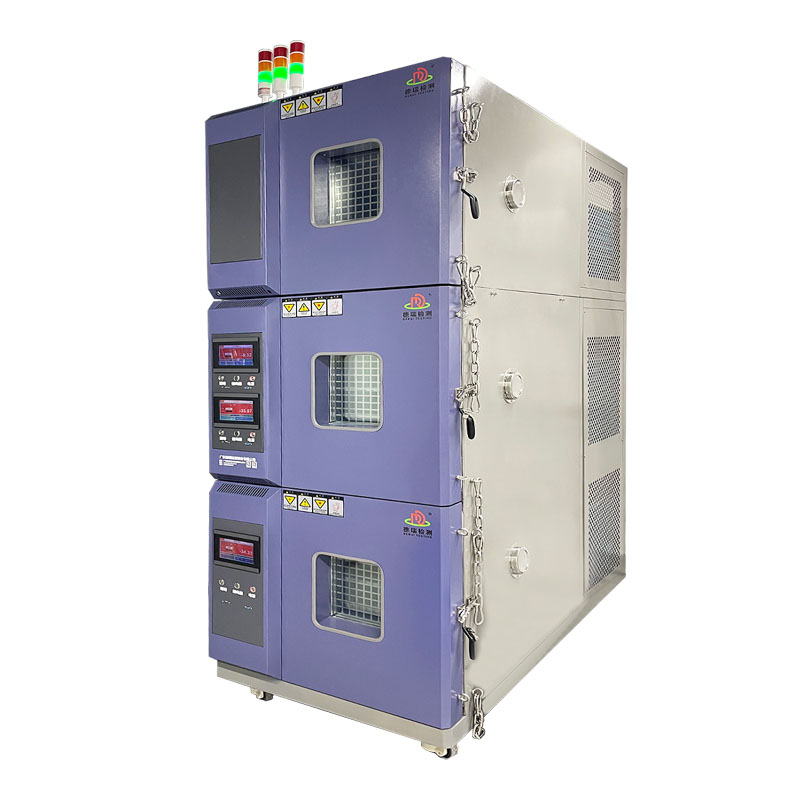
1. Why Battery Testing Chambers Are Different
Testing batteries inside an environmental chamber is not the same as testing electronics. Lithium-ion batteries present unique hazards that demand specialized chamber designs:
1.1 The Thermal Runaway Risk
When a lithium-ion cell undergoes thermal runaway, it releases:
- Toxic and flammable gases — H₂, CO, CO₂, VOCs, HF (hydrogen fluoride)
- High-temperature ejecta — Jet flames reaching 900°C+
- Rapid pressure spikes — Can rupture seals and blow chamber doors
- Secondary ignition — Released gases can ignite outside the cell
A standard environmental test chamber is not designed to contain these events. This is why explosion-proof (EX-proof) design is mandatory for battery testing chambers.
1.2 Key Differences from Standard Chambers
| Feature | Standard Temp/humidity test chambers Chamber | Battery Testing Chamber |
|---|---|---|
| Explosion protection | None | Mandatory EX-proof with gas venting |
| Gas monitoring | Not required | CO, H₂, O₂, VOC, pressure sensors |
| Door interlock | Standard | Blast-resistant, pressure-relief doors |
| Emergency suppression | None | Sprinkler / gas suppression system |
| Viewing window | Standard glass | Tempered safety glass with blast rating |
| Sample heating method | Direct radiant | Indirect / enclosed to prevent spark ignition |
| Ventilation | Closed-loop | Active exhaust with gas scrubbing |
| Structural integrity | Standard sheet metal | Reinforced steel frame, pressure-rated |
| Certification | CE / UL standard | ATEX, IECEx, or equivalent explosion protection |
2. Key Testing Standards
2.1 UN 38.3 — Transportation Testing
The UN Manual of Tests and Criteria, Section 38.3 is the global regulatory requirement for shipping lithium batteries. Every battery pack shipped internationally must pass these 8 tests:
| Test | Description | Chamber Requirement |
|---|---|---|
| T1: Altitude simulation | 11.6 kPa for 6 hours (simulates 15,000m altitude) | Vacuum-capable chamber |
| T2: Thermal test | 72°C → -40°C cycles (6 hours each, 10 cycles max) | Wide temp range, fast ramp |
| T3: Vibration | Sinusoidal sweep 7–200 Hz (not chamber, but often done simultaneously) | Vibration table + chamber |
| T4: Shock | 150g / 6ms half-sine (not chamber, but sequential) | Drop tester |
| T5: External short circuit | 0.1Ω external short at 55°C | Heating chamber + short circuit |
| T6: Impact | 15.8mm bar impact at 9.1kg | Impact tester |
| T7: Overcharge | 2× max charge current, 1.5× max charge voltage | Power supply + chamber |
| T8: Forced discharge | Forced discharge at 1× rated capacity | Power supply + chamber |
T2 (Thermal Test) is the most demanding chamber test — it requires cycling between -40°C and +72°C within a 6-hour window per cycle, for up to 10 cycles. A chamber must have a ramp rate of at least 5°C/min to meet the cycle time requirement.
2.2 IEC 62660 — EV Battery Cell Testing
| Standard | Application | Key Chamber Tests |
|---|---|---|
| IEC 62660-1 | Capacity and performance | 20°C standard test, cycle life at various temps |
| IEC 62660-2 | Power and energy | High-rate discharge at -20°C to +60°C |
| IEC 62660-3 | Mechanical integrity | Crush, penetration, vibration (combined chamber + vibration) |
| IEC 62660-4 | Safety and abuse | Thermal abuse testing — heating at 5°C/min to 130°C, 300°C, 500°C |
2.3 SAE J2464 — EV Battery Abuse Testing
Developed by SAE International for EV battery safety validation:
- Thermal abuse: Chamber heating at 10°C/min to failure point
- Overcharge: 1C to 200% SOC at elevated temperatures
- Short circuit: External 5mΩ short at 25°C and 55°C
- Combined environmental stress: precision temperature test chambers during mechanical abuse
2.4 Other Critical Standards
| Standard | Region | Focus |
|---|---|---|
| UL 2580 | USA | Safety for EV battery packs |
| ECE R100 | Europe | EV battery approval |
| GB 38031 | China | EV battery safety requirements |
| ISO 6469-1 | International | On-road vehicle safety — battery |
| IEC 62619 | International | Industrial secondary batteries (ESS) |
| UN 38.3 | Global | All lithium battery transportation |
3. Types of Battery Testing Chambers
3.1 Standard Battery Temp/Humidity Chamber
For routine cycle life testing, performance characterization, and development testing — where thermal runaway risk is low.
Specifications: Temperature: -70°C to +180°C | Humidity: 10–98%RH | Volume: 200–2,000L
Best for: R&D cycle life testing, C-rate characterization, calendar aging studies, BMS algorithm validation.
⚠️ Warning: Do not use standard chambers for high-SOC cells, large-format cells, or cells with known failure modes without first assessing the thermal runaway risk.
3.2 Explosion-Proof (EX-Proof) Battery Chamber
The industry standard for safety and abuse testing of lithium-ion batteries. Designed to contain and safely vent thermal runaway events.
Key features:
- Pressure-rated chamber shell (typically 2–5 bar design pressure)
- ATEX / IECEx certified electrical components (no spark sources)
- Active gas exhaust with H₂ / CO monitoring
- Pressure relief valves and blast-resistant doors
- Optional CO₂ or water mist suppression systems
Best for: UN 38.3 T2 testing, IEC 62660-3 abuse testing, SAE J2464 abuse testing, safety validation of new cell chemistries.
3.3 Walk-In Battery Testing Chamber
Large-format chambers for testing complete battery packs, modules, and even electric vehicles at the pack level.
Specifications: Volume: 5,000–100,000L | Temp: -70°C to +80°C | Humidity: 10–95%RH | Can be configured as EX-proof
Best for: Full-scale EV battery pack qualification, energy storage system (ESS) testing, large-format cell testing (pouch cells, prismatic cells 300Ah+).
3.4 Rapid Charge/Discharge Chamber
Specialized chambers integrated with high-power cyclers for fast-charging validation, peak power testing, and charge acceptance studies.
Key features:
- Wide temperature range (-40°C to +80°C) to test fast-charging limits
- Precise temperature control (±0.5°C) for data quality
- Low thermal inertia design for fast transitions between test temperatures
- Integrated data acquisition for correlating C-rate performance with temperature
Best for: Fast-charging protocol development, battery model validation, peak power testing at temperature extremes.
3.5 Hybrid Temperature-Vibration Chamber
Combines environmental temperature control with multi-axis vibration testing — critical for automotive battery pack qualification.
Best for: Combined thermal-mechanical stress testing, road vibration simulation, NVH (noise, vibration, harshness) correlation testing.
4. Temperature & Humidity Requirements by Battery Type
4.1 Cell Format Comparison
| Cell Type | Typical Size | Thermal Risk | Chamber Requirement |
|---|---|---|---|
| Cylindrical (18650, 21700, 4680) | Small | Lower (contained venting) | Standard or EX-proof |
| Prismatic (large-format) | Medium-Large | High | EX-proof strongly recommended |
| Pouch | Variable | Very high (no metal can) | EX-proof mandatory |
| Blade (CTP) | Large module | Very high | EX-proof mandatory, walk-in |
| Full pack | Vehicle-scale | Extreme | EX-proof walk-in, active suppression |
4.2 Temperature Range by Application
| Application | Temperature Range | Humidity | Notes |
|---|---|---|---|
| Consumer electronics (smartphones) | -20°C to +55°C | Optional | Small cells, lower risk |
| Power tools | -20°C to +60°C | Optional | Medium C-rate |
| EV passenger vehicles | -40°C to +60°C | 10–90%RH | Full SOC range |
| EV buses / trucks | -40°C to +55°C | 10–90%RH | Large packs |
| Energy storage (ESS) | -30°C to +55°C | 10–90%RH | Long duration, large scale |
| Aerospace / aviation | -55°C to +70°C | Controlled | Extreme conditions |
| Cold chain / frozen | -40°C to +25°C | Variable | Storage/freeze application |
| Hot climate / desert | -10°C to +85°C | Variable | High temp degradation |
5. Safety Requirements: Why Explosion-Proof Matters
5.1 What "Explosion-Proof" Actually Means
An explosion-proof chamber is not a chamber that prevents explosions. It is a chamber designed to contain an explosion safely, preventing the propagation of flame and pressure waves to the outside environment.
Key design principles:
1. Pressure piling prevention — Chamber structure rated above maximum expected pressure
2. Flame arrestance — All openings fitted with flame arrestors
3. Temperature rating — All surfaces rated above maximum expected temperature
4. Gas venting — Controlled release path for combustion gases
5. Spark elimination — All electrical components rated for hazardous areas (ATEX Zone 1/2)
5.2 ATEX Certification Zones
| Zone | Definition | Chamber Requirement |
|---|---|---|
| ATEX Zone 0 | Continuous hazardous atmosphere | Not applicable for chambers |
| ATEX Zone 1 | Hazardous atmosphere likely during normal operation | Full EX-proof required |
| ATEX Zone 2 | Hazardous atmosphere only in abnormal conditions | EX-proof recommended |
| Non-hazardous | No expected gas release | Standard chamber acceptable |
Practical guidance: For routine UN 38.3 T2 testing at controlled SOC levels, a Zone 2-rated chamber is generally sufficient. For destructive abuse testing at 100% SOC, Zone 1-rated chamber is recommended.
5.3 Gas Monitoring Systems
Every battery testing chamber should include multi-gas monitoring:
| Gas | Explosion Risk | Toxic Risk | Monitor Required |
|---|---|---|---|
| H₂ (hydrogen) | ⭐⭐⭐⭐⭐ | Low | ✅ Mandatory |
| CO (carbon monoxide) | Low | ⭐⭐⭐⭐⭐ | ✅ Mandatory |
| O₂ (oxygen) | Supports combustion | — | ✅ Recommended |
| VOCs | ⭐⭐⭐ | ⭐⭐⭐ | ✅ Recommended |
| HF (hydrogen fluoride) | Low | ⭐⭐⭐⭐⭐ | ✅ Required for NMC chemistries |
| Temperature / pressure | Overpressure | — | ✅ Mandatory |
6. 2026 Pricing Benchmarks
Prices are indicative USD, FOB origin. China-manufactured EX-proof chambers offer 40–60% cost savings vs. European/US equivalents.
6.1 By Chamber Type
| Chamber Type | Budget Tier | Mid-Range | Premium |
|---|---|---|---|
| Standard battery chamber (200–500L) | $8,000–$20,000 | $20,000–$45,000 | $45,000–$80,000 |
| Standard battery chamber (500–1,500L) | $20,000–$50,000 | $50,000–$120,000 | $120,000–$250,000 |
| EX-proof battery chamber (200–500L) | $25,000–$60,000 | $60,000–$150,000 | $150,000–$300,000 |
| EX-proof battery chamber (500–1,500L) | $60,000–$150,000 | $150,000–$350,000 | $350,000–$700,000 |
| Walk-in battery chamber (5,000L+) | $150,000–$400,000 | $400,000–$900,000 | $900,000–$2,000,000 |
| EX-proof walk-in (5,000L+) | $300,000–$700,000 | $700,000–$1,500,000 | $1,500,000–$3,500,000+ |
| Hybrid temp-vibration chamber | $100,000–$300,000 | $300,000–$800,000 | $800,000–$2,000,000+ |
| Rapid charge/discharge chamber | $30,000–$80,000 | $80,000–$200,000 | $200,000–$500,000 |
6.2 Cost Factors to Negotiate
| Factor | What to Negotiate |
|---|---|
| Gas monitoring package | Include H₂, CO, O₂, VOC, HF sensors in base price |
| Explosion-proof rating | Specify ATEX Zone 1 or 2 in the quote |
| Ramp rate | ≥5°C/min for UN 38.3 T2 compliance; ≥10°C/min for abuse testing |
| Temperature uniformity | ±1°C or better across working volume |
| Warranty | Minimum 2 years; 3 years for EX-proof components |
| Commissioning & IQ/OQ/PQ | Factory acceptance test (FAT) + on-site qualification |
| Spare parts kit | Request first-year spare parts kit with consumables |
7. Top Manufacturers for Battery Testing
7.1 Premium / Industrial Tier
| Manufacturer | Country | Specialty | Chamber Type | Best For |
|---|---|---|---|---|
| ESPEC | Japan | Full range, precision | Standard + EX-proof | Global OEM / TIER 1 automotive |
| Weiss Technik | Germany | Automotive testing | Walk-in + hybrid | European automotive |
| Thermotron | USA | Reliability testing | EX-proof available | US aerospace & defense |
| Angelantoni | Italy | Thermal vacuum | Standard + custom | Aerospace battery |
| Binder | Germany | Laboratory precision | Standard (non-EX) | R&D labs |
| CSZ (Cincinnati SubZero) | USA | Temperature cycling | Standard + EX | US industrial |
7.2 China Export Tier (Best Value)
| Manufacturer | Specialty | Certification | Best For |
|---|---|---|---|
| Sanwood | EX-proof battery chambers | CE, UL available | International ESS projects |
| ASLI | Full range + EX-proof | CE, ATEX available | Cost-sensitive buyers |
| Haida | Standard + walk-in | CE, ISO | Budget labs |
| Bell Test Equipment | EX-proof for EV | CE, ATEX | EV battery manufacturers |
| Guangchuang (GuoRay) | ESS chambers | CE | Energy storage projects |
| Nanjing Link | Standard + walk-in | CE, UL available | Academic research |
2026 Note: Chinese manufacturers have significantly improved ATEX/IECEx certification quality and English-language documentation. Several now offer remote commissioning support and global spare parts networks, making them viable for international projects at 40–60% of European/US pricing.
8. Test Protocols & Procedures
8.1 UN 38.3 T2 Thermal Test Protocol
```
Step 1: Charge cell/module to:
- 100% SOC for Li-ion (4.2V/cell typical)
- Per manufacturer's specification
Step 2: Place in chamber at 72°C ±2°C for 6 hours
Step 3: Transition to -40°C ±2°C within 6 hours
Step 4: Hold at -40°C for 6 hours
Step 5: Total cycle time: 12 hours maximum per cycle
Step 6: Repeat steps 2–5 for 10 cycles total
Step 7: Hold at 20°C ±5°C for 24 hours
Step 8: Inspect for:
- Mass loss > 0.1%
- Voltage drop > 10%
- Physical damage
- Fire / explosion (fail)
```
Chamber requirements for T2:
- Temperature accuracy: ±2°C (exposure zone), ±5°C (transition)
- Ramp rate: ≥5°C/min (to meet 6-hour transition)
- Chamber volume: Test sample ≤ 30% of working volume
8.2 IEC 62660-4 Thermal Abuse Protocol
```
Step 1: Charge to 50% SOC at 20°C
Step 2: Heat chamber at 5°C/min to 130°C
(or to cell failure, whichever comes first)
Step 3: Hold at 130°C until 30 minutes after thermal runaway
Step 4: Record:
- Onset temperature of thermal runaway
- Maximum temperature reached
- Time to thermal runaway from start of heating
- Any fire, explosion, venting
Step 5: Repeat at 300°C and 500°C for safety assessment
```
8.3 Cycle Life Testing Protocol (R&D)
```
Standard: IEC 62660-1, IEC 62619
Cycle: CC-CV charge at 1C, CC discharge at 1C
(or per test specification)
Temperature: 25°C ±2°C (standard)
Also tested at: 0°C, 10°C, 45°C
End-of-life criteria:
- 80% of initial rated capacity ( automotive)
- 70% for stationary storage
- Internal resistance increase > 20%
Test duration: Can extend to 3–5 years for calendar life
```
9. Common Pitfalls in Battery Chamber Procurement
❌ Pitfall 1: Buying Non-EX Chamber for Abuse Testing
Purchasing a standard temperature chamber for UN 38.3 T2 or IEC 62660-4 thermal abuse testing creates serious safety risks and potential regulatory non-compliance.
Fix: Always specify explosion-proof chamber (ATEX Zone 1 or 2) for any testing above 50% SOC, or any destructive/abuse testing protocol.
❌ Pitfall 2: Underestimating Chamber Ramp Rate
A chamber rated at 3°C/min will fail to complete UN 38.3 T2 within the required 6-hour transition window. You need ≥5°C/min.
Fix: Verify ramp rate under full load conditions (not empty chamber). Request the manufacturer's test data.
❌ Pitfall 3: Ignoring Gas Monitoring
Without H₂ and CO monitoring, there's no way to detect a developing thermal runaway event before it becomes critical.
Fix: Specify H₂, CO, O₂, VOC, pressure, and temperature sensors as standard equipment. Set automated alarm thresholds per manufacturer guidance.
❌ Pitfall 4: Undersizing for Large Battery Packs
Testing an EV battery pack at 400V 100Ah in a 200L chamber is physically impossible.
Fix: Measure your largest test sample dimensions and add 30%. If the pack is >1,000L equivalent volume, plan for a walk-in chamber.
❌ Pitfall 5: Skipping FAT (Factory Acceptance Test)
Accepting a chamber without witnessing a thermal performance test at the factory means discovering performance issues after delivery.
Fix: Require FAT at the manufacturer's facility with your test profile or a standard IEC 60068 cycle. Include this as a contractual requirement.
10. Procurement Checklist
Before issuing an RFQ for a battery testing chamber:
- [ ] Testing standards required (UN 38.3, IEC 62660, SAE J2464, UL 2580)
- [ ] Battery type and chemistry (NMC, LFP, LTO, solid-state)
- [ ] Cell format (cylindrical, prismatic, pouch) and size
- [ ] Maximum test sample dimensions and volume
- [ ] SOC level for planned tests (determines EX-proof requirement)
- [ ] Temperature range required (min °C / max °C)
- [ ] Humidity requirement (yes/no)
- [ ] Ramp rate requirement (≥5°C/min minimum for UN 38.3 T2)
- [ ] EX-proof certification level (ATEX Zone 1 or 2)
- [ ] Gas monitoring package (H₂, CO, O₂, VOC, HF)
- [ ] Safety suppression system (water mist, CO₂, others)
- [ ] Chamber volume (based on largest sample + 30% buffer)
- [ ] Data acquisition integration (Ethernet, CAN, Modbus)
- [ ] Budget range (including installation, calibration, warranty)
- [ ] Site requirements (power supply, floor load, ventilation)
- [ ] Calibration and qualification support (IQ/OQ/PQ documentation)
Conclusion
Battery testing environmental chambers are specialized, high-stakes equipment where safety, compliance, and performance must be non-negotiable. The explosion-proof requirement, multi-gas monitoring, and high ramp rate specifications set battery chambers apart from standard environmental test equipment.
When evaluating suppliers in 2026, prioritize those with:
- Proven battery testing experience and references
- ATEX/IECEx certification with documentation
- Ramp rate performance verified under load
- Comprehensive gas monitoring as standard
- Responsive technical support in your region
For a custom chamber recommendation based on your specific battery chemistry, test standards, and facility constraints, [contact our technical team].
Related guides: [2026 Environmental Test Chamber Buying Guide →] | [thermal shock testing equipment Chamber vs Temperature Humidity Chamber →]