Environmental Test Equipment for EV Charging Stations and Enclosures
Date: 11/09/2026 Categories: Resources、Technical articles Views: 1917
An EV charging cabinet, a power module and a charging connector do not have the same loading or environmental-test needs. Plan the laboratory by specimen and exposure first, then choose the chamber and interfaces. A general temperature–humidity chamber should not be treated as a substitute for dust, water or complete EVSE certification testing.
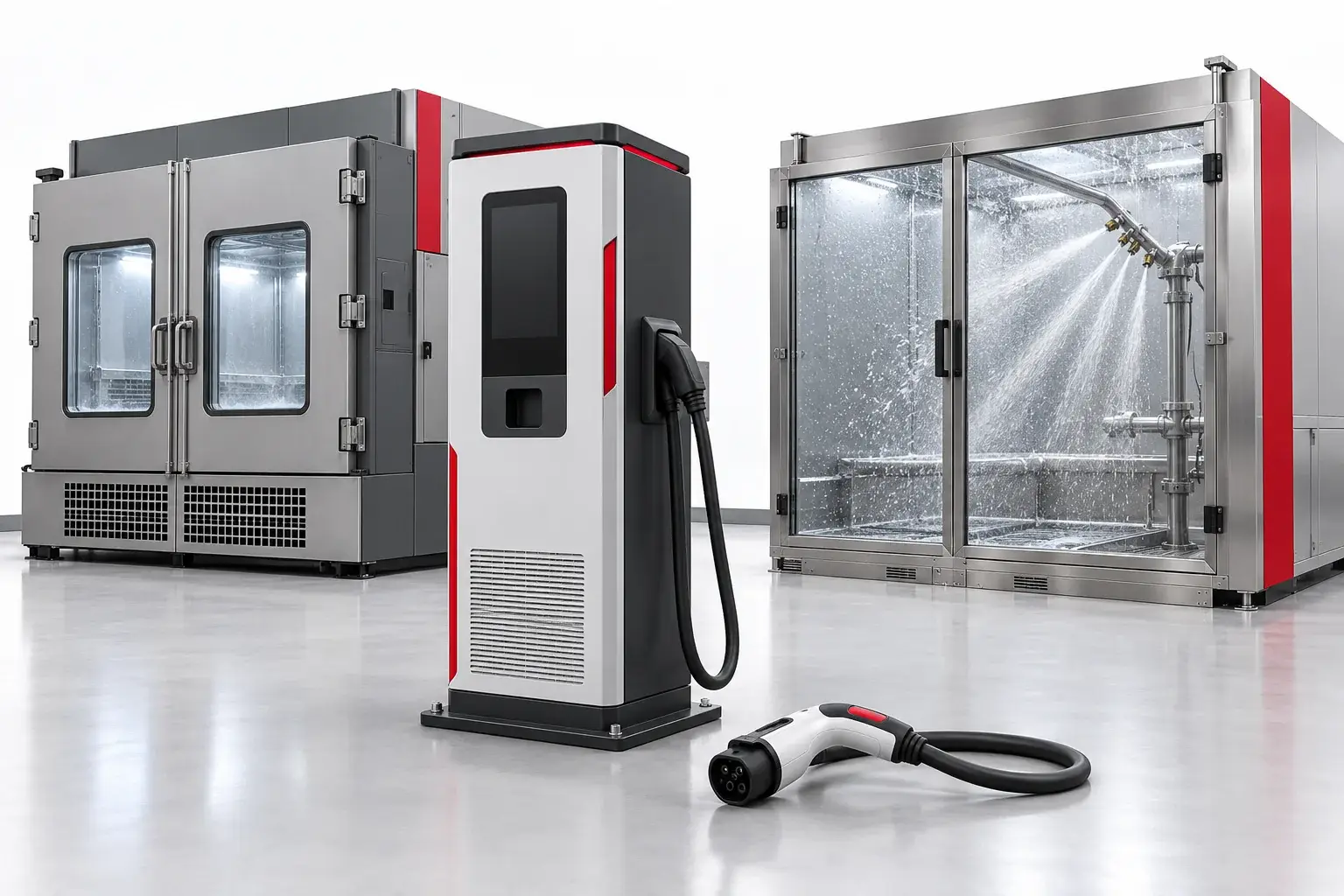
Separate the Charging Station from Its Components
A ground-mounted charging station is not the same product as an onboard charger installed in a vehicle. Its enclosure, mounting, ventilation, cable routes and access panels create different equipment-selection questions. Identify whether the test concerns the complete cabinet, a subassembly or a separate connection component.
For the complete cabinet, record external dimensions, mass, support points, open-door clearance and the handling method. Include protruding cables, connectors and any pedestal or mounting base that will remain during the test. A walk-in room may be considered when the complete loaded assembly cannot be accommodated by a reach-in chamber.
For modules and connectors, specify the fixture, electrical/communication interfaces and the surface or junction being evaluated. A smaller specimen can still require substantial cable access or powered heat removal. Size alone should not determine the configuration.
Map Each Environmental Exposure to Suitable Equipment
Obtain the product, customer and target-market requirements before assigning equipment. The applicable standard and test sequence may differ with the product type and market. Do not give every charging station a universal IP rating, temperature profile or corrosion duration.
| Evaluation task | Equipment family to review | Inputs that affect selection |
|---|---|---|
| Cold, dry heat or temperature cycling | Temperature chamber or walk-in room | Assembly envelope, heat output, transitions and sensor basis |
| Damp heat or humidity cycling | Configured temperature–humidity chamber | Paired temperature/RH points, condensation conditions and operating state |
| Dust ingress | Method-appropriate dust test equipment | Enclosure size, mounting, dust method and any required pressure arrangement |
| Water exposure | Specified drip, spray, jet or immersion equipment | Exact exposure, geometry, surfaces and fixture |
| Material weathering or corrosion | Applicable weathering or corrosion system | Material, method, specimen preparation and evaluation endpoint |
This matrix is a planning aid, not a mandatory test list. Some tasks may be assigned to an external laboratory rather than duplicated in-house. Keep equipment procurement separate from the certification body’s assessment of the complete product.
Plan the Cabinet Layout and Interfaces Together
Describe how the station is installed in service and how it will be mounted in the test. Door seals, cable glands, vents, interfaces and connector parking positions can be part of the enclosure arrangement. Document the configuration so later runs do not use a materially different assembly.
For climate testing, provide specimen heat dissipation and the required operating modes. Define which external loads, simulators or monitoring devices will remain outside the chamber and how their connections pass through the boundary. The heat released inside may differ from the station’s rated charging power.
Where a full cabinet is loaded on a trolley or pallet, include that support in the thermal and geometric review. Check doorway height, floor loads, airflow and sensor access. A nominal room capacity does not establish that the required faces or connections remain accessible.
For water or dust equipment, the fixture must support the required exposure without masking critical surfaces or creating an unrepresentative seal. Identify all penetrations and specify how their treatment follows the adopted procedure.
Treat Powered Operation as a Separate Design Decision
State whether the specimen is unpowered, monitored at low energy, operating under a defined load or changing modes during exposure. Those are different tasks. A chamber’s electrical supply does not establish its specimen-power capability or the safety of a wet-test arrangement.
Define electrical isolation, monitoring, protective response and external equipment responsibilities with qualified personnel. For high-power operation, include the complete power circuit, heat balance, load/simulator and laboratory risk assessment in the engineering review.
Do not energize a charging cabinet during water exposure merely because the test equipment has a cable port. The adopted method and approved electrical arrangement must establish the operating condition. Equipment selection should support that approved plan, not create an improvised test procedure.
If the charging system includes energy storage, separate the battery-related hazards from the enclosure’s environmental duty. A climatic room alone does not establish the protections needed for every energy-storage or abnormal-operation test.
Specify Results and Acceptance Evidence Before Ordering
For each exposure, identify the physical conditions to be demonstrated by the equipment and the product checks performed by the laboratory. A temperature record, water-delivery check or dust-system verification documents equipment operation; it does not by itself establish that the EVSE passed its product requirements.
| Record | What it should identify |
|---|---|
| Specimen configuration | Cabinet revision, seals, mounting, connections and operating state |
| Exposure setup | Method/edition, fixture, geometry, sensors and equipment settings |
| Run evidence | Actual conditions, specimen measurements, interruptions and deviations |
| Product evaluation | Required inspection, electrical/function checks and decision criteria |
| Equipment handover | Supplied accessories, manuals, calibration information and agreed demonstrations |
Agree the equipment acceptance plan using the FAT checklist and record template. Keep product qualification and market-access certification with the responsible testing and certification process. Owning a chamber does not grant certification.
Build a Phased Laboratory Equipment Inquiry
Start with the tests the laboratory must run in-house and the specimens it actually handles. Group requirements by equipment family, then identify shared fixtures, utilities and monitoring. This is more useful than purchasing a large general-purpose room and assuming every exposure can be added later.
Review the temperature chamber range, rain and water test equipment, dust test chambers and walk-in solutions. These families serve different physical exposures; their capabilities should be matched to the exact programme.
Send cabinet/component drawings, target market, applicable requirements, operating state, heat output and facility constraints. Ask the proposal to separate chamber equipment, fixtures, specimen services, external electrical test equipment and acceptance evidence. That turns a broad “EV charger test lab” request into equipment decisions that can be compared and implemented.
Build a Specimen-by-Exposure Equipment Matrix
List complete cabinets, power modules, control boards, displays, cables and connectors separately. For each item, record the required exposure and the product check that follows it. Some equipment may be shared across specimens, while other tasks require dedicated geometry or external laboratory support.
For a hypothetical laboratory, connector water exposure and cabinet temperature cycling may belong to different systems and schedules. The fact that both items are part of the same charging station does not make one chamber suitable for both tasks.
Use the matrix to discuss in-house priorities with engineering and purchasing. Repeated development work may justify local equipment, while an infrequent specialist assessment may remain external. This decision should reflect workload, method and available competence rather than a requirement to buy every chamber family at once.
Document the Cabinet Configuration That Will Be Tested
Record cabinet revision, vents, filters, cable glands, doors, gaskets and mounting details as required by the adopted programme. Identify which connections remain in their service positions and which external test connections need a method-approved treatment.
For a climatic run, define the power state and how the specimen is monitored. A standby cabinet and a cabinet operating against an external load can impose different thermal duties. Measure or estimate the heat retained inside rather than substituting charging power for internal dissipation.
For ingress testing, review the exposure arrangement with the responsible laboratory. A fixture, temporary cable or sealed opening can change the tested configuration. Keeping these details in the setup record makes later results interpretable and prevents an equipment acceptance run from being mistaken for complete product qualification.
Turn the Laboratory Plan into Phased Purchase Packages
Separate each package into equipment, fixtures, specimen services, site work, measurement interfaces and acceptance evidence. Identify which infrastructure can be shared without assuming that all exposure systems use the same utilities or drainage.
Define a first phase around the tests the laboratory is ready to perform. Leave later phases tied to explicit product and workload decisions rather than unverified future upgrades. Adding high-power operation or water-exposure capability can change the safety and installation scope substantially.
A useful proposal answers what is included for the named specimen and procedure, what must be supplied by others and what demonstrates readiness at handover. Send DERUI the equipment matrix and cabinet/component drawings so the discussion can progress from a general EVSE requirement to a defined environmental-test package.
Questions Before You Specify the Equipment
Does an EV charging station need the same tests as an onboard charger?
Not automatically. A stationary EVSE installation and a vehicle-mounted onboard charger have different product scopes and conditions. Use the requirements for the actual specimen and target market.
Can one temperature–humidity chamber perform IP water and dust tests?
Not by default. These are distinct physical exposures requiring suitable equipment or specifically engineered and validated modules.
Does chamber purchase provide UL or other product certification?
No. Equipment supply and the product’s testing/certification process are separate. Define the test programme with the responsible laboratory or certification organization.
What information is needed for an EVSE chamber proposal?
Provide the cabinet or component drawings, mass and mounting, test requirements, powered state, heat released inside, interfaces, monitoring and site conditions.
Plan My EV Charging Equipment Test Setup
Send the cabinet or component drawing, required exposures, operating modes and target-market requirements. Ask DERUI to map the specimens to suitable chamber families, fixtures and site services.