







Walk-In Environmental Test Chamber FAQs
Date: 12/29/2025Views: 9694
A consolidated guide to applications, stability testing, size, selection, cost, maintenance and comparison with smaller chambers.
What Is a Walk-In Stability Chamber?
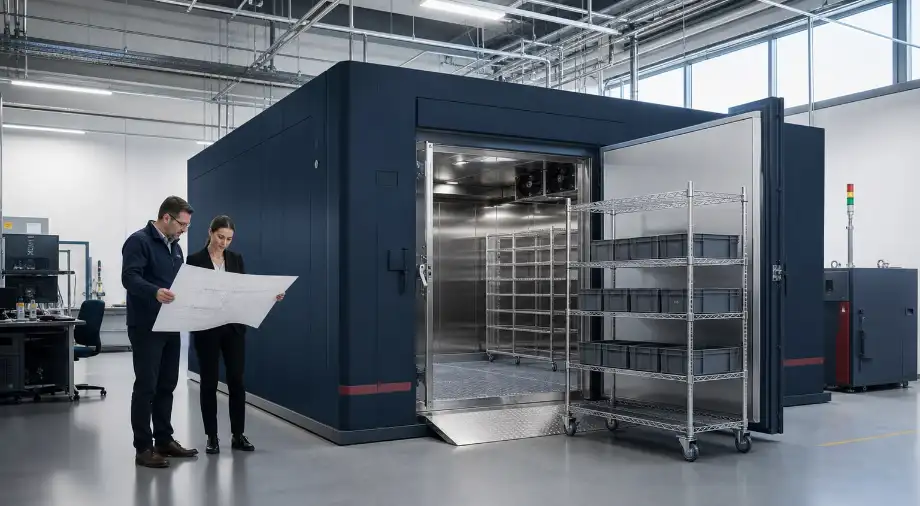
A walk-in stability chamber is a large temperature-and-humidity-controlled room intended for long-duration storage and stability studies. It is commonly associated with pharmaceutical ingredients, finished products, packaging and other materials that must remain at defined climatic conditions for extended periods. It differs from a general reliability chamber because stability work prioritizes long-term uniformity, monitoring, alarms, data integrity, recovery and qualification rather than aggressive temperature cycling.
If an ICH condition is required, provide the exact study condition, tolerance, storage duration, loading pattern, door-opening routine, monitoring and qualification requirements. Saying “ICH compliant” alone is not a complete specification.
What Is a Walk-In Environmental Chamber Used For?
- Full-size automotive parts, battery modules and large electronic assemblies
- Batch aging, burn-in and production reliability screening
- Aerospace, defense and telecommunications equipment
- Packaging, construction materials and industrial components
- Pharmaceutical or material stability storage when configured for that purpose
- Large fixtures, racks or products that require powered operation during exposure
One walk-in room should not be assumed to perform every stress. Temperature/humidity, altitude, salt spray, dust, rain and battery-abuse testing impose different construction and safety requirements.
Can a Walk-In Chamber Simulate Both Heat and Cold?
Yes, a temperature walk-in chamber can be designed for heating and refrigeration, while a climatic version can also control humidity within a defined temperature/RH operating envelope. Performance must be confirmed at the actual setpoints, load and rate. A chamber that reaches a low temperature empty may not achieve the same condition with several kilowatts of powered samples.
How Is Walk-In Chamber Size Determined?
There is no single international list of “standard sizes.” Manufacturers may offer common modular dimensions, but useful size is determined from the complete specimen envelope, quantity, fixtures, airflow clearance, access aisle, door size, shelving, floor load and possible future products.
| Input | Why it matters |
|---|---|
| Specimen and fixture dimensions | Establishes minimum clear workspace and door opening. |
| Total mass and material | Changes thermal response and floor requirements. |
| Powered heat load | Determines refrigeration capacity at critical low setpoints. |
| People entering the room | Requires operational procedures and appropriate safety review. |
| Racks and carts | Affects internal layout, circulation and loading access. |
| Building route | Determines whether an integral unit fits or modular site assembly is needed. |
How Do I Choose a Walk-In Chamber?
- Define the standard and complete temperature/humidity profile.
- Provide sample size, mass, quantity, fixture and airflow restrictions.
- State continuous and peak heat dissipation.
- Specify ramp rate, dwell, cycles and door-opening frequency.
- List cable, power, coolant, sensor and data connections.
- Complete a sample risk assessment.
- Confirm power, ventilation, drainage, cooling method and floor loading.
- Agree on FAT, site acceptance, calibration and training.
Walk-In vs Reach-In vs Benchtop
| Type | Best suited to | Main trade-off |
|---|---|---|
| Benchtop | Small components and limited laboratory space | Limited load size and heat-removal capacity |
| Reach-in | Components and assemblies loaded through a front door | Less flexible for very large or wheeled specimens |
| Walk-in | Large products, racks and batch testing | Higher site, energy, installation and maintenance demands |
How Much Does a Walk-In Test Chamber Cost?
A responsible quotation requires a specification. Major cost drivers include room size, minimum temperature, humidity capability, change rate, heat load, refrigeration redundancy, safety configuration, material selection, data system, site assembly, utilities, calibration and international shipping. Avoid comparing quotations only by cubic volume: two rooms of the same size can require very different mechanical systems.
What Maintenance Does It Require?
Routine tasks normally include cleaning the workspace, checking door seals and drains, inspecting filters and condensers, confirming water quality, reviewing alarms and data, and scheduling calibration and qualified refrigeration/electrical service. Frequency depends on usage, environment and the manufacturer’s manual. Operators should not open live electrical panels or service refrigerant systems unless trained and authorized.
Existing DERUI Delivery Arrangement
DERUI’s typical walk-in production period is 35–50 days after technical and commercial confirmation. Units that remain within container transport dimensions may be produced as integral systems; oversized rooms are supplied in sections for site assembly. Final schedule and installation scope must be confirmed in the contract.
Common Walk-In Questions
Is a walk-in chamber always a stability chamber?
No. Stability rooms are optimized for long-term controlled storage, while industrial walk-in chambers may be designed for cycling, powered loads or large reliability tests.
Can customers choose air-cooled or water-cooled refrigeration?
The cooling approach depends on capacity, room heat rejection, ambient conditions and available cooling water. It should be decided during site review.
Can the room be customized?
DERUI can review custom dimensions, doors, load capacity, layout, ranges, rates, materials, ports, observation windows, control/data functions and project-specific safety options.
Related DERUI Resources
Review DERUI’s walk-in chamber solutions, compare the wider environmental test chamber range, or prepare the project using the environmental chamber RFQ checklist.
Plan a Walk-In Chamber
Provide a room layout, specimen data, heat load and test profile for engineering review.









