THB vs HAST for Semiconductor Moisture Reliability Testing
Date: 08/20/2026 Categories: Applications、Electronics & Semiconductors Views: 9451
SEMICONDUCTOR MOISTURE RELIABILITY
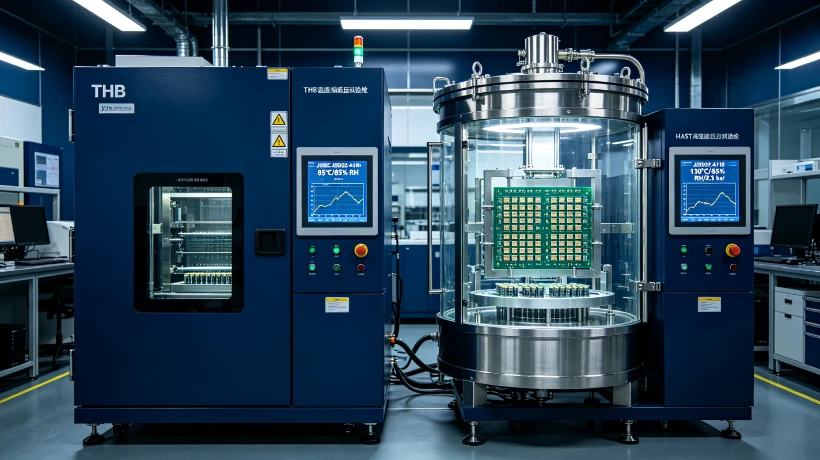
THB uses controlled temperature, humidity and electrical bias; HAST uses a pressurized, unsaturated humidity environment at higher temperature. Biased HAST and unbiased HAST are separate test arrangements. Selecting the faster exposure without checking the device, governing method and bias requirements can lead to the wrong equipment or an unusable qualification result.
This guide helps semiconductor reliability engineers compare the methods and turn an approved test plan into a chamber requirement. It covers the environmental system, test boards, electrical connections and evidence needed for review—not just the nominal temperature range.
THB, biased HAST and uHAST: the practical differences
| Selection point | THB | Biased HAST | uHAST |
|---|---|---|---|
| Method reference | JESD22-A101 | JESD22-A110 | JESD22-A118 |
| Exposure | Temperature and humidity with bias, normally in an atmospheric chamber | Higher-temperature, pressurized unsaturated humidity with bias | Higher-temperature, pressurized unsaturated humidity without bias during exposure |
| Published example, not a universal recipe | 85°C / 85% RH, 1,000 hours | 110°C / 85% RH, 264 hours | 110°C / 85% RH, 264 hours |
| Equipment question | Can the system sustain the specified condition with the actual biased load? | Can the pressure chamber, feedthroughs and bias system support the approved method? | Can the pressure chamber support the specified unbiased exposure and recovery? |
| Readout | Defined electrical checks and acceptance limits | Defined electrical checks and acceptance limits | Pre/post electrical checks as specified; unbiased does not mean untested |
The example conditions above are reported by Nisshinbo Micro Devices for its qualification program. They illustrate the distinction; use your controlled standard edition and customer specification for the actual conditions, tolerances, sample size, preconditioning and readout schedule.
Choose the approved method before choosing the chamber
Start with the qualification requirement for the device and package. Record whether the customer explicitly requires THB, permits a HAST alternative, or requires both as part of a wider qualification program. A chamber supplier can assess equipment fit, but the device qualification owner must approve a change of test method.
THB may be the required route when the program specifies sustained temperature-humidity-bias exposure. HAST may be appropriate where the qualification plan permits higher-temperature accelerated moisture exposure. The decision also depends on package materials, electrical operation, failure mechanisms and any limits of the test board or socket.
Do not convert exposure hours directly into field life. A shorter accelerated test is not automatically equivalent to a specific number of service years. Establishing an acceleration relationship requires an appropriate model, assumptions and evidence for the relevant failure mechanism.
Bias, boards and self-heating can change the exposure
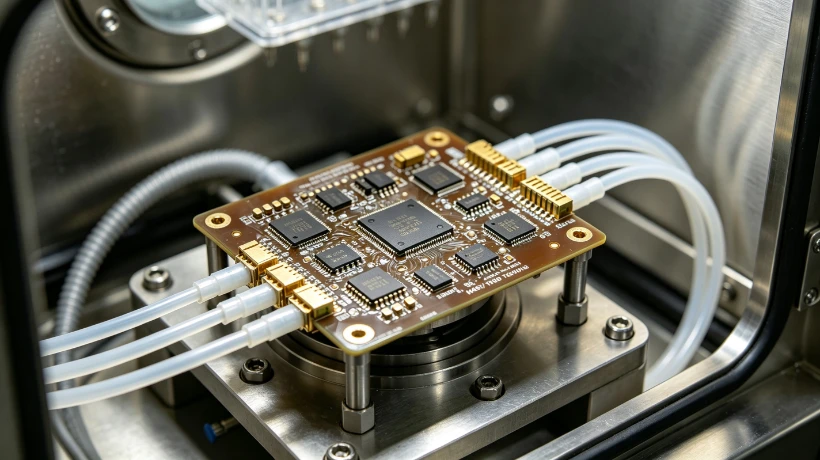
For biased testing, specify the actual circuit rather than writing only “powered.” Include the supply voltage, current limit, pin assignment, static or switched operation, duty cycle and number of devices per board. Identify who supplies the power sources, switching hardware, monitoring software and fixtures.
Device dissipation can make the package warmer than the surrounding chamber environment. That difference matters when interpreting moisture exposure. Ask how the setup will document relevant specimen temperatures and whether the approved method calls for a particular bias schedule. A chamber-air trace alone cannot describe every device’s local condition.
Boards, sockets, wiring and connectors must remain suitable throughout the exposure. Review spacing, insulation, leakage measurement requirements, material compatibility and cleanliness. Fixture contamination or connection degradation can obscure the difference between a device failure and a test-setup problem.
- Define the channel count and the maximum simultaneous load.
- Identify the measurement location: chamber sensor, board or device.
- Specify the condition for applying and removing bias.
- Agree on the response to an open circuit, abnormal leakage, power interruption or chamber fault.
What to verify in a THB or HAST chamber quotation
| Requirement | Ask for this in the configuration review |
|---|---|
| Environmental performance | The required temperature/RH combination, tolerance and duration with the proposed load—not independent maximum temperature and humidity ratings. |
| Pressure capability for HAST | The intended unsaturated test condition, pressure rating and basis, controlled operating sequence and applicable installation requirements. |
| Loaded workspace | Board dimensions, rack arrangement, quantity, connection clearance and the proposed working zone. |
| Electrical interfaces | Feedthrough ratings, channel allocation, sealing arrangement, power-source scope and data connections. A cable port alone is not a complete bias system. |
| Records and interruption handling | Recorded channels, sampling interval, clock alignment, alarm history and the agreed action after an interrupted exposure. |
| Acceptance evidence | A documented demonstration of the quoted condition and configuration, calibration scope and agreed acceptance limits. |
A general-purpose temperature test chamber is a starting point for reviewing atmospheric conditions only when the offered configuration includes the required humidity capability and interfaces. It is not a substitute for a pressure-rated HAST system. Request written, model-specific confirmation before ordering.
Why a PCT chamber is not automatically a HAST chamber
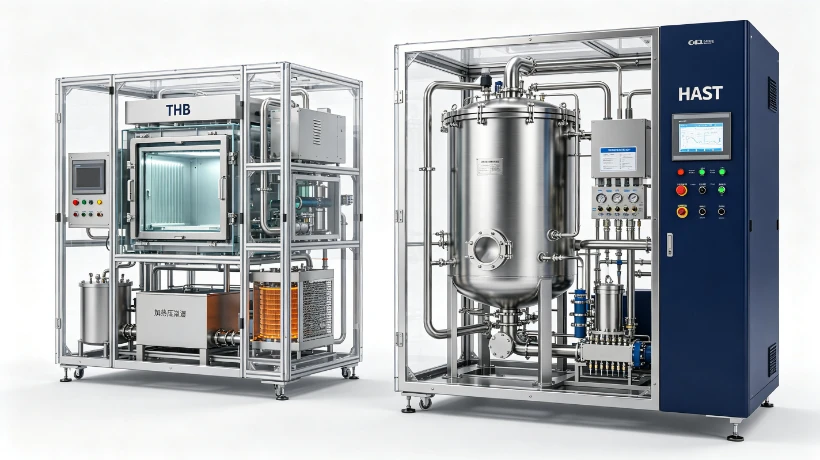
Pressure cooker or autoclave testing is commonly associated with saturated steam exposure, while HAST uses a controlled unsaturated humidity environment. Pressure alone does not establish equivalence. The control system, operating sequence, electrical interfaces and applicable method all need review.
The DERUI PCT chamber page is relevant when your requirement calls for that type of pressure-moisture equipment. Its product name is not proof of JESD22-A110 or JESD22-A118 capability. For a HAST inquiry, send the exact method and bias requirements so capability can be confirmed separately.
For background on saturated and unsaturated pressure-moisture exposure, see ESPEC’s technical discussion of humidity reliability testing. This historical background does not replace a current controlled test method.
Plan the readouts before starting exposure
Record baseline electrical results and the specimen identification before loading. Define any required preconditioning, intermediate measurements, final measurements and recovery timing in the approved test plan. Keep the measurement method consistent so changes in the test arrangement do not masquerade as changes in the device.
When a leakage increase, corrosion indication, parametric shift or functional interruption appears, retain the environmental history, bias records and fixture details. Record when it occurred and which devices or channels were affected. Use the investigation to distinguish a device-related finding from a socket, wiring, instrumentation or chamber interruption.
A pass decision requires the agreed acceptance limits and valid exposure evidence. A completed chamber program, or the absence of a chamber alarm, is not by itself a semiconductor qualification result.

Send a complete moisture-test configuration request
The following information allows the equipment discussion to begin with a defined test rather than a generic chamber size:
- Method: standard number, edition, customer document and whether THB, biased HAST or uHAST is required.
- Exposure: temperature, RH, duration, any pressure specification and the required sequence.
- Test assembly: device/package type, board and rack drawings, quantities and loading photographs.
- Electrical scope: bias circuit, voltage, current, power dissipation, channel count and monitoring requirements.
- Evidence: required readouts, data format, calibration and acceptance demonstration.
- Installation: destination, power supply, water, drainage, available space and applicable site requirements.
If a detail is not yet decided, identify it as an open item. This lets the review separate a budgetary equipment proposal from a fully defined purchase specification.
Frequently asked questions
Can HAST replace a 1,000-hour THB test?
Only where the governing qualification plan permits that substitution. Different stress conditions and durations do not establish a universal conversion. Obtain approval from the qualification owner before changing the method.
Does HAST always include electrical bias?
No. Biased HAST and uHAST are distinct arrangements. Public semiconductor qualification references associate JESD22-A110 with biased HAST and JESD22-A118 with unbiased HAST. Specify which one is required.
Can an 85°C/85% RH chamber run THB?
The environmental setpoint is only part of the requirement. Confirm the loaded operating capability, duration, boards, bias connections, monitoring and approved procedure. A setpoint in a brochure does not verify the complete test setup.
Is the chamber supplier responsible for defining pass/fail limits?
The device qualification owner defines the acceptance criteria. The supplier should identify what the offered equipment can control, record and demonstrate against the agreed specification.
Technical references
- Nisshinbo: published reliability test conditions and JEDEC method mapping.
- Cirrus Logic: THB, biased HAST and uHAST qualification overview.
- ESPEC: technical background on moisture reliability testing.
Confirm the edition and full requirements of the controlled standard used by your program. This guide is an equipment-planning aid, not a reproduction of a JEDEC procedure.
Have a THB or HAST requirement to review?
Send the method, specimen layout and bias requirements to DERUI. Ask for confirmation of the equipment scope, any capability gaps and the evidence needed before purchase.