ชั้น 1, หมายเลข 3, ถนนชูการ์, เมืองหงเหมย, ตงกวน, มณฑลกวางตุ้ง, ประเทศจีน

ผู้ผลิตห้องทดสอบสิ่งแวดล้อม 20 ปีส่งมอบลูกค้าทั่วโลกกว่า 3000 ราย           อีเมล: shirley@deruitest.com
WhatsApp Consultation:+86 135 2795 8363

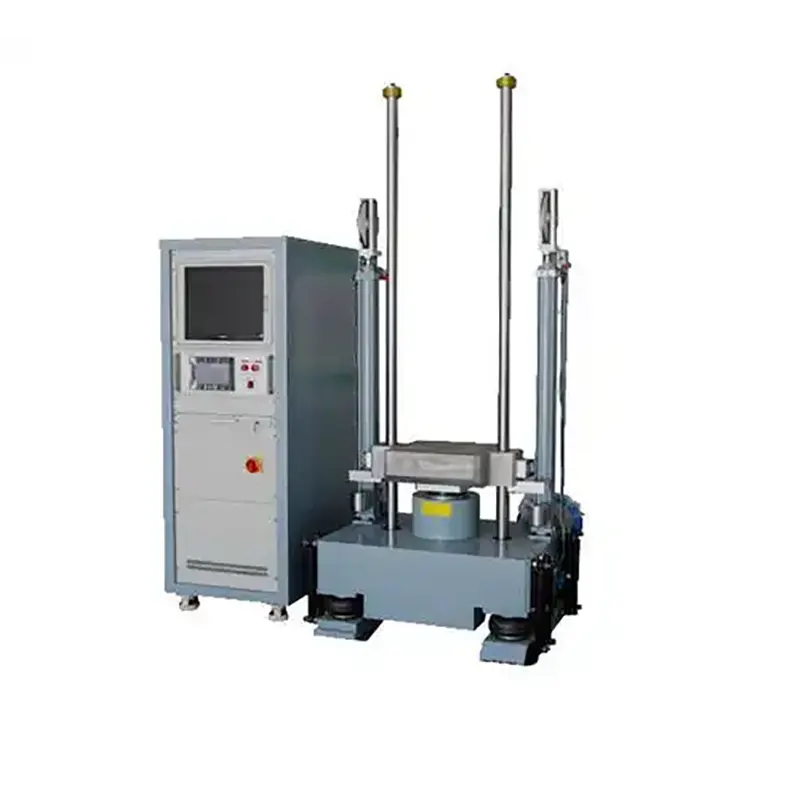
แท่นทดสอบการสั่นสะเทือนด้วยแม่เหล็กไฟฟ้าความถี่ 600Hz

The DERUI DR-D701 electromagnetic vibration test bench should be selected against the specimen's actual sine, random or battery-transport vibration profile. Confirm its drive architecture and loaded force–stroke–velocity–frequency envelope before committing to a test method.

รุ่น DR-D701
Engineering Focus Reproduce the specified profile with specimen and fixture installed
Architecture Shaker versus four-point platform requires approved drawing
Frequency Current page conflicts: 600 Hz heading versus 5–5,000 Hz body
Sizing Check total moving mass, force, stroke, velocity, acceleration and axes together
Before Quotation Send profile, load/fixture drawing and FAT targets; request signed DR-D701 datasheet
ปลอดภัยและเชื่อถือได้
คุณภาพดี
การรับประกันคุณภาพ
การปรับแต่ง
ข้อความWhatsApp
หมายเลขสายด่วน 15580327593
  • รายละเอียดสินค้า
  • คำถามที่พบบ่อย
  • พารามิเตอร์ทางเทคนิค
  • ติดต่อเรา
VIBRATION PROFILE → MACHINE ARCHITECTURE → WITNESSED PROOF

Can DR-D701 Reproduce Your Vibration Profile with the Real Payload?

A frequency number alone cannot answer that. The proposed machine must sustain the specified acceleration or displacement after the specimen and fixture are installed, in the required axis, for the full test duration. Use this page to define that engineering decision before ordering DR-D701.

Model evidence status: DERUI's live page identifies DR-D701 but labels it “600Hz” in the H1 while its body claims “5–5,000Hz.” Those cannot both be treated as a single confirmed rating. Ask for the serial/model-specific datasheet.
Start withMethod + waveform + axis
Then sizeSpecimen + fixture + moving element
Then verifyForce + stroke + velocity + control
01 · Identify the machine

Is DR-D701 a Shaker System or a Multi-Point Vibration Platform?

The present page uses “electromagnetic shaker,” “four-point excitation” and “uniform table vibration” as if they describe one unambiguous machine. They may imply different actuator and control architectures. This must be resolved before a technical claim—or a vibration-standard comparison—is credible.

Electrodynamic shaker route

Request the shaker model, armature diameter/mass, amplifier rating, cooling method, controller, head expander or slip table, and loaded performance envelope. A single shaker system is normally selected around force, displacement, velocity and acceleration limits.

Multi-point platform route

Request actuator count/location, table size, payload distribution, phase synchronization, control-point placement and measured spatial uniformity. A “four-point” statement cannot substitute for this evidence.

Publishing gate: obtain a real DR-D701 machine photo, nameplate and mechanical drawing before describing its drive mechanism. The present gallery and prose alone do not resolve the architecture.
02 · Size the load

Why 100 kg and 50 g Cannot Be Quoted in Isolation

The first screening calculation for a shaker is required force ≈ total moving mass × target acceleration. “Total” includes the specimen, fixture, armature or slip-table moving parts, adapters, cables and relevant attachments—not just the specimen on the bench. Resonance and control strategy can increase the practical demand, so final selection requires the vendor's rated envelope and a witnessed run.

Illustrative sizing only—not a DR-D701 capability claim

If a proposed test has a 20 kg specimen, 10 kg fixture and 8 g peak acceleration, even the specimen plus fixture alone call for approximately (20 + 10) × 8 × 9.81 = 2,354 N peak. The moving-element mass, margins and dynamic effects would increase the required system rating. This example cannot prove DR-D701 can perform the test.

Low frequencies: stroke

Large displacement may be required before a high acceleration value is reached. Confirm peak-to-peak stroke and mechanical clearance.

Middle band: velocity

The velocity limit can constrain the sweep even when force and stroke appear adequate.

High frequencies: force/control

Moving mass, fixture resonances and sensor placement govern whether target acceleration is actually maintained.

For a sinusoidal point, peak displacement is x = a/(2πf)². This relationship explains why the same acceleration target can demand very different travel at different frequencies. It is a physics check, not a substitute for the machine's measured performance curve.

03 · Choose the right test

Three Profiles That Should Not Be Merged into One Claim

Buyer request Required input What DR-D701 must demonstrate
IEC 60068-2-6 sinusoidal vibration Frequency band, sweep rate, amplitude/acceleration, axes, duration, functional checks and mounting Loaded sine sweep with control tolerance and resonance handling
IEC 60068-2-64 broadband random vibration PSD breakpoints, overall grms, duration, axes, control/abort channels Installed random controller, force rating, control spectra and data report
UN 38.3 T.3 battery transport vibration Adopted manual revision, specimen definition, mounting orientations, prescribed sweep and post-test criteria Method-specific profile, fixture/monitoring and witnessed evidence; no automatic product certification

IEC describes cURL Too many subrequests by single Worker invocation. To configure this limit, refer to https://developers.cloudflare.com/workers/wrangler/configuration/#limits as a sinusoidal method and IEC 60068-2-64 as broadband random. The UN Manual of Tests and Criteria has a separate T.3 transport-vibration procedure. The final test plan, not the standard name in a brochure, determines suitability.

04 · Control the specimen

The Fixture and Accelerometer Can Decide the Result

Mounting review

Document the bolt pattern, fixture material, stiffness, first fixture resonance, specimen center of gravity and cable routing. A heavy, flexible fixture may consume force and distort the input before the specimen sees the intended vibration.

When the test changes axis, define whether a horizontal slip table or a separate mounting orientation is used. The horizontal assembly's mass and travel must be included in sizing.

Control review

Place control and monitoring accelerometers according to the method and fixture dynamics. Agree single- or multi-point control, abort limits, notching where appropriate, sensor calibration and what waveform/PSD report will be delivered.

At resonances, the specimen can experience an amplified response while the control point remains within tolerance. Compare both control and response channels during FAT.

Battery-specific boundary: the shaker is only one part of a battery test. State the cell/battery condition, voltage and temperature monitoring, containment/exhaust review and post-test inspection separately.
05 · Evidence that closes the purchase risk

Ask DERUI to Prove One Representative Loaded Profile

1. Identify the build

DR-D701 nameplate, actual machine and fixture photos, shaker/actuator, amplifier, controller and axis hardware.

2. Show the envelope

Rated sine/random force, frequency, stroke, velocity, acceleration, payload and table size—with definitions and simultaneous-limit conditions.

3. Witness the profile

Run a representative specimen/fixture mass at agreed low-, mid- and high-band points. Supply raw control data and deviation/abort record.

Also agree factory utilities: electrical input, cooling airflow, floor loading, room noise, lifting/access clearance and any climate-chamber interface. If combined temperature/vibration is required, review the separate combined system rather than assuming it is part of DR-D701.

06 · Buyer questions

Questions to Resolve Before Quotation

Is the DR-D701 frequency ceiling 600 Hz or 5,000 Hz?

The live page states both. The correct value—and whether it changes by configuration—requires a signed DR-D701 datasheet and loaded performance curve. The H1 should not retain “600Hz” until resolved.

Does “100 kg load” mean it can deliver 50 g with 100 kg installed?

No such combined capability is proven by the page. Total moving mass and the force, velocity, stroke and frequency limits must be checked at the required test points.

Is random vibration standard?

The current copy claims sine and random, but the exact controller, amplifier and loaded random-force rating are not identified. Confirm the ordered software and witnessed PSD run.

Does the machine provide four-point excitation?

The phrase appears in the existing copy without a machine drawing. Confirm the actual actuator architecture before making it a product feature.

Will this automatically satisfy UN 38.3?

No. A qualified laboratory must follow the adopted T.3 procedure with the correct specimen and records; the equipment must first be shown capable of the required loaded profile.

Send One Profile. Get a Verifiable System Proposal.

Share the test method and your specimen/fixture data. Ask for the exact DR-D701 configuration, a sizing calculation and a witnessed sample run—not a collection of unrelated headline maximums.

Request DR-D701 engineering review

Attach these four items

  • Waveform or PSD and duration
  • Specimen and fixture mass/drawing
  • Axes and sensor locations
  • Acceptance/reporting requirements
เฟซบุ๊กLinkedInXRedditWhatsApp
  1. คำถาม: โต๊ะทดสอบการสั่นสะเทือนแม่เหล็กไฟฟ้าถูกใช้เพื่ออะไร?
    A: โต๊ะทดสอบการสั่นสะเทือนแม่เหล็กไฟฟ้า (หรือเครื่องเขย่า) ใช้เพื่อจำลองสภาพแวดล้อมการสั่นสะเทือนในห้องปฏิบัติการที่ควบคุมได้ เป็นสิ่งจำเป็นสำหรับการทดสอบความทนทาน ความน่าเชื่อถือ และความสมบูรณ์ของโครงสร้างของผลิตภัณฑ์ เช่น ชิ้นส่วนยานยนต์ อะไหล่อากาศยาน อิเล็กทรอนิกส์ (แผงวงจรพิมพ์) และแบตเตอรี่ เพื่อให้แน่ใจว่าพวกเขาสามารถทนต่อการสั่นสะเทือนระหว่างการขนส่งและการใช้งานได้.

  2. คำถาม: โต๊ะทดสอบการสั่นสะเทือนแม่เหล็กไฟฟ้าทำงานอย่างไร?
    A: มันทำงานบนหลักการของแม่เหล็กไฟฟ้า สัญญาณไฟฟ้า (คลื่นไซน์, สุ่ม หรือโปรไฟล์ช็อก) ถูกส่งไปยังแอมพลิฟายเออร์ไฟฟ้า ซึ่งขับเคลื่อนกระแสไฟฟ้าขนาดใหญ่ผ่านขดลวด (อาร์มาเจอร์) ที่แขวนอยู่ในสนามแม่เหล็ก ซึ่งสร้างแรง (แรงลอเรนซ์) ที่ทำให้ขดลวดและโต๊ะ/แพลตฟอร์มทดสอบที่เชื่อมต่อเคลื่อนที่ ทำให้เกิดการสั่นสะเทือนกลไกที่แม่นยำและทำซ้ำได้.

  3. คำถาม: ข้อดีหลักของเครื่องเขย่าแม่เหล็กไฟฟ้ากว่าประเภทอื่นคืออะไร?
    A: เครื่องเขย่าไฟฟ้าไดนามิกให้การควบคุมที่เหนือกว่าช่วงความถี่กว้าง (โดยปกติ 5 Hz ถึง 5,000 Hz+) ความสามารถในการเร่งความเร็วสูง (สูงสุด 50 g หรือมากกว่า) และความสามารถในการจำลองโปรไฟล์การสั่นสะเทือนที่ซับซ้อน เช่น ซายน์ สุ่ม และช็อก พวกเขามักจะสะอาดกว่า แม่นยำกว่า และต้องการการบำรุงรักษาน้อยกว่าคู่แข่งแบบไฮดรอลิกสำหรับการใช้งานความถี่สูงส่วนใหญ่.

  4. คำถาม: “การกระตุ้นสี่จุด” หมายถึงอะไรบนโต๊ะทดสอบการสั่นสะเทือน?
    A: การกระตุ้นสี่จุดหมายถึงระบบขับเคลื่อนที่มีตัวกระตุ้นแม่เหล็กไฟฟ้าสี่ตัว (หนึ่งที่มุมแต่ละมุมของโต๊ะ) ทำงานร่วมกัน การออกแบบนี้ช่วยให้การกระจายการสั่นสะเทือนเป็นไปอย่างสม่ำเสมอทั่วพื้นผิวทดสอบทั้งหมด ขจัด “จุดร้อน” และให้ความเครียดที่เสถียรและเชื่อถือได้กับตัวอย่างทดสอบทั้งหมด ซึ่งเป็นสิ่งสำคัญสำหรับผลลัพธ์ที่แม่นยำและทำซ้ำได้.

  5. คำถาม: อุตสาหกรรมใดบ้างที่นิยมใช้ระบบทดสอบการสั่นสะเทือนแม่เหล็กไฟฟ้า?
    A: อุตสาหกรรมหลักได้แก่ ยานยนต์ (ทดสอบส่วนประกอบและการปฏิบัติตามข้อกำหนดแบตเตอรี่ UN38.3), อวกาศและการป้องกันประเทศ (การคัดเลือกชิ้นส่วนสำหรับการสั่นสะเทือนในเที่ยวบิน), อิเล็กทรอนิกส์สำหรับผู้บริโภค (การทดสอบความทนทานสำหรับโทรศัพท์มือถือ คอมพิวเตอร์แล็ปท็อป), การผลิตอุตสาหกรรม, และ การวิจัยและพัฒนา ห้องปฏิบัติการในภาคส่วนต่าง ๆ.

  6. คำถาม: ควรมองหาอะไรเมื่อเลือกแท่นทดสอบการสั่นสะเทือนด้วยแม่เหล็กไฟฟ้า?
    A: ข้อกำหนดสำคัญที่ควรพิจารณาคือ: ช่วงความถี่, ความเร่งสูงสุด (g), การเคลื่อนที่ (มม.), ความสามารถในการรับน้ำหนัก (กก.), ไม่ว่าคุณจะต้องการ แนวตั้งหรือแนวนอน ทิศทาง, และ การปฏิบัติตามมาตรฐาน (เช่น IEC 60068, MIL-STD). นอกจากนี้ ควรประเมินคุณสมบัติ เช่น วงจรต้านการรบกวน ซอฟต์แวร์ควบคุม และการสนับสนุนและการรับประกันจากผู้ผลิต.

  7. คำถาม: คุณจะมั่นใจในความถูกต้องของการทดสอบการสั่นสะเทือนด้วยแม่เหล็กไฟฟ้าได้อย่างไร?
    A: ความถูกต้องได้รับการรับรองผ่าน การสอบเทียบเป็นประจำ โดยใช้เครื่องวัดความเร่งอ้างอิง, ตัวควบคุมดิจิทัลขั้นสูง ที่จัดการสัญญาณอินพุตอย่างแม่นยำ และมี วงจรป้องกันสัญญาณรบกวนในตัว เพื่อลดสัญญาณรบกวนทางไฟฟ้าให้เหลือน้อยที่สุด คุณสมบัติต่างๆ เช่น การกระตุ้นแบบสี่จุดที่สม่ำเสมอ ยังช่วยป้องกันข้อมูลที่คลาดเคลื่อนซึ่งเกิดจากการเคลื่อนที่ของโต๊ะที่ไม่สม่ำเสมอ.

  8. ถาม: แท่นทดสอบการสั่นสะเทือนด้วยแม่เหล็กไฟฟ้าสามารถทำการทดสอบแบบหลายแกนได้หรือไม่
    A: เครื่องเขย่าแนวตั้งมาตรฐานจะทดสอบในแกนเดียว สำหรับการทดสอบแบบหลายแกน มักใช้ระบบที่มี โต๊ะสลิป (สำหรับการเคลื่อนที่ในแนวนอน) หรือกำหนดค่าเป็น การตั้งค่าเครื่องเขย่าหลายตัว. ระบบบูรณาการขั้นสูงบางระบบได้รับการออกแบบมาโดยเฉพาะสำหรับการจำลองการสั่นสะเทือนแบบหลายแกนพร้อมกัน.

  9. ถาม: การออกแบบป้องกันสัญญาณรบกวนมีความสำคัญเพียงใดในเครื่องเขย่าการสั่นสะเทือน
    A: สำคัญอย่างยิ่ง สัญญาณรบกวนทางไฟฟ้าจากแหล่งจ่ายไฟหรืออุปกรณ์โดยรอบสามารถปนเปื้อนสัญญาณควบคุมและการวัด ทำให้ผลการทดสอบไม่ถูกต้อง เครื่องเขย่าคุณภาพสูงมีวงจรป้องกันสัญญาณรบกวนโดยเฉพาะเพื่อให้แน่ใจว่าการสั่นสะเทือนที่ “สะอาด” และข้อมูลที่เชื่อถือได้ ซึ่งมีความสำคัญอย่างยิ่งสำหรับการทดสอบการปฏิบัติตามข้อกำหนดและการตรวจจับข้อผิดพลาดตั้งแต่เนิ่นๆ.

  10. ถาม: แท่นทดสอบการสั่นสะเทือนด้วยแม่เหล็กไฟฟ้าต้องมีการบำรุงรักษาอะไรบ้าง
    A: การบำรุงรักษาตามปกติรวมถึงการตรวจสอบและขันสลักเกลียวยึดให้แน่น การตรวจสอบระบบระบายความร้อน (อากาศหรือน้ำ) การตรวจสอบตลับลูกปืนของกระดองสำหรับรอยสึก และการสอบเทียบระบบเป็นระยะ การปฏิบัติตามกำหนดการของผู้ผลิตและการใช้อะไหล่แท้เป็นสิ่งสำคัญสำหรับความน่าเชื่อถือและประสิทธิภาพในระยะยาว.

Use this sheet to close the gaps in the current DR-D701 page. It is not a signed performance guarantee or a replacement for the manufacturer's datasheet.

Selection item Current evidence / required document
Identity and architecture DR-D701 on live page; request nameplate, real photos and actuator/drive drawing
Frequency 600 Hz in H1; 5–5,000 Hz in body. Do not publish either as confirmed ceiling until reconciled
Sine/random force No model-specific rating or force-versus-frequency curve supplied
Stroke and velocity 25 mm peak-to-peak appears in general copy; velocity is not defined. Require both with conditions
Acceleration/payload 50 g and 100 kg appear separately. No simultaneous loaded point is established
Fixture and axes Table size, bolt pattern, allowed center of gravity, vertical/horizontal hardware and effective moving mass to confirm
Controller and sensors Sine/random licensing, control/limit accelerometers, calibration and raw export to confirm
Facility Amplifier nameplate, power, cooling, floor loading, noise and installation clearance to confirm
FAT Witness selected loaded sine and/or random profile with tolerance, abort and report data
WhatsAppWhatsApp
WhatsAppWhatsApp
WhatsApp
ข้อความข้อความ

ขอใบเสนอราคา