




Étage 1, No. 3, Avenue Shugang, Ville de Hongmei, Dongguan, Province du Guangdong, Chine

Fabricant de chambres d'essai environnemental depuis 20 ansPlus de 3000 livraisons clients dans le monde entier    Email : shirley@deruitest.com
WhatsApp Consultation:+86 135 2795 8363

Chambre d'essai de simulation d'altitude pour batterie

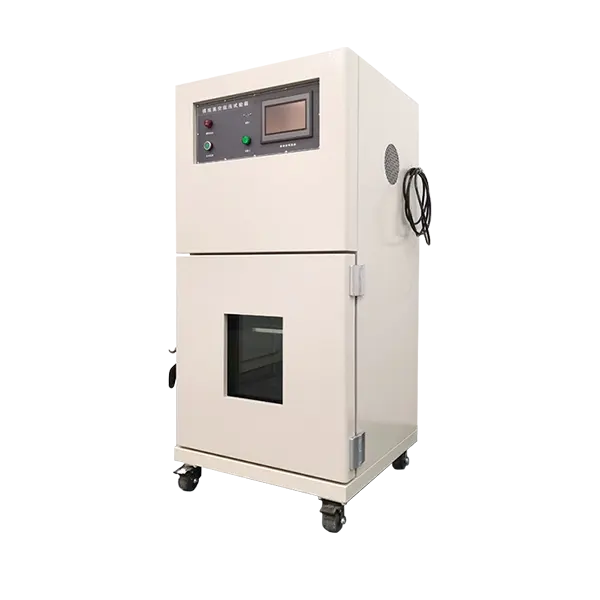
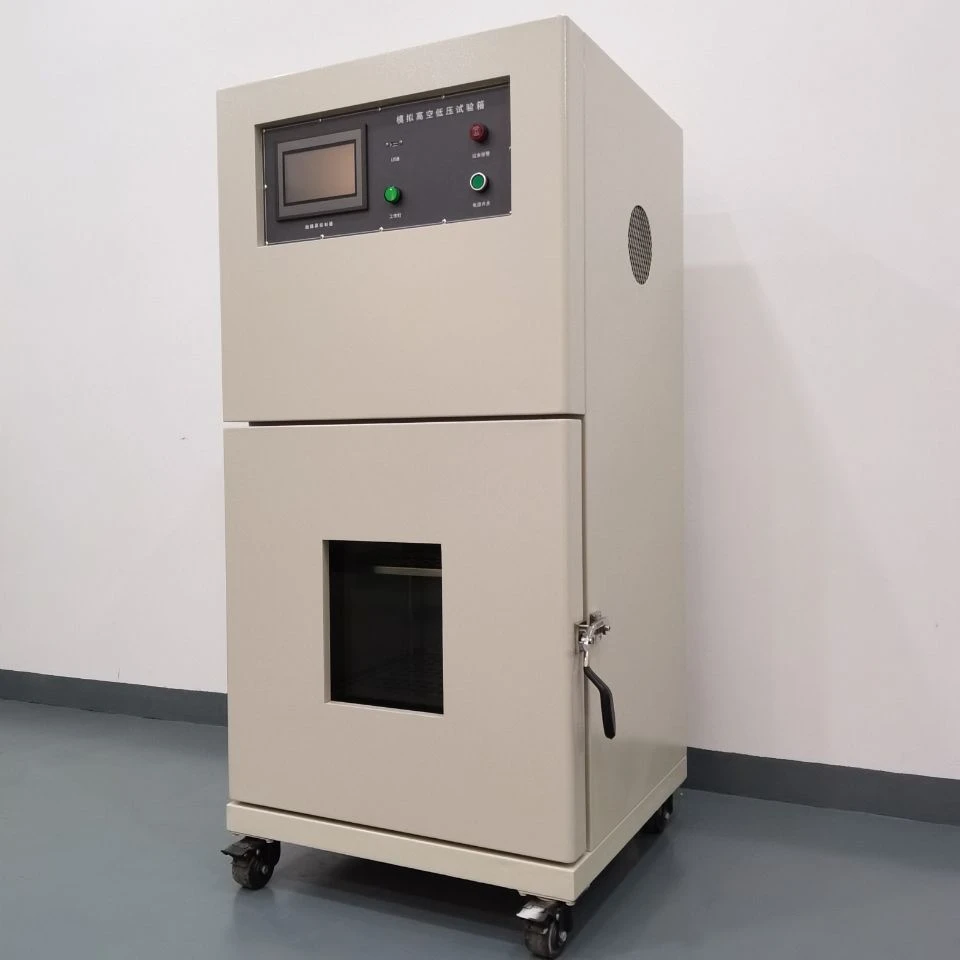
Le DERUI DR-D203 battery altitude simulation test chamber provides controlled low-pressure exposure for lithium cell and battery testing. Its 125 L workspace and 5.0–101.3 kPa absolute-pressure range include the 11.6 kPa condition used in UN 38.3 T.1. This is a low-pressure-only chamber; the laboratory maintains and records the required ambient temperature separately.

ModèleDR-D203 battery low-pressure chamber
cURL Too many subrequests by single Worker invocation. To configure this limit, refer to https://developers.cloudflare.com/workers/wrangler/configuration/#limits500 × 500 × 500 mm (W × D × H), 125 L
Plage de pression5.0–101.3 kPa absolute; UN 38.3 T.1 reference condition: 11.6 kPa or less
ControlE600 7-inch touchscreen; automatic pressure and hold-time settings; time-stamped pressure recording and export
TempératureNo built-in heating or cooling; laboratory ambient condition is maintained and documented separately
ApplicationBattery low-pressure exposure and UN 38.3 T.1 test planning; the complete test and report remain the laboratory’s responsibility

Sûr et fiable
bien fabriqué
Assurance qualité
personnalisation
MessageWhatsApp
Numéro de hotline 15580327593
  • Détails du produit
  • Paramètres techniques
  • FAQ
  • Contactez-nous
DR-D203 · Battery Low-Pressure Chamber

125 L Battery Altitude Simulation Test Chamber

Specify a controlled absolute-pressure hold for battery transport testing without paying for an unneeded heating and refrigeration system. The revised DR-D203 has a 500 × 500 × 500 mm workspace, a 5.0–101.3 kPa absolute-pressure range and automatic vacuum control through a 7-inch touchscreen.

cURL Too many subrequests by single Worker invocation. To configure this limit, refer to https://developers.cloudflare.com/workers/wrangler/configuration/#limits500 × 500 × 500 mm · 125 L
Absolute pressure5.0–101.3 kPa
Test focusLow-pressure exposure, including the 11.6 kPa T.1 condition

What this chamber is—and is not

DR-D203 is a low-pressure altitude simulation chamber for cells, batteries and other specimens whose test plan calls for reduced air pressure. It does not include active heating or refrigeration. For UN 38.3 T.1, the laboratory must maintain and document the required 20 ± 5 °C ambient condition independently; a pressure-capable chamber alone does not certify a test result.

Do not substitute this model for a temperature-altitude chamber. Simultaneous programmed hot/cold and low-pressure exposure requires a separately specified system. The observation window and door restraint are standard construction features, not a verified thermal-runaway containment rating.

DR-D203 technical specifications

Paramètre 125 L configuration
Internal workspace 500 × 500 × 500 mm (W × D × H), 125 L geometric volume; two levels with two mesh shelves
cURL Too many subrequests by single Worker invocation. To configure this limit, refer to https://developers.cloudflare.com/workers/wrangler/configuration/#limits Approximately 800 × 750 × 1480 mm (W × D × H); final unit governs
Plage de pression 5.0–101.3 kPa absolute; minimum 5.0 kPa
Pressure control accuracy At ≤5 kPa: ±0.5 kPa; above 5–40 kPa: ±1 kPa; above 40–80 kPa: ±2 kPa. Confirm the agreed acceptance point and test conditions in the order.
Pressure release rate 15 ± 3 kPa/min
Control and sensing E600 Youyi 7-inch touchscreen; diffused-silicon pressure sensor; automatic upper/lower pressure limits, hold time, end-of-test venting and alarm settings
Data record Time-stamped pressure curve and export included in the confirmed standard configuration; request the file format, sampling interval and FAT demonstration in the order.
Chamber structure 4.0 mm SUS304 stainless-steel reinforced interior; 1.2 mm powder-coated cold-rolled steel exterior; rock-wool infill; high-temperature silicone door seal
Window and door 19 mm tempered-glass window, 250 × 300 mm; door restraint chain
Vacuum pump Daertuo VP750; 220 V / 0.25 kW motor; pump noise ≤75 dB as supplied specification
cURL Too many subrequests by single Worker invocation. To configure this limit, refer to https://developers.cloudflare.com/workers/wrangler/configuration/#limits Emergency stop, pressure-limit protection, pressure-reducing valve, automatic and manual venting, grounding and fast fuse; protection scope must be checked against the actual battery hazard assessment
Power and weight 220 V / 50 Hz, rated equipment power 2 kW; approximately 250 kg
Entretien Replaceable custom door seal; vacuum-pump oil replacement and routine pump service

Product quotation, drawings and factory acceptance results govern the delivered unit.

How to specify a UN 38.3 T.1 setup

Test profileIdentify the adopted Manual edition, absolute-pressure target at or below 11.6 kPa, required hold, test sequence and laboratory ambient-temperature record.
cURL Too many subrequests by single Worker invocation. To configure this limit, refer to https://developers.cloudflare.com/workers/wrangler/configuration/#limitsProvide chemistry, dimensions, mass, quantity, state of charge and condition. Shelf load limits and usable clearance must be approved before loading.
cURL Too many subrequests by single Worker invocation. To configure this limit, refer to https://developers.cloudflare.com/workers/wrangler/configuration/#limitsAgree on pressure/temperature instruments, calibration evidence, exported traces, observations and before/after measurements needed by the laboratory.

This equipment supports the low-pressure portion of a test program; it does not itself confer UN 38.3 approval. Confirm the applicable method and reporting criteria with your laboratory.

Standard safety equipment and operating limits

The confirmed standard configuration includes an emergency stop, pressure protection, pressure-reducing valve, automatic end-of-test release and manual venting. A 19 mm tempered-glass window and side-mounted door restraint are also fitted. The vacuum pump has an exhaust outlet. None of these statements establishes a rated capability to contain battery fire, explosion or thermal runaway.

The standard chamber has no confirmed powered-test feedthrough. Keep specimens unpowered during a standard T.1 storage exposure unless a separately engineered configuration and approved procedure explicitly require otherwise. Gas detection, fire interfaces and laboratory exhaust treatment must be evaluated for the specimen and facility; do not assume they are included.

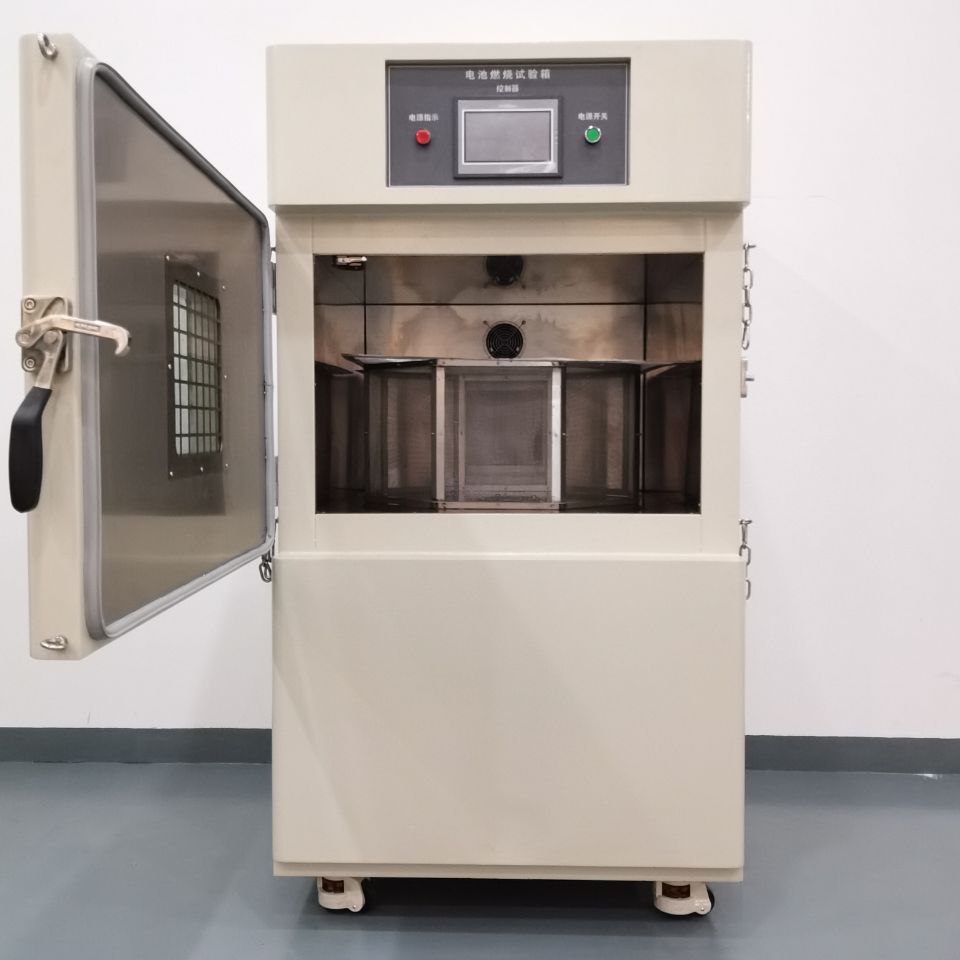
Real DR-D203 equipment photograph
UN 38.3 T.1 lithium battery altitude simulation workflow from low pressure exposure to result evaluation

Common selection questions

Does the DR-D203 control temperature?

No. It is a low-pressure-only chamber without active heating or cooling. The laboratory must establish and document the ambient condition required by its test procedure.

Is a 5.0 kPa minimum enough for UN 38.3 T.1?

The specified pressure range includes the T.1 target of 11.6 kPa absolute or less. Whether a particular test is valid also depends on duration, ambient condition, samples, measurements and the adopted method edition.

Can the chamber generate a compliant test report by itself?

No. Its standard pressure-trace export supports evidence collection, while the laboratory remains responsible for calibration, sample identification, observations, electrical measurements and the complete report.

Configure the chamber for your test plan

Send the required standard edition, specimen details, pressure profile, lab ambient conditions and reporting requirements. DERUI can confirm the delivered configuration, shelf capacity, safety scope and factory acceptance points before quotation.
Request a DR-D203 configuration review

FacebookLinkedInXRedditWhatsApp
Modèle DR-D203
Taille de la boîte intérieure 400*400*400mm (L*P*H)
Taille de l'équipement 630*620*1130mm (L*P*H)
Matériau de la boîte intérieure Plaque en acier inoxydable SUS304, épaisseur de 3,0 mm
Matériau de la boîte extérieure Plaque d'acier laminé à froid avec traitement de peinture, épaisseur de 1,5 mm
Fenêtre d'Observation Taille 250*250mm, deux couches de verre trempé, fenêtre transparente avec maillage en acier inoxydable
Mobilité de l'équipement Le fond de l'équipement est équipé de quatre roulettes universelles, permettant un déplacement libre
Plage de pression 0,5-100kPa, pression d'air de test couramment utilisée 11,6 kPa
Affichage du niveau de vide Type d'affichage numérique du manomètre SMC
Méthode de contrôle Contrôle par bouton-poussoir
Minuteur Affichage numérique à LED, réglage libre entre 0-9999h
Fluctuations de pression ≤5%
Porte de la boîte Porte simple avec ouverture à gauche et chaîne anti-explosion sur le côté de la porte
Plateau de stockage 2
Poids de l'équipement 130kg
Alimentation électrique AC220V
Puissance 1kW

1, Qu'est-ce qu'une chambre d'essai de simulation d'altitude de batterie ?
C'est une chambre spécialisée conçue pour tester les batteries dans diverses conditions simulées d'altitude.

2, Comment fonctionne la simulation d'altitude ?
La chambre utilise des capteurs précis et des systèmes de contrôle pour reproduire différentes conditions d'altitude afin d'assurer des tests précis.

3, Pourquoi les tests d'altitude sont-ils importants pour les batteries ?
Les tests d'altitude sont cruciaux pour comprendre la performance et la fiabilité des batteries dans différents environnements.

4. Quels types de batteries peuvent être testés ?
La chambre est polyvalente et peut tester une variété de batteries, y compris lithium-ion, nickel-métal hydrure, et autres.

5, La régulation de la température est-elle incluse ?
Oui, notre chambre comprend une gestion thermique avancée pour maintenir des températures de test idéales.

6, Puis-je personnaliser les profils de test ?
Absolument ! La chambre permet des configurations de test personnalisées adaptées à des types de batteries spécifiques.

7, quelles fonctionnalités de sécurité sont incluses ?
Les mécanismes de sécurité incluent des systèmes d'arrêt d'urgence, une protection contre la surpression, et une ventilation complète.

8, L'installation est-elle complexe ?
L'installation est simple, et nos experts offrent un soutien pour assurer une mise en place correcte.

WhatsAppWhatsApp
WhatsAppWhatsApp
WhatsApp
MessageMessage

Demandez un devis