Key Differentiators in European, North American, and Asian-Made Environmental Test Chambers
Date: 12/19/2025 Categories: Technical articles Views: 5468
Comparative Analysis & Extended Guide: Environmental Test Chambers by Region
Part 1: Core Differentiators at a Glance
| Feature | European-Made Chambers | North American-Made Chambers | Asian-Made Chambers (Japan/S. Korea, China as separate tiers) |
|---|---|---|---|
| Engineering Philosophy | Precision & Long-Term Reliability: "Over-engineered" for durability, seamless integration into automated lines. | Robustness & Innovation: High performance for demanding specs, focus on user-serviceability and cutting-edge features. | Japan/Korea: Technological Precision & Efficiency. China: Cost Optimization & Scalability. |
| Key Market Driver | Stringent EU regulations (REACH, RoHS), high labor costs, automotive/aerospace heritage. | Defense, aerospace, automotive, and tech (semiconductor) standards (MIL-STD, SAE, ASTM). | Domestic industrial boom, export growth, competitive supply chains. |
| Typical Build Quality | Exceptional craftsmanship. Heavy-duty components. Focus on seamless welds and finish. | Very high, but with a focus on functional durability. May prioritize serviceability over "fit and finish." | Japan/Korea: Very high, comparable to West. China: Wide range—from low-cost basic to high-end improving rapidly. |
| Control & Software | Highly advanced, often with superior UI/UX. Strong in data integrity and compliance tracking (21 CFR Part 11 ready). | Very powerful and flexible. Often leads in integrating latest tech (IoT, advanced diagnostics). Can be complex. | Japan/Korea: Excellent, user-friendly. China: Rapidly improving. Basic on low-end, surprisingly capable on high-end. |
| Primary Strengths | Unmatched consistency, longevity, and precision for critical applications. Best-in-class climate chambers. | Handling extreme conditions, innovative solutions for unique test profiles, strong after-sales support network. | Japan/Korea: Excellent value in mid-high tier, energy efficiency. China: Unbeatable cost, fast delivery, vast model selection. |
| Perceived Weaknesses | Highest upfront cost. Can be less flexible with customizations. | Can be expensive. Software/controls sometimes seen as less intuitive than EU. | China (specific): Variable quality, less proven long-term reliability, limited support in some regions. |
| Typical Price Point | Premium | Premium to High | Japan/Korea: Competitive with West. China: Budget to Mid-Market. |
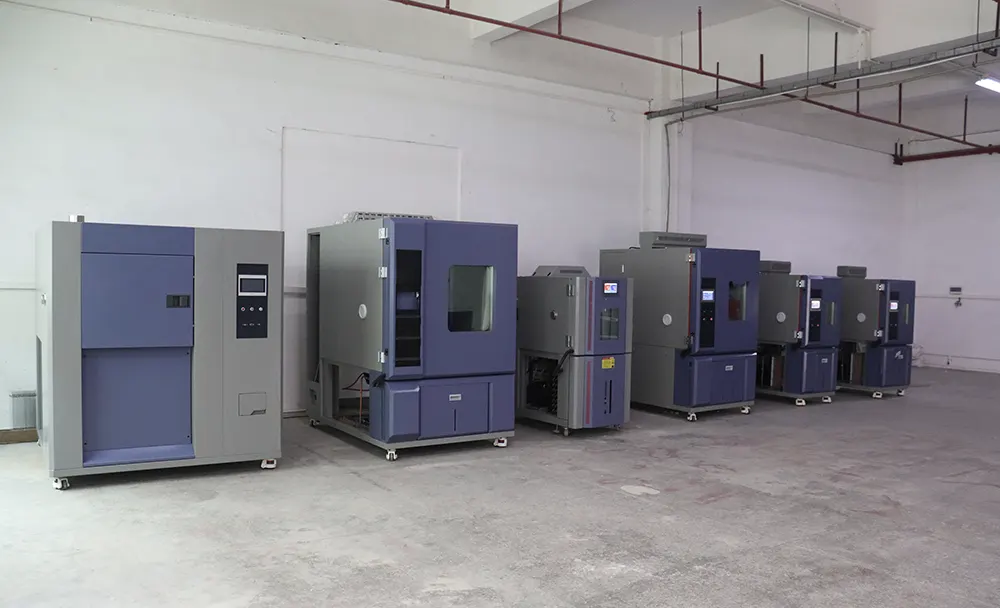
Part 2: Detailed Regional Analysis
1. European-Made Chambers (Germany, Italy, UK, etc.)
- Heritage & Regulation: Deep roots in precision engineering (German Maschinenbau) and the stringent regulatory environment of the EU. This drives a focus on flawless execution, material traceability, and environmental compliance (e.g., using approved refrigerants).
- Design Focus:
- Longevity & Stability: Built to operate reliably for decades in 24/7 industrial settings, often with lower total cost of ownership.
- System Integration: Excel in being integrated into larger, automated manufacturing or testing lines (common in automotive).
- Climatic Precision: Renowned for temperature/humidity chambers with exceptional uniformity and stability, crucial for pharmaceutical and material science.
- Target User: Industries where test integrity is non-negotiable—automotive OEMs, aerospace, premium consumer goods, and regulated pharma.
2. North American-Made Chambers (USA & Canada)
- Heritage & Innovation: Driven by the demands of the aerospace, defense, and technology sectors. This fosters a culture of solving extreme testing challenges (e.g., rapid temperature change, combined stress testing).
- Design Focus:
- Performance & Serviceability: Designed to meet or exceed demanding specifications (MIL-STD, ASTM). Emphasis on modular design and ease of maintenance by customer technicians.
- Technology Leadership: Often first to market with advanced features, sophisticated simulation software, and robust remote monitoring/IoT capabilities.
- Broad Application Range: Strong presence in niche segments like AGREE chambers, salt spray/corrosion, and highly customized solutions.
- Target User: Defense contractors, aerospace giants, semiconductor companies, and research labs requiring cutting-edge or highly specific test capabilities.
3. Asian-Made Chambers
This region requires segmentation, as the differences between Japan/South Korea and China are profound.
- Japanese & South Korean:
- Philosophy: Blend high technological prowess with operational efficiency. Focus on energy efficiency, compact footprints, and intuitive controls.
- Strength: Produce chambers that are very competitive with top-tier European and American models, often at a slight price advantage. Excellent in precision and reliability for electronics, battery, and automotive component testing.
- Brands: Seen as reliable, high-quality alternatives to Western brands.
- Chinese:
- Market Evolution: The landscape is bipolar.
- Tier 1 (Established/Export-Oriented): Companies that have invested heavily in R&D, quality control, and Western-style sales/support networks. Their products are closing the gap in performance and reliability at 20-40% lower cost.
- Tier 2 (Domestic/Low-Cost): Focus on the massive domestic market and price-sensitive exports. Build quality, component sourcing (compressors, controllers), and long-term reliability can be inconsistent.
- Key Advantage: Unbeatable cost, fast turnaround, and flexibility. They dominate the budget-conscious and "good enough" market segment and are making strong inroads into mid-range applications.
- Market Evolution: The landscape is bipolar.
Part 3: Extended Analysis: Application-Specific Preferences & Future Trends
4. Selection by Industry & Application
Different testing needs amplify the strengths of products from specific regions.
- Automotive Electronics & EV Battery Testing:
- Europe: Preferred for long-term stability and data reliability, ideal for multi-month battery cycle life tests and stringent standards (e.g., LV 124).
- North America: Excels in abuse testing involving high charge/discharge rates combined with extreme temperature shocks.
- Japan/Korea: Offers excellent value and meets Asian OEM standards effectively.
- China (High-Tier): A viable option for cost-sensitive mass-production testing.
- Aerospace & Defense:
- North America: Dominant. Products are specialized for complex military/aerospace standards (MIL-STD-810, RTCA DO-160), leading in rapid thermal cycling and combined environmental stress testing.
- Europe: A strong competitor in civil aviation and satellite component testing.
- Pharmaceuticals & Medical Devices:
- Europe: Highly recommended. Its design philosophy aligns naturally with strict GMP and FDA 21 CFR Part 11 compliance requirements for data integrity.
- North America: Also provides top-tier, compliant solutions, widely accepted in innovative biotech firms.
- Consumer Electronics (R&D vs. Production Line):
- R&D Validation: European, North American, and Japanese brands are mainstream, as their test results carry higher global recognition.
- Production Line (e.g., PCBA aging): Chinese manufacturing is the global backbone. Its optimization for cost, speed, and scalability perfectly matches consumer electronics manufacturing demands.
5. Globalization and Future Trends
The pure "country of origin" label is blurring. Future competition revolves around the convergence of technology, supply chains, and business models.
- Globalized Supply Chains: Top Western manufacturers commonly have production bases in Asia for cost and market proximity. Leading Chinese firms acquire European brands or establish R&D centers abroad to access technology and high-end markets.
- Simultaneous Convergence & Divergence:
- Convergence: Gaps are narrowing rapidly in "visible" areas like controller accuracy, energy efficiency, connectivity, and UI.
- Continued Divergence: The real differentiators remain core component lifespan, long-term operational stability, performance retention under extreme conditions, and seamless global service support—barriers built by top Western brands over decades.
- Future Competitive Focal Points:
- Smartization & Predictive Maintenance: Using AI and IoT data to predict failures and optimize test cycles.
- Sustainability: Adoption of lower GWP refrigerants and higher energy efficiency.
- Service & Data Value: Evolving from selling equipment to providing "Testing as a Service" and data analytics solutions.
Part 4: Practical Decision-Making Tools
6. Ultimate Decision Flowchart & Key Questionnaire
Decision Flowchart:
[Start] → Define Core Test Standards & Budget →
                ↓
        ┌─────────────────┐
        │ Is Budget Extremely │ → Yes → Research Chinese Tier-1 brands.
        │   Constrained?   │        Scrutinize case studies & local support.
        └─────────────────┘
                ↓ No
        ┌─────────────────┐
        │ Does testing involve │ → Yes → Prioritize North American solutions.
        │ extreme conditions/ │
        │  special standards? │
        └─────────────────┘
                ↓ No
        ┌─────────────────┐
        │ Are data compliance │ → Yes → Prioritize European solutions.
        │ & long-term stability │
        │    the top priority? │
        └─────────────────┘
                ↓ No
        ┌─────────────────┐
        │ Seeking the best balance│ → Yes → Evaluate Japanese/Korean &
        │ of tech, cost & reliability?│        Chinese top-tier options deeply.
        └─────────────────┘
                ↓
        [Request proposals, conduct technical clarifications & on-site visits]
Key Questions for Suppliers (Go Beyond the Spec Sheet):
- Core Components: "What are the brands and models of the compressor, sensors, and controller? Can you provide the spare part numbers?"
- Performance Verification: "Can you provide third-party certification reports for uniformity and deviation under both empty and full load? What is the sensor mapping diagram?"
- Long-Term Reliability: "What is the design life of key components (e.g., evaporator, sheet metal)? What is the Mean Time Between Failures (MTBF) data for similar 24/7 operation cases?"
- Service Support: "What is the guaranteed response time for a local engineer in case of a breakdown? Do you provide detailed fault code manuals and remote diagnostic support?"
- Compliance: "Does the software meet 21 CFR Part 11 requirements (if needed)? Is the equipment itself compliant with directives like RoHS/REACH?"
Final Summary & Recommendation
Selecting an environmental test chamber is a precise trade-off among performance, reliability, Total Cost of Ownership (TCO), and risk.
- View European manufacturing as an "insurance policy" for your most critical applications and irreplaceable data.
- View North American manufacturing as a "specialty tool" for tackling unconventional, extreme testing challenges.
- View Japanese/Korean manufacturing as "precision-engineered options" offering reliable and economical choices in mainstream high-end applications.
- View Chinese manufacturing as the "practical engine" driving global scale testing, with its high-tier products continuously redefining value propositions.
Ultimately, on-site visits to a shortlisted supplier's facility (or key customer sites), hands-on experience with their software, and direct conversations with their senior engineers will lead to a more informed decision than comparing paper specifications alone. The global market is dynamically evolving, but understanding these core differentiators, rooted in regional culture and industrial history, remains your most reliable compass.