Calle Shugang 1, No. 3, Town de Hongmei, Ciudad de Dongguan, Provincia de Guangdong, China

Fabricante de cámaras de prueba ambiental con 20 años de experienciaMás de 3000 entregas a clientes en todo el mundo           Correo electrónico: shirley@deruitest.com
WhatsApp Consultation:+86 135 2795 8363

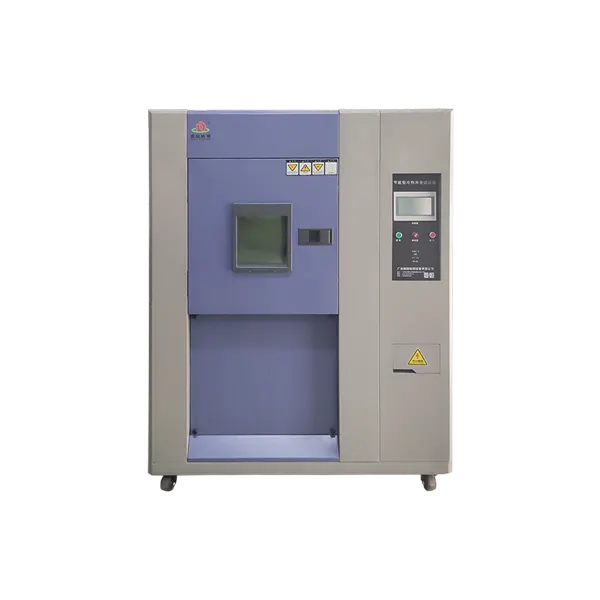
Cámara de prueba de choque térmico de ahorro de energía

La DERUI DR-H203-50 energy-saving temperature shock test chamber combines rapid hot–cold exposure with capacity matching and insulated zone management. Energy use should be compared under the same cycle, specimen load and facility conditions.

Modelo DR-H203-50
Tipo de prueba Air-to-air temperature shock
Published Ranges Hot +60°C to +150°C; cold 0°C to -40°C or -55°C
Efficiency Metric Measured kWh under a defined cycle and specimen load
Before Quotation Confirm architecture, load, transfer, recovery, utilities and comparison baseline
Segura y confiable
bien hecha
Garantía de calidad
personalización
MensajeWhatsApp
Número de línea directa 15580327593
  • Detalles del producto
  • Parámetros técnicos
  • Preguntas frecuentes
  • Contáctanos
Energy-Efficient Air-to-Air Thermal Shock

DR-H203-50 Energy-Saving Temperature Shock Test Chamber

Combine rapid hot–cold exposure with capacity matching, insulated zone management and measurable energy reporting. Select the chamber around the required transfer, loaded recovery, specimen demand and cycle profile—then compare energy consumption under the same conditions.

ModeloDR-H203-50
Tipo de pruebaAir-to-air thermal shock
Efficiency metricMeasured kWh per defined cycle
Primary decisionPerformance before savings

What Energy-Efficient Thermal Shock Must Deliver

Thermal shock can reveal failures caused by unequal expansion and contraction, including solder-joint cracking, delamination, seal leakage, coating separation and intermittent electrical faults. Lower energy use is useful only when the required exposure remains valid.

Maintain the required shock profile

Hot/cold conditions, transfer, recovery, dwell and cycle count must remain within the approved procedure.

Match capacity to the specimen

Workspace, specimen mass, fixtures and powered heat determine stored thermal capacity and recovery demand.

Reduce uncontrolled zone losses

Insulation, seals and controlled transfer openings reduce heat exchange between stored hot and cold environments.

Measure, do not assume

Compare total kWh using the same cycle, load, ambient condition, cooling method and measurement boundary.

No unsupported percentage: an “energy-saving” claim needs a named baseline and repeatable measurement conditions.

Published DR-H203-50 Baseline

Artículo Published value Project confirmation
Modelo DR-H203-50 Confirm usable workspace and specimen envelope
Hot-zone range +60°C to +150°C Confirm setpoint, dwell and tolerance
Cold-zone options 0°C to -40°C or 0°C to -55°C Select the project configuration
Heat-storage preparation Room temperature to +180°C within 35 min Zone preparation; not specimen response time
Cold-storage preparation Room temperature to -55°C within 60 min Confirm ambient and load condition
Conversion time 2–10 s Define basket transfer or airflow switching architecture
Recovery/stabilization 5 min Confirm sensor point, tolerance and representative load
Supply AC380V, 50/60Hz, three-phase Confirm site current and cooling utilities
Controlador 7-inch or 10-inch touchscreen Confirm programmes, communications and data functions

Where Lower Energy Consumption Can Come From

Capacity control

Heating and refrigeration stages can be matched to current demand instead of operating every stage continuously at maximum output. The exact control implementation is configuration-dependent.

Zone isolation

Effective insulation, door sealing and controlled transfer openings preserve stored hot and cold conditions between exposures.

Cycle-aware operation

Controller logic can reduce unnecessary conditioning during idle periods while preparing zones before the next exposure.

Correct sizing

An oversized system conditions more air and structure than needed. Use the specimen envelope, mass and heat capacity to select workspace and thermal capacity.

cURL Too many subrequests by single Worker invocation. To configure this limit, refer to https://developers.cloudflare.com/workers/wrangler/configuration/#limits

Requisito What must be defined
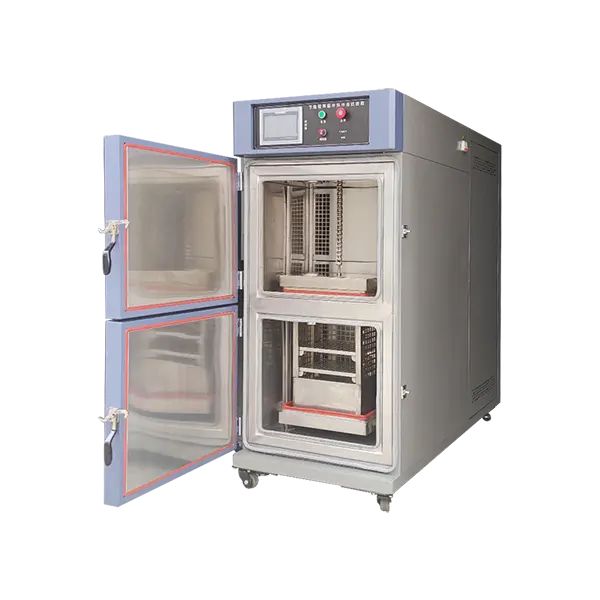
Architecture Two-zone specimen transfer or three-zone air-diverter arrangement and whether the specimen moves
Transfer and recovery Maximum conversion time, recovery tolerance, measurement point and empty/loaded condition
Dwell Whether dwell begins at transfer, chamber-air recovery or specimen stabilization
Cargar Dimensions, mass, quantity, fixture, heat capacity, powered watts and cable interfaces
Energy boundary Preconditioning, active cycles, standby, facility cooling and the full measurement period
cURL Too many subrequests by single Worker invocation. To configure this limit, refer to https://developers.cloudflare.com/workers/wrangler/configuration/#limits Sensor positions, records, alarms, data format and FAT criteria

cURL Too many subrequests by single Worker invocation. To configure this limit, refer to https://developers.cloudflare.com/workers/wrangler/configuration/#limits

Use the same cycle

Keep hot/cold setpoints, dwell basis, transfer, recovery requirement and number of cycles identical.

Use the same load

Specimen mass, material, fixture, initial temperature and operating heat must be comparable.

Control facility conditions

Record room temperature, supply voltage and cooling-water condition where applicable.

Report useful metrics

Compare total kWh, kWh per completed cycle, peak demand, recovery time and any failure to remain within tolerance.

Start with the Exact Test Procedure

IEC 60068-2-14:2023 addresses change-of-temperature tests. Semiconductor and microelectronic programmes may refer to other methods. Confirm the exact standard, edition, procedure, severities and acceptance criteria rather than claiming blanket compliance from the chamber name.

cURL Too many subrequests by single Worker invocation. To configure this limit, refer to https://developers.cloudflare.com/workers/wrangler/configuration/#limits a conventional single-zone chamber may produce a slower air ramp and a different stress mechanism. Transfer time alone also does not prove loaded specimen recovery.

Information Required for Configuration

Specimen

Envelope, quantity, mass, fixture, material, heat capacity, powered watts and cable connections.

Shock profile

Hot/cold temperatures, dwell, conversion, recovery, cycles and specimen measurements.

Facility

Voltage, available current, ambient conditions, cooling method, water, drainage and heat rejection.

Efficiency objective

Operating hours, comparison baseline and whether the target is lower kWh, peak demand, cooling-water use or total operating cost.

Preguntas Frecuentes

What makes this an energy-saving thermal shock chamber?

The design objective is to reduce avoidable heating, cooling and zone losses while maintaining the specified shock cycle. The actual result must be measured against a defined baseline.

Is rated power the same as energy consumption?

No. Rated power is a capacity or maximum-demand value. Energy consumption depends on power over time, controller duty, load, setpoints and facility conditions.

How should savings be verified?

Measure total kWh over the same preconditioning, active-cycle and standby boundary using the same specimen and exposure conditions.

Does faster conversion guarantee a valid test?

No. Recovery, dwell, uniformity and the specimen response criteria must also satisfy the selected procedure.

Can a standard temperature chamber replace it?

Only if the governing method permits the achieved transition. A single workspace usually creates a different thermal rate than stored hot and cold zones.

What is required for a quotation?

Send the method, specimen data, cycle, transfer and recovery requirements, powered heat, utilities, operating schedule and energy comparison target.

Specify Performance and Energy Use Together

Send DERUI the specimen load, thermal shock method, hot/cold profile, transfer and recovery limits, facility conditions and operating schedule. The proposal can then define the chamber architecture and the energy measurement basis.
Request a Configuration Review

FacebookLinkedInXRedditWhatsApp
Modelo DR-H203-50
Rango de choque térmico (Alta temperatura: +60℃~+150℃; Baja temperatura: 0℃~-40℃; 0℃~-55℃)
Tiempo de calentamiento (zona de almacenamiento de calor) RT~180℃≤35min
Tiempo de enfriamiento (zona de almacenamiento en frío) RT~-55℃≤60min
Tiempo de recuperación y estabilización de la temperatura 5min
Tiempo de conversión de temperatura 2-10S
Materiales de la caja interior y exterior Caja exterior: Placa de acero laminado en frío tratada contra óxido con esmalte. Caja interior: Placa de acero inoxidable SUS304#
Material de aislamiento Material de aislamiento de espuma de poliuretano PU resistente al fuego y de alta resistencia + fibra de vidrio ultrafina
Sistema Sistema de control de temperatura de equilibrio P.I.D+SSR+microordenador
Sistema de enfriamiento Compresor de doble etapa semi-hermético (enfriado por agua)/compresor de doble etapa totalmente hermético (enfriado por aire)
Dispositivo de protección de seguridad Interruptor sin fusible, interruptor de protección de alta y baja presión del compresor, protección contra sobrecorriente, protección contra sobrecalentamiento, interruptor de protección de alta presión del refrigerante, sistema de alarma de fallos
Accesorios Ventana de visualización (tipo opcional especial), dos estantes ajustables hacia arriba y hacia abajo, orificio de prueba de alimentación eléctrica, ruedas, soporte de nivelación
Fuente de alimentación AC380V50HZ/60HZ 3∮
Controlador Controlador de pantalla táctil LCD de 7 pulgadas/10 pulgadas, pantalla en chino/inglés
Compresor Marca francesa “Taylor”, marca alemana “Bitzer”/“Bock”
Más parámetros ¡Por favor, contáctenos!

Pregunta 1: ¿Eres un fabricante? ¿Puedes personalizar el equipo según nuestros requisitos específicos?

Sí, somos un fabricante chino de cámaras de prueba ambiental con 20 años de experiencia en la industria. Podemos personalizar el equipo según sus requisitos exactos. Nuestro equipo de I+D interno ofrece servicios OEM, ODM y OBM para garantizar que su solución satisfaga sus necesidades comerciales.

Pregunta 2: ¿Qué tan pronto puedo obtener una cotización?
Respuesta 2: Normalmente proporcionamos cotizaciones en 24 horas después de recibir su consulta. Si necesita una respuesta más rápida, no dude en llamarnos o enviarnos un correo electrónico para informarnos de sus necesidades urgentes, y daremos prioridad a su consulta.

Pregunta 3: ¿Cuál es el tiempo de entrega habitual de sus productos?
Respuesta 3: El tiempo de entrega estándar para la mayoría de nuestros productos es de 30 días. Para pedidos más grandes o equipos personalizados, el tiempo de entrega puede extenderse de 30 a 50 días, dependiendo de la cantidad y la personalización requerida.

Pregunta 4: ¿Qué métodos de pago aceptan?
Respuesta 4: Ofrecemos una variedad de opciones de pago seguras, incluyendo PayPal, T/T, Visa, Western Union, etc., para garantizar que pueda elegir la forma más conveniente para su transacción.

Pregunta 5: ¿Qué métodos de entrega están disponibles?
Respuesta 5: Enviamos a todo el mundo mediante múltiples métodos: transporte marítimo, aéreo o exprés (DHL, FedEx, etc.). Siempre recomendaremos la opción de entrega más rentable y eficiente según su ubicación y preferencias.

Pregunta 6: ¿Cómo se calculan los costos de envío y los impuestos?
Respuesta 6: Los costos de envío dependen del modo de transporte, destino y peso del equipo. Siempre proporcionamos información clara sobre los cargos de entrega con anticipación. Los impuestos son determinados por las regulaciones locales en su país y son gestionados por el país receptor.

Pregunta 7: ¿Incluye instalación y capacitación? ¿Es necesario que los técnicos estén en el sitio?
Respuesta 7: No se necesitan técnicos en el sitio. Todas nuestras máquinas están diseñadas para ser fáciles de instalar y listas para usar. Proporcionamos manuales de usuario detallados y capacitación remota gratuita por parte de nuestros ingenieros expertos. Si necesita asistencia, también podemos guiarle a través de videos de instalación y soporte remoto en tiempo real.

Pregunta 8: ¿Qué tipo de servicio postventa puedo esperar?
Respuesta 8: Ofrecemos soporte de por vida para todos nuestros productos. Nuestro equipo de ingeniería profesional responderá a cualquier problema en 12 horas. La mayoría de los problemas se pueden diagnosticar y resolver de forma remota. Si es un problema de hardware, enviaremos piezas de repuesto gratuitas vía DHL y proporcionaremos instrucciones detalladas de instalación.


Pregunta 9: ¿Ofrecen servicios de garantía para su equipo?
Respuesta 9: Sí, todo el equipo cuenta con una garantía integral de un año. También ofrecemos servicios de mantenimiento y soporte después del período de garantía para asegurar que su equipo funcione de la mejor manera durante muchos años.

Pregunta 10: ¿Puedo visitar su fábrica?
Respuesta 10: Sí, puede visitar nuestra fábrica en Dongguan, China. Ver nuestra operación en persona y discutir su proyecto cara a cara nos ayudará a entender mejor sus necesidades. Podemos organizar la visita según su conveniencia.

WhatsAppWhatsApp
WhatsAppWhatsApp
WhatsApp
MensajeMensaje

Solicitar una Cotización