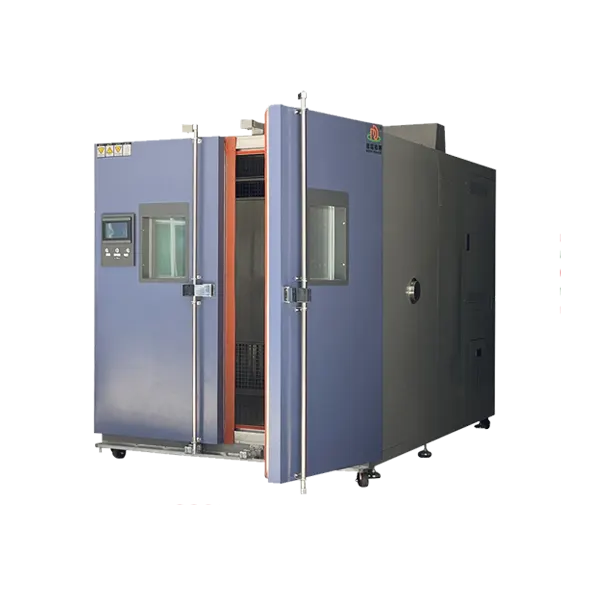
Rapid Hot-to-Cold Transfer for Small Components and Assemblies
The DR-H203-50 uses preconditioned hot and cold storage zones to expose a specimen basket to rapid temperature changes. It is intended for components, electronics, connectors, seals, coatings and material assemblies whose governing procedure requires transfer between established environments.
Thermal shock is not the same as programmed temperature cycling in one workspace. The critical results depend on the specimen transfer, zone recovery, dwell definition, loaded basket and temperature measurement method—not only the maximum hot and cold settings.
Direct answer: choose this 50 L model only when the specimen, fixture, cables and required movement fit the basket and the stated hot/cold conditions reproduce the approved procedure. Confirm every performance value with a representative load before purchase.
DR-H203-50 Technical Parameters
These values come from the existing product table. Final basket dimensions, exposure ranges and loaded performance must be defined in the approved technical agreement.
| Item | Published value |
|---|---|
| Nominal capacity | 50 L |
| High-temperature exposure range | +60°C to +150°C |
| Low-temperature exposure options | 0°C to −40°C or 0°C to −55°C |
| Hot-zone heating | Room temperature to 180°C in ≤35 min |
| Cold-zone cooling | Room temperature to −55°C in ≤60 min |
| Published conversion time | 2–10 s |
| Published recovery/stabilization | 5 min |
| Control | PID + SSR + microcomputer balanced temperature control |
| Cooling alternatives | Semi-hermetic two-stage water-cooled or fully hermetic two-stage air-cooled refrigeration |
| Controlador | 7-inch or 10-inch LCD touch screen; Chinese/English display |
| Fonte de alimentação | AC380 V, 50/60 Hz, three phase |
| Construção | SUS304 stainless-steel interior; treated cold-rolled-steel exterior |
Conflict corrected: the old FAQ states 10–15 s conversion and 3–5 min stabilization, which conflicts with the table. The quotation must state the agreed figures, timing start/finish points, sensor location, tolerance and test load. Compressor brand and accessories must also be confirmed rather than treated as universal.
Translate the Standard into a Loaded Thermal Shock Cycle
Use the exact procedure and edition named by the customer. IEC 60068-2-14 includes change-of-temperature tests, while semiconductor, automotive, aerospace and OEM documents can use different transfer, dwell and measurement rules.
Prepare both zones
Establish the specified hot and cold conditions before specimen exposure.
- Zone setpoints and tolerance
- Preconditioning time
- Empty or loaded readiness
- Alarm and abort limits
Transfer the specimen
Move the basket according to the method and record the actual transfer event.
- Transfer-time definition
- Basket payload
- Cable movement
- Door/opening losses
Recover and dwell
Clarify whether dwell starts at transfer, zone recovery or specimen stabilization.
- Sensor location
- Recovery tolerance
- Dwell at each extreme
- Cycle count and deviations
50 Litres Does Not Define Usable Test Capacity
The basket, airflow clearance and specimen thermal mass determine usable capacity. A small but dense metal assembly may challenge recovery more than a larger lightweight plastic part.
Specimen envelope
Confirm basket dimensions, fixture, orientation, clearance and any moving cables.
Thermal mass
Provide mass, materials and heat capacity so hot/cold zone recovery can be assessed.
Powered load
State heat dissipation, monitoring current, feedthroughs and whether operation continues during transfer.
Measurement basis
Separate basket movement time, zone-air recovery and specimen temperature response.
Taxa de processamento
Define specimens per batch, cycles, daily operating time and changeover needs.
Quotation requirement: every transfer and recovery claim should identify the representative load, temperature points, ambient condition, cooling method, sensor position and allowed tolerance.
Nine Inputs for DR-H203-50 Selection
Method and edition
Procedure, severity and customer-specific deviations.
Hot/cold profile
Exposure temperatures, transfer, recovery, dwell and cycles.
Specimen package
Dimensions, mass, materials, quantity, fixture and clearance.
Movement
Allowable orientation, shock, basket travel and cable routing.
Monitoring
Air/specimen sensors, powered state, channels and sampling.
Método de refrigeração
Air- or water-cooled system, room heat rejection and water supply.
Utilidades
Voltage, current, drainage, ventilation, access and floor loading.
Segurança
Over-temperature, refrigeration, overcurrent, alarm and emergency stop.
Documentação
Drawings, calibration, test records, manuals and acceptance report.
Factory acceptance: verify ordered configuration, basket dimensions, zone ranges, transfer sequence, controller, protection logic and representative loaded cycle against one agreed protocol.
DR-H203-50 Thermal Shock Chamber FAQs
Is the shock range the same as the storage-zone range?
No. The published exposure range, hot-zone preheating and cold-zone precooling values describe different functions. Confirm the specimen exposure range separately from zone preparation capability.
Is the conversion time 2–10 seconds or 10–15 seconds?
The old page conflicts. Its technical table says 2–10 s while its FAQ says 10–15 s. Use only the value confirmed in the final technical agreement with a defined start point, endpoint and load.
Does five-minute recovery apply to every specimen?
No. Recovery depends on payload, temperatures, fixture, cooling method and tolerance. Verify it using a representative loaded condition.
Can this replace a temperature cycling chamber?
Only when the governing method accepts specimen transfer between prepared zones. A stationary specimen exposed to programmed air ramps experiences a different profile.
Should air-cooled or water-cooled refrigeration be selected?
Compare ambient temperature, room heat rejection, available cooling water, utilities, noise and loaded recovery. Confirm the selected system in the quotation.
What is needed for an accurate quotation?
Send the method, temperature graph, specimen drawing and mass, transfer and recovery definitions, cycles, monitoring, utilities and acceptance requirements.
Verify DR-H203-50 Against Your Loaded Cycle
Send the procedure, specimen, hot/cold profile, transfer, recovery, monitoring and laboratory utilities.