
200-TYPE CABINET · 1200 L ENCLOSURE · PROGRAMMABLE SPRAY TIMING
A Wider Salt Fog Cabinet for Long Specimens and Large Fixture Layouts
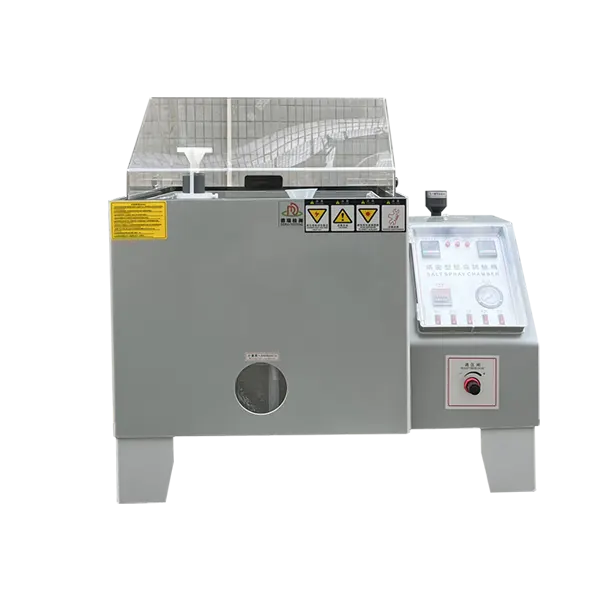
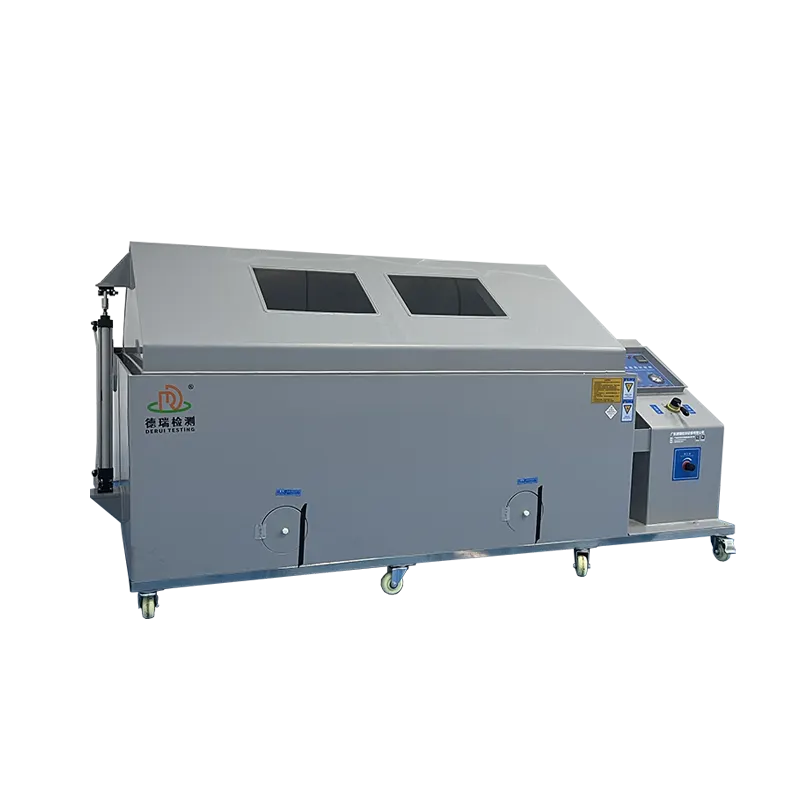
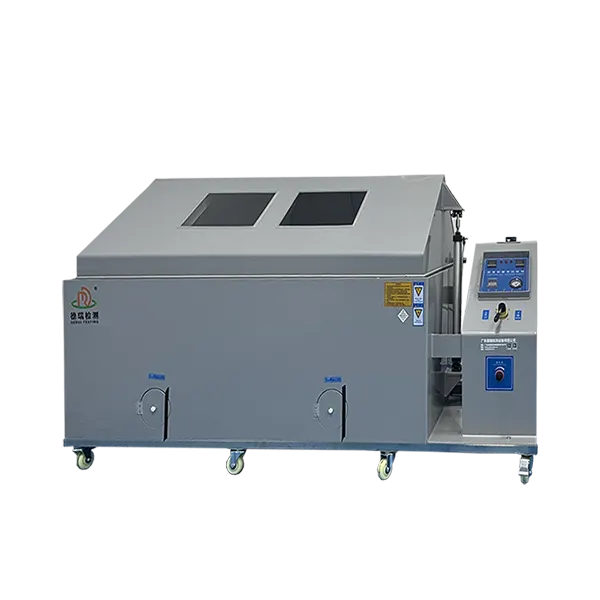
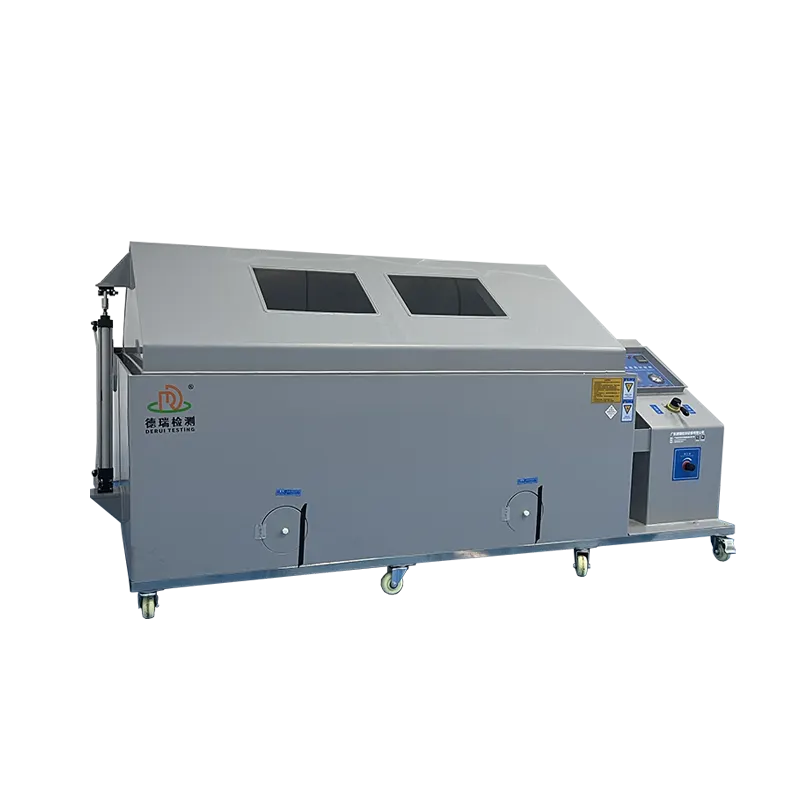
Das DERUI DR-H304-200 1200L programmable salt spray test chamber provides a 2000 × 1000 × 600 mm enclosure with continuous or periodic spray operation. Choose it when the required specimen and fixture arrangement needs more horizontal space or height than a smaller cabinet can provide.
2000 mm internal width
Review long specimens and their complete supports.
600 mm internal height
Include inclination, fixtures and collection clearance.
Continuous / periodic spray
Define the timing required by the exposure programme.
This is a large cabinet configuration, not a walk-in test room. Submit the loading drawing and required method to review fit, handling, utilities and acceptance before selecting the equipment.
What the 2000 mm Enclosure Adds
The 200-type designation corresponds to 2000 mm internal width—not a 200 L volume. The internal dimensions calculate to 1200 L geometric capacity. Compared with DR-H304-160, this model adds 400 mm of width and 100 mm of height while retaining 1000 mm depth.
That larger envelope can accommodate a longer supported specimen or a wider group of fixtures where the required orientation and fog clearances are maintained. It does not establish a rated fixture mass, a guaranteed sample count or unrestricted use of every internal millimetre.
Plan Supports, Drainage and Access for Long Specimens
A long part changes more than the required cabinet width. Support positions, contact areas and drainage must remain compatible with the test. Provide the fixture design and total mass rather than assume standard rods can carry any assembly.
| Loading decision | What to show in the drawing |
|---|---|
| Long coated panels or formed parts | Required exposed faces, inclination, support locations and end clearances. |
| Wide component fixtures | Overall width/depth, part spacing, fixture contact points and mass. |
| Multiple specimen groups | Compatible exposure conditions, individual identifiers and collector access. |
| Parts with recesses or drainage paths | Orientation that avoids shielding and runoff onto other specimens or collectors. |
| Loading and removal | Handling approach, cover clearance and access without changing the prescribed mounting. |
Use side and top views to check the full envelope. A 600 mm-high enclosure can still be unsuitable if a tall fixture or prescribed inclination consumes the remaining clearance. Choose the test orientation first, then confirm fit.
For metal finishes and coated assemblies, identify the surfaces included in evaluation and any excluded edges or contacts. Keep the mounting arrangement reproducible between runs; a fixture change may alter the exposure even if the specimen itself is unchanged.
Define the Spray Sequence You Need
The listed control modes are continuous and periodic spray. Specify the required exposure duration, spray/stop timing and inspection rules so the ordered controller can be reviewed against the programme.
| Control requirement | Information to include |
|---|---|
| Continuous salt fog | Required uninterrupted exposure and permitted access or fault handling. |
| Periodic spray | Spray-on and spray-off timing, repeats and the treatment of non-spray intervals. |
| Test interruption | Rules for stopping, restarting, documenting lost exposure and handling affected specimens. |
| cURL Too many subrequests by single Worker invocation. To configure this limit, refer to https://developers.cloudflare.com/workers/wrangler/configuration/#limits | Required channels, timestamps, alarms and export format if automated records are requested. |
If a customer specifies a full cyclic corrosion procedure, provide the complete sequence for a separate capability review. A recipe name or software setting is not sufficient evidence that the apparatus can create every required environmental stage.
1200L Cabinet Technical Configuration
The DR-H304-200 provides a 2000 mm-wide salt fog enclosure. Values below describe this cabinet configuration; the complete method, solution chemistry and acceptance conditions belong in the agreed test programme.
| Spezifikation | DR-H304-200 configuration |
|---|---|
| Modell | DR-H304-200; 200-type cabinet |
| cURL Too many subrequests by single Worker invocation. To configure this limit, refer to https://developers.cloudflare.com/workers/wrangler/configuration/#limits | 1200 L geometric enclosure volume |
| cURL Too many subrequests by single Worker invocation. To configure this limit, refer to https://developers.cloudflare.com/workers/wrangler/configuration/#limits | 2000 × 1000 × 600 mm |
| cURL Too many subrequests by single Worker invocation. To configure this limit, refer to https://developers.cloudflare.com/workers/wrangler/configuration/#limits | 2700 × 1250 × 1500 mm; additional opening, service and utility clearance required |
| Cabinet construction | 8 mm rigid PVC plate |
| Specimen supports | 10 mm glass-fiber rods and corrosion-resistant V supports for inclined placement |
| Temperaturbereich | cURL Too many subrequests by single Worker invocation. To configure this limit, refer to https://developers.cloudflare.com/workers/wrangler/configuration/#limits |
| Temperaturfluktuation | ≤ ±0,5°C |
| Temperaturschönheit | ≤ ±2°C |
| cURL Too many subrequests by single Worker invocation. To configure this limit, refer to https://developers.cloudflare.com/workers/wrangler/configuration/#limits | ±1°C |
| Spray operation | cURL Too many subrequests by single Worker invocation. To configure this limit, refer to https://developers.cloudflare.com/workers/wrangler/configuration/#limits |
| NSS cabinet operating setting | 35 ±1°C in the listed configuration |
| CASS cabinet operating setting | 50 ±1°C in the listed configuration; select compatible chemistry and the required method before ordering |
| Air-saturator settings | 47 ±1°C for the listed NSS configuration; 63 ±1°C for the listed CASS configuration |
| Nebel-Erfassungsrate | 1.0–2.0 mL per 80 cm² per hour; measurement interval and positions follow the adopted procedure |
| Solution tank | cURL Too many subrequests by single Worker invocation. To configure this limit, refer to https://developers.cloudflare.com/workers/wrangler/configuration/#limits |
| Luftquelle | Buyer-provided; specify air cleanliness, pressure, delivery and connections |
| Protection functions | Electrical protection, overpressure, overtemperature and overload/fuse protection |
| Listed accessories | Test salt, collection/measuring vessel and one spray-nozzle set; item quantities defined in the quotation |
Volume is calculated before fixtures and exposure clearances. Temperature uniformity, fluctuation and indication accuracy are separate specifications. Agree the measurement positions, loading arrangement and fog verification required for acceptance.
Match the Chemistry and Verification to the Method
Specify the required standard and edition, NSS/AASS/CASS exposure, specimen preparation, duration and acceptance endpoint. A larger cabinet changes loading space, not the validity of a chosen chemistry for the product.
NSS
Neutral salt fog operation with the required preparation, cabinet conditions and collected-fog checks.
AASS / CASS
Method-specific acidic chemistry, compatible solution paths, operating conditions and contamination controls.
Cabinet verification
Defined collector positions, temperature checks and any required corrosivity evaluation, separate from instrument calibration.
Das ISO 9227 scope separates NSS, AASS and CASS and includes cabinet-corrosivity evaluation. Use the product requirement for specimen details and result interpretation. Salt fog exposure does not provide a universal conversion from chamber hours to years in service.
For a primary CASS equipment requirement, see the CASS corrosion chamber. For broader method selection and evaluation, use the salt spray testing guide.
Verify the Loaded Layout Across the Cabinet
Long specimens or broad fixtures can change where fog reaches the exposed surfaces and collection vessels. Agree a representative loading arrangement for acceptance and document it before testing.
| Überprüfen | Record to retain |
|---|---|
| Collectors | Position, opening area, collection interval, individual volume and calculated rate. |
| Specimen arrangement | Identifiers, support locations, orientation, spacing and exposed faces. |
| Operating conditions | Required temperature and solution checks, air conditions and replenishment events. |
| Changes or faults | Access, adjustments, interruptions, corrective action and treatment of affected exposure. |
Keep collector readings individually visible. An average can conceal one location collecting too much and another too little. Place collectors according to the method, away from inappropriate direct discharge or runoff.
The solution in the tank and the collected fog are related but distinct measurements. Apply the prescribed checks and measurement conditions rather than assume the prepared solution alone proves an acceptable exposure.
Check the 2700 mm Cabinet and Its Service Connections
The external dimensions are 2700 × 1250 × 1500 mm in width × depth × height. Check delivery access, the final installation drawing and the handling route before fixing the laboratory layout.
| Installation item | Planning decision |
|---|---|
| Footprint and access | Cover movement, inspection, loading/removal and service clearances in addition to cabinet dimensions. |
| Compressed air | Buyer-provided source with specified cleanliness, delivery, pressure and connections. |
| Electrical supply | Ordered voltage, phase, frequency, rated power, protection and cable requirements. |
| Solution and water | Method-appropriate water quality, preparation space and access to the 40 L tank. |
| Exhaust / drainage | Corrosion-resistant routes, connection locations and facility-approved waste handling. |
The 40 L tank is not a guaranteed unattended runtime. Define inspection and refilling arrangements around the actual consumption and test procedure. More chamber volume does not remove the need for solution and nozzle maintenance.
Use the operating instructions for cleaning, replenishment and permitted access. Request any required automatic filling or remote-record function as an explicit configuration item rather than assume it follows from the word programmable.
1200L Cabinet, 1080L Cabinet or Walk-In Room?
| Equipment choice | Internal W × D × H | Selection distinction |
|---|---|---|
| DR-H304-160 / 800 L | 1600 × 1000 × 500 mm | Smaller width and height envelope for suitable batch layouts. |
| DR-H304-200 / 1200 L | 2000 × 1000 × 600 mm | The wider/deeper cabinet configuration covered on this page. |
| DR-H304-1080 / 1080 L | 2000 × 900 × 600 mm | Same listed width and height, but 100 mm less internal depth. |
| DR-H304-B walk-in salt spray room | Project-defined | Separate project for oversized assemblies and walk-in loading access. |
The DR-H304-200 and DR-H304-1080 are different geometries. Keep each model attached to its own dimensions and electrical configuration when comparing quotations.
If your part requires walk-in access or a room-sized loading route, do not treat a 1200 L cabinet as a replacement for a custom test room. Browse the salt spray equipment category for the full equipment range.
Agree a Loading-Based Acceptance and Quotation
An equipment proposal should show how the cabinet fits the specimen arrangement and required procedure. Agree the exposure demonstration and documentation before ordering.
Loading review
Complete specimen/fixture envelope, total mass, support design, required orientation and access.
Acceptance demonstration
Agreed spray operation, representative-load temperature and fog checks, protections and requested records.
Handover scope
Accessory quantities, operating instructions, calibration scope, maintenance information and any witness requirements.
Equipment acceptance does not approve the corrosion resistance of your products. Keep the apparatus checks and subsequent specimen evaluation separate, with individual results against the applicable endpoint.
DR-H304-200 Large-Specimen FAQs
Does 200-type mean a 200L chamber?
No. DR-H304-200 has a 2000 × 1000 × 600 mm internal enclosure, corresponding to 1200 L nominal geometric volume.
Will a 2000mm-long part fit?
Not automatically. Include the support envelope, required orientation, collector positions, loading route and clearances before confirming fit.
What does it add over the 800L DR-H304-160?
It adds 400 mm internal width and 100 mm internal height. Both listed cabinets have 1000 mm internal depth. Specimen capacity still depends on the layout.
Does programmable spray mean full cyclic corrosion testing?
No. Continuous and periodic spraying establish spray operation. Humidity, drying and multi-stage transitions need separately specified functions and verification.
Is DR-H304-200 the same as DR-H304-1080?
No. Both list 2000 mm width and 600 mm height, but DR-H304-200 has 1000 mm depth and DR-H304-1080 has 900 mm depth.
Can the standard supports carry a heavy assembly?
Provide the fixture drawing, total mass and contact points for a support review. A rated payload cannot be inferred from the cabinet volume or rod diameter.
Does the 40L tank guarantee unattended testing for a fixed duration?
No. Consumption, refilling and inspection depend on operating conditions and the procedure. Use the configuration-specific instructions.
What should I send for a proposal?
Send specimen and fixture drawings, total mass, quantity, required method and sequence, inspection rules, records and installation utilities.
PLAN YOUR LARGE-SPECIMEN SALT FOG SETUP
Show Us the Complete Fixture.
Specify the Right 1200L Cabinet.
Send your specimen and support drawings, required exposure and spray timing. Include the loading mass, utilities and acceptance requirements to request a DR-H304-200 configuration review.