Environmental Chamber Data Logging: Export and Alarm Record Requirements
Date de publication :11/09/2026 Catégorie :Resources、Articles techniques Nombre de vues :4854
A chamber can display a useful curve while exporting too little information for your report. Specify the required channels, timestamps, file structure and event records before selecting the controller package. Then include an actual export demonstration in acceptance instead of treating “USB available” as proof that all documentation needs are covered.
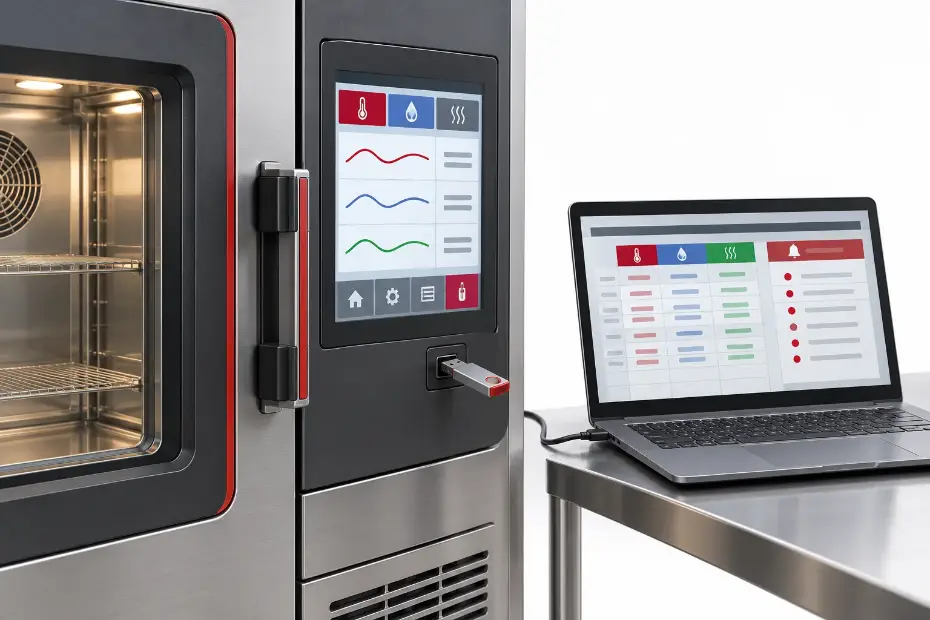
Separate Control, Recording and Independent Measurement
The channel used to control the chamber is not necessarily the only channel your test needs. A project may require control temperature, independent air measurements, specimen temperatures, humidity, operating state and external electrical measurements. Name each function and identify which device records it.
A controller display can show a setpoint and measured value without storing every value at the interval needed for analysis. Similarly, an external logger can record specimen temperature without recording the chamber programme or alarm state. Plan how those records will be associated.
Use a channel list that includes the sensor location, unit, acquisition device and intended use. For acceptance measurements, distinguish controller indication from the independent measurements used to evaluate performance. Do not present the two as equivalent without an agreed basis.
Define the Export Fields Before Choosing a File Format
CSV and spreadsheet files are useful only if their contents can be understood outside the controller software. Ask for a representative export and inspect the header, units, time basis and missing-data treatment. A file that opens in a spreadsheet is not automatically complete or traceable.
| Field or record | What to define | Review question |
|---|---|---|
| Timestamp | Date/time format, time zone and clock basis | Can records from different devices be aligned? |
| Channel identity | Sensor label, location and engineering unit | Can the reported point be traced to the setup? |
| Setpoint and measured value | Separate fields where both are required | Can commanded conditions be distinguished from actual values? |
| Run and programme identity | Test ID, recipe/version and segment information | Can the file be matched to the approved test? |
| State or validity information | Stops, missing records, alarms and status codes | Can a reviewer identify interruptions or invalid readings? |
This is a procurement field list, not a claim that every controller exports every item. Identify which fields are native to the selected controller, which come from an external recorder and which belong in the accompanying run record.
Choose Sampling and Storage Around the Test
Logging needs differ between a long steady exposure and a rapid transition. Define the time resolution required to evaluate the event, the expected run duration and the number of channels. A short demonstration may not reveal whether a long run fills the memory or overwrites earlier data.
Document whether the sampling interval is fixed, selectable or event-driven. If the export contains averaged or reduced data, identify the reduction method. Do not assume that a dense-looking screen curve means the same sampling is available in the exported file.
Ask what happens when memory fills, storage is removed, the network disconnects or power is interrupted. Review recovery and data retention using the manufacturer’s approved procedures. Functional testing should not bypass safeguards or introduce an unsafe fault simply to complete a checklist.
Keep the original export and any processing steps. If the report uses resampled data, retain enough information to distinguish that calculation from the original acquisition record.
Specify Alarm and Interruption Evidence Separately
A temperature log can show a deviation without explaining whether the programme paused, a door opened or a protective limit operated. Define the event evidence needed for review. This may include the event type, occurrence time, clearance time, programme state and acknowledgement, depending on the selected system.
Do not assume the alarm list is included in the same export as process data. Ask whether event records are stored, displayed only, exported separately or retained by another system. Identify the relationship between the event file and the test run.
| Demonstration item | cURL Too many subrequests by single Worker invocation. To configure this limit, refer to https://developers.cloudflare.com/workers/wrangler/configuration/#limits |
|---|---|
| Agreed alarm event | Authorized demonstration procedure, recorded event and process response |
| Stop and restart | Time of interruption, programme handling and data continuity |
| Exportation de données | Original file with known run ID and readable channel definitions |
| Clock alignment | Documented time basis across controller and external instruments |
| Archive and retrieval | Named storage location, file naming and retrieval check |
For laboratories with controlled-record requirements, involve quality and IT staff early. User access, audit trails, electronic signatures and network security are distinct capabilities; a basic curve export does not establish them.
Demonstrate the Workflow with a Short, Known Run
Prepare a harmless test programme with identifiable segments and the agreed channels. Record the setup, execute the run and export the files using the proposed delivery configuration. Where appropriate, use the approved procedure to demonstrate an agreed event.
- Open the export on a normal review computer, not only on the chamber screen.
- Check channel names, units, start/end times and expected record count.
- Match an identifiable segment change to the programme record.
- Locate the event in the event record and align its timestamp with process data.
- Retrieve the original files from the proposed archive location.
Record software/controller version, options and external recording equipment in the handover package. A demonstration on a different controller or software option should not be treated as proof of the purchased configuration.
Put the Data Scope into the Chamber Inquiry
Send the channels, maximum run length, sampling needs, preferred file format and reporting workflow with the specimen and environmental profile. State whether local USB export is sufficient or whether networking and external integration are part of the project.
Request interfaces by their intended task. “Ethernet” describes a connection, not necessarily a documented control interface or a supported API. Identify the requested protocol, software responsibility and any restrictions before planning an automated laboratory system.
Le desktop temperature and humidity chamber et cURL Too many subrequests by single Worker invocation. To configure this limit, refer to https://developers.cloudflare.com/workers/wrangler/configuration/#limits pages are starting points for equipment selection. Use the FAT record template to capture the agreed controller and export demonstration, rather than assuming a shared feature set across all models.
A clear record specification helps both the laboratory and supplier decide what belongs inside the controller package and what should be handled by independent acquisition or reporting tools.
Read a Sample Export as a Reviewer, Not Only as an Operator
Choose a short known programme and inspect its exported record without relying on the person who ran it. Can a second reviewer identify the test, channel locations, units and time zone from the file and associated setup record? If not, define the missing information before handover.
For a hypothetical export, a column labelled Temp1 could mean control air, an independent air probe or a specimen sensor. Rename it or provide a controlled channel map. Likewise, a missing value should be distinguishable from a measured zero; the appropriate representation belongs in the agreed data format.
Check numerical formatting on the computer used for reporting. Regional date settings, decimal separators or spreadsheet conversions can change how a file appears. Retain the original export and use a documented import method when the result will support an auditable calculation.
Write a Small Data Acceptance Script Before the Demonstration
A data acceptance script can be a sequence of review steps rather than software code. Name the run, start the agreed programme, create an authorised identifiable event where appropriate, finish the run, export the records and retrieve the archive copy.
Define what each step should demonstrate: channel presence, timestamp alignment, programme identity, interruption evidence or successful retrieval. Do not assume an alarm email proves the event is retained in the exported test record. They are different outputs.
Use the purchased controller options and software version during the demonstration. Record any external computer, licence or recorder needed to reproduce the workflow. The result should make exclusions visible so the laboratory does not discover after delivery that a reporting function depended on an unquoted software package.
Assign Ownership of Records After Equipment Delivery
Decide who names runs, exports files, checks completeness and retains the original records. A technically capable controller does not solve an unclear laboratory record process. Agree how test identifiers connect to specimen and programme revisions.
For networked equipment, involve IT in account access, backups and the permitted connection method. Remote viewing, remote control and automated file transfer have different operational implications. Keep required functions specific rather than requesting unrestricted connectivity.
If controlled electronic records are required, assess the complete system and applicable quality requirements. A CSV export does not establish audit-trail or electronic-signature compliance. Send the reporting workflow with the equipment enquiry so the proposed controller package can be evaluated against a real task.
Questions Before You Specify the Equipment
Does a USB port guarantee CSV data export?
No. Confirm the port function, supported export format, available channels and data fields on the selected controller. Demonstrate the actual workflow.
Can controller data replace independent acceptance measurements?
Only if the agreed procedure permits that measurement basis. Define the role of control sensors and independent measurement channels separately.
Is a plotted curve enough for a technical report?
Not when the report requires original channel data, calculations or traceability. Retain the raw export, setup record and relevant event information.
Does remote viewing mean an API is available?
No. Browser access, file download and a supported programmable interface are different functions. Specify and verify each required task.
Define My Chamber Data Package
Send the required channels, run duration, sampling interval, file format and report workflow. Ask DERUI to identify the controller, recording options and acceptance demonstration for your project.