Air-Cooled vs Water-Cooled Environmental Chambers: A Facility Selection Guide
Date de publication :11/09/2026 Catégorie :Resources、Articles techniques Nombre de vues :8515
Choose a chamber cooling arrangement from the test duty and the facility—not from the assumption that one option is always cheaper or more efficient. Air-cooled and water-cooled systems both remove heat from the refrigeration circuit, but they place different demands on room ventilation, water services, installation work and ongoing support.
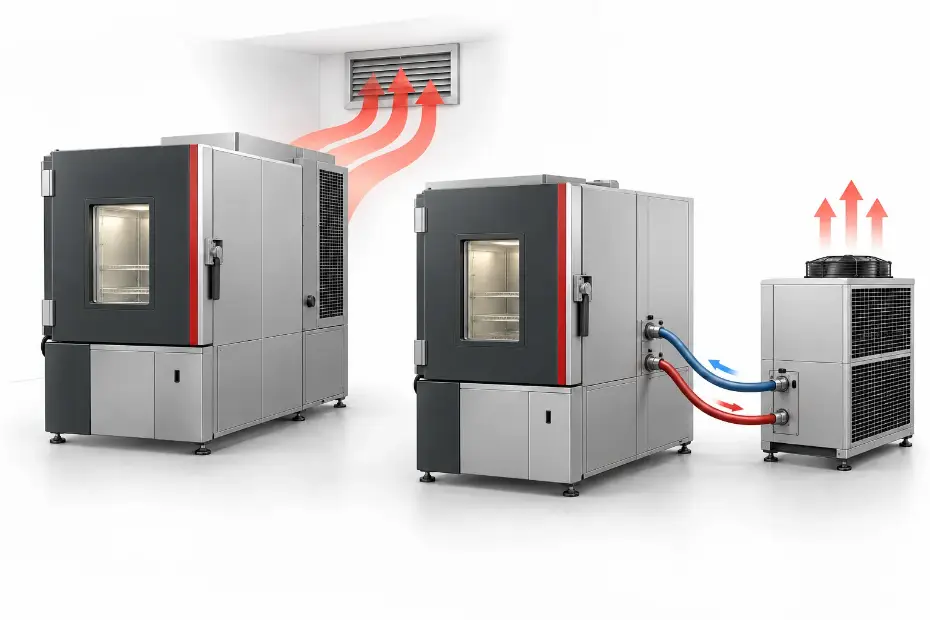
Understand What Is Being Cooled
In this comparison, air-cooled and water-cooled refer to the refrigeration condenser. They do not describe whether air circulates around the specimen, and water cooling does not mean the product is immersed in water. Keep the specimen cooling method separate from the condenser arrangement.
An air-cooled condenser transfers rejected heat to the air around it. A water-cooled condenser transfers heat to a water circuit, which must then reject that heat elsewhere. Depending on the installation, that circuit may use suitable building process water, a cooling tower arrangement or a dedicated cooling system.
Moving the heat into water does not make it disappear. The facility still needs a complete route from the chamber condenser to the final heat-rejection point. When reviewing the proposal, identify every part of that route and the party responsible for it.
Check the Laboratory Heat-Rejection Route
An air-cooled chamber can simplify the water-service scope, but the room must handle the heat leaving its condenser. A small room containing several chambers may need a different HVAC assessment from an open industrial area with one unit. Provide the expected operating schedule and simultaneous equipment use, not only the room dimensions.
Ask for heat-rejection information under the relevant duty and the allowed ambient operating conditions. Do not assume that the chamber electrical nameplate alone gives the room cooling load at every point in a test cycle. Refrigeration operation, specimen heat and other equipment affect the actual site assessment.
If a proposal uses remote heat rejection or ducting, have the manufacturer review the arrangement. Adding a restrictive duct to an air-cooled condenser is not equivalent to an engineered remote-condenser installation. Airflow and access requirements must remain compatible with the equipment.
| Facility question | Air-cooled review | Water-cooled review |
|---|---|---|
| Where does condenser heat go? | Into the local or engineered remote air path | Into the water circuit, then to its final rejection point |
| What site service is needed? | Suitable air conditions, circulation and room heat removal | Suitable water conditions, capacity and return arrangement |
| What can limit operation? | High ambient temperature, recirculated hot air or restricted airflow | Inadequate flow, unsuitable water temperature, fouling or loop limits |
| What must stay accessible? | Condenser, filters and refrigeration service points | Connections, valves, strainers and refrigeration service points |
Describe the Cooling-Water Service as a System
“Cooling water available” is not a complete specification. Provide the supply temperature range, flow capacity, pressure conditions, water quality and the available return path. Describe what changes when other equipment draws from the same circuit.
For a dedicated loop, identify whether the quoted package includes the heat-rejection device, pump, reservoir, piping, treatment, control interfaces and installation. A water-cooled chamber quotation may not include all external equipment needed to operate it.
Keep cooling water separate from humidification or specimen-spray water. Their quality, flow and operating purpose can differ. A facility connection that is suitable for a condenser is not automatically suitable for a humidifier, and a purified-water outlet may not provide the capacity required by the condenser.
Water-system design and connection should follow the equipment documents and qualified site engineering. The review should cover drainage or leak management, isolation for maintenance and any required response to a loss of flow. Do not adopt another chamber’s pressure or flow values as a universal requirement.
Compare Installed Scope Instead of Base Price
To compare two proposals, place them on the same test-duty and site basis. Use the required minimum temperature, loaded heat dissipation, transitions, humidity points and operating schedule. Differences in refrigeration capacity should not be mistaken for differences caused only by cooling method.
| Budget item | What the comparison should include |
|---|---|
| Chamber package | Specified loaded performance, controls and condenser arrangement |
| Facility work | Electrical connection, room cooling changes or cooling-water connections |
| External plant | Any remote condenser, cooling unit, pumps and water treatment |
| cURL Too many subrequests by single Worker invocation. To configure this limit, refer to https://developers.cloudflare.com/workers/wrangler/configuration/#limits | Handling, piping, insulation, connections and commissioning |
| Operating basis | Actual duty, local tariffs, water arrangement and service schedule |
| Support | Access, maintenance responsibilities and documentation |
There is no useful universal energy-saving percentage for one arrangement over the other. An operating-cost estimate needs comparable equipment data and local assumptions. The environmental chamber budget guide explains the broader purchase scope; use it alongside this cooling-system comparison.
Use the Site Conditions to Narrow the Options
No existing cooling-water service: assess air cooling against the room’s heat-removal capacity. If that is unsuitable, compare the complete water-cooled package, including the external loop, rather than assuming the chamber price is the total project cost.
Existing process-water circuit: supply its operating range and spare capacity. The review must account for water quality, simultaneous users and seasonal changes. An existing pipe near the chamber location is not proof that the service is suitable.
Several chambers in a shared laboratory: review the combined duty. Staggered test schedules, common cooling services and room HVAC may affect the decision. State whether all units must achieve their demanding operating points at the same time.
Large or demanding specimen loads: prioritize a system that meets the loaded performance requirement under the available site conditions. Avoid choosing a cooling arrangement first and only later discovering that the proposed configuration cannot achieve the required duty.
Put the Decision into the Inquiry and Acceptance Plan
Send a short facility brief with the specimen information. Include available power, the intended room, local ambient conditions, existing cooling-water data and any restrictions on heat, noise, water use or installation access. For the equipment duty, provide the complete temperature profile, maximum powered heat and typical test duration.
Request a proposal that names the condenser arrangement, required site services and excluded work. Ask how the cooling service will be checked during commissioning and what operating conditions must be maintained. These details make the purchase easier to compare and the installation easier to accept.
Review the cURL Too many subrequests by single Worker invocation. To configure this limit, refer to https://developers.cloudflare.com/workers/wrangler/configuration/#limits or cURL Too many subrequests by single Worker invocation. To configure this limit, refer to https://developers.cloudflare.com/workers/wrangler/configuration/#limits for the equipment family, then define cooling around the actual specimen and site. Acceptance records can be organized using the FAT checklist and record template.
Compare Two Hypothetical Facility Decisions
Consider a small laboratory with no cooling-water loop and limited room cooling. Air cooling avoids an external water connection, but rejected heat still enters the room. The facility review therefore needs the chamber's heat-rejection data and the capacity available during simultaneous equipment use. A proposal is incomplete if it prices the chamber but ignores the room.
Now consider a facility with an existing process-water loop. Water cooling may be practical, but the loop's label is not evidence of capacity. The review should establish its available flow and temperature range when other users operate, plus water quality, return conditions and maintenance arrangements.
Neither example proves a universal winner. They show why a comparison should start with a documented facility constraint and an equivalent loaded test duty. The resulting proposal may use local air cooling, an engineered remote arrangement or a suitable water circuit, depending on the reviewed system.
Build an Operating-Cost Comparison with Named Assumptions
Ask for comparable consumption information over an agreed operating sequence rather than estimating annual cost from a nominal compressor rating. Record run hours, local tariffs and any external pumps, cooling plant or room air-conditioning included in the estimate.
Keep measured values, supplier estimates and buyer assumptions visibly separate. If the external cooling system serves several machines, state how its consumption is allocated. If seasonal room or water conditions change the result, describe those cases rather than presenting one precise annual figure without context.
A simple comparison can list the chamber package, incremental facility work, external plant, installation and annual operating assumptions in separate rows. It does not need a claimed payback period unless the inputs support one. Ask which costs are fixed project costs and which vary with test utilisation.
Record the Conditions That Keep the Decision Valid
At handover, record the cooling arrangement and the site conditions against which it was selected. Include service connection drawings, the intended heat-rejection route and the maintenance responsibilities for both equipment and facility components.
If a laboratory later adds more chambers, encloses the plant area or changes its water loop, review the original assumptions again. An arrangement that performed correctly at commissioning may be affected by a changed facility even when the chamber itself has not changed.
For a configuration review, send both the current facility data and the most demanding test sequence. Request a proposal that explains the cooling scope clearly enough for purchasing and facilities to compare the installed solution, not just the cabinet price.
Questions Before You Specify the Equipment
Is a water-cooled chamber always more efficient?
No universal comparison applies. Evaluate the same test duty and include the energy used by the external cooling system, pumps and room cooling where relevant.
Does an air-cooled chamber need ventilation?
Its condenser needs suitable airflow and ambient conditions, and rejected heat must be managed by the facility. The final arrangement follows the equipment requirements and site HVAC review.
Is a water chiller included with a water-cooled chamber?
Not automatically. Identify the external plant, piping, pumps, treatment, controls and installation in the written supply scope.
Can cooling water also supply the humidifier?
Do not assume so. Treat condenser cooling and humidification as separate services and compare their required water quality and operating conditions.
Review My Chamber Cooling Requirements
Send your test profile, specimen heat output, room conditions and available cooling-water information. Ask DERUI for a configuration with a defined heat-rejection route and installation scope.