How to Specify Loaded Ramp Rate for an Environmental Test Chamber
تاريخ النشر:11/09/2026 تصنيف:Resources、مقالات تقنية عدد المشاهدات:3338
“10°C/min” is not enough to specify an environmental chamber. The requirement also needs a temperature interval, a heating or cooling direction, an air or specimen measurement basis and a defined load. Put these details into the inquiry so the quoted performance and the acceptance check describe the same test.
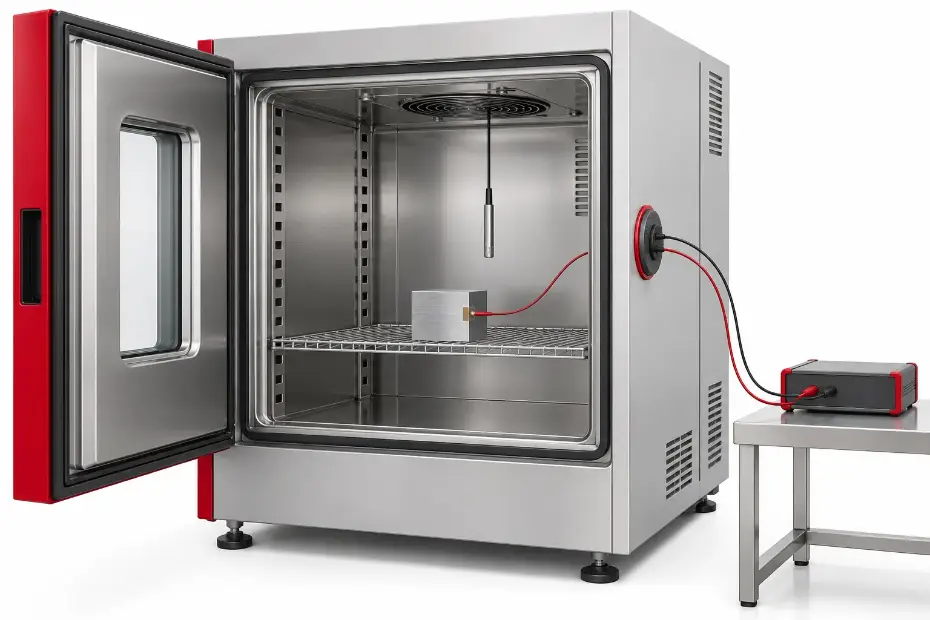
Decide Whether the Requirement Applies to Air or the DUT
Chamber air and the device under test do not necessarily change temperature at the same rate. A sensor suspended in circulating air responds differently from one attached to a heavy assembly or embedded in its center. The required measurement basis should come from the test procedure and the engineering objective.
Define the location on the specimen that matters. A surface, housing, connector and internal component can reach the target condition at different times. If the test requires a specimen temperature, replacing it with the controller display changes the acceptance question.
Record chamber-air channels separately from specimen channels. Identify sensors by location, not only as “T1” or “T2.” A photograph or sketch of the installation helps the supplier reproduce the setup and makes the final result easier to review.
Describe the Load in More Than Kilograms
Total mass is important, but it is not a complete thermal description. Material, shape, exposed surface, packaging and airflow restrictions influence the response. The same mass distributed across thin parts will not behave like a compact solid block.
Include holders, trays, cables and fixtures in the loading description. A substantial metal fixture can add thermal mass or conduct heat into the specimen. The loading arrangement can also obstruct supply or return air and change the useful working zone.
For powered specimens, state continuous and peak heat output, the operating sequence and whether dissipation changes with temperature. Electrical input power is not automatically the heat released inside the chamber: account for energy exported to external loads or equipment when relevant.
| Load input | Useful RFQ description |
|---|---|
| Specimen | Dimensions, material, mass, quantity and orientation |
| Fixtures and trays | Drawings, material, mass and contact with the specimen |
| Powered operation | Heat released inside the chamber and its time/temperature dependence |
| cURL Too many subrequests by single Worker invocation. To configure this limit, refer to https://developers.cloudflare.com/workers/wrangler/configuration/#limits | Cables, coolant lines, feedthroughs and external equipment |
| Airflow | Occupied envelope, spacing and obstructions around the load |
Use a representative load for a performance demonstration only when its relationship to the real assembly has been agreed. Matching mass alone does not make a dummy load thermally equivalent.
State the Temperature Interval and Rate Definition
A reported average rate describes a temperature difference divided by elapsed time across specified endpoints. It does not establish the slope at every point. A required linear rate needs its own tracking tolerance, evaluation interval and treatment of transition regions.
For heating and cooling, specify the interval separately. Also state the starting stabilization condition and how the timing begins and ends. Without this information, two reports may use different portions of the same curve and produce numbers that are not comparable.
Endpoint tolerances and measurement noise can influence the calculated time. Agree the calculation rule before testing rather than choosing it after seeing the curve. Keep the original time-stamped data so the evaluation can be reconstructed.
Turn an Incomplete RFQ into a Testable Requirement
The following is a fictional drafting example, not a chamber specification or a test-standard requirement. Its purpose is to show the additional information needed to evaluate a loaded ramp request.
| Incomplete statement | More useful requirement |
|---|---|
| “Cooling rate: 5°C/min” | Average cooling magnitude of at least 5°C/min between +80°C and −20°C, evaluated at the identified chamber-air sensor with the documented load. |
| “With samples” | Example load: four unpowered aluminum assemblies, 8 kg combined, plus a 2 kg fixture; dimensions and positions defined in drawing EX-01. |
| “Reach the test temperature” | State whether reaching the limit applies to air, every required specimen sensor or a designated reference point, and define the tolerance and stabilization rule. |
| “Provide a test report” | Supply raw time-stamped channels, load/setup record, sensor locations, utility conditions and the stated calculation method. |
A specimen-rate requirement would replace the air-sensor basis in this example and identify the specimen channels to be assessed. If both air and specimen limits matter, write two requirements rather than treating them as interchangeable.
Do not use a fictional example as an order specification without adapting it to the actual test. Review the complete sequence, including dwell, recovery, powered operation and repeated cycles.
Agree the Measurement and Acceptance Evidence
The acceptance setup should record load identity, fixture arrangement, sensor attachment, channel sampling, ambient conditions and relevant utilities. Decide whether the requirement applies to every specified channel or to another agreed evaluation basis. Identify what happens if a run is interrupted.
Review the applicable method and scope before selecting a chamber-performance procedure. For example, IEC 60068-3-7 addresses loaded temperature-chamber measurements for cold and dry-heat tests; it is not a universal acceptance method for every humidity cycle or rapid-ramp requirement.
Use a documented test plan with suitable instruments and an agreed decision rule. Keep calibration information and uncertainty treatment appropriate to the required tolerances. A screenshot showing one controller value cannot replace the requested multi-channel transition record.
ال FAT checklist organizes the broader acceptance package. This article supplies the ramp-specific inputs; it does not replace the equipment’s approved performance procedure.
Compare Proposals on the Same Loaded Duty
Ask each supplier to respond to the same load, curve and measurement basis. A higher catalog air rate does not automatically guarantee a specified specimen rate. Conversely, purchasing more nominal speed may not solve an airflow restriction or a poorly defined test.
Separate what is demonstrated from what is proposed. A report from an empty chamber, another temperature interval or a different specimen may help describe the system, but it should not be presented as the result of your loaded condition.
Review the cURL Too many subrequests by single Worker invocation. To configure this limit, refer to https://developers.cloudflare.com/workers/wrangler/configuration/#limits configuration and the temperature chamber selection guide. For a technical proposal, submit the complete profile, sample/fixture drawing, heat output and the sensor basis that will determine acceptance.
Review a Supplier Curve Before Comparing the Headline Rate
Read the axes, channel names and time basis before reading the stated ramp result. Confirm the heating or cooling direction and locate the exact interval used for the calculation. Check whether the trace is chamber air, a specimen channel or a controller setpoint.
Next, identify the tested load and operating state. A curve without a fixture record, sample arrangement or powered-heat condition cannot answer a fully specified loaded question. It may still be useful background information, but its evidential scope is narrower.
Look for the original time-stamped data and the evaluation rule when the rate is critical to acceptance. A plotted curve can conceal averaging, omitted points or a change of time scale without implying deliberate manipulation. Asking for the underlying record makes the result reproducible and avoids selecting a supplier from incomparable brochure graphs.
Define What Happens at the Ends of a Ramp
A transition requirement and a dwell requirement are connected but different. State whether the ramp ends when an identified air sensor enters a tolerance band or when the required specimen channels satisfy the specified condition. Then define the dwell timing in the adopted test procedure.
For a powered assembly, discuss the operating mode during heating, cooling and stabilisation. Changing specimen power at the end of the ramp changes the thermal duty. The chamber programme, specimen control and measurement record should describe that sequence consistently.
Also agree how overshoot, an interruption or an invalid sensor reading is handled. Do not invent a generic allowable excursion or remove inconvenient samples after the run. The decision rule should be fixed before the demonstration and associated with the approved requirement.
Use a Requirement-to-Evidence Review at Order Placement
Assign an identifier to each performance requirement and link it to the proposed demonstration. Include the loading drawing revision, measurement basis, endpoints, tolerances and utility conditions in that link. This prevents an apparently minor drawing change from silently changing the acceptance task.
If the final specimen is unavailable, record what the representative load establishes and what remains to be checked with the real assembly. A demonstration with a substitute can be an agreed project step without being described as proof of every later test.
The most useful enquiry package contains the temperature-time profile, dimensioned load, fixture details, internal heat and required data channels. Send these together. Choosing a nominally faster cabinet first and defining the loaded result afterwards makes both quotation and acceptance harder to resolve.
Questions Before You Specify the Equipment
Does a catalog air ramp rate guarantee the same rate inside my product?
No. Product geometry, materials, fixture contact, airflow and powered heat affect specimen temperature. Define and assess the required specimen channels separately.
Is average ramp rate the same as a linear rate?
No. An average is calculated across stated endpoints. A linear requirement needs a defined slope, tracking tolerance and evaluation method.
Can I use an aluminum dummy load?
Only with an agreed representation of the real test. Equivalent mass alone does not establish equivalent heat transfer, airflow or heat generation.
What is the minimum information for a loaded-ramp review?
Provide the profile, measurement basis, sample and fixture drawings, materials and masses, loading arrangement, powered heat and the intended evaluation conditions.
Review My Loaded Temperature Profile
Send the temperature curve, specimen and fixture details, powered heat output and air or DUT measurement requirements. Ask DERUI to assess the loaded duty and proposed acceptance evidence.