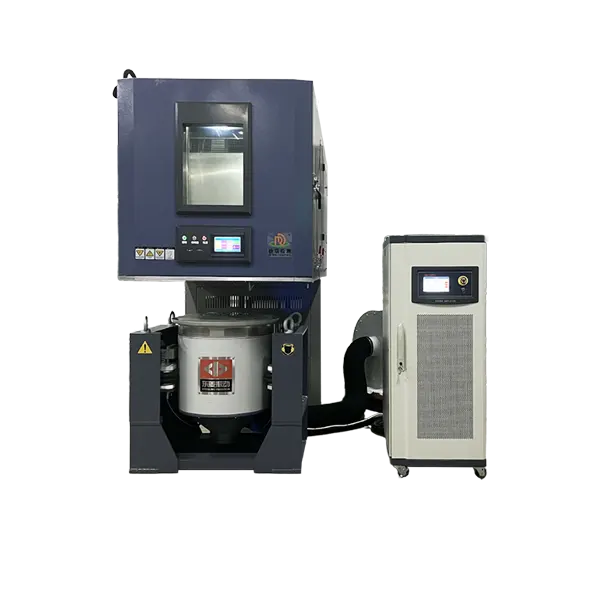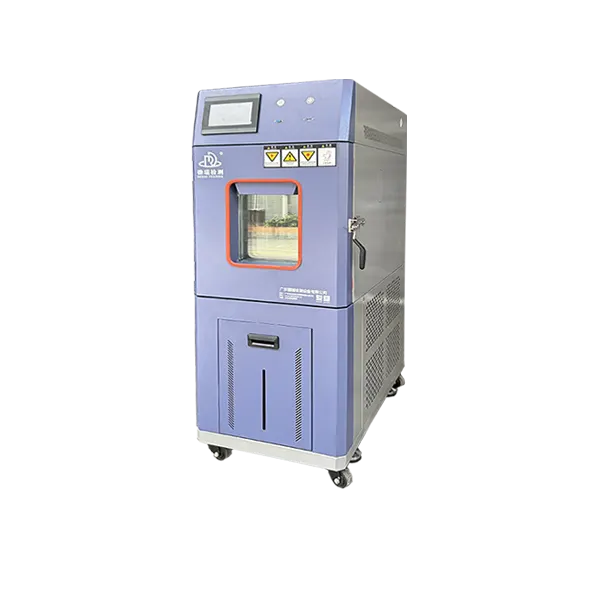


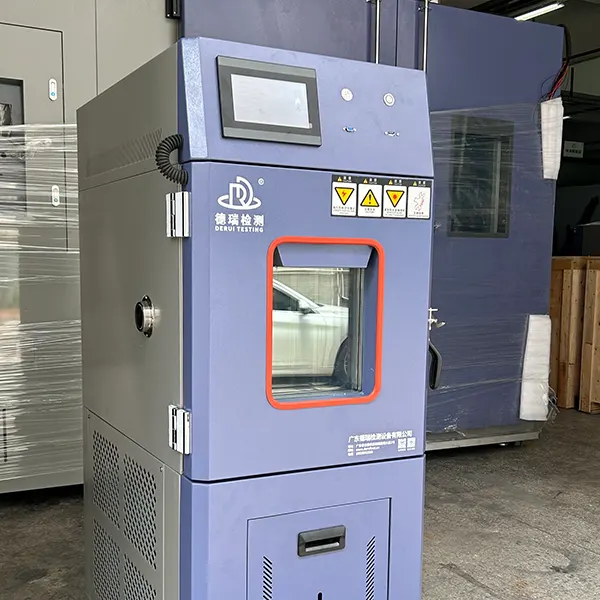








Choose a Small Chamber That Fits the Specimen—and the Test Profile
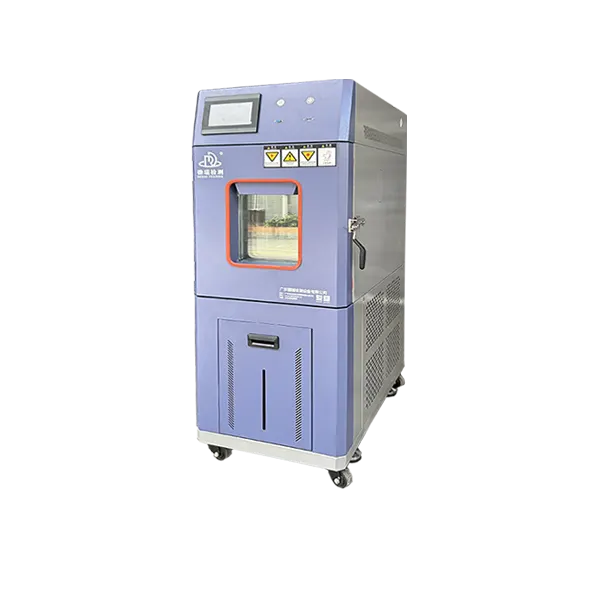
Test sensors, electronics, material coupons and small assemblies without specifying a large test room. The DERUI DR-H201-50 combines an approximately 50 L workspace with a choice of −20°C or −40°C low-temperature configurations, each extending to +150°C.
Start with the specimen envelope and required programme. The right configuration must accommodate the fixture, connections and airflow while reaching the agreed conditions with your actual thermal load.
Temperature Only—or Programmable Temperature and Humidity?
These are different equipment requirements. Choose the route that describes your test rather than assuming every small environmental chamber includes humidity control.
| Your requirement | Selection route | What to send |
|---|---|---|
| Cold, dry heat or programmed temperature changes | DR-H201-50 temperature configuration | Minimum and maximum temperature, ramp definition, dwell times and specimen heat load |
| Temperature and humidity maintained together | Separate temperature-and-humidity configuration review | Each temperature/RH pair, tolerance, dwell, transition and loaded specimen condition |
| Another workspace volume or unusual specimen shape | Specimen-led sizing review | Full mounted envelope, quantity, cables, airflow clearance and installation limits |
The DR-H201-50 specification on this page does not include an RH operating range. If your test needs high humidity at moderate temperature, include the complete paired setpoints: the requested RH must be achievable at each specified temperature, not merely appear as a separate maximum in a brochure.
For a broader equipment comparison, see the cURL Too many subrequests by single Worker invocation. To configure this limit, refer to https://developers.cloudflare.com/workers/wrangler/configuration/#limits. For temperature-only alternatives, browse the cURL Too many subrequests by single Worker invocation. To configure this limit, refer to https://developers.cloudflare.com/workers/wrangler/configuration/#limits.
Check Usable Space Before Choosing Nominal Litres
The 350 × 320 × 450 mm internal dimensions describe the chamber, not the largest acceptable specimen. Allow space around the assembly for air circulation, shelf supports, cable bends and temperature probes. Do not pack specimens against the air inlet or return.
For a powered device, state its heat dissipation in watts during each stage, not only its electrical input rating. A specimen that generates heat can change cooling performance and the difference between air temperature and component temperature. Provide the expected operating state and any independent specimen-temperature measurement.
- Photograph or draw the specimen in its fixture, including protruding connectors.
- State specimen count, individual mass and total mounted mass.
- Identify cable routing and the required port diameter or electrical interface.
- Define when the dwell begins: air at setpoint, specimen stabilized, or another agreed criterion.
DR-H201-50 Technical Configuration
| Modelo | DR-H201-50 |
|---|---|
| Nominal workspace | Approximately 50 L |
| Internal dimensions | 350 × 320 × 450 mm |
| Temperature options | −20°C to +150°C or −40°C to +150°C |
| Taxa de aquecimento | 3°C/min; agree the interval, load and average/linear measurement basis |
| Control accuracy | Published value ±0.5°C; define verification conditions |
| cURL Too many subrequests by single Worker invocation. To configure this limit, refer to https://developers.cloudflare.com/workers/wrangler/configuration/#limits | Published values ±2°C / ±2°C; verify at agreed conditions |
| Display resolution | 0.01°C; not a workspace accuracy rating |
| Construção | Mirror-finished SUS304 interior; coated-steel exterior |
| Peso do equipamento | Approximately 300 kg; final configuration dependent |
| Humidity control | Not specified for this model; request a separately defined configuration if needed |
Display resolution, control accuracy, fluctuation and spatial uniformity describe different characteristics. Agree verification points, loading and acceptance conditions in the technical specification rather than treating a fine digital display as proof of uniform temperature.
Configure Access, Monitoring and Protection Around the Sample
The listed arrangement includes a SUS304 workspace, two stainless-steel shelves, an observation window and internal lighting. Confirm the selected cable-port arrangement: the listing identifies 50 mm or 100 mm port options; these are alternatives to define in the order, not two ports to assume are both supplied.
Discuss additional shelves, a different observation arrangement, specimen feedthroughs, remote monitoring or data export when the programme requires them. Specify the channels, recording interval and file format. These functions must be identified in the offered configuration rather than inferred from a touch-screen controller.
For installation, confirm the external dimensions, approximately 300 kg equipment mass, floor or support capacity, ventilation and maintenance access. Specify destination voltage and frequency. Final refrigeration selection and protective functions should match the ordered range, specimen risk and installation requirements.
Define the Programme Before Comparing Ramp Rates
A useful programme states the starting condition, every setpoint and dwell, transition requirements, number of repetitions and treatment of interruptions. The published heating rate is 3°C/min, but the temperature interval, loading and average-versus-linear basis must be agreed for the proposed machine.
If faster transitions are necessary, send the complete profile for a thermal-load review. Do not compare an unloaded average air-temperature rate from one quotation with a loaded linear specimen-temperature requirement in another.
For IEC 60068 cold, dry-heat or temperature-change work, provide the adopted edition and procedure. Chamber capability must match the specified severity, specimen type and measurement conditions. A single-compartment temperature chamber is not a substitute for a dedicated thermal-shock system when the procedure requires a different transition mechanism.
Make the Proposal Useful to Engineering and Purchasing
| Decision | Agree before purchase |
|---|---|
| Desempenho | Selected temperature range; agreed loaded profile; measurement locations; fluctuation and uniformity acceptance |
| Specimen access | Shelf layout, fixture envelope, ports, wiring and monitoring scope |
| Segurança | Temperature limits, alarms, specimen shutdown and recovery after interruption |
| Evidence and handover | Dimensional drawing, utility requirements, operating instructions, calibration scope and agreed factory demonstration |
You do not need a finished purchase specification to start. Send the profile or a sketch of the assembly, identify the unresolved questions, and request a configuration review before choosing the final chamber.
Request a Compact Chamber Configuration Review
Send your temperature programme and specimen dimensions. If humidity is required, include each temperature/RH pair and dwell time so the proposal can distinguish a temperature-only DR-H201-50 from a separately specified climatic configuration.