Altitude Testing Explained: Pressure, Temperature, MIL-STD-810H Method 500.6 and IEC 60068-2-13
Yayın tarihi:07/04/2026 Kategori:Teknik makaleler Görüntüleme sayısı:11102
Altitude Testing Starts with Pressure—not an Altitude Label
Use this guide to distinguish steady low-pressure exposure from operational altitude, rapid decompression and combined temperature-pressure testing. It explains how MIL-STD-810H Method 500.6 and IEC 60068-2-13 differ, what must be tailored, and what chamber capability should be verified before a test plan is approved.
Altitude testing in one minute
Altitude testing reduces the chamber's absolute pressure to reproduce the air density associated with transport, storage or operation at elevation. Temperature may be controlled at the same time when the product's real environment or governing procedure requires it. The test can expose cooling limitations, electrical arcing, seal leakage, enclosure deformation, lubricant behavior and functional instability that remain hidden at normal atmospheric pressure.
Absolute pressure, gauge pressure and simulated altitude
Low-pressure environmental testing should be specified in absolute pressure—normally kPa absolute, hPa or mbar. Gauge pressure describes pressure relative to the surrounding atmosphere and can therefore create ambiguity when used for altitude simulation. A requirement of 11.6 kPa means approximately 11.6 kPa absolute, not “11.6 kPa below atmospheric pressure.”
Pressure-to-altitude conversion is useful for planning, but it varies with the atmospheric model and assumed conditions. The pressure value and tolerance stated by the governing document should control the test.
| Approximate altitude | Reference absolute pressure | Planning use |
|---|---|---|
| Sea level | 101.3 kPa | Ambient baseline |
| 3,000 m / 9,840 ft | About 70.1 kPa | High-ground operation or transport |
| 4,500 m / 14,760 ft | About 57.5 kPa | Severe terrestrial elevation |
| 7,620 m / 25,000 ft | About 37.6 kPa | Aircraft/cargo profile reference |
| 12,192 m / 40,000 ft | About 18.8 kPa | High-altitude aviation reference |
| 15,240 m / 50,000 ft | About 11.6 kPa | Air-transport and decompression reference |
| 30,480 m / 100,000 ft | About 1.0 kPa | Very-low-pressure capability reference |
These values are approximate planning references, not a replacement for the pressure table, tolerance and atmospheric model cited by the approved test procedure.
MIL-STD-810H Method 500.6: four procedures with different equipment demands
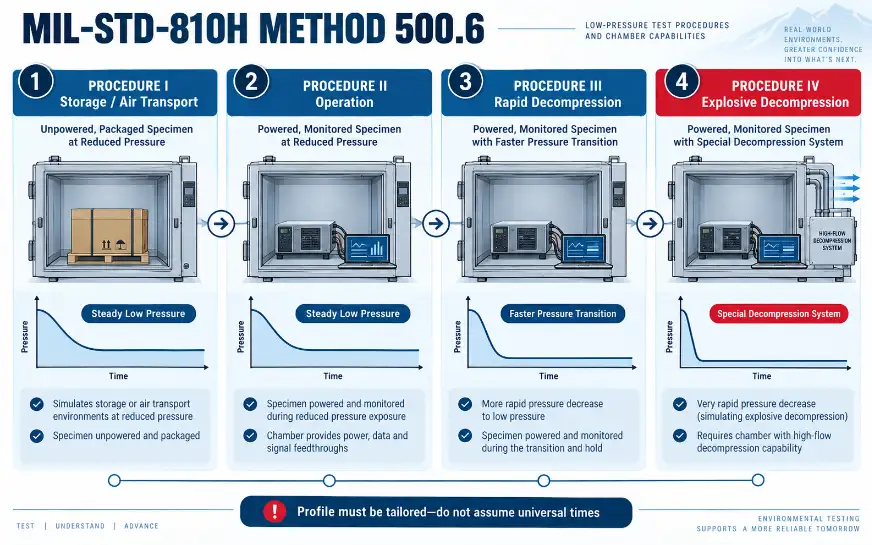
MIL-STD-810H is an environmental-engineering and laboratory-test standard. Its official scope emphasizes tailoring realistic environmental conditions to the materiel life cycle rather than imposing one universal profile. Method 500.6 therefore needs the test authority to select the applicable procedure, pressure, temperature, duration, transition and item configuration.
| Procedure | What it evaluates | Chamber capability to verify |
|---|---|---|
| I — Storage / Air Transport | Survival of the item in its storage or transport configuration during low-pressure exposure | Pressure endpoint, controlled reduction/recovery, dwell stability, packaging clearance and post-test inspection |
| II — Operation / Air Carriage | Performance while the item operates at the selected pressure and associated condition | Powered feedthroughs, monitoring channels, heat-load capacity, observation and traceable data |
| III — Rapid Decompression | Response to a defined fast pressure loss representing a relevant life-cycle event | Valve and vacuum-system flow, start/end pressure, timed transition, data rate and safety interlocks |
| IV — Explosive Decompression | Response to the shortest justified decompression event for the applicable platform or compartment | Project-specific high-flow architecture, containment, structural design, high-speed recording and hazard controls |
IEC 60068-2-13:2021 Test M
IEC 60068-2-13:2021 specifies low-air-pressure test methods for specimens that may encounter reduced pressure during transport, storage or service. The 2021 fifth edition aligns its severities with the IEC 60721 family and adds guidance on selecting exposure duration.
Use IEC 60068-2-13 when the requirement cites Test M or an IEC low-pressure severity. Do not automatically replace it with a MIL-STD-810H procedure: the documents have different structures, tailoring practices and acceptance contexts. When temperature, humidity and low pressure must be combined, verify the specific combined-environment method and the chamber's permitted operating envelope rather than assuming Test M alone defines the full sequence.
| Soru | MIL-STD-810H Method 500.6 | IEC 60068-2-13:2021 |
|---|---|---|
| Primary framework | Life-cycle environmental tailoring for materiel | Standardized Test M low-air-pressure method |
| Low-pressure procedures | Storage/transport, operation, rapid decompression and explosive decompression | Low-air-pressure exposure using the applicable selected severity and duration |
| Pressure profile | Tailored to platform, life-cycle profile and requirements | Selected from or defined with the applicable IEC/product requirement |
| Powered operation | Depends on selected procedure and approved test plan | Depends on specimen requirement and referenced specification |
| Rapid/explosive decompression | Addressed by Procedures III and IV | Not a substitute for Method 500.6 decompression procedures |
| Pass/fail | Defined by materiel requirements and test plan | Defined by the relevant product specification or agreed acceptance criteria |
Pressure, altitude and temperature relationship
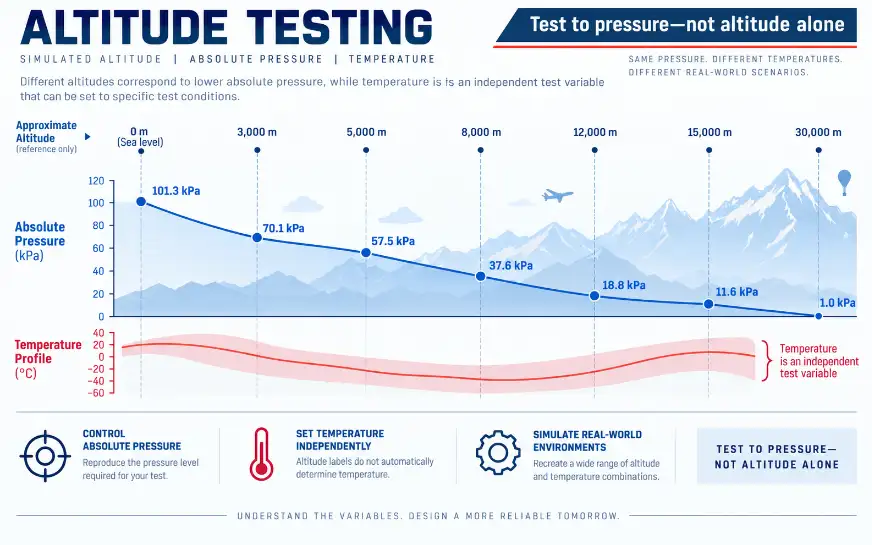
Absolute pressure is the controlled test variable; simulated altitude is a planning reference, while temperature follows the approved test profile.
When temperature and pressure must run together
Reduced air density changes heat transfer and electrical behavior. A powered electronic assembly can run hotter at altitude even when the air temperature remains unchanged. Seals, lubricants and materials can also respond differently when temperature and pressure change together. Combined control is justified when the real service condition, failure mechanism or governing procedure requires the interaction.
Related standards: identify the exact clause before configuring equipment
| Document | Relevant use | Procurement caution |
|---|---|---|
| RTCA DO-160G Section 4 | Temperature and altitude conditions for airborne equipment | State the applicable category and complete profile; do not claim blanket DO-160 compliance |
| UN Manual of Tests and Criteria, 38.3 T.1 | Lithium cell/battery altitude simulation for transport | T.1 uses ≤11.6 kPa for at least 6 h at 20 ±5°C; battery safety and the rest of 38.3 remain separate requirements |
| IEC 60068-2-39 | Combined temperature or temperature/humidity with low air pressure | Check the cited edition, sequence and severity rather than treating it as Test M |
| GB/T 2423.21 | Chinese low-air-pressure environmental test method | Use the edition required by the customer or laboratory |
| GJB 150.2A | Low-pressure (altitude) testing for the applicable Chinese military project | Confirm procedure, profile, reporting and project authorization |
| ASTM D6653 / ISO 2873 | Reduced-pressure testing for packaging or complete filled transport packages | Package size, load, pressure cycle and observation requirements govern chamber selection |
Chamber selection checklist
The right chamber is defined by the complete test profile, not by nominal litres or ultimate pressure alone.
| Selection item | cURL Too many subrequests by single Worker invocation. To configure this limit, refer to https://developers.cloudflare.com/workers/wrangler/configuration/#limits | Why it changes the design |
|---|---|---|
| Working space | Loaded specimen envelope, mass, fixture, shelves, cable routing and service clearance | Determines usable airflow, access, structure and pumping volume |
| Basınç | Starting pressure, endpoint, tolerance, dwell, reduction and recovery rates | Sizes pumps, valves, piping, control range and pressure sensor |
| Sıcaklık | High/low endpoints, rate, stabilization and simultaneous pressure points | Determines refrigeration, heating and thermal compensation under reduced density |
| Powered load | Voltage, current, heat output, operation sequence and monitored parameters | Affects feedthroughs, heat-load capacity, sensors and safety |
| Decompression | Procedure, start/end pressure and maximum transition time | Conventional evacuation may not satisfy rapid or explosive decompression |
| cURL Too many subrequests by single Worker invocation. To configure this limit, refer to https://developers.cloudflare.com/workers/wrangler/configuration/#limits | Temperature, absolute pressure, specimen channels, sampling rate, CSV and communication protocol | Defines controller, acquisition and report traceability |
| Güvenlik | Stored energy, chemistry, vent gas, flammables, pressure release and emergency response | Determines containment, detection, interlocks and permitted specimen operation |
| cURL Too many subrequests by single Worker invocation. To configure this limit, refer to https://developers.cloudflare.com/workers/wrangler/configuration/#limits | Calibration points, load condition, FAT duration, third-party witness and report language | Prevents disagreement after manufacture and before shipment |
For combined thermal and altitude work, review the DERUI altitude temperature test chamber. For the full product category and alternative configurations, compare the altitude test chamber range.
Build the test plan before the chamber program
- Identify the authority.
Record the exact standard edition, method, procedure/category, product requirement and customer deviations. - Define the specimen state.
State packaging, orientation, load, powered operation, heat output, monitoring and preconditioning. - Write the complete profile.
List temperature and absolute pressure setpoints, rates, dwell, cycles and permitted interruptions. - Define observations.
Specify electrical, thermal, mechanical, leakage and visual parameters before, during and after exposure. - Approve safety controls.
Complete the hazard review, interlock matrix, emergency response and access restrictions. - Agree on evidence.
Fix calibration points, sampling, curve export, deviations, photographs, FAT and final report requirements.
Common failure modes altitude testing can reveal
These are possible failure mechanisms, not guaranteed outcomes. Product-specific acceptance criteria must define what constitutes a failure.
Frequently asked questions
Is simulated altitude the same as vacuum?
Altitude testing uses partial vacuum to reduce absolute pressure, but “vacuum” alone does not define the environmental profile. Altitude work normally requires controlled pressure, transition, dwell and often temperature or powered operation.
Should a test requirement use metres, feet or kPa?
Record the altitude reference if it helps users understand the scenario, but program and verify the absolute pressure required by the governing document. Include tolerance and atmospheric model where applicable.
Does MIL-STD-810H Method 500.6 define one standard altitude?
No. The profile is tailored from the item life cycle, platform and approved requirement. Do not select a universal pressure, duration or rate for every item.
What is the main difference between Method 500.6 and IEC 60068-2-13?
Method 500.6 sits within MIL-STD-810H's life-cycle tailoring framework and includes four procedures, including decompression events. IEC 60068-2-13 is Test M for low-air-pressure exposure using the applicable selected severity and duration. Use whichever document the requirement cites.
Can a standard altitude chamber perform rapid decompression?
Not automatically. Rapid decompression requires the specified starting and ending pressures to be reached within the required time. Pumping capacity, valve flow, piping, chamber volume, load and data rate must be engineered and demonstrated together.
When should temperature and pressure run simultaneously?
Run them together only when the governing method, actual service environment or approved failure-mechanism analysis requires combined stress. Otherwise follow the specified separate conditioning and exposure sequence.
Does UN 38.3 T.1 require temperature-altitude cycling?
T.1 is an altitude-simulation exposure at ≤11.6 kPa for at least six hours at 20 ±5°C. It should not be confused with T.2 thermal testing or T.4 shock. The complete UN 38.3 sequence and battery safety controls remain applicable.
What information should be sent for a chamber quotation?
Send the exact standard and procedure, loaded specimen dimensions and mass, temperature-pressure sequence, decompression rate, powered interfaces, heat load, safety hazards, utilities, records and FAT requirements.
Primary references
- U.S. DoD ASSIST Quick Search — MIL-STD-810 document details
- IEC 60068-2-13:2021 — Environmental testing, Test M: Low air pressure
- RTCA DO-160 official standards information
- UNECE Manual of Tests and Criteria, Revision 8 and Amendment 1
Consult licensed/current standards and the approved product requirement for complete procedures. This article is an equipment-selection and planning guide, not a substitute for the standards.
Turn the altitude requirement into a chamber specification
Send DERUI the standard edition, procedure, specimen envelope, powered load, temperature-pressure profile, transition time, safety conditions and FAT points. The engineering review will confirm whether a standard altitude-temperature chamber or a special decompression configuration is required.
- Standard, edition and procedure
- Loaded workspace and heat output
- Pressure-temperature sequence
- Monitoring, safety and FAT evidence