

Rapid Decompression Testing for Avionics: Profile, Chamber and MIL-STD-810H Method 500.6
วันที่เผยแพร่:08/20/2026 หมวดหมู่:อวกาศและการป้องกันประเทศ、การใช้งาน จำนวนผู้เข้าชม:7887
Rapid Decompression Testing for Avionics: From Test Profile to Chamber Evidence
A pressure endpoint alone cannot show whether an airborne electronic unit will survive a sudden loss of cabin pressure. Define the starting and final absolute pressure, transition, specimen operating state and evidence before selecting the chamber.
What rapid decompression testing needs to demonstrate
The test exposes a representative avionics assembly to an approved rapid pressure change. Depending on installation and the governing requirement, the engineering team may need to observe continued operation, safe failure, enclosure integrity or recoverability. A display that shows the final altitude or pressure does not prove the transition actually occurred at the required rate.
Scope: This is an equipment-planning guide for avionics. It does not certify a device to DO-160 or MIL-STD-810H, nor does it replace the controlled standard and test plan.
Rapid versus explosive decompression: do not treat them as interchangeable
For a program invoking MIL-STD-810H Method 500.6, Procedure III addresses rapid decompression and Procedure IV addresses explosive decompression. They are distinct procedures. Commercial airborne equipment may instead cite an applicable category and test within RTCA DO-160 Section 4. Record the actual document, edition, category or procedure before selecting any equipment.
| Decision | Rapid decompression | Explosive decompression |
|---|---|---|
| Profile | Fast, controlled drop between specified absolute pressures. | A more severe, separately specified pressure transition; do not infer it from a rapid-test label. |
| Chamber capability | Verify pressure control, evacuation path, valve response and achieved transition under the defined volume/load. | Requires engineering review of pressure reservoir/flow path, structural containment, venting and instrumentation response. |
| cURL Too many subrequests by single Worker invocation. To configure this limit, refer to https://developers.cloudflare.com/workers/wrangler/configuration/#limits | Time-stamped pressure trace and synchronized specimen observations. | High-rate trace and safety record appropriate to the approved procedure. |
| Quotation | Provide start/end pressure, maximum transition time, chamber volume and repeat count. | Quote separately against the actual explosive-decompression requirement and hazard assessment. |
Neither the time nor the pressure target is universal across programs. If the requirement only names “high altitude,” request the full profile before assuming that a standard low-pressure chamber can perform either decompression test.
Start from the avionics installation and failure risk
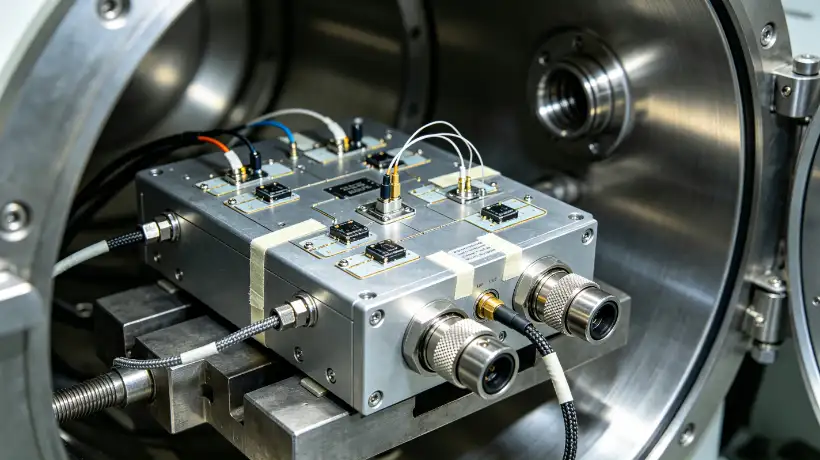
Identify whether the equipment is installed inside a pressurized cabin, an unpressurized bay or another aircraft location. Record the aircraft operating envelope and the equipment's required behavior during and after decompression. Possible observations include enclosure deformation, seal or vent failure, display or optical change, insulation issues, data interruption and loss of cooling under reduced air density. These are investigation targets, not promises that every specimen will exhibit them.
Powered operation needs its own plan
If the product must remain energized, specify voltage, current, heat output, operating mode and the channels to be monitored through the event. Select sealed feedthroughs, strain relief, independent specimen-power cutoff and electrical protection for the actual load. A low-pressure setpoint by itself cannot demonstrate functional continuity.
Translate the requirement into a measurable pressure-time profile
| Input to confirm | Why the chamber supplier needs it |
|---|---|
| Standard edition, method/category and customer deviations | Prevents mixing DO-160 and Method 500.6 procedures or applying the wrong severity. |
| Starting and final absolute pressure, tolerance and transition window | Defines pump, valve, piping, control and acquisition requirements. |
| Temperature and preconditioning | Separates the commanded chamber temperature from transient specimen behavior. |
| Loaded specimen, fixture, free volume and cabling | Changes effective volume, leakage, pumping response and access. |
| Operating state and synchronized sampling | Determines feedthroughs, heat-load evaluation and evidence quality. |
| Cycles, hold, recovery and pass/fail observations | Defines the full sequence and factory acceptance check. |
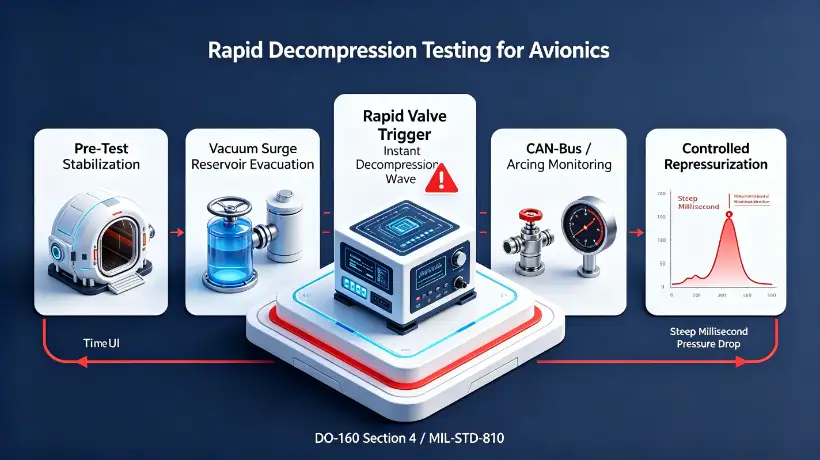
Acceptance tip: Capture the actual pressure-versus-time curve, sensor identification, sampling interval, alarm events and any deviation; also record the specimen's functional channels and post-test inspection.
Chamber selection and factory acceptance
Ask the supplier to demonstrate the required transition in the proposed usable workspace. The ultimate pressure achieved after several minutes is not evidence that the system meets a rapid transition. Chamber volume, fixture displacement, specimen heat, ports, vacuum pump capacity, valve path and leakage all affect performance. For especially severe transitions, a different architecture may be needed; do not assume a routine altitude-temperature chamber provides explosive decompression.
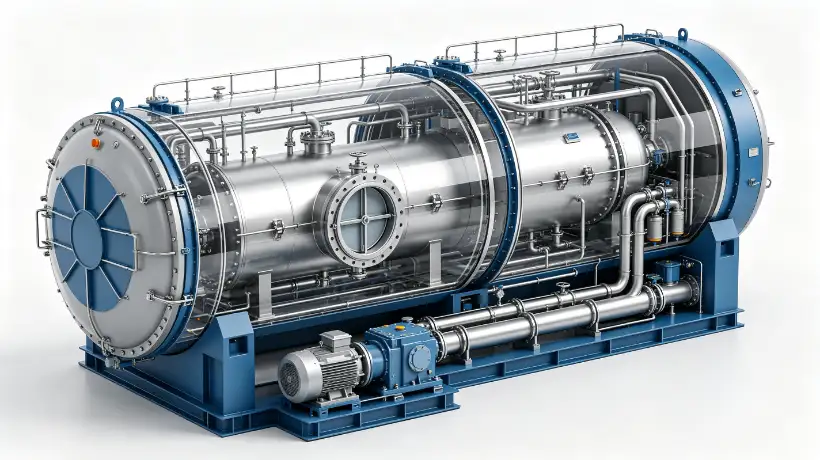
For combined temperature and altitude work, review the DERUI altitude temperature test chamber as a configuration starting point; confirm rapid/explosive decompression capability separately. The altitude chamber category helps compare alternative systems.
Interpreting the result without overclaiming
Align the chamber trace, test-item measurements and event log. A functional interruption that occurs before the specified pressure transition reaches the specimen is different from an interruption during the event. Likewise, an alarm or a post-test mark does not identify a root cause by itself. Preserve the fixture drawing, software state, power mode, photographs and raw logs so engineering teams can reproduce the investigation.
For the broader distinction among steady low-pressure exposure, temperature-pressure coupling and Method 500.6 procedures, see our altitude testing explanation. This page focuses on the avionics decompression decision and the evidence a buyer should request.
คำถามที่พบบ่อย
Is a chamber rated to a very low pressure automatically suitable for rapid decompression?
No. The pressure endpoint does not demonstrate the specified pressure change within the required time in the chosen workspace. Ask for an actual pressure-time trace under the agreed condition.
Can one chamber perform both rapid and explosive decompression?
Only if the proposed configuration has been engineered and verified against both approved profiles. Procedure IV must not be inferred from support for Procedure III.
Does DO-160 Section 4 use the same procedures as MIL-STD-810H Method 500.6?
No. They are separate documents for different program contexts. Use the specified edition, category or method; do not mix terminology or limits.
What should a buyer provide for a meaningful quotation?
Send the governing document and edition, initial/final absolute pressures, transition time, temperature, specimen size and mass, powered interfaces, monitoring, safety hazards and FAT acceptance points.
Sources and next steps
Consult the licensed/current standards for complete procedures: DoD ASSIST MIL-STD-810 document record และ RTCA DO-160 overview. The FAA AC 120-76E listing illustrates why representative powered equipment and decompression evidence matter for specific EFB uses; it is not a blanket avionics qualification requirement.
Specify the decompression event before requesting a chamber
Send the actual standard edition and profile, specimen drawing, powered-load data, interface list, safety assessment and FAT criteria. DERUI can review whether a standard altitude-temperature configuration or a dedicated decompression system should be quoted.









